Via Emmaus on the Road: Revelation 9

Further Resources


Revelation 9 (ESV)

And the fifth angel blew his trumpet, and I saw a star fallen from heaven to earth, and he was given the key to the shaft of the bottomless pit. He opened the shaft of the bottomless pit, and from the shaft rose smoke like the smoke of a great furnace, and the sun and the air were darkened with the smoke from the shaft. Then from the smoke came locusts on the earth, and they were given power like the power of scorpions of the earth. They were told not to harm the grass of the earth or any green plant or any tree, but only those people who do not have the seal of God on their foreheads. They were allowed to torment them for five months, but not to kill them, and their torment was like the torment of a scorpion when it stings someone. And in those days people will seek death and will not find it. They will long to die, but death will flee from them.

In appearance the locusts were like horses prepared for battle: on their heads were what looked like crowns of gold; their faces were like human faces, their hair like women’s hair, and their teeth like lions’ teeth; they had breastplates like breastplates of iron, and the noise of their wings was like the noise of many chariots with horses rushing into battle. 10 They have tails and stings like scorpions, and their power to hurt people for five months is in their tails. 11 They have as king over them the angel of the bottomless pit. His name in Hebrew is Abaddon, and in Greek he is called Apollyon.

12 The first woe has passed; behold, two woes are still to come.

13 Then the sixth angel blew his trumpet, and I heard a voice from the four horns of the golden altar before God, 14 saying to the sixth angel who had the trumpet, “Release the four angels who are bound at the great river Euphrates.” 15 So the four angels, who had been prepared for the hour, the day, the month, and the year, were released to kill a third of mankind. 16 The number of mounted troops was twice ten thousand times ten thousand; I heard their number. 17 And this is how I saw the horses in my vision and those who rode them: they wore breastplates the color of fire and of sapphire and of sulfur, and the heads of the horses were like lions’ heads, and fire and smoke and sulfur came out of their mouths. 18 By these three plagues a third of mankind was killed, by the fire and smoke and sulfur coming out of their mouths. 19 For the power of the horses is in their mouths and in their tails, for their tails are like serpents with heads, and by means of them they wound.

20 The rest of mankind, who were not killed by these plagues, did not repent of the works of their hands nor give up worshiping demons and idols of gold and silver and bronze and stone and wood, which cannot see or hear or walk, 21 nor did they repent of their murders or their sorceries or their sexual immorality or their thefts.

Soli Deo Gloria!
Via Emmaus on the Road: Revelation 8

Further Resources


Revelation 8 (ESV)

The Seventh Seal and the Golden Censer

When the Lamb opened the seventh seal, there was silence in heaven for about half an hour. Then I saw the seven angels who stand before God, and seven trumpets were given to them. And another angel came and stood at the altar with a golden censer, and he was given much incense to offer with the prayers of all the saints on the golden altar before the throne, and the smoke of the incense, with the prayers of the saints, rose before God from the hand of the angel. Then the angel took the censer and filled it with fire from the altar and threw it on the earth, and there were peals of thunder, rumblings, flashes of lightning, and an earthquake.

The Seven Trumpets

Now the seven angels who had the seven trumpets prepared to blow them.

The first angel blew his trumpet, and there followed hail and fire, mixed with blood, and these were thrown upon the earth. And a third of the earth was burned up, and a third of the trees were burned up, and all green grass was burned up.

The second angel blew his trumpet, and something like a great mountain, burning with fire, was thrown into the sea, and a third of the sea became blood. A third of the living creatures in the sea died, and a third of the ships were destroyed.

10 The third angel blew his trumpet, and a great star fell from heaven, blazing like a torch, and it fell on a third of the rivers and on the springs of water. 11 The name of the star is Wormwood. A third of the waters became wormwood, and many people died from the water, because it had been made bitter.

12 The fourth angel blew his trumpet, and a third of the sun was struck, and a third of the moon, and a third of the stars, so that a third of their light might be darkened, and a third of the day might be kept from shining, and likewise a third of the night.

13 Then I looked, and I heard an eagle crying with a loud voice as it flew directly overhead, “Woe, woe, woe to those who dwell on the earth, at the blasts of the other trumpets that the three angels are about to blow!”

Soli Deo Gloria!

Via Emmaus on the Road: Revelation 7

Further Resources


Revelation 7 (ESV)

The 144,000 of Israel Sealed

After this I saw four angels standing at the four corners of the earth, holding back the four winds of the earth, that no wind might blow on earth or sea or against any tree. Then I saw another angel ascending from the rising of the sun, with the seal of the living God, and he called with a loud voice to the four angels who had been given power to harm earth and sea, saying, “Do not harm the earth or the sea or the trees, until we have sealed the servants of our God on their foreheads.” And I heard the number of the sealed, 144,000, sealed from every tribe of the sons of Israel:

12,000 from the tribe of Judah were sealed,

12,000 from the tribe of Reuben,

12,000 from the tribe of Gad,

12,000 from the tribe of Asher,

12,000 from the tribe of Naphtali,

12,000 from the tribe of Manasseh,

12,000 from the tribe of Simeon,

12,000 from the tribe of Levi,

12,000 from the tribe of Issachar,

12,000 from the tribe of Zebulun,

12,000 from the tribe of Joseph,

12,000 from the tribe of Benjamin were sealed.

A Great Multitude from Every Nation

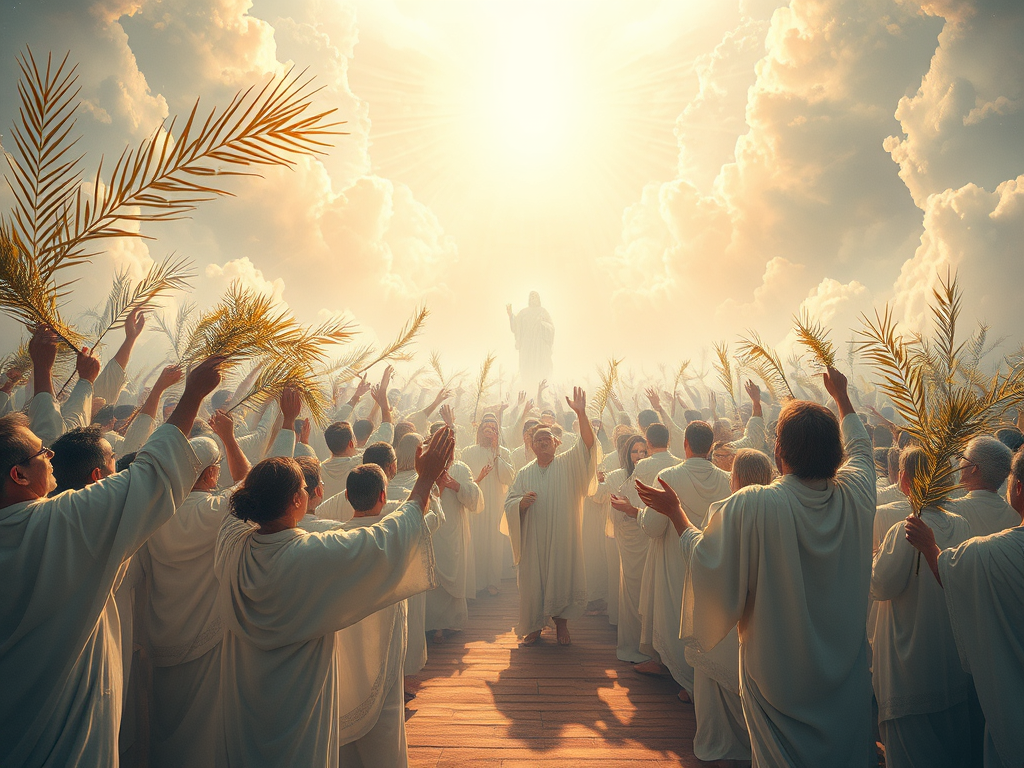
After this I looked, and behold, a great multitude that no one could number, from every nation, from all tribes and peoples and languages, standing before the throne and before the Lamb, clothed in white robes, with palm branches in their hands, 10 and crying out with a loud voice, “Salvation belongs to our God who sits on the throne, and to the Lamb!” 11 And all the angels were standing around the throne and around the elders and the four living creatures, and they fell on their faces before the throne and worshiped God, 12 saying, “Amen! Blessing and glory and wisdom and thanksgiving and honor and power and might be to our God forever and ever! Amen.”

13 Then one of the elders addressed me, saying, “Who are these, clothed in white robes, and from where have they come?” 14 I said to him, “Sir, you know.” And he said to me, “These are the ones coming out of the great tribulation. They have washed their robes and made them white in the blood of the Lamb.

15  “Therefore they are before the throne of God,

and serve him day and night in his temple;

and he who sits on the throne will shelter them with his presence.

16  They shall hunger no more, neither thirst anymore;

the sun shall not strike them,

nor any scorching heat.

17  For the Lamb in the midst of the throne will be their shepherd,

and he will guide them to springs of living water,

and God will wipe away every tear from their eyes.”

Soli Deo Gloria!

Via Emmaus on the Road: 2 Thessalonians 1

Further Resources


2 Thessalonians 1

Greeting

Paul, Silvanus, and Timothy,

To the church of the Thessalonians in God our Father and the Lord Jesus Christ:

Grace to you and peace from God our Father and the Lord Jesus Christ.

Thanksgiving

We ought always to give thanks to God for you, brothers, as is right, because your faith is growing abundantly, and the love of every one of you for one another is increasing. Therefore we ourselves boast about you in the churches of God for your steadfastness and faith in all your persecutions and in the afflictions that you are enduring.

The Judgment at Christ’s Coming

This is evidence of the righteous judgment of God, that you may be considered worthy of the kingdom of God, for which you are also suffering— since indeed God considers it just to repay with affliction those who afflict you, and to grant relief to you who are afflicted as well as to us, when the Lord Jesus is revealed from heaven with his mighty angels in flaming fire, inflicting vengeance on those who do not know God and on those who do not obey the gospel of our Lord Jesus. They will suffer the punishment of eternal destruction, away from the presence of the Lord and from the glory of his might, 10 when he comes on that day to be glorified in his saints, and to be marveled at among all who have believed, because our testimony to you was believed. 11 To this end we always pray for you, that our God may make you worthy of his calling and may fulfill every resolve for good and every work of faith by his power, 12 so that the name of our Lord Jesus may be glorified in you, and you in him, according to the grace of our God and the Lord Jesus Christ.

Soli Deo Gloria!

Via Emmaus on the Road: 1 Thessalonians 5

Further Resources


1 Thessalonians 5 (ESV)

The Day of the Lord

Now concerning the times and the seasons, brothers, you have no need to have anything written to you. For you yourselves are fully aware that the day of the Lord will come like a thief in the night. While people are saying, “There is peace and security,” then sudden destruction will come upon them as labor pains come upon a pregnant woman, and they will not escape. But you are not in darkness, brothers, for that day to surprise you like a thief. For you are all children of light, children of the day. We are not of the night or of the darkness. So then let us not sleep, as others do, but let us keep awake and be sober. For those who sleep, sleep at night, and those who get drunk, are drunk at night. But since we belong to the day, let us be sober, having put on the breastplate of faith and love, and for a helmet the hope of salvation. For God has not destined us for wrath, but to obtain salvation through our Lord Jesus Christ, 10 who died for us so that whether we are awake or asleep we might live with him. 11 Therefore encourage one another and build one another up, just as you are doing.

Final Instructions and Benediction

12 We ask you, brothers, to respect those who labor among you and are over you in the Lord and admonish you, 13 and to esteem them very highly in love because of their work. Be at peace among yourselves. 14 And we urge you, brothers, admonish the idle, encourage the fainthearted, help the weak, be patient with them all. 15 See that no one repays anyone evil for evil, but always seek to do good to one another and to everyone. 16 Rejoice always, 17 pray without ceasing, 18 give thanks in all circumstances; for this is the will of God in Christ Jesus for you. 19 Do not quench the Spirit. 20 Do not despise prophecies, 21 but test everything; hold fast what is good. 22 Abstain from every form of evil.

23 Now may the God of peace himself sanctify you completely, and may your whole spirit and soul and body be kept blameless at the coming of our Lord Jesus Christ. 24 He who calls you is faithful; he will surely do it.

25 Brothers, pray for us.

26 Greet all the brothers with a holy kiss.

27 I put you under oath before the Lord to have this letter read to all the brothers.

28 The grace of our Lord Jesus Christ be with you.

Soli Deo Gloria!

Via Emmaus on the Road: 1 Thessalonians 4

Further Resources


1 Thessalonians 4 (ESV)

A Life Pleasing to God

Finally, then, brothers, we ask and urge you in the Lord Jesus, that as you received from us how you ought to walk and to please God, just as you are doing, that you do so more and more. For you know what instructions we gave you through the Lord Jesus. For this is the will of God, your sanctification: that you abstain from sexual immorality; that each one of you know how to control his own body in holiness and honor, not in the passion of lust like the Gentiles who do not know God; that no one transgress and wrong his brother in this matter, because the Lord is an avenger in all these things, as we told you beforehand and solemnly warned you. For God has not called us for impurity, but in holiness. Therefore whoever disregards this, disregards not man but God, who gives his Holy Spirit to you.

Now concerning brotherly love you have no need for anyone to write to you, for you yourselves have been taught by God to love one another, 10 for that indeed is what you are doing to all the brothers throughout Macedonia. But we urge you, brothers, to do this more and more, 11 and to aspire to live quietly, and to mind your own affairs, and to work with your hands, as we instructed you, 12 so that you may walk properly before outsiders and be dependent on no one.

The Coming of the Lord

13 But we do not want you to be uninformed, brothers, about those who are asleep, that you may not grieve as others do who have no hope. 14 For since we believe that Jesus died and rose again, even so, through Jesus, God will bring with him those who have fallen asleep. 15 For this we declare to you by a word from the Lord, that we who are alive, who are left until the coming of the Lord, will not precede those who have fallen asleep. 16 For the Lord himself will descend from heaven with a cry of command, with the voice of an archangel, and with the sound of the trumpet of God. And the dead in Christ will rise first. 17 Then we who are alive, who are left, will be caught up together with them in the clouds to meet the Lord in the air, and so we will always be with the Lord. 18 Therefore encourage one another with these words.

Soli Deo Gloria!

Via Emmaus on the Road: 1 Thessalonians 2

Further Resources


1 Thessalonians 2 (ESV)

Paul’s Ministry to the Thessalonians

For you yourselves know, brothers, that our coming to you was not in vain. But though we had already suffered and been shamefully treated at Philippi, as you know, we had boldness in our God to declare to you the gospel of God in the midst of much conflict. For our appeal does not spring from error or impurity or any attempt to deceive, but just as we have been approved by God to be entrusted with the gospel, so we speak, not to please man, but to please God who tests our hearts. For we never came with words of flattery, as you know, nor with a pretext for greed—God is witness. Nor did we seek glory from people, whether from you or from others, though we could have made demands as apostles of Christ. But we were gentle among you, like a nursing mother taking care of her own children. So, being affectionately desirous of you, we were ready to share with you not only the gospel of God but also our own selves, because you had become very dear to us.

For you remember, brothers, our labor and toil: we worked night and day, that we might not be a burden to any of you, while we proclaimed to you the gospel of God. 10 You are witnesses, and God also, how holy and righteous and blameless was our conduct toward you believers. 11 For you know how, like a father with his children, 12 we exhorted each one of you and encouraged you and charged you to walk in a manner worthy of God, who calls you into his own kingdom and glory.

13 And we also thank God constantly for this, that when you received the word of God, which you heard from us, you accepted it not as the word of men but as what it really is, the word of God, which is at work in you believers. 14 For you, brothers, became imitators of the churches of God in Christ Jesus that are in Judea. For you suffered the same things from your own countrymen as they did from the Jews, 15 who killed both the Lord Jesus and the prophets, and drove us out, and displease God and oppose all mankind 16 by hindering us from speaking to the Gentiles that they might be saved—so as always to fill up the measure of their sins. But wrath has come upon them at last!

Paul’s Longing to See Them Again

17 But since we were torn away from you, brothers, for a short time, in person not in heart, we endeavored the more eagerly and with great desire to see you face to face, 18 because we wanted to come to you—I, Paul, again and again—but Satan hindered us. 19 For what is our hope or joy or crown of boasting before our Lord Jesus at his coming? Is it not you? 20 For you are our glory and joy.

Soli Deo Gloria!

Via Emmaus on the Road: 1 Thessalonians 1

Further Resources


1 Thessalonians 1 (ESV)

Greeting

Paul, Silvanus, and Timothy,

To the church of the Thessalonians in God the Father and the Lord Jesus Christ:

Grace to you and peace.

The Thessalonians’ Faith and Example

We give thanks to God always for all of you, constantly mentioning you in our prayers, remembering before our God and Father your work of faith and labor of love and steadfastness of hope in our Lord Jesus Christ. For we know, brothers loved by God, that he has chosen you, because our gospel came to you not only in word, but also in power and in the Holy Spirit and with full conviction. You know what kind of men we proved to be among you for your sake. And you became imitators of us and of the Lord, for you received the word in much affliction, with the joy of the Holy Spirit, so that you became an example to all the believers in Macedonia and in Achaia. For not only has the word of the Lord sounded forth from you in Macedonia and Achaia, but your faith in God has gone forth everywhere, so that we need not say anything. For they themselves report concerning us the kind of reception we had among you, and how you turned to God from idols to serve the living and true God, 10 and to wait for his Son from heaven, whom he raised from the dead, Jesus who delivers us from the wrath to come.

Soli Deo Gloria!

Leaving ‘Left Behind’ Behind: Sixteen Ways to Read Matthew 24 with the Grain of Scripture

6 And you will hear of wars and rumors of wars. See that you are not alarmed, for this must take place, but the end is not yet. 7 For nation will rise against nation, and kingdom against kingdom, and there will be famines and earthquakes in various places. 8 All these are but the beginning of the birth pains.
— Matthew 24:6–8 —

A few years ago I read a book about Mark’s Gospel, The Cross at a Distance. In it, Peter Bolt argued that Mark 13 was not an eschatological vision of the future, despite its world-shaking imagery. Rather, he showed that in the context of Mark’s Gospel, the Olivet Discourse was an apocalyptic explanation of the cross. That is to say, that when the Olivet Discourse is read in the context of Mark’s Gospel it functions as explanatory of what was going to happen on the cross.

In another blogpost on Mark 13 I have captured his arguments in 16 points. (Until this blogpost is completed, you can see why I think the Olivet Discourse should be read historically and not futuristically). In this blogpost I want to offer a similar reflection on Matthew 24.

From the start it should be clear that if Mark uses Jesus’s Olivet Discourse in Mark 13 to prepare the way for the cross, then Matthew 24 is most likely to do the same. The same could be said for Luke 21, but we will leave Luke be for now. Certainly, these three “synoptic” Gospels rely on one another, and while each has its own focus and particular details, it would be highly unlikely for Jesus’s message to his disciples about the destruction of the temple to have a different interpretations in each Gospel.

Rather, if Bolt is correct about the way Mark 13 functions in his Gospel, then it follows that Matthew 24 is more than likely related to events forthcoming in the life of Jesus and not just events that remain to be set in the future—as these passages are often read. Thus, in what follows I will make the case from Matthew 24 for a partial preterist reading of this passage that highlights the reality of Christ’s ascension.[1]

This reading stands against the popular Dispensational interpretation that puts all of these events in the future. It is different than the view of someone like D. A. Carson who takes an eclectic approach to the passage—some of these things are fulfilled in the first century and some are future. It is similar to that of R. C. Sproul, who argues that Matthew 24 is all about the destruction of the temple. Yet, for all the ways that Matthew 24 does find fulfillment in the events of A.D. 70, I believe the treatment of the Son of Man coming on the clouds is an explicit reference to his ascension (see Matt. 24:29–31).

So, in the remainder of this blogpost, I offer a partial preterist reading of Matthew 24 in 16 points. My interpretation will highlight the events of the cross, the ascension, and the coming destruction of Jerusalem. This reading does not deny the forthcoming return of Christ and his judgment on the last day. In fact, unlike Mark 13, I believe Matthew does include a description of this final judgment in Matthew 25. But like Mark 13 and Luke 21, the primary focus of the Olivet Discourse is related to events that will occur during the generation that lives between Christ’s crucifixion and the destruction of the temple in A.D. 70.

Perhaps, this will be a fresh way of reading Matthew 24 for you. But I assure you that it is not novel. Rather, it has many advocates in church history, including most recently men like Sproul, Kenneth Gentry, Brian Orr, and others. Take time to consider, therefore, the exegetical points made below and then draw your conclusions from the best reading of Matthew 24, even if it stands against the popular versions of Left Behind theology that sees this chapter as one that speaks about some yet-future cataclysmic event.[2] Continue reading

Last Things First: Four More Ways Christ’s Birth Fulfills An End Times Prophecy

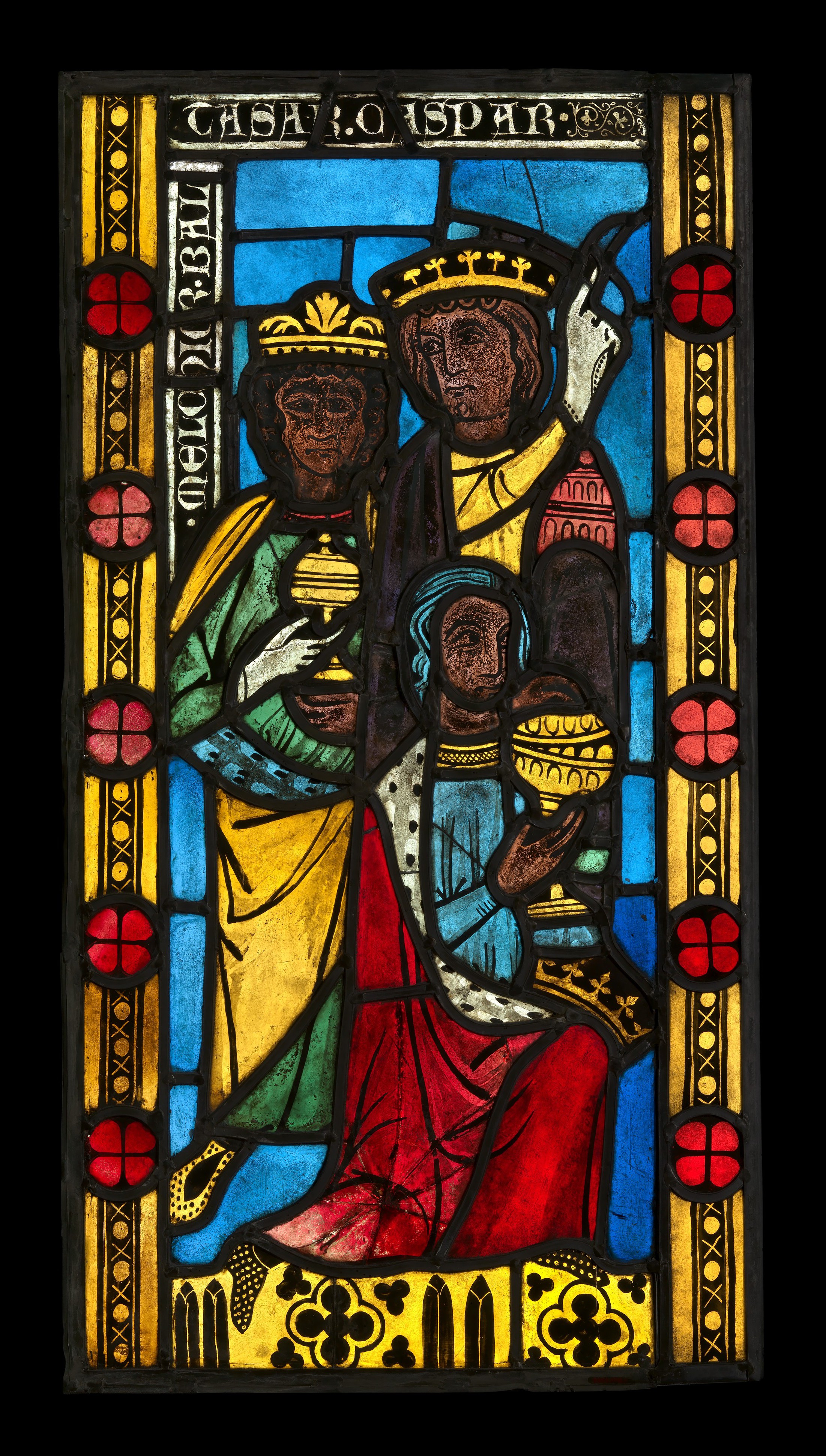
The Adoration of the MagiPicking up where I left off yesterday, I want to continue showing how the end-times prophecy of Isaiah 60 is fulfilled in the birth of Christ. From Isaiah 60:1–6, I highlighted three ways that Christ’s birth fulfilled the promises of (1) light, (2) joy, and (3) treasures brought to the temple. Today, I will pick up four more promises that are fulfilled in Christ’s birth.

4. Gentiles Have Been Received By Christ

In Isaiah 60:6 the LORD says kings will come to Zion bringing gifts. Now, in verse 7, we find the promise that those gifts “will beautify my beautiful house.” This “house” is a reference God’s holy temple, the place where God dwelt on earth. But incredibly, this house, its altar and inner sanctuary, were off limits–especially to Gentiles. And yet here, in Isaiah 60 we find the invitation for Gentile kings to “come up with acceptance on my altar.” The inclusion of “acceptance” is remarkable.

Under the old covenant, Gentiles were ritually and religiously unclean. In Ezekiel 44:6–9, Israel received the harshest condemnation because they permitted Gentiles to come near to God’s house. But now, Isaiah 60 says these foreign kings will be acceptable. How is this possible? The answer goes back to the international scope of the Servant’s work (Isa. 49:6–7).

While God chose Israel to be his covenant people in the Old Testament, the goal was always bigger. God would redeem a people from all nations, a theme that runs throughout Isaiah, and goes back to Abraham himself (see Gen. 12:1–3). In Isaiah 60, we now see the nations coming to Zion, bringing gifts (vv. 6–9), and building up the city of God. Listen to verse 10, “Foreigners shall build up your walls, and their kings shall minister to you; for in my wrath I struck you, but in my favor I have had mercy on you.”

Incredibly, when God exiled the people of Israel to Babylon and the nations, he in turn made a way for the nations to begin coming to Zion to find salvation in Israel’s king. In Zechariah 8:23, the post-exilic prophet puts it like this, “In those days ten men from the nations of every tongue shall take hold of the robe of a Jew, saying, ‘Let us go with you, for we have heard that God is with you.’” Indeed, in God’s unfathomable wisdom, he would turn Israel’s exile into a pathway of salvation for the nations. And in Isaiah 60:6–16 we find the nations coming to Israel bringing gifts and finding a place to reside near God.

In the New Testament, this emigration towards Zion is seen in the way the Magi come to Jerusalem to worship the king of the Jews. Most likely, these men of the East came to Jerusalem in response to the knowledge they received from exiled Jews. Daniel is a likely candidate for this kind of knowledge, but it could be others too. For our purposes, it is clear that Isaiah 60’s vision of the nations coming to Zion anticipates the arrival of the Magi. Or to turn it around, Matthew includes their pilgrimage to Zion (to Jesus, not just Jerusalem) to show how Isaiah 60 is being fulfilled.

On this point, we can go even further. These Gentile kings did not merely come to Bethlehem, they were welcomed into the Jewish living space Joseph, Mary, and Jesus. As Matthew 2:11 begins, “And going into the house, they saw the child with Mary his mother.” Let us not miss the significance of this moment. These unclean Gentiles are received into the presence of the Israel’s king because of their worshipful faith. This too reinforces the fact that Isaiah 60 is being fulfilled in the way Gentile kings are received the King of the Jews. Continue reading