 At the end of 2 Peter 3:18 Peter prays that the church might grow in grace and knowledge. Truly, when that happens Christians not only learn truths about God, they come to know God and share his character through studied communion with him. Likewise, in becoming like our heavenly Father we learn what is most important to God, and how, in our fallen world, can and should give grace to people who do not perceive as we do (rightly or wrongly) what is most important.
Extending grace to others has application in all areas of life, including theology. Yet, too often in an attempt to give grace to others, well-meaning (and well-deceived) Christians can compromise the truth. Therefore, learning to contend for the faith while growing in the fruit of the Spirit can be a difficult. Yet, nothing is more important than knowing how to hold the sound doctrines God has given to us.
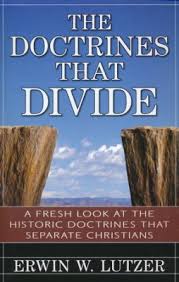
On this subject, how to hold the truth in love, there are very few books. Albert Mohler’s article on Theological Triage is instrumental here, but for books, the list is short. One book that should be included, however, is Erwin Lutzer’s The Doctrines that Divide: A Fresh Look at the Historic Doctrines that Separate Christians. In this book published in 1998, Lutzer considers nine different theological debates. They include
- Is Christ Truly God?
- Is Christ Truly Man?
- Was Mary the Mother of God?
- Was Peter the First Pope?
- Justification: By Faith, Sacraments, or Both?
- Why Can’t We Agree about the Lord’s Supper?
- Why Can’t We Agree about Baptism?
- Predestination or Free Will?
- Can a Saved Person Ever Be Lost?
With pastoral wisdom, Lutzer explains various angles to the subject and argues with great winsomeness for his own position. In fact, showing the complexity of the predestination and free will question, he spends four chapters, considering differences that arose at different points in church history. Continue reading
 Via Emmaus