Another Step Toward a Biblical Ecclesiology: Acts 9 on Baptism, Membership, and the Church

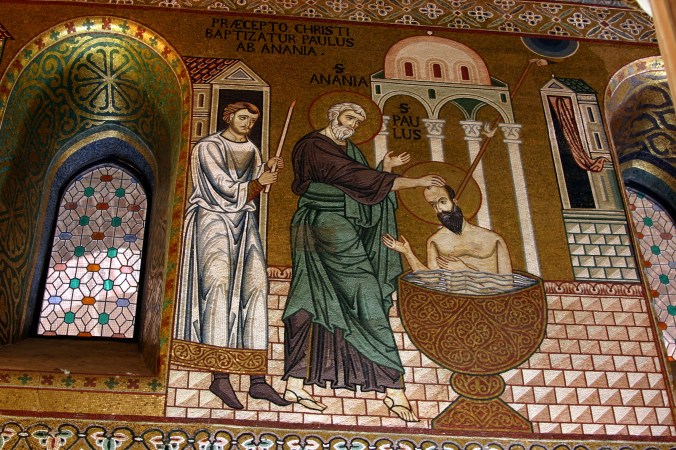
baptism_of_st_paul_-_capela_palatina_-_palermo_-_italy_2015-2The book of Acts is pivotal for understanding the nature and function of the church. It is also challenging, because it presents a church that is “born” on Pentecost, at first contained to Jerusalem, but later expanded to Judea and Samaria and finally unleashed the ends of the earth. At the same time, it’s founding members were believers before receiving the Spirit and yet the gift of the Spirit is one of the distinguishing marks of the church as it spreads from Israel to Italy. In four instances (Acts 2, 8, 10, 19), the Spirit is given, but in no two instances are the exact events the same. For instance, speaking in tongues accompanies the Spirit in Acts 2, 10, 19, but not Acts 8. Likewise, water baptism precedes the Holy Spirit in Acts 8, but follows in Acts 10.

From just a sampling of evidences, the book of Acts is both foundational and frustrating for understanding the nature of the church. It is foundational because of the patterns we see in how churches are formed—the Word of God is preached, Jews then Samaritans than Gentiles repent and believe, they are baptized, and then gathered into churches. Yet, it is frustrating because not everything in Acts is reproducible today. The personal visitations by Jesus, the miracles of healing, the speaking in tongues, and the survival of snake bites are all incidents that we might say have discontinued—unless one believes otherwise. For now my point is not to defend or deny cessationism, but to merely highlight how that debate among others finds difficulty in Acts.

Any point of ecclesiology, therefore, needs to be aware of Acts transitional nature. It should take into account how the Holy Spirit has given us this book to teach us about the founding of the church, but it is not a manual for every point of doctrine. That being said, where else do we turn in Scripture to find how to plant, revitalize, and shepherd churches? Therefore, we do need to watch for patterns and principles in Acts, but always with awareness of some discontinuity between Acts period of transition and our own day.

Clearing Up Two Points of Ecclesiology

With this approach to Acts in mind, I want to clear up two points of ecclesiology from Acts 9. From this chapter, I have heard two statements about the church:

  1. Paul’s baptism by Ananias suggests a local church is not (absolutely) needed for a legitimate baptism.
  2. The Church is fundamentally a universal concept, as Acts 9:31 describes the church regionally, not locally (i.e., in one spatio-temporal location).

While there is truth in these statements, ultimately I think we are on more solid ground to say

  1. Paul’s baptism was unique, but not so unique as to break from the normative pattern of the New Testament. We should exercise caution when making application from his experience, but at the same time, we can see how his unusual experience fits the larger pattern of baptism and “church membership” in Acts.
  2. The universal Church “throughout all Judea and Galilee and Samaria . . .” is a located in spatio-temporal “locales” (something I’ve tried to describe elsewhere).

In what follows, I will argue that Paul’s baptism is both a unique point in redemptive history and one that follows the pattern of baptism and church membership (i.e., association with other disciples in a local church). Exploring the relationship of Paul’s baptism to the churches in Damascus and Jerusalem will also prove the corollary: life in the universal church is experienced through local assemblies. In the end, I will list seven points of application from this chapter related to ecclesiology. Continue reading

The Testimony of Two: Why Baptism Requires a Harmony of Witnesses

baptism1In your Law it is written that the testimony of two people is true.
— John 8:17 —

In recent months I’ve been in discussion about the meaning of baptism, and who is saying what when a believer is immersed for identification with Jesus. Is baptism an individual’s testimony (alone)? Or is it the church’s testimony? Or, is it both?

With this question in mind, I recently read John 8 where Jesus makes the axiomatic statement in verse 17: “In your Law it is written that the testimony of two people is true.” In context, he is preparing to say he and his Father both testify to his messianic identity, even if the Pharisees in all of their well-studied folly could not receive this testimony. The point Jesus makes is that his identity is secured by multiple witnesses. In fact, John’s whole Gospel hangs on this premise, that there are a dozen or more witnesses testifying to Christ.

From this consideration, my question is, What role does the legal requirement of two or three witnesses play in baptism? If baptism is a legal act, whereby the disciple of Jesus is marked out and publicly identified, should this not include more than one witness? And have some churches misunderstood (or misapplied) baptism when they teach and practice that all that matters is the individual’s faith? Certainly, the one undergoing baptism is testifying to their allegiance to Christ, but what role, biblically speaking, does the legal requirement of two or three witnesses play in the ordinance of baptism? Continue reading

The Church’s Place in *Framing* the Gospel (A Review of 1 Corinthians 1–10)

sermon photoIn 2016 our church has spent the year in 1 Corinthians, at least the first 10 chapters. As we turn our attention to the birth of Lord in just a couple weeks, we took time to review a few aspects of ecclesiology (the doctrine of the church) that we’ve seen in Paul’s letter. For now the debate about Trinity-gender analogies (1 Corinthians 11:3) and head coverings (11:6, 10) will have to wait.

In what we considered yesterday, I made seven applications from 1 Corinthians 1–10 related to the universal and local church. Here they are in list form. You can listen or read the sermon notes; study questions and further resources are listed below.

  1. The church is both local and universal.
  2. The universal church is made of local churches.
  3. Individual Christians experience the universal church thru the local church.
  4. The local church calls the universal church to walk together as disciples of Christ.
  5. The local church (not the universal church) has been given leaders who know their sheep.
  6. The local church has power AND wisdom to exercise the keys of the kingdom.
  7. The local church provides visible boundaries for the universal church.

All sermons in the series “The Life-Changing Gospel in God’s Local Church” can be found here. Continue reading

“All [Ecclesiology] is Local”: Why Experiencing the Universal Church is a Local Occurrence

churchYesterday, I argued that the universal church is comprised of a myriad of local churches and that for those who look carefully, this pattern can be seen in Paul’s language about the universal church and his letters to local churches. Today, we turn the looking glass slightly to see the places in Paul’s letters where he speaks of the church as a singular, (more abstract) universal church.

While at first this might seem to be a counter-example to the preceding argument, I believe when we look at these examples, we will see that when Paul speaks of the universal church, he does as speaking about (1) a certain kind of people, (2) an eschatological community, or (3) one universal church manifested through a myriad of local churches—yesterday’s argument.

From Paul’s letters, I see four things we can say about the universal church that further support the thesis that local churches make up the current universal church on earth. (This does not discount the chronological aspect, that the universal church also includes the people of God in the past and future). Here are the four ways Paul speaks of the universal church. Let me know what you think. My explanations are below.

  1. The Universal Church as a Certain Kind of People
  2. The Universal Church as Christ’s Body and Bride
  3. The Universal Church as a Persecuted People
  4. The Universal Church as an Extended Family (Multiple Local Households)

Continue reading

An Ecclesiology of Churches: Why the Universal Church Is Best Regarded as a Myriad of Local Churches


lights To the church of God that is in Corinth, to those sanctified in Christ Jesus,
called to be saints together with all those who in every place call upon the name
of our Lord Jesus Christ, both their Lord and ours.
– 1 Corinthians 1:2 –

When someone says, “I’m a part of the universal church,” what do they mean? Do they mean they are a Christian and by implication they must be a member of the world-wide communion of saints? In our day of individual expression and come-as-you-are spirituality, I think this is what many mean. But it’s not just those who try to do Christianity on their own that may feel a pull towards the universal church sans the local church. There are plenty of well-read, Bible students who have also found fellowship and community outside a local assembly.

But if that is so, where do universal church-ers, to borrow a phrase from Jonathan Leeman, celebrate communion? Under whose authority are they? And does such spiritual oversight need to come from a church? Is there any connection between the church they attend on Sunday and the elect of God from all nations? If not, why go to a local church at all? But if there is a relationship between the local church and universal church, what is it?

How Do I Get to the Universal Church?

I ask these questions because I suspect many Christians have not given lengthy thought to the relationship between the church or churches they attend on any given Sunday (i.e., a local church) and the elect of God who will one day gather around the throne of Christ (i.e., the universal church). After all, when was the last time you heard a sermon on the differences and distinctives of the local and universal church? Continue reading

Israel and the Church: Continuity, Discontinuity, or Something of the Two?

haysIn his influential study on intertextuality, Echoes of Scripture in the Letters of PaulRichard Hays argues the apostle Paul’s hermeneutic is “functionally ecclesiocentric rather than christocentric” (xiii). In a series of essays, he shows how the apostle applies Old Testament texts to the New Testament church, and in so doing he questions the commonly held assumption that Paul wrote with a Christocentric approach to the Old Testament.

In comparison to the Gospels, especially Matthew and John, Hays shows that Paul is much more reticent to cite messianic prooftexts. Rather, writing to local churches who are comprised of the eschatological people of God (cf. 1 Corinthians 10:11), he applies the Old Testament scriptures semi-directly to the church. I say semi-directly, because the old covenant scriptures only apply through the mediation of Jesus Christ, a point Hays goes on to affirm: “christology is the foundation on which [Paul’s] ecclesiocentric counterreadings are constructed” (120).

For Hays, his aim is to observe the hermeneutical principles at work in Paul’s letters. My question is more systematic. What does Paul’s method of interpretation say to us about the relationship between Israel and the Church? Debates rage between Dispensationalists who make a clear division between Israel and the Church and Covenant Theologians who have ostensibly replaced Israel with the Church. Thankfully, these hard divisions have been revised in recent years—Progressive Dispensationalists see more continuity between Israel and the Church (even as they retain a unique place for Israel), and Covenant Theologians like Richard Gaffin and Anthony Hoekema have centered Old Testament promises in Jesus Christ and his new covenant people. Still, the debate continues: how should we relate the testaments? Continue reading

George Eldon Ladd on “The Kingdom and the Church”

alreadyIs the kingdom present or future? Is it now or not yet? Could it in any way be both? If so, how?
In evangelical circles this question has been answered for the last half-century with a view called “inaugurated eschatology.” This view affirms Christ’s present royal position as seated at God’s right hand, even as he rules the church by way of his Spirit (Matthew 28:20; John 16:7; Ephesians 1:21–23).  At the same time, his kingdom has not been yet consummated, and the people who have believed the good news of the kingdom await the day when he will return to establish his rule on the earth.

Among the many names who have advocated this position, few are more important than George Eldon Ladd, the late New Testament professor from Fuller Seminary. During the middle decades of the twentieth century, his books on the kingdom of God engaged Dispensationalism and Covenant Theology alike. And in each, he provided a rich biblical exposition on the subject.

Ladd maintained that the kingdom of God is found in Christ’s reign more than the location of his rule (i.e., his realm).[1] He understood the kingdom as a future reality, but one that had broken into the present. Against a view of the kingdom of God as spiritualized in the individual—a view based on a poor translation of Luke 17:21 (“the kingdom of God is within you,” KJV; rather than “the kingdom of God is in the midst of you,” ESV)—Ladd centered the presence of Christ’s kingdom in the church, without confusing the church with the kingdom. In this way, Ladd opposed both replacement theology and classical Dispensationalism.

Today, his works remain invaluable for students of eschatology. Indeed, those who are unfamiliar with him or inaugurated eschatology are missing the best exegetical research on the kingdom of God for the last two generations. While certainly fallible—as his biography shows—his studies have been a major catalyst in evangelical theology.

In what follows is a summary of five points from a chapter entitled “The Kingdom and the Church” in his A Theology of the New Testament.[2]  Continue reading

Being and Building a Better Church: Temple Language in Paul

buildingIn Jesus the Temple Wheaton professor and New Testament scholar, Nicholas Perrin, makes an important correction on the way we read “temple language” in the letters of Paul. He writes, “When we come to the apostle Paul, we find a corpus of literature permeated with temple imagery” (65). What Perrin observes is the way Paul’s Second Temple Judaism forms a vital backdrop for Paul’s choice of words. Instead of being an incidental metaphor, Perrin argues Paul is leaning heavily on his Jewish background and its temple theology.

Whereas modern Christians might use temple language in more abstract or metaphorical ways, Paul uses it in specific, concrete ways. After all, he writes in a day when Jews continued to worship in a physical building. Therefore, when he speaks of the church as a “temple” (1 Corinthians 3:16–17; Ephesians 2:21), “building” (1 Corinthians 3:9), or “household” (1 Timothy 3:15), when he speaks of the apostles as “pillars” (Galatians 2:9), or when he speaks of the body as a temple of God (1 Corinthians 6:19), his life as a sacrifice (Philippians 2:17; 2 Timothy 4:6), and ethical living as ritual purity (2 Corinthians 6:14–7:1), he is not using an accessible metaphor. He is speaking concretely about the fact that the church of God, erected from the cornerstone of Christ, is the new and living temple of God.

Perrin makes his point emphatically as he comments on 1 Corinthians 3:9–10.

Although some readers suppose that Paul’s analogy between the Corinthian community and ‘God’s building’ was more or less arbitrary, as if ‘God’s building’ could just as easily have been exchanged with, say, ‘God’s pyramid,’ with limited difference in meaning, I find this approach unconvincing. After all, had any building served Paul’s analogy, he could have quite easily omitted the qualifier ‘of God,’ but obviously chose not to do so. Second, the effortless slide from ‘God’s field’ to ‘God’s building’ in v.9 is not an abrupt mixing of metaphors, but an appeal to two lines of imagery (architectural and horticultural) that in the Jewish literature finds their convergence in the temple. Third, the very fact that vv. 16–17 of the same chapter explicitly compare the Christian believers to a divinely inhabited temple — and from the Jewish point of view there was only one of these — should further disincline us to think that Paul has anything but the temple in mind here. God’s building is not any old house belonging to God; it is God’s unique temple. (67)

In truth, a brief survey of Paul’s letters shows that “temple language” shows up in a variety of places and a variety of ways. Sometimes the language speaks directly of a temple, a building, or “parts” of the edifice (e.g., foundation, pillar, etc.). Other times the temple language is more veiled, as in the metaphorical “building up.” Such language can be read without any recognition of the temple, but that’s the problem. Such a reading misses the fuller picture.

To correct our vision, let’s consider a number of these references. (Feel free to suggest others in the comments). Continue reading

A Better Understanding of Baptism

baptismBobby Jamieson is a clear thinker and compelling writer. He is also a good friend. But it’s not his friendship that impels me to commend his two books. Rather, it is the fact that I think his two books on baptism (Going Public: Why Baptism is Required for Membership and Understanding Baptism) succeed in answering the question: If baptism doesn’t save, why does it matter?

In a day when church membership is often taken lightly and popular ecclesiology focuses on activities and attractions more than exegetical essentials, Jamieson’s two books explain why Scripture requires baptism and why churches need to reclaim the value of this ordinance.

In what follows, I want to highlight three arguments from Understanding Baptism addressing three different kinds of people. First, he makes a case for why Christians reticent to be baptized should be baptized. Second, he explains why baptism is necessary for membership. And third, he shows how membership in the local church is the natural result of baptism.

In truth, this blog can’t do justice to all the Scripture Jamieson considers in his two books. Rather, if you find yourself in one of these camps—(1) an unbaptized believer, (2) baptized but not (intending to become) a church member, or (3) a member indifferent towards baptism—my aim is to spur you on towards picking up his book and going to the Bible to see what it says about baptism and the church. Continue reading

A Perfect Balance: The Church Universal and Local

churchTo the church of God that is in Corinth, to those sanctified in Christ Jesus, called to be saints together with all those who in every place call upon the name of our Lord Jesus Christ, both their Lord and ours:
— 1 Corinthians 1:2 —

In the ancient world Corinth collected many cultures and housed large numbers of gatherings. It is not surprising Paul sought to establish a church there (Acts 18) and when he wrote his first letter to them to address concerns he described them as ‘the church of God that is in Corinth.’

In these words, Paul intersected the two aspects of the church—the church universal (church of God) with the church local (that is in Corinth). Such a balanced presentation of the church foreshadows much of what Paul would say throughout his letter and it reminds us that whenever we think of the church, we must avoid two errors:

  1. Parochialism. Focusing so much on the local church one can forget the larger work of God in the world. In this, the local church blocks out a vision of the growing kingdom.
  2. Expansionism. Focusing so much on the universal church one can neglect the importance of the local gathering. In this, the kingdom of God engulfs the church.

Corrective to both of these extremes, we can see in 1 Corinthians 1:2 how the local and universal church intersect. Moreover, in the matrix between local and universal, there is great potential for fruitful reflection, much like the marketplace in Corinth itself. Continue reading