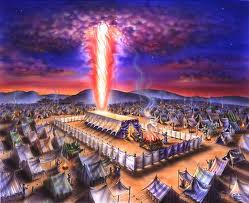
When we think about the tabernacle, the first thing to realize is that it is more than meets the eye. In other words, the tabernacle is built to show off theological, cosmological, and Christological truths–just to name a few. Today, lets consider a couple of these things.
1. A Portable Mountain of God
First up, the tabernacle’s three sections—the courtyard where the people would bring sacrifices, the holy place (the first section in the tabernacle) where the priests would work, and the holy of holies where the high priest would enter once a year on the Day of Atonement, all correspond to the pattern that Moses saw on the mountain. A few verses prove this:
25:8-9. And let them make me a sanctuary, that I may dwell in their midst. Exactly as I show you concerning the pattern of the tabernacle, and of all its furniture, so you shall make it.
25:40. And see that you make them [Mercy Seat, Table, Golden Lampstand] after the pattern for them, which is being shown you on the mountain.
26:30. Then you shall erect the tabernacle according to the plan for it that you were shown on the mountain. (cf. The Bronze Altar, 27:8)
God gives Moses a vision and instruction of this tabernacle, so that Israel can see beyond it to the throne room of God—remember, most of the people never went inside, so this information has a curb appeal because of the mysterious of God’s tent.
2. The Cosmos
Second, in general and in detial, the tabernacle which is God’s earthly dwelling place with Israel is simultaneously constructed in a way that represents all creation. Gregory Beale has proven this thesis in his book, The Temple and the Church’s Mission: A Biblical Theology of the Dwelling Place of God. More succinctly, T. D. Alexander has followed Beale with his more popular treatment, From Eden to New Jerusalem: An Introduction to Biblical Theology. For our consideration, let me mention a couple verses.
Ps 78:69. He built his sanctuary like the high heavens, like the earth, which he has founded forever. Clearly, this proves in a single verse the connection between the tabernacle and the construction of the universe. However, you will also find in Scripture those places where Scripture describes the reverse–the universe is God’s macrocosmic temple.
Psalm 104:1-6. Bless the LORD, O my soul! O LORD my God, you are very great! You are clothed with splendor and majesty, covering yourself with light as with a garment, stretching out the heavens like a tent. He lays the beams of his chambers on the waters; he makes the clouds his chariot; he rides on the wings of the wind; he makes his messengers winds, his ministers a flaming fire. He set the earth on its foundations, so that it should never be moved. You covered it with the deep as with a garment; the waters stood above the mountains.
The significance of this microcosmic-macrocosmic temple is simply that what God does in Israel has cosmic significance. God’s goal is much larger than a singular sanctuary in the Middle East; it prepares the way for Christ and the garden-temple that is revealed in Revelation 21-22.
3. Eden
Not only is Moses given a vision of God’s mountain throne and the cosmos which he upholds, what we learn in the construction of this tabernacle is the way it points back to Eden. Notice a couple of connections.
- Gold in the tabernacle goes back to the gold that existed in Eden (Gen 2:11-12; Exodus 25:7, 11, 17, 31; cf. 1 Kings 6:30)
- The Menorah points back to tree of life (Gen 2:9; 3:22; Exod 25:31-35); the bread of God’s presence corresponds to the food provided by God in the garden (Gen 2:17).
- Angels embroidered on the Veil reflects the angel who dwelt outside Eden (Gen 3:24).
- That God would dwell and even walk in the midst of Israel is Eden-like (Gen 3:8; 26:12).
Significance
Now the question arises: Why does this matter? Let me suggest two reasons.
Typology. Each of its elements is meant to represent something else—it is like a giant object lesson for Israel and for us. In fact, verse 40, which is quoted in Hebrews 8:5, actually uses the word “type” (typon, LXX). Thus, to understand the furniture of Exodus 25 and the tabernacle itself (26), courtyard (27), we must appreciate its symbolism and typology. (We will explore this more in the days ahead.
Telos. Since the purpose of the tabernacle is typological, it is also eschatological. It does point back to Eden, but even more it points ahead to a permanent rest in the land. This is prefigured in Israel’s entrance into Canaan, but even more it foreshadows the work of Christ and the dwelling he promises in the age to come.
Thus, if you know the Bible well, you know Rev 21:22 says that in the end there will be no temple in the city, but that doesn’t deny an eternal cosmic temple. What is a temple, but the dwelling place of God. And what Revelation teaches is that at the end of the age the God who dwells in heaven, will again dwell with man on earth; and not just in one box-shaped tabernacle. All creation will be his dwelling place. The glory of God will cover the earth.
Revelation 21:16 makes this so clear in the light of Exodus 25-40. John records that the city of God that comes down from heaven is 12,000 stadia (1380 miles) in length, width, and height. It is a perfect cube–just like the holy of holies.
So to understand Revelation 21, we must read it with Exodus 26, and what we see is that at the end of the age, the whole earth will be as holy as the holy of holies. So the goal of God is not a 15x15x15 golden box in Israel. His goal is a perfect, purified world where he dwells with his redeemed. This is what Exodus teaches us.
It beckons for a temple not made with human hands, even as it is given to Moses for the construction with human hands. Exodus points beyond itself and leads us to see that Jesus is the builder of this better tabernacle, and if we care at all about what God has done in Christ and/or is doing, we must see look carefully at the details of the tabernacle.
May God give us eyes to see his design in this ancient tabernacle and hearts that long for the temple that is to come!
Soli Deo Gloria, dss
 Via Emmaus