Via Emmaus on the Road: Colossians 4

Further Resources


Colossians 4 (ESV)

Masters, treat your bondservants justly and fairly, knowing that you also have a Master in heaven.

Further Instructions

Continue steadfastly in prayer, being watchful in it with thanksgiving. At the same time, pray also for us, that God may open to us a door for the word, to declare the mystery of Christ, on account of which I am in prison— that I may make it clear, which is how I ought to speak.

Walk in wisdom toward outsiders, making the best use of the time. Let your speech always be gracious, seasoned with salt, so that you may know how you ought to answer each person.

Final Greetings

Tychicus will tell you all about my activities. He is a beloved brother and faithful minister and fellow servant in the Lord. I have sent him to you for this very purpose, that you may know how we are and that he may encourage your hearts, and with him Onesimus, our faithful and beloved brother, who is one of you. They will tell you of everything that has taken place here.

10 Aristarchus my fellow prisoner greets you, and Mark the cousin of Barnabas (concerning whom you have received instructions—if he comes to you, welcome him), 11 and Jesus who is called Justus. These are the only men of the circumcision among my fellow workers for the kingdom of God, and they have been a comfort to me. 12 Epaphras, who is one of you, a servant of Christ Jesus, greets you, always struggling on your behalf in his prayers, that you may stand mature and fully assured in all the will of God. 13 For I bear him witness that he has worked hard for you and for those in Laodicea and in Hierapolis. 14 Luke the beloved physician greets you, as does Demas. 15 Give my greetings to the brothers at Laodicea, and to Nympha and the church in her house. 16 And when this letter has been read among you, have it also read in the church of the Laodiceans; and see that you also read the letter from Laodicea. 17 And say to Archippus, “See that you fulfill the ministry that you have received in the Lord.”

18 I, Paul, write this greeting with my own hand. Remember my chains. Grace be with you.

Soli Deo Gloria!

Via Emmaus on the Road: Colossians 3

Further Resources


Colossians 3 (ESV)

Put On the New Self

If then you have been raised with Christ, seek the things that are above, where Christ is, seated at the right hand of God. Set your minds on things that are above, not on things that are on earth. For you have died, and your life is hidden with Christ in God. When Christ who is your life appears, then you also will appear with him in glory.

Put to death therefore what is earthly in you: sexual immorality, impurity, passion, evil desire, and covetousness, which is idolatry. On account of these the wrath of God is coming. In these you too once walked, when you were living in them. But now you must put them all away: anger, wrath, malice, slander, and obscene talk from your mouth. Do not lie to one another, seeing that you have put off the old self with its practices 10 and have put on the new self, which is being renewed in knowledge after the image of its creator. 11 Here there is not Greek and Jew, circumcised and uncircumcised, barbarian, Scythian, slave, free; but Christ is all, and in all.

12 Put on then, as God’s chosen ones, holy and beloved, compassionate hearts, kindness, humility, meekness, and patience, 13 bearing with one another and, if one has a complaint against another, forgiving each other; as the Lord has forgiven you, so you also must forgive. 14 And above all these put on love, which binds everything together in perfect harmony. 15 And let the peace of Christ rule in your hearts, to which indeed you were called in one body. And be thankful. 16 Let the word of Christ dwell in you richly, teaching and admonishing one another in all wisdom, singing psalms and hymns and spiritual songs, with thankfulness in your hearts to God. 17 And whatever you do, in word or deed, do everything in the name of the Lord Jesus, giving thanks to God the Father through him.

Rules for Christian Households

18 Wives, submit to your husbands, as is fitting in the Lord. 19 Husbands, love your wives, and do not be harsh with them. 20 Children, obey your parents in everything, for this pleases the Lord. 21 Fathers, do not provoke your children, lest they become discouraged. 22 Bondservants, obey in everything those who are your earthly masters, not by way of eye-service, as people-pleasers, but with sincerity of heart, fearing the Lord. 23 Whatever you do, work heartily, as for the Lord and not for men, 24 knowing that from the Lord you will receive the inheritance as your reward. You are serving the Lord Christ. 25 For the wrongdoer will be paid back for the wrong he has done, and there is no partiality.

Soli Deo Gloria!

Via Emmaus on the Road: Colossians 2

Further Resources

Colossians 2 (ESV)

For I want you to know how great a struggle I have for you and for those at Laodicea and for all who have not seen me face to face, that their hearts may be encouraged, being knit together in love, to reach all the riches of full assurance of understanding and the knowledge of God’s mystery, which is Christ, in whom are hidden all the treasures of wisdom and knowledge. I say this in order that no one may delude you with plausible arguments. For though I am absent in body, yet I am with you in spirit, rejoicing to see your good order and the firmness of your faith in Christ.

Alive in Christ

Therefore, as you received Christ Jesus the Lord, so walk in him, rooted and built up in him and established in the faith, just as you were taught, abounding in thanksgiving.

See to it that no one takes you captive by philosophy and empty deceit, according to human tradition, according to the elemental spirits of the world, and not according to Christ. For in him the whole fullness of deity dwells bodily, 10 and you have been filled in him, who is the head of all rule and authority. 11 In him also you were circumcised with a circumcision made without hands, by putting off the body of the flesh, by the circumcision of Christ, 12 having been buried with him in baptism, in which you were also raised with him through faith in the powerful working of God, who raised him from the dead. 13 And you, who were dead in your trespasses and the uncircumcision of your flesh, God made alive together with him, having forgiven us all our trespasses, 14 by canceling the record of debt that stood against us with its legal demands. This he set aside, nailing it to the cross. 15 He disarmed the rulers and authorities and put them to open shame, by triumphing over them in him.

Let No One Disqualify You

16 Therefore let no one pass judgment on you in questions of food and drink, or with regard to a festival or a new moon or a Sabbath. 17 These are a shadow of the things to come, but the substance belongs to Christ. 18 Let no one disqualify you, insisting on asceticism and worship of angels, going on in detail about visions, puffed up without reason by his sensuous mind, 19 and not holding fast to the Head, from whom the whole body, nourished and knit together through its joints and ligaments, grows with a growth that is from God.

20 If with Christ you died to the elemental spirits of the world, why, as if you were still alive in the world, do you submit to regulations— 21 “Do not handle, Do not taste, Do not touch” 22 (referring to things that all perish as they are used)—according to human precepts and teachings? 23 These have indeed an appearance of wisdom in promoting self-made religion and asceticism and severity to the body, but they are of no value in stopping the indulgence of the flesh.

Soli Deo Gloria!

Via Emmaus on the Road: Colossians 1

Further Resources

Colossians 1

Greeting

Paul, an apostle of Christ Jesus by the will of God, and Timothy our brother,

To the saints and faithful brothers in Christ at Colossae:

Grace to you and peace from God our Father.

Thanksgiving and Prayer

We always thank God, the Father of our Lord Jesus Christ, when we pray for you, since we heard of your faith in Christ Jesus and of the love that you have for all the saints, because of the hope laid up for you in heaven. Of this you have heard before in the word of the truth, the gospel, which has come to you, as indeed in the whole world it is bearing fruit and increasing—as it also does among you, since the day you heard it and understood the grace of God in truth, just as you learned it from Epaphras our beloved fellow servant. He is a faithful minister of Christ on your behalf and has made known to us your love in the Spirit.

And so, from the day we heard, we have not ceased to pray for you, asking that you may be filled with the knowledge of his will in all spiritual wisdom and understanding, 10 so as to walk in a manner worthy of the Lord, fully pleasing to him: bearing fruit in every good work and increasing in the knowledge of God; 11 being strengthened with all power, according to his glorious might, for all endurance and patience with joy; 12 giving thanks to the Father, who has qualified you to share in the inheritance of the saints in light. 13 He has delivered us from the domain of darkness and transferred us to the kingdom of his beloved Son, 14 in whom we have redemption, the forgiveness of sins.

The Preeminence of Christ

15 He is the image of the invisible God, the firstborn of all creation. 16 For by him all things were created, in heaven and on earth, visible and invisible, whether thrones or dominions or rulers or authorities—all things were created through him and for him. 17 And he is before all things, and in him all things hold together. 18 And he is the head of the body, the church. He is the beginning, the firstborn from the dead, that in everything he might be preeminent. 19 For in him all the fullness of God was pleased to dwell, 20 and through him to reconcile to himself all things, whether on earth or in heaven, making peace by the blood of his cross.

21 And you, who once were alienated and hostile in mind, doing evil deeds, 22 he has now reconciled in his body of flesh by his death, in order to present you holy and blameless and above reproach before him, 23 if indeed you continue in the faith, stable and steadfast, not shifting from the hope of the gospel that you heard, which has been proclaimed in all creation under heaven, and of which I, Paul, became a minister.

Paul’s Ministry to the Church

24 Now I rejoice in my sufferings for your sake, and in my flesh I am filling up what is lacking in Christ’s afflictions for the sake of his body, that is, the church, 25 of which I became a minister according to the stewardship from God that was given to me for you, to make the word of God fully known, 26 the mystery hidden for ages and generations but now revealed to his saints. 27 To them God chose to make known how great among the Gentiles are the riches of the glory of this mystery, which is Christ in you, the hope of glory. 28 Him we proclaim, warning everyone and teaching everyone with all wisdom, that we may present everyone mature in Christ. 29 For this I toil, struggling with all his energy that he powerfully works within me.

Soli Deo Gloria!

Colossians 1:24: Suffering for the Sake of the Body (pt. 2)

My Final Answer:

The “lack” that Paul’s sufferings are filling up is the representative absence of Christ’s redemptive sufferings. Let me expound: What Christ did on the cross was a singular event in space and time, yet it was for all time and for all people. The distance between the singular event and the fullness of humanity is the lack. The application of reconciliation needs to be extended to all people. That is where Paul’s suffering, and your suffering and my suffering come in. We suffer to fill up the lack of proclamation of Christ’s propitiation. Therefore, what Christ propitiated, we proclaim. What he did, we declare. The redemption he accomplished we make known through declaration, and as the Lord ordains our sufferings for his sake, we demonstrate his death and resurrection in our bodily afflictions.

Commenting on this, John Piper writes:

Christ has prepared a love offering for the world by suffering and dying for sinners. It is full and lacking nothing—except one thing, a personal presentation by Christ himself to the nations of the world. God’s answer to this lack is to call the people of Christ (people like Paul) to make a personal presentation of the afflictions of Christ to the world…In [our] sufferings they see Christ’s sufferings. Here is the astounding upshot: God intends for the afflictions of Christ to be presented to the world through the afflictions of his people (Desiring God, 225).

In short, Paul’s suffering validated and attested to the life-giving power of the message he proclaimed, so that in his life he demonstrated Christ’s sacrificial death and resurrection power (cf. Phil. 3:9-10).  In the church, the world is able to see the body of Christ. In the suffering of Christ’s body, they are given a living, breathing, suffering testimony of the savior who bled and died to make reconciliation with God possible. This was God’s design for his church from the beginning.  Reflecting on this call to suffer, Romanian pastor Joseph Tson comments:

[Speaking in first person, in the life of Paul, he says]: If I had remained in Antioch…nobody in Asia Minor or Europe would have been saved. In order for them to be saved, I have had t accept being beaten with rods, scourged, stoned, treated as the scum of the earth, becoming a walking death. But when I walk like this, wounded and bleeding, people see the love of God, people hear the message of the cross, and they are saved. If we stay in the safety of our affluent churches and we do not accept the cross, others may not be saved. How many are not saved because we don’t accept the cross? (Quoted by John Piper in Desiring God, 230).

Let me summarize: Christ’s sufferings redeemed; Paul’s sufferings reveal. They do not add to Christ’s all-sufficient work, but they do extend its all-sufficient power and message (cf. 2 Cor. 4:7-11). The purpose of God in Christ’s sufferings was to redeemed a people dead in trespasses and sins; the purpose of God in Paul’s sufferings was to bear witness to the sufferings of another, and amazingly Paul’s bodily afflictions were designed by God to advance that message.  So then, Paul’s sufferings for the gospel, and ours, are not supplementary, but complementary.  They are essential, not optional.

Jesus promised his followers a cross. He said that if the world hated the master, they would also hate his servants. Therefore, in telling the world about his saving work, we can expect to suffer. Yet, in that suffering we demonstrate in our flesh the power of God’s love and the very cross that we declare. When the world sees suffering, bleeding, dying Christians telling of their suffering, bleeding, dying savior with joy (“I rejoice in my sufferings for your sake,” Col. 1:24a), they are filling up what is lacking in Christ’s afflictions—namely the representative witness of the savior’s redemption. And in so doing, we follow in the faithful footsteps of Paul and we fill up what is lacking in Christ’s afflictions.

Lord Jesus, give us more grace to move towards the suffering you have designed for us to embrace in our bodies, and may the world know that while we suffer, we do it joyfully, looking forward to the resurrection of the body in the age to come.

Sola Deo Gloria, dss

Colossians 1:24: Suffering for the Sake of the Body (pt. 1)

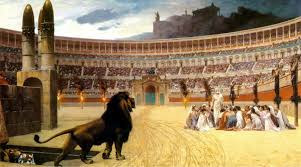
lion“In my flesh I am filling up what is lacking in Christ’s afflictions
for the sake of his body, that is, the church”?
— Colossians 1:24 —

What does Colossians 1:24 mean? Initially, it sounds like he is diminishing the work of Jesus Christ on the cross. But is he? Surely not!?!

Stripped from its context, Paul’s words make Christ’s atonement sound incomplete and deficient. Or at least they give credence to some brand of works-based theology that finds merit in the works of the saints. But I would contend that such an interpretation is too hasty, and not at all what Paul is intending.

This past weekend, I had the privilege and the challenge of preaching Colossians 1:24 at Kenwood Baptist Church, where I labored to explain what Paul meant that in his flesh he, and by extension we, must fill up what is lacking in Christ’s afflictions.  Below are some of my observations and interpretations that helped me understand this “hard text.”  Tomorrow, I will provide my final answer.

(From the beginning, I gladly admit that I found much interpretive assistance from the commentaries of Peter O’Brien and Douglas Moo, but most of all I was helped by John Piper’s chapter on “Suffering” in Desiring God).

Four Preliminary Observations

1. Paul’s suffered because of God’s mercy.

In fact, his suffering flows out of the mercy and grace of God spoken of in the previous verses. Verses 21–23 highlight the mercy of God in reconciling sinners through the death of Jesus Christ. At the end of verse 23, Paul says that he has become a minister of this gospel hope. Then in verse 24, he launches off into speaking about his ministry and its suffering. So it seems that Paul is impassioned by the mercy of God to suffer for Christ and for his church.  This same kind of logic is found in Romans 9:1-6, where after declaring for eight chapters the mercies of God, he passionately suggests forfeiture of his own salvation if only he could bring salvation to his brethren.  Suffering is not and cannot be disconnected from mercy. Without mercy, suffering has no power.  In the daily mercies and comfort of God, saints find renewed endurance and reasons for suffering well.

2. Paul’s suffered with Christ.

Verse 24 says that Paul is filling up “Christ’s afflictions.” Some translators and commentators, have tried to escape the problem of this verse by saying that the afflictions are Paul’s, not Christ’s. This would mean that Paul is suffering and he is doing so for Christ, but that in no way is Paul’s suffering effecting concerning Christ’s work. But the grammar does not allow for that interpretation.

So Paul’s sufferings are coterminous with Christ’s, that is they extend to the same boundary as Jesus’ afflictions. This makes sense, in that when Paul was himself was persecuting the church, Jesus confronted him and asked, “Why are you persecuting me?” (Acts 9:6). Jesus Christ, raised from the dead is unified with his church, and resultantly, when the church suffers, Christ suffers. So Paul is saying that he suffers with Christ. This idea is made explicit in Philippians 3:10, when he says, “that I may know him and the power of his resurrection, and may share his sufferings, becoming like him in his death.” There is a fellowship in the sufferings of Christ. So when Paul suffers in the flesh, Christ suffers, and thus the apostle suffers with Christ.

3. Paul suffered for/on behalf of the church.

His sufferings are not self-absorbed or introspective. He sees them as being done for those who he loves, the bride of Christ. In this way, he sees his sufferings as a benefit to the church, in Colossae and everywhere else. This idea is seen here and again in Colossians 1:29–2:1 (cf. 2 Tim. 1:8ff). This leads to a fourth observation.

4. Paul’s suffered for the expansion of the gospel.

This whole section is filled with language that depicts the gospel of Christ going forward. And Paul rejoices in his sufferings because he sees the gospel going out.  Letting Scripture illuminate Scripture, Paul’s self-effacing, gospel-promoting attitude can be seen also in the letter to the Philippians when he speaks of the brothers who are proclaiming the gospel looking to do him harm (cf. Phil. 1:15–18).  Apparently, while in prison, there are some gospel evangelists who see their proclamation as doing injury to Paul and they are glad.  Paul’s response is simply amazing as he is rejoices that the name of Jesus is going further and further–at personal expense to his name and ministry.

Putting this all together we see the context of Paul’s suffering in the light of ministry and not mediation; with Christ and not for Christ; and for the sake of gospel proclamation, not for any kind of further merit or propitious enhancement. In other words, before getting to the text, the context tells us that’s Paul’s suffering is not securing salvation, it is proclaiming the sure salvation that has already been accomplished.

Two Interpretive Boundaries

When we compare this passage to others in Colossians and throughout the NT, we see there are a few other interpretive boundaries that guard us from making theological error.

1. Paul’s theology disallows a diminished atonement.

Paul is not saying that Jesus work on the cross is deficient. On the contrary, his doctrine of salvation is consistent, and it always elevates the singular nature of Christ’s atoning death (see his arguments in Romans 5, 8; Galatians 3–4).  In Colossians, Paul makes it plain that the work of Christ is absolutely sufficient (and necessary) for salvation (cf. Colossians 1:12-14. 1:15–20. 2:13–15).  Summarizing his points, when Christ died on the cross, it was finished, full atonement had been made. This is Paul’s message of the cross and the plenary message of the New Testament (cf. John 19:30; Hebrews 9–10).

2. Paul’s language presents an interpretive boundary.

The term “afflictions” used by Paul in verse 24 is nowhere used of Christ’s redemptive work on the cross. Jesus is accursed on the cross, sheds his blood, is crucified, and is put to death, but he is not “afflicted” on the cross. It is rather the kind of language that the community that follows Jesus should regularly anticipate. Tribulations, trials, hardships, and sufferings are the lot of the Messianic community. In keeping with the eschatological nature of church, the “Messianic woes” have been passed the followers of Jesus, and they should expect to be afflicted on behalf of the one they follow. This is why Jesus said that all who follow him must pick up the cross daily. The call to follow Christ is a call to die (Deitrich Bonhoeffer in The Cost of Discipleship). The kind of affliction that Paul is referencing here is more fully developed in 2 Corinthians 1:3–8, which speak of the afflictions of ministry and gospel service.

For more reflections on this passage, see Part 2 of this post.

Sola Deo Gloria, ds

Adamic Imagery in Colossians 1:15-20

Colossians 1:15-20 is one of the most exalted views of Jesus Christ in all the Scriptures.  It demands doxological invocation through theological description. 

In just six verses, Paul unfolds a litany of magnificent truths that span the horizon of biblical theology and reach from the horrors of hell (Christ’s experience on the cross) to the glories of heaven (Christ’s headship in the church and His rule over all creation). Consider:  He is the image of God.  He is the firstborn son over all creation.  He is the Creator of all things.  All things!  Nothing exists without his sovereign oversight.  He upholds the universe, thus he sustains each photon of light from the star whose light has not yet reached the earth.  He is the head of the church.  And he is the firstborn from the dead.  Each truth deserves individual attention.  Taken together they crescendo in praise. 

But these truths are not vaccuous propositions devoid of context and biblical definition.  Paul writes these things to contest the false teaching erupting in Colossae.  Paul lifts up the glory of Christ to combat any notion that deficiency in the life, death, and resurrection of Jesus Christ.  He draws on OT concepts and language to declare Christ has come and fulfilled all things–the law (cf. Rom. 10:4); the promises (cf. 2 Cor. 1:20; the offices of the OT (cf. the book of Hebrews).  He is the God, and in him the fullness of God dwells bodily (Col. 1:19; 2:9).

In making his case, Paul conflates Jesus Christ’s eternal deity and creativity with his functional role as the second Adam.  GK Beale provides helpful commentary and analysis of this Adam-Christ relationship.  He writes:

The three descriptions for Christ in Colossians 1:15-17 (“image of God,” “firstborn,” “before all things”) are thus different ways of referring to Christ as an end-time Adam, since they were common ways of referrring to the first Adam or to those who were Adam-like figures and were given the first Adam’s task whether this be Noah, the patriarchs, or the nation of Israel (GK Beale, “Colossians,” in Commentary on the NT Use of the OT, 854).

While the first Adam imaged God and was YHWH’s firstborn son (Luke 3:38), he was not “before all things.”  In this way, Jesus Christ is a greater Adam, one who is both Creator and incarnated as the perfect image of God.  Whereas, every other son of Adam (daughter of Eve), bears in being a marred image of God, Jesus Christ is the perfect image of God, “the radiance of God’s glory and the exact representation of His nature” (Heb. 1:3).  Thus, we who have been redeemed by the Second Adam, who have been buried with him in baptism, and await the redemption of our bodies and to be clothed with the imperishable, are being conformed into the image of the second Adam, the perfect man.  This is the corporeal hope of the Christian life, we will be glorified in our bodies (cf. Rom. 8:29-30), when Christ comes again.

Beale goes on to speak of Jesus position of authority, for as the perfect man, he has always retained his Divine Nature (cf. Phil. 2:5-11):

This position of authority is also grounded in Paul’s acknowledgement that Christ is the sovereign Creator of he world (1:16) and sovereignly maintains its ongoing existence (1:17b).  Therefore, Christ perfectly embodies the ruling position that Adam and his flawed human successors should have held, and he is at the same time the perfect divine Creator of all thins, who is spearate fro mand sovereign over that which he has created, especially underscored by the clause ‘all things have been created through him and for him’ at the end of 1:16 (854).

As we read our Bible’s may we see the intracanonical connections that help us better understand our Savior; and as we see these Spirit-illumined truths, may our hearts be filled with joy as we consider our great and gracious Immanuel.

Sola Deo Gloria, dss