The Air That We Breathe: Expressive Individualism, I, and Me

mirrorFew modern theologians have helped me think more clearly about culture than David Wells. His collection of works on modernity and postmodernity (listed below) address the many ways evangelicalism has been bent and broken by chasing the winds of culture. Considering the ways the modern world (with its penchant for technology, urbanization, consumerism, and mass communication) has refocused Christianity, and the way modern philosophies have turned religion towards the subject, he shows why so much modern Christianity mirrors the world, rather than prophetically modeling a different way of life.

For me, his observations have been a helpful corrective against the acids of culture that eat away at our soul. He has given me eyes to be a better cultural exegete, and his Reformed convictions, have pressed me back to the Bible to see what it says about any number of topics. Most recently, I picked up his Losing Our Virtue: Why the Church Must Recover Its Moral Vision to consider in more detail the effects of individualism on the church.

What follows are a few quotes, observations, and insights on the topic of expressive individualism—a poisonous air wafting through so many American churches.  Continue reading

Another Step Toward a Biblical Ecclesiology: Acts 9 on Baptism, Membership, and the Church

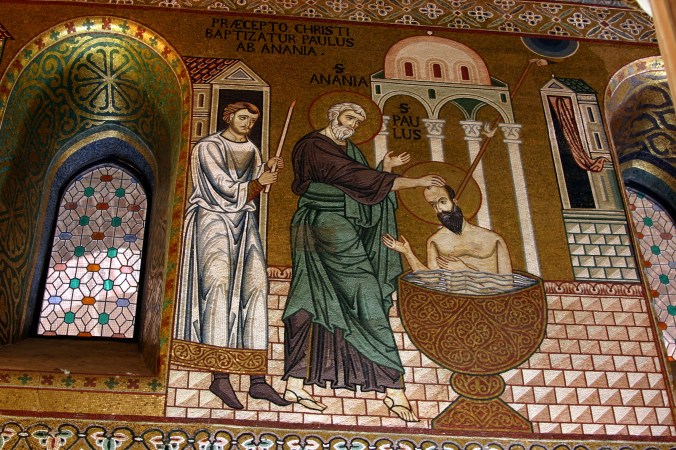
baptism_of_st_paul_-_capela_palatina_-_palermo_-_italy_2015-2The book of Acts is pivotal for understanding the nature and function of the church. It is also challenging, because it presents a church that is “born” on Pentecost, at first contained to Jerusalem, but later expanded to Judea and Samaria and finally unleashed the ends of the earth. At the same time, it’s founding members were believers before receiving the Spirit and yet the gift of the Spirit is one of the distinguishing marks of the church as it spreads from Israel to Italy. In four instances (Acts 2, 8, 10, 19), the Spirit is given, but in no two instances are the exact events the same. For instance, speaking in tongues accompanies the Spirit in Acts 2, 10, 19, but not Acts 8. Likewise, water baptism precedes the Holy Spirit in Acts 8, but follows in Acts 10.

From just a sampling of evidences, the book of Acts is both foundational and frustrating for understanding the nature of the church. It is foundational because of the patterns we see in how churches are formed—the Word of God is preached, Jews then Samaritans than Gentiles repent and believe, they are baptized, and then gathered into churches. Yet, it is frustrating because not everything in Acts is reproducible today. The personal visitations by Jesus, the miracles of healing, the speaking in tongues, and the survival of snake bites are all incidents that we might say have discontinued—unless one believes otherwise. For now my point is not to defend or deny cessationism, but to merely highlight how that debate among others finds difficulty in Acts.

Any point of ecclesiology, therefore, needs to be aware of Acts transitional nature. It should take into account how the Holy Spirit has given us this book to teach us about the founding of the church, but it is not a manual for every point of doctrine. That being said, where else do we turn in Scripture to find how to plant, revitalize, and shepherd churches? Therefore, we do need to watch for patterns and principles in Acts, but always with awareness of some discontinuity between Acts period of transition and our own day.

Clearing Up Two Points of Ecclesiology

With this approach to Acts in mind, I want to clear up two points of ecclesiology from Acts 9. From this chapter, I have heard two statements about the church:

  1. Paul’s baptism by Ananias suggests a local church is not (absolutely) needed for a legitimate baptism.
  2. The Church is fundamentally a universal concept, as Acts 9:31 describes the church regionally, not locally (i.e., in one spatio-temporal location).

While there is truth in these statements, ultimately I think we are on more solid ground to say

  1. Paul’s baptism was unique, but not so unique as to break from the normative pattern of the New Testament. We should exercise caution when making application from his experience, but at the same time, we can see how his unusual experience fits the larger pattern of baptism and “church membership” in Acts.
  2. The universal Church “throughout all Judea and Galilee and Samaria . . .” is a located in spatio-temporal “locales” (something I’ve tried to describe elsewhere).

In what follows, I will argue that Paul’s baptism is both a unique point in redemptive history and one that follows the pattern of baptism and church membership (i.e., association with other disciples in a local church). Exploring the relationship of Paul’s baptism to the churches in Damascus and Jerusalem will also prove the corollary: life in the universal church is experienced through local assemblies. In the end, I will list seven points of application from this chapter related to ecclesiology. Continue reading

The Testimony of Two: Why Baptism Requires a Harmony of Witnesses

baptism1In your Law it is written that the testimony of two people is true.
— John 8:17 —

In recent months I’ve been in discussion about the meaning of baptism, and who is saying what when a believer is immersed for identification with Jesus. Is baptism an individual’s testimony (alone)? Or is it the church’s testimony? Or, is it both?

With this question in mind, I recently read John 8 where Jesus makes the axiomatic statement in verse 17: “In your Law it is written that the testimony of two people is true.” In context, he is preparing to say he and his Father both testify to his messianic identity, even if the Pharisees in all of their well-studied folly could not receive this testimony. The point Jesus makes is that his identity is secured by multiple witnesses. In fact, John’s whole Gospel hangs on this premise, that there are a dozen or more witnesses testifying to Christ.

From this consideration, my question is, What role does the legal requirement of two or three witnesses play in baptism? If baptism is a legal act, whereby the disciple of Jesus is marked out and publicly identified, should this not include more than one witness? And have some churches misunderstood (or misapplied) baptism when they teach and practice that all that matters is the individual’s faith? Certainly, the one undergoing baptism is testifying to their allegiance to Christ, but what role, biblically speaking, does the legal requirement of two or three witnesses play in the ordinance of baptism? Continue reading

“You Will Be My Witnesses”: Five Truths About Witnessing From the Book of Acts

lionWhen I was in college and a young believer, one of the first Christian books I read was Bill Bright’s Witnessing without FearIt was a helpful introduction to evangelism and the call of disciples to be witnesses for Jesus. Just beginning to understand what it meant to follow Christ and make disciples, this book helped immensely to be a ‘witness’ for Christ. Today, I’m still thankful for that book.

Recently, as I read through Acts, the theme of witnessing came to the fore again. And how could it not?

In Acts 1:8 Jesus tells his disciples to remain in Jerusalem until the Holy Spirit comes to empower them to be his witnesses in Jerusalem, Judea and Samaria, and to the ends of the earth. Indeed, “witnessing” is something more than a spiritual discipline or a Tuesday night activity. It is the very essence of who we are as Christians. But what does that mean? And how exactly are we to speak about Jesus?

“Witness” and “Witnessing” in Acts

Perhaps the best way to answer that question is to see how the apostles “witnessed” to Jesus in the book of Acts. After Jesus’ identifies his followers as his witnesses in Acts 1:8, Luke uses the word μάρτυς 12 more times to describe the witness-bearing of the early church (1:8, 22; 2:32, 40; 3:15; 4:33; 13:31; 14:3, 17; 22:5, 20, 15; 26:16). (He also uses the verb μαρτύρομαι twice, 20:26; 26:22).

From observing how this word is used we can begin to sketch what a faithful witness might look like. While a whole theology of witnessing could be written from Acts and the rest of the New Testament (e.g., see Allison Trites, The New Testament Concept of Witness), let me suggest five truths about witnessing from the book of Acts. Continue reading

Let’s Increase the Drama: Kevin Vanhoozer on the Church as Gospel Theater

drama.jpegWhy should you commit to, participate in, become a member—or however you want to describe it—of a local church? Because Christians are called to gather to “dramatize” the gospel of Jesus Christ.

While “drama” in the church is often a troublesome condition related to strife and gossip; rightly understood, drama is the very reason why the church exists. Consider the insightful words of Kevin Vanhoozer (The Drama of Doctrine), who describes the communion of the church as a theater troupe called and commissioned to interpret God’s Script through their faithful living and Word-based improvisation.

The church has to celebrate what no other institution can celebrate: communion with God and communion with others. The Lord’s Supper is a communal act of solemn, yet ultimately joyful, thanksgiving. The shared bread and wine recall the theo-drama’s climax and rehearse the play’s conclusion. It is a key scene to the meaning of the whole, and it ought to affect our interpretation of all the other scenes. The Supper cannot, however, be performed by individual actors, no matter how virtuosic their talent; it takes a company. A company is, in the first instance, an assembly. The church is that singular assembly that keeps company gospel and with one another, not least by breaking bread together (com panis = “with bread”). But the church is a company, second, in the theatrical sense: a troupe of speakers, singers, and actors. It is the company of the forgiven, and this is why the company communicates, indeed radiates, joy.

Continue reading

The Church’s Place in *Framing* the Gospel (A Review of 1 Corinthians 1–10)

sermon photoIn 2016 our church has spent the year in 1 Corinthians, at least the first 10 chapters. As we turn our attention to the birth of Lord in just a couple weeks, we took time to review a few aspects of ecclesiology (the doctrine of the church) that we’ve seen in Paul’s letter. For now the debate about Trinity-gender analogies (1 Corinthians 11:3) and head coverings (11:6, 10) will have to wait.

In what we considered yesterday, I made seven applications from 1 Corinthians 1–10 related to the universal and local church. Here they are in list form. You can listen or read the sermon notes; study questions and further resources are listed below.

  1. The church is both local and universal.
  2. The universal church is made of local churches.
  3. Individual Christians experience the universal church thru the local church.
  4. The local church calls the universal church to walk together as disciples of Christ.
  5. The local church (not the universal church) has been given leaders who know their sheep.
  6. The local church has power AND wisdom to exercise the keys of the kingdom.
  7. The local church provides visible boundaries for the universal church.

All sermons in the series “The Life-Changing Gospel in God’s Local Church” can be found here. Continue reading

An Ecclesiology of Churches: Why the Universal Church Is Best Regarded as a Myriad of Local Churches


lights To the church of God that is in Corinth, to those sanctified in Christ Jesus,
called to be saints together with all those who in every place call upon the name
of our Lord Jesus Christ, both their Lord and ours.
– 1 Corinthians 1:2 –

When someone says, “I’m a part of the universal church,” what do they mean? Do they mean they are a Christian and by implication they must be a member of the world-wide communion of saints? In our day of individual expression and come-as-you-are spirituality, I think this is what many mean. But it’s not just those who try to do Christianity on their own that may feel a pull towards the universal church sans the local church. There are plenty of well-read, Bible students who have also found fellowship and community outside a local assembly.

But if that is so, where do universal church-ers, to borrow a phrase from Jonathan Leeman, celebrate communion? Under whose authority are they? And does such spiritual oversight need to come from a church? Is there any connection between the church they attend on Sunday and the elect of God from all nations? If not, why go to a local church at all? But if there is a relationship between the local church and universal church, what is it?

How Do I Get to the Universal Church?

I ask these questions because I suspect many Christians have not given lengthy thought to the relationship between the church or churches they attend on any given Sunday (i.e., a local church) and the elect of God who will one day gather around the throne of Christ (i.e., the universal church). After all, when was the last time you heard a sermon on the differences and distinctives of the local and universal church? Continue reading

Psalm 46: Two Sermons, One Message of Hope

cross.jpeg God is our refuge and strength, a very present help in trouble.
Therefore we will not fear though the earth gives way,
though the mountains be moved into the heart of the sea,
though its waters roar and foam,
though the mountains tremble at its swelling. Selah
— 
Psalm 46:1–3 —

In a(n election) season of great consternation, the Christian’s hope and joy does not change if she keeps her mind fixed on the Lord. This is the promise of the prophet Isaiah and our Lord Jesus.

You keep him in perfect peace
whose mind is stayed on you,
because he trusts in you. (Isaiah 26:3)

I have said these things to you, that in me you may have peace. In the world you will have tribulation. But take heart; I have overcome the world. (John 16:33)

For followers of Christ, peace is not gained (or kept) by a calm and consistent world. Rather, steadfast communion with our Lord secures our peace and overcomes our anxieties.

With that in mind, I preached yesterday a message from Psalm 46 at Castleview Church in Indianapolis, Indiana. What a joy it was to gather with God’s people to remind ourselves that our God is with us and our God is working for us. At the same time, I was even more encouraged when on my way home I listened to Dave Ross—not the World Series catcher, but one of our elders at Occoquan Bible Church—hit a home run as he preached Psalm 46.

In preparation for the Sunday before Election Day, he and I collaborated on our messages, only he opened his message with a powerful retelling of 1 Corinthians and how it calls the church to retain its focus on Christ and the gospel. A very powerful and timely reminder. In both our messages we preached to ourselves and others about the Lord’s sovereign purposes and his gracious promises.

This week, if you are feeling overwhelmed with fear going into tomorrow’s election, let me encourage you to listen to his message (“Election Daze vs. Kingdom Praise“) or mine (“God with Us, God for Us: Two Truths in Troubled Times“).

On that note, you may find help in few other reflections too.

In this uncertain world, may God enable you to put all your trust in the prince of peace, so that you have wisdom and power to walk by faith in this world and not by sight.

Soli Deo Gloria, ds

Take Hold of God and Give Grace: Sixteen Considerations for Election 2016


electionWhat do we say to our church in the face of the impending election? Pastor, what will you say to a church divided on the issue? Christian, how are you holding fast to the gospel and protecting your church from the divisions that this election could produce in the church? What is most important in this electoral season—winning the presidency or preserving the Church’s witness to the world?

As a pastor, these are just some of the questions on my mind, and so I write this post as an attempt to help shepherd our church and to think biblically about how Christians might maintain a focus on Christ in this tumultuous season. My prayer and aim is to see Christians of different political convictions retaining focus on Christ and his kingdom, even as they live out their faith in the public square.

And so in 2016, I offer 16 considerations—six ways we can take hold of God and ten ways we can give grace to one another, even as wrestle with the challenges of this year’s election. May God use these to encourage and challenge your heart. May he be pleased to use them to purify our hope in him and our church’s commitment to the Great Commandment and the Great Commission.

Six Ways to Take Hold of God

1. Take heart in God.

God is sovereign and we can rest in his rule (Psalm 103:19; Daniel 4:34–35). No matter what happens on November 8 (or on any other day), it will not overturn his work in the world. In fact, for good or bad, God will use this election to expose idols, test faith, and ultimately gather sheep. Scripture repeatedly tells us no king, no nation, no president has the absolute power to halt God’s kingdom. We must remember this, preach this to one another, and take comfort in this fact—God’s kingdom has come and is coming. Continue reading

The Disciple-Making Church: Teaching Disciples to Obey All Christ Has Said About the Church


htIn 2001 I took a summer job at the Harris Teeter in Virginia Beach. While on “project” with Campus Crusade for Christ (Cru), I sought a place to work and witness for three months. Harris Teeter fit the bill, and hiring me they knew I’d return to Michigan in August.

That being known, Harris Teeter invested 20 man-hours to train me, like they did every new employee. On top of the on the job training I received working in the deli, they sent myself and another project member to “night school.” Over the course of two weeks, they paid us for our studies in a corporate classroom.

If you’re not familiar with Harris Teeter, they are a grocery store that prides itself on customer service. It identifies itself as a “North Carolina based grocery committed to world class customer service.” Ask a manager and they will tell you they’re here to serve. Join their rewards program and you will become a “Very Important Customers.” Apply for a summer job—like I did—and they’ll train you for 20 hours.

I still remember some of the principles of customer service: “If a customer asks you for help finding a product, don’t point. Don’t explain the path to the product. Walk them to the aisle.” Harris Teeter was and is committed to giving customers the highest shopping experience. And all this for bread and meat that will go bad next week. Continue reading