Willingly and Truthfully: How a Pastor Demonstrates His Love

herd of sheep on focus photography

The elder to the elect lady and her children, whom I love in truth, . . .
– 2 John 1 –

In 2 John 1, the Beloved Apostle declares his love for the church. This love is for the church (“the elect lady”), as well as for her members (“her children”), and it sets the tone for his whole letter. As John expresses it, his love motivates him to write, and his love leads him to warn the church against false teachers. Indeed, such is the love of a pastor. Love that is biblical must lead others to the truth. And any love devoid of truth is not truly loving.

Throughout the New Testament love and truth are joined as one. For example, Paul says that love always rejoices in the truth (1 Cor. 13:4). Likewise, John’s love for the church moves him to rejoice when God’s children are walking in truth (2 John 4). The author of Hebrews urges us to spur one another on towards love and good deeds (Heb. 10:24–25)—good deeds defined by the truth of Scripture. And even Jesus is identified as the one who is fullness of grace and truth (John 1:14, 17), or, as these two words come from the Hebrew pair hesed (lovingkindness) and emet (truth/faithfulness), he is full of love and truth. Just as John highlights in 2 John 3 reads, “Grace, mercy, and peace will be with us, from God the Father and from Jesus Christ the Father’s Son, in truth and love.

In short, those leading the church are to love the people of God in truth. Yet, to echo Pilate: What is truth? Or, for that is matter: What is love? In this blogpost, I will begin to explore that question: What does it mean for a pastor to demonstrate love?

Love Must Truth

In our modern age, love is defined by unbounded affirmation and the willingness to celebrate self-expression, whatever that expression may be. Accordingly, those who love in truth, or attempt to love others with the truth, may not be well-received. They may be hated!

For those catechized by the world and its therapeutic ideas of self-esteem, challenging someone may be received as harsh or even hateful. And more, any pastor who dares to disciple a church or a church member in ways that the recipient does not esteem acceptable may easily be assigned as unloving or even unsafe. In such a world, the truths of God’s Word do not change, but appreciation for them do. And thus, Christians face the difficulty of returning to the old paths.

In generations gone by, generations forged by Christian convictions, correction was received, if not pursued; authority was respected; and love was evidenced by service, sacrifice, and selflessness. Today, vestigial remains of true love remain, but not without careful attention to what love actually is and isn’t. And if this is true in general; it is especially true for pastors.

How do pastors love God’s church? What should congregations expect of those who lead them? And what does Scripture say about the pastor and his responsibility to love the flock? Those questions could easily invite a book on the subject, The Pastor and His Love perhaps. Yet, short of that project, let me offer two answers. And in the days to come, as the Lord allow, I’ll add more. Continue reading

A Dangerous Calling: Two Ways to Seek Ministry

boy wearing crown statue

Adonijah the son of Haggith exalted himself, saying, ‘I will be king.”
– 1 Kings 1:5 – 

But seek first the kingdom of God and his righteousness,
and all these things will be added to you.
– Matthew 6:33 –

There is nothing wrong with seeking the kingdom of God, or in seeking a place in that kingdom. In fact, it is absolutely right. Yet, with every good intention, there is the possibility to go astray, to take something good and to seek it badly. And for this reason, it is not sufficient to seek the kingdom. We must seek the kingdom and his righteousness.

In other words, seeking God’s kingdom is not the whole command. We must seek God’s kingdom righteously, which is to say, we must seek to be righteous in God’s kingdom. And this is the point that I want to pursue here and in the next two blogposts.

Unfortunately, too many followers of Christ have seen ministers who have sought the kingdom without righteousness. Likewise, too many who are now serving the Lord can reflect on the ways (multiple ways?) we have pursued ministry for vain reasons or with wrong motivations.

For instance, I learned of pastor last fall whose church had served as a money laundering front for his financial dealings. Clearly, he was seeking a kingdom, but not the Lord’s. Yet, as he stood in the pulpit each week, his vain pursuits were not seen. It took years for his self-interest to come to light. As Paul writes to Timothy, “The sins of some people are conspicuous, going before them to judgment, but the sins of others appear later” (1 Tim. 5:24).

So too, the fruit of ministry takes time to discover. Sometimes what looks like good fruit is not genuine. Similarly, for every ministry aspiration that is good, there are other aspirations that are corroded by pride, selfish ambition, and vain glory. As Paul David Tripp declared, ministry is A Dangerous Calling. How dangerous? So dangerous that three of the men who endorsed his book are no longer in ministry.

Accordingly, we should both be slow in seeking ministry (James 3:1). And we should be slow to affirm the ministries of others (1 Tim. 5:22). At the same time, we should be quick to learn from Scripture, what God says about seeking the ministry and a place of service in his kingdom. And to help us, I want to return to the book of 1 Kings and the story of Adonijah, the self-promoting son of David. For in him, and in comparison to Solomon, we can learn much about ministry. Continue reading

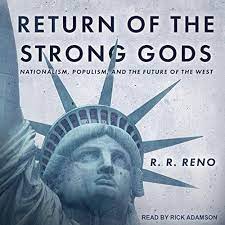
Tolle Lege: The Return of the Strong Gods by R. R. Reno

an aerial shot of the apple park in california

Apple Park in Cupertino, California

From Brexit to the rise and fall of Donald Trump, we have heard a lot about the dangers of globalism and return of populism. Many charged Trump with a kind of nationalism that led to all kinds of racism, fascism, and other political maladies. But many others, would share a concern for commercial giants like Apple, Amazon, and Alphabet Inc. (that’s Google’s parent company) who are assuming powers that transcend geopolitical nations.

In short, debates range today over what is most dangerous: Is it the tyrannical rise of globalism which calls for diversity, antiracism, and economic justice? Or is the greater concern a view of the world that affirms boundaries, borders, and limited budgets?

Those are big questions which touch on every area inch of public life, but connecting them all is a shared history of how to make sure that the fascism of Nazi Germany and the race-based slavery of America don’t happen again. Indeed, the push towards diversity and the denial of strong authorities is strongly associated with a push against the world events that ran from 1917 to 1945. Throw in the boom of technology and the ideologies of the 1960s (chronicled in Carl Trueman’s The Rise and Triumph of the Modern Self ) and you have a starting place for understanding our age.

The Return of the Strong Gods

renoAdding to this understanding in R. R. Reno’s book The Return of the Strong Gods: Nationalism, Populism, and the Future of the West. In this work of history and cultural commentary, Reno begins with the idea of the Open Society put forward by Karl Popper. He argues that Popper, along with many others, pushed hard against the militant authorities of the two world wars and called for a society that had no such “strong gods.” Reno explains how this worked out in the liberal policies of the 1960s and following, and how our world today is suffering under the weight of a world without any strong ideas. In other words, by evacuating strong leaders, strong ideas, strong gods from the world, it created a nice, safe, open space for individuals to express themselves without destroying others. Continue reading

Restoring the Right Hand of Fellowship: A New Sermon Miniseries

jack-sharp-ShCVvQbQBDk-unsplashFour Truths About Fellowship: A Sermon on 1 John 1:1–2:6

As we know all too well, sin always separates. And thus, when fellowship breaks, there is, lurking somewhere, sin unconfessed. In those times, it is tempting to fix the problem(s) with our own wisdom and to work overtime to recreate the fellowship that was had before. Yet, in times when fellowship is lost, we must remember that God alone can “fix” it. And accordingly we should seek him first and all his righteousness.

To put it seasonally, before the Lord gives his church spring rains, he often makes us feel the bitterness of winter’s cold. This coldness may have known sources, or its chilling drafts may strike us without ever revealing the source of their cold. Yet, whatever the source of winter, we should remember that God is working, and that spring is coming. As Hosea 6:1–3 tells us, we must remember that the Lord is the one who breaks us, so that he can bind us; he hurts us (or permits us to feel pain), so that he can heal us (see Psalm 105). Then, from this place of weakened condition, we are invited to return to know the Lord.

This is the promise: God will sanctify his people, and he will bring them to confess their sins. And until sin is confessed, joy will be withheld. Yet, when we seek his light and see our darkness, it will prompt true confession, repentance, forgiveness, and grace. And this grace will bring a new season of fellowship, all provided by the Lord. Continue reading

Fellowship 101: Five Truths To Move Beyond Bubba’s Shrimp Scampi

erika-giraud-7KhbREQPFD4-unsplashWhat does fellowship mean?

In Christian circles the word fellowship, and its Greek equivalent (koinōnia), is used for all kinds of things. There are fellowship meals, fellowship events, fellowship coordinators, fellowship halls, and even internship experiences called fellowships. Additionally, you have a ministry called Bible Study Fellowship, which labors to distinguish themselves from being a church, even as some individuals treat that ministry as their church. At the same time, there are churches who go by the name Bedrock Baptist Fellowship, or something like that. And you can find all sorts of resources aimed to improve fellowship.

With all its various uses, “fellowship” is the equivalent to Bubba’s endless array of Shrimp Dishes. Indeed, like shrimp kabobs, shrimp creole, shrimp gumbo, etc., fellowship goes with everything. Yet, by going with everything, its utility has permitted Christians to do many things with fellowship that go beyond the bounds of the Bible.

Again, what does fellowship mean?

If we open our concordances, we find the word koinōnia (fellowship, partnership) 19 times in the New Testament: Acts 2:42; Romans 15:26; 1 Corinthians 1:9; 10:16 [2x]; 2 Corinthians 6:14; 8:4; 9:13; 13:14; Galatians 2:9; Philippians 1:5; 2:1; 3:10; Philemon 6; Hebrews 13:16; and 1 John 1:3, 6, 7. From these uses, we might begin to see what God says about fellowship.

Clearly, any time we restrict ourselves to a word to form a doctrine or a practice we miss related concepts, metaphors, stories, and more. Yet, because this word is used so often to justify so many types of Christian activities, we would do well to examine the word. Do we have a faithful understanding of the word? And do we abide by it? Continue reading

Hang On and Hold Fast: A New Year’s Resolution for 2024

chjpdmf0zs9sci9pbwfnzxmvd2vic2l0zs8ymdiylteyl2xyl2rpz2l0ywxjd2nvbw1vbndlywx0agz0odq4djm1nc1pbwfnzs5qcgc. . . Let us run with endurance the race that is set before us,
looking to Jesus, the founder and perfecter of our faith . . .
Hebrews 12:1–2

Let us hold fast the confession of our hope without wavering,
for he who promised is faithful.
Hebrews 10:23

As we step into 2024, I want to offer two words pictures that frame the way we might think about the upcoming year. If this election year is anything like the last election year (2020), it will, in the infamous words of Ned Ryerson, be a “doozy.”

Doozy or not, however, the year of the Lord 2024 was planned by God before the foundation of the world and it will proceed according to his plan, whether than plan involves regime changes, military operations, economic failures, societal revolution, or just mundane progress. In all that could occur this year, there is nothing that will separate us, the children of God, from the love of God in Jesus Christ. And so, as we step into this year, we should do so with faith in God’s son, hope in God’s future, and love for God’s people.

To do that I want to offer two images from Hebrews. Both call Christians to refuse to shrink back and to endure the trials of life with steadfastness. With these biblical images, may the Spirit of God give us grace to endure as we think rightly about this upcoming year. Continue reading

Applying Progressive Covenantalism to the Errant Demands for Corporate Confession: My 2023 ETS Paper

Dividing-the-Faithful-cover

ETS Paper Link:

Waking Up to Corporate Confession:
What Scripture Does and Does Not Say
About Corporate Guilt and Repentance

It has been some time since I have posted here. Actually, it has longer than I remembered (May 2023). But that does not mean writing has slowed. You can find regular content that I am writing and/or editing at Christ Over All, where for the last six months we have looked at a number of pertinent issues, including

At the same time, my new book Dividing the Faithful: How a Little Book on Race Fractured a Movement Founded on Grace released in September. This book responds to Michael Emerson and Christian Smith’s book Divided by Faith. I believe their sociological study surveying black and white relations in the American church is poison pill. Undergirded by progressive views of culture and liberal theology, it leeched Critical Race Theory into the evangelical water supply. And churches, pastors, and scholars have been trying to catch up since.

At the same time that I wrote Divided by Faith, I also wrote an article on the demand for white churches and their pastors to publicly confess their white supremacy and complicity in racism. These demands reached fever pitch in 2020, and to help our church think about these matters I wrote up the attached paper. It just so happens that my paper followed very closely to the progressive covenantalism advocated by Stephen Wellum and Peter Gentry. And so today, at the Evangelical Theological Society, I am reading this paper—or at least, a portion of it.

You can find the whole thing here. And if you read it, let me know what you think. For a teaser, here’s the opening page:

In 2020, the death of George Floyd touched off a series of questions about racism and corporate guilt, not to mention justice and the justice system. In churches across the country, decisions split as to the right public response. Similarly, academics took up the issue, albeit often in more popular platforms. For instance, Michael Rhodes asked online, “Should We Repent of Our Grandparents’ Racism?” And Kyle Dillon wrote for The Gospel Coalition, “Are We Held Accountable for the Sins of Our Forefathers?” In both articles, biblical theology was used to affirm the need for modern individuals to identify with the sins of their fathers.

What can be appreciated in these articles was the way these men applied Scripture, especially the Old Testament, to contemporary questions. What was problematic, however, was the way they made applications that did not address the covenantal differences between Israel and today. As Stephen Wellum has demonstrated in his chapter on doing ethics from the perspectives of Progressive Covenantalism, the Old Testament remains needful for instruction, correction, reproof, and training in righteousness (2 Tim. 3:16–17), but biblical ethicists must recognize covenantal differences when they apply God’s Word.

In this paper, I will pick up where Wellum left off and apply progressive covenantal categories to questions about corporate guilt and repentance. In particular, I will seek to answer some of the following questions:

    • Are new covenant believers responsible for the sins of their ancestors?
    • How should we apply Leviticus 26:40–44, which calls for the need to confess the sins of our fathers?
    • Do the corporate confessions of Daniel, Ezra, and Nehemiah call us to do the same?
    • How does the New Testament understand confession in the corporate sense?
    • And most specifically, if we were to turn the clock back to 2020, what might we say from Scripture about the practice of corporate confessions.

In what follows, I will answer these questions and show how progressive covenantalism provides a more robust biblical answer to ethical questions concerning corporate guilt, generational sin, and corporate repentance.

Again, you can keep going here.

For now, I will keep working on writing and editing at Christ Over All. But Lord willing, in the near future, I will be back on this site to add more biblical and theological reflections. Until then . . .

Soli Deo Gloria, ds

What Is the Mission of the Church in a Racialized World?

Gospel,+Race,+&+the+ChurchLast year, I joined Nicholas Piotrowski, Charles Ware, and Gus Pritchard for an event in Indianapolis called “Gospel, Race, and the Church.” Through six short messages and six panel discussions, plus a Q & A we worked through many subjects related to contemporary discussions on race and justice in the church. While this subject is fraught with landmines, the overall tenor of the event was positive, biblical, and prayerfully helpful.

To encourage candidness in the moment, the audios were not made public, so I can’t link to those. But what follows is an updated version of my second message. You can find the manuscript of the first message (Is Racial Justice a Gospel Issue?) here.

***********

Here is the thesis that I want to argue: Your race is more important than your ethnicity.

When defined biblically and not sociologically, one’s race is more important for identity formation than one’s ethnicity. And by extension, the mission of the church is to help you make that statement true. Which raises the question. What is race? And do you know what your race is?

As insulting as that question may sound at first, I am going to suggest it is an easy question to mistake—especially if we have fused biblical ideas with worldly ideologies. At the same time, if we can answer this question from the Bible and the Bible alone, then we have hope for knowing and growing the mission of the church. This is the point that I will argue here, and here is how I will proceed.

  1. I will show why the concept of racialization in America is popular and pervasive, but ultimately unhelpful—if not harmful.
  2. I will attempt to draw the lines of race and ethnicity according to the Bible.
  3. With those lines in place, I will demonstrate that the mission of the church helps men and women, who hold PhD’s in ethnic Partiality, ethnic Hostility, ethnic Discrimination, grow up into Christ, who is the head of a new chosen race, redeemed from nation (ethnē).

So that’s we are going. Continue reading

The Priesthood of All Believers: A Call for All to Proclaim the Gospel

b02007a106a73b935c8de8eeb4be056cab88c37fLast year I wrote a book on the priesthood, and tonight I will teach a lesson on the priesthood of believers in Romans 15. And so in preparation for that lesson, I am dusting off a piece of my dissertation (edited) and posting it here. It’s on the priesthood of believers.

*********

When we think of the priesthood of believers, we often think of 1 Peter 2:5, 9–10, and rightly so. In addition to defiling the high priest’s servant when he cut off his ear (N.B. Jesus does not heal Malchus in John’s Gospel), Peter also picked up the sword of the Spirit to positively articulate a vision of the church as a royal priesthood. And in what follows, I will reflect on his thoughts from his first epistle.

At the same time, Paul too had a vision for the priesthood–a vision for priesthood that is often under-appreciated. And so, in the second portion below, I will highlight the one place where he uses the word “priest,” actually “priestly” (hierourgounta). From his usage, and Peter’s, we learn a key lesson, that the priestly ministry of the church means evangelism for all. Let’s consider. Continue reading

You Will Be Saved By Childbearing: A Sermon That Touches Baptist Churches, Christian Homes, and Christian Nationalism

baby beside woman

Truly, truly, I say to you, you will weep and lament, but the world will rejoice. You will be sorrowful, but your sorrow will turn into joy. When a woman is giving birth, she has sorrow because her hour has come, but when she has delivered the baby, she no longer remembers the anguish, for joy that a human being has been born into the world. So also you have sorrow now, but I will see you again, and your hearts will rejoice, and no one will take your joy from you.
— John 16:21–23 —

Few things in life are more terrifying or exhilarating than the final moments before a baby is born. When a wife turns to her husband and says, “It’s time,” that husband knows—or he better know—that everything he’s doing needs to stop. Now!

A few weeks ago, this scenario played itself out on national television, as Robert Griffin took a phone call and immediately ran from the field during the middle of the Fiesta Bowl. While at first his co-hosts questioned him for taking a call during the live broadcast, as soon as the reason was given, everyone understood and everyone cheered. Such is the celebration that comes when the long-awaited child is here and about to enter the world.  (I share the clip with great pain for my Michigan Wolverines.)

Indeed, there is something wonderful about birth, even as it comes through immense pain for the mother and an immense sense of helplessness (not to mention adoration) for the father. Even more, childbirth is meant to picture something of God’s plans for salvation.

Like marriage, childbirth is a picture of the gospel, or at least the new birth, which comes when God grants life to his children. Explaining regeneration in John 3, Jesus indicates that this new birth—a birth from above—is much more than a metaphor. It is the very means by which God is going to save the world.

Likewise, as Jesus nears the cross, he returns to the imagery of childbirth, when in John 16:21–23, he says that the birth of pangs of salvation are here. As the bridegroom, Jesus says that “It’s time!” And importantly, he is not only saying that it is time for his cross, but he is also saying it is time for the bride (the church) to experience the pain of receiving her children.

In the Old Testament, especially in Isaiah, we discover that Mount Zion is a mother who will receive the children of God (cf. Psalm 87). And now that Jesus is going to be lifted up (on Calvary but also in glory), it is time for Mother Zion to receive her offspring. This is a key point in John 16 and one that we need to understand, if we are going to rightly relate childbirth to salvation and salvation to rearing children in the Lord.

On Sunday, I preached on this point and you can find the sermon here. Along the way, this sermon touched on appropriate and inappropriate ways to relate home and heaven, child birth and salvation—subjects that are on the forefront of Christian’s minds today.

As the moral fiber of our country continues to crumble, in large part because the family has been eviscerated, Christian Nationalism seems to offer a suitable solution. Yet, advocates of Christian Nationalism, especially those who are Baptist, should know that the foundations offered by the likes of Stephen Wolfe—see p. 217 in his The Case for Christian Nationalism—depend upon a view of the covenant that Baptists cannot affirm. For this reason and others, Baptists should be cautious of trying to reform America with his brand of postmillennialism. Instead, we should go back to Scripture to see how the new covenant informs the mission of the church, the way Christians can impact culture, and the way the law applies to the state today.

Long story short, more needs to be said on how child birth relates to salvation and how churches should foster Christian homes and influence nations with Christian truth. In the months ahead, Christ Over All will be addressing just this in two issues on the Christian Home (May) and Christian Nationalism (October). In our day, all of us need to think more carefully about how God is bringing light into the world and how the church plays a part in influencing the state. Stay tuned. Until then, however, I offer this sermon as entrée to the subject.

Soli Deo Gloria, ds

Photo by Jonathan Borba on Pexels.com