
Of Weddings and Witnessing: The Evangelistic Pressure to Stay Positive in a Negative World

wedding reception

For even if I made you grieve with my letter, I do not regret it—though I did regret it, for I see that that letter grieved you, though only for a while. As it is, I rejoice, not because you were grieved, but because you were grieved into repenting. For you felt a godly grief, so that you suffered no loss through us.

– 2 Corinthians 7:8–9 –

In a world without sin, sermons on marriage would not be needed.

In fact, without sin, pastors might not be needed either. Or at least, they would not be needed to condemn sin, preach repentance, or offer grace. They might be needed to organize the worship of God in Christ—for God, the almighty, good, and glorious Creator would still be praised. Or, they might be needed to study the history of God’s world and to report their findings.

But, in a world without sin, heralds of the gospel would not be called to preach Christ crucified for wicked sinners, for there would be no sin. Nor would such pastors have the task of identifying idols and destroying every false idea that stands against Christ. Instead, they could just be unswervingly cheerful.

Tragically, in a world overrun with sin, many preachers have taken this path. Famously, when Larry King asked Joel Osteen about the eternal condition of Jews, Muslims, and other unbelievers, Osteen said he didn’t like to talk about sin, only about love and what the Bible says about Jesus.

Yet, what does the Bible say about Jesus? And what does Jesus say about sin? Quite a bit, actually.

The whole reason the Son of God became man was to climb the hill of Calvary and put an end to sin and death. Jesus’s whole ministry consisted of preaching about the kingdom of God and calling sinners to repent (Mark 1:14–15). Thus, it is a misnomer to speak of Christ’s love without addressing man’s sin (cf. 1 John 4:10). Unless we address the wrath of God, we cannot understand his grace or preach his gospel. Continue reading

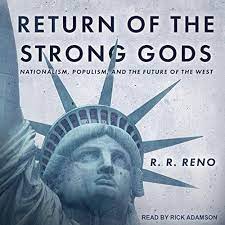
Tolle Lege: The Return of the Strong Gods by R. R. Reno

an aerial shot of the apple park in california

Apple Park in Cupertino, California

From Brexit to the rise and fall of Donald Trump, we have heard a lot about the dangers of globalism and return of populism. Many charged Trump with a kind of nationalism that led to all kinds of racism, fascism, and other political maladies. But many others, would share a concern for commercial giants like Apple, Amazon, and Alphabet Inc. (that’s Google’s parent company) who are assuming powers that transcend geopolitical nations.

In short, debates range today over what is most dangerous: Is it the tyrannical rise of globalism which calls for diversity, antiracism, and economic justice? Or is the greater concern a view of the world that affirms boundaries, borders, and limited budgets?

Those are big questions which touch on every area inch of public life, but connecting them all is a shared history of how to make sure that the fascism of Nazi Germany and the race-based slavery of America don’t happen again. Indeed, the push towards diversity and the denial of strong authorities is strongly associated with a push against the world events that ran from 1917 to 1945. Throw in the boom of technology and the ideologies of the 1960s (chronicled in Carl Trueman’s The Rise and Triumph of the Modern Self ) and you have a starting place for understanding our age.

The Return of the Strong Gods

renoAdding to this understanding in R. R. Reno’s book The Return of the Strong Gods: Nationalism, Populism, and the Future of the West. In this work of history and cultural commentary, Reno begins with the idea of the Open Society put forward by Karl Popper. He argues that Popper, along with many others, pushed hard against the militant authorities of the two world wars and called for a society that had no such “strong gods.” Reno explains how this worked out in the liberal policies of the 1960s and following, and how our world today is suffering under the weight of a world without any strong ideas. In other words, by evacuating strong leaders, strong ideas, strong gods from the world, it created a nice, safe, open space for individuals to express themselves without destroying others. Continue reading

On Religious Liberty and the Freedom to Worship

declaration

But seek the welfare of the city where I have sent you into exile, and pray to the Lord on its behalf, for in its welfare you will find your welfare.
— Jeremiah 29:7 —

Today marks the 240th anniversary of the signing of the Declaration of Independence—a day that marks the birth of our nation and reminds us of the wonderful liberties we have in America. In celebration our family read that founding declaration this morning and praised God for placing us in this country.

At the same time, though, my praise is mixed with pain and petition.

America is not what it was when it was founded. In many wonderful ways the liberties that were not afforded to all men have been extended. But in other less admirable ways, the liberties constituent in the Declaration, Constitution, and Bill of Rights have devolved into a libertine version of hyper-individualism. (On this point listen Albert Mohler’s recent discussion with Yuval Levin). Whereas rights were once understood to be endowed by our creator, rights have become things which men can create or castrate as they—or the Supreme Court–wish.

One of the greatest differences the founders vision of liberty and today’s is found in the increasing distinction between the “freedom of worship” and the “freedom of religion.” The former is the freedom of personal belief and private religious assembly; the latter is the constitutional right—the very first right—which says in the Bill of Rights: “Congress shall make no law respecting an establishment of religion, or prohibiting the free exercise thereof; . . .”

In our day, the change in language to “freedom of worship” is altering the understanding of this first amendment right, and with societal pressure Christians are being forced to mute their beliefs—especially with regards to marriage, sex, and lifestyle choices (a clever euphemism in and of itself). For that reason, on this day of liberty I am both grateful and grieved.

But perhaps, as a pastor, I am most concerned about the way some Christians and Christian leaders celebrate the Fourth of July without voicing any concern for these changes. Can we watch fireworks, grill hotdogs, and eat apple pie, assuming all is well? I think not. As Os Guiness (A Free People’s Suicide: Sustainable Freedom and America’ Future) and Eric Metaxas (If You Can Keep It: The Forgotten Promise of America’s Liberty) have observed, America’s liberty is under threat from within. And therefore, this holiday leads me in two directions regarding religious liberty and the freedom to worship. Continue reading

Postmodernity and Evangelical Thought (1): An Introduction

Postmodernism (PM) can be defined as a mood that questions authority, denies absolute truth, and locates meaning in the language of local communities.  While PM is the product of twentieth century thought, its precursors go back much further in history.  For instance, Friedrich Schleiermacher espoused a view of doctrine that was impermanent and always changing relative to the community in which it was experienced.  While situated more than a century before the likes of Derrida, Lyotard, and other philosophers of language, Schleiermacher’s liberal theology anticipates the postmodern turn.

Still, the question of authority, truth, and community predates Schleiermacher, too.  In John 18:38 Pilate, in a discussion about kingdoms, authority, and truth, asks Jesus, “What is truth?”  The relativism in his question comes not from a philosophical system of Western thought; it comes from the human condition that stands outside of the Garden.

Ever since Adam and Eve ate of the forbidden fruit, their offspring has sought to assert their own authority, to make up their own laws, and to live in their own cities of men.  Over time, as Western Civilization once again threw off the constraints of God’s Word and church tradition, the question of the hour is that of Pilate: What is truth?

This series of blog posts aims to give an answer to the postmodern mood that undergirds our ambient culture.  To answer the question about postmodernism we must first consider modernism, as post-modernism stands in direct relationship to his period of time and thought.  Second, I will survey postmodernism and its major contributing voices.  And third, this series will consider the effect postmodernism has had on evangelical theology, and what evangelicals must do to wisely and selectively appropriate the tenets of postmodernity.

As we go along, let me know what you think.

Soli Deo Gloria, dss

What is a Christian?

In his Commentary on Galatians, Martin Luther has a number of choice statements about the gospel, faith, and conversion.  Commenting on Galatians 2:16, hear how this Reformer defines a ‘genuine Christian’:

(For those not familiar with King James English, please forgive the hath’s and saith’s)

We therefore make this definition of a Christian: a Christian is not he who hath no sin, but he to whom God imputeth not his sin, through faith in Christ.  That is why we so often repeat and beat into your minds, the forgiveness of sins and imputation of righteousness for Christ’s sake.  Therefore when the law accuseth him and sin terrifieth him, he looketh up to Christ, and when he hath apprehended Him by faith, he hath present with him the conqueror of the law, sin, death, and the devil: and Christ reigneth and ruleth over them, so that they cannot hurt the Christian.  So that he hath indeed a great and inestimable treasure, or as St. Paul saith: ‘the unspeakable gift’ (2 Cor 6:15), which cannot be magnified enough, for it maketh us the children and heirs of God.  This gift may be said to be greater than heaven and earth, because Christ, who is this greater gift, is greater (Martin Luther, Commentary on Galatians, trans. Erasmus Middleton [Reprint: Grand Rapids: Kregel Classics, 1979], 72).

It bears repeating, “a Christian is not one who has no sin,” but one who has advocate with God the Father, Jesus Christ our mediator.  In him do erring sinners find pardon and relief when they come to him in faith.

Since our natural tendency is to work for our salvation and to trust our own religious accomplishments, we must, as Luther says, “often repeat and beat into [our] minds, the forgiveness of sins and imputation of righteousness” comes from faith in Jesus Christ alone and not through our own works.

Hallelujah!  What a Savior!

dss

Christianity goes back…back…back…back

bockIn a pluralistic world and in a divided Christian church, how do you know that Christianity that is considered historic and called “orthodox” is indeed true?  It is because Darrell Bock answers, quoting the great theologian Chris Berman, “it goes back…back…back…back…”

This week, Dr. Darrell Bock, DTS Professor and author of Breaking the DaVinci Code, commentaries on Luke, and Jesus According to Scripture, has delivered a series of Gheens lectures as Southern Seminary.  In this lectures, Dr. Bock has argued for the authenticity of orthodox Christianity, over against alternative Christianity’s seen on the History Channel, in Barnes & Noble, and found in university settings.  Today, in his most stimulating lecture, Bock drew on the the historicity of 1st century Christianity and argued that “orthodoxy in an oral culture without a sacred and written text” is indeed possible, and after looking at the evidence is in fact warranted.  In short, he is arguing that even before a recognized canon, the message of Christianity was certain and singular.

To aid in his efforts, Bock adduced five alliterated ways in which the early church would taught a singular and unified doctrine.  These five ways contend against the notion, espoused by secular media and academia, that the earliest Christianity was pluriform.  These historically certifiable means of instruction serve to evidence that the message of the Bible was original to the earliest converts and not created after the fact–as has been maintained lately in books like The DaVinci Code

Here are five ways for early church instruction:

  1. Scriptures:  In the Hebrew Bible, God has revealed himself to the people of Israel and given promises and prefigurations that found telic fulfillment in Jesus Christ.  THe earliest Christian community read these regularly in corporate settings and would have depended heavily on them to understand Jesus the Messiah of Israel (see Matthew 1-2 for ways in which Jesus “fulfilled” OT Scripture; cf. 2 Cor. 1:20; John 5:39)
  2. Schooling:  In the early church, short, theologically-informing confessions and creeds helped retain, defend, and the instruct the church of God.  Written for the purpose of educating converts, these terse statements can be found today in the NT. Examples of these are in 1 Corinthians 15:1ff; 8:4-6; 1 Timothy 3:16.
  3. Singing:  Through hymns the church learned core doctrine and worshiped the triune God.  Two examples can be found in Philippians 2:5-11 and Colossians 1:15-20.  These ancient hymns, predate Paul’s letters and take us back to the first decade after Pentecost.
  4. Sacraments: Jesus left his church with two gospel-revealing ordinances–baptism and the Lord’s supper.  Both of these are to be regular parts of worship.  The first being recapitulated as often as a new convert professes faith; the latter being done on regular basis within the life of the church.  In the NT, these ‘sacraments,’ occur in places like Luke 22; 1 Corinthians 11 (Lord’s supper); and Romans 6; Colossians 2; and 1 Peter 3 (Baptism).  Every time these reenactments commenced they retold the story of a believer’s union with Christ–his death and resurrection and the hope of eternal life with Christ.
  5. Supervisors:  Finally, God gave apostles to the church to supervise the doctrine and the teaching (cf. Eph. 2:20-21; 4:11ff).  This is why the requirement in Acts 1 was that the 12th apostle replacing Judas be one who was a witness of Jesus’ life from the beginning.  They had to be eye witnesses of all Jesus did and taught to ground the earliest church in the truth of Christianity.

Listening to Dr. Bock’s lectures this week was not only informative, but entertaining.  Bock is a gifted speaker, and today’s lecture was superb.  It not only informed the mind, but warmed the affections for the glory and greatness of the resurrected Christ.  All of them are worth listening to, but today’s especially.  You can listen to them here.

Sola Deo Gloria, dss