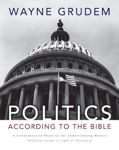
Politics According to the Bible (2): Significant Christian Influence

[This is the second in a series of posts on Wayne Grudem’s Politics According to the Bible: A Comprehensive Resource for Understanding Modern Political Issues in Light of Scripture].

In his second chapter, Wayne Grudem advocates “A Better Solution,” what he calls “Significant Christian Influence on Government.”  In his proposal, he surveys the Bible to enumerate a host of biblical examples who were used by God to influence their respective political leaders.  He also points out passages of Scripture that give Christians instruction on how to interact with government and governors, before raising a number of debated questions, not the least of which include, “Is America a Christian Nation?”

After addressing the preliminary matter of how to rightly interpret the Bible in a way that denies liberal distortions, Grudem enlists biblical support for his position.  Moving from the Old Testament to the New, he lists numerous saints who have been used by God to impact government.  Some of these include Daniel, Joseph, Moses, Nehemiah, Esther, and Mordecai.  While each of these saints trusted in God to accomplish his work in the world, they were also steadfast to plead with their respective “government officials.”  Moreover, the prophets in the Old Testament regularly addressed the kings of Israel (e.g. Isaiah and Jeremiah) and the rulers and conduct of foreign nations (e.g. Isa 13-23; Jer 46-51; Ezek 25-32; Amos 1-2; Hab 2; Zeph 2; and Obadiah addressed Edom, while Jonah and Nahum addressed Nineveh).

In the New Testament, John the Baptist (Matt 14:3-4; Luke 3:18-20) and the apostle Paul (Acts 24:24-25) both addressed the conduct of their government officials.  More precisely though, in the New Testament, Paul devotes the first 7 verses in Romans 13 to the God-ordained place of government.  It is helpful to remember the context of this letter was to a people who were oppressed by their government leaders.  Nevertheless, Paul affirms the goodness of government as an institution and calls Christian to submit themselves to these “ministers of God” (Rom 13:6).  Likewise, Peter in his first epistle instructs Christians to submit themselves to the governing authorities (2:13-14).  In these inspired letters, God has given Christians guidelines for interacting and influencing government.

Grudem then applies these teachings to the democratic process in America.  While waiting to develop his thoughts further until chapter 3 and following, he does mention the fact that Christians in America share in the governance of the nation through the system of representation.  He writes,

To be able to vote is to have a share in the ruling power.  Therefore all citizens who are old enough to vote have a responsibility before God to know what God expects of civil government and what kind of moral and legal standards he wants government to follow.  But how can citizens learn what kind of government God is seeking? They can learn this only if churches teach about government and politics from the Bible (62).

Grudem also raises the issue of whether or not America is a “Christian Nation.”  He does well to define precisely what that means, and gives a balanced answer of yes and no.  His overall conclusion is the question is not all that helpful, because it “leads to arguments, misunderstanding, and confusion” (65).  His point is well taken, and he helpfully shows that America has always been a nation “significantly influence by Christianity” and still should be as the biblical data teaches.

He tackles a number of other questions that concern the way the church and its members should exercise their citizenship to influence the government.  He makes the point that different persons will have different roles and involvement in government, just like different Christians have different gifts and roles in the church.  Nevertheless, he urges that all Christians play a role in influencing government for justice and good.

One final note, he raises the issue of whether or not Christians should vote for non-Christians.  His discussion is helpful and perhaps challenging to many believers who always vote Christian.  He includes an article that he wrote in the fall of 2007, in preparation for the 2008 presidential election.  His letter can be found on http://www.townhall.com and he argued for why Christians should vote for Mitt Romney, a mormon.  His argument is sound and it shows the difference between the biblical qualifications for elected office and the biblical qualifications for pastors–they are not the same.

Going back to the Bible again, Grudem expounds,

[H]ave we come to the point where evangelicals will only vote for people they consider Christians? I hope not, for nothing in the Bible says that people have to be born again Christians before they can be governmental authorities who are used greatly by God to advance his purposes. God used Pharaoh, King of Egypt to raise Joseph to a position of authority over the whole country, so he could save his people from famine (Genesis 41:37-57). God used Nebuchadnezzar, King of Babylon, to protect and raise up Daniel and his Jewish friends to positions of high authority over Babylon (Daniel 2:46-49). God used Cyrus, King of Persia, to restore the Jewish exiles to their homeland (Isaiah 45:16; Ezra 1:1-4), and used Darius, King of Persia, to protect the Jewish people as they rebuilt the temple in Jerusalem (Ezra 6:1-12). God used Ahasuerus, King of Persia, to raise up Esther as Queen and to give Mordecai high authority and honor in his kingdom (Esther 6:10-11; 8:1-2, 7-15). In the New Testament age, God used the peace enforced by the secular Roman Empire, the Pax Romana, to enable the early Christians to travel freely and spread the Gospel throughout the Mediterranean world.

Here in the United States, God used not only Founding Fathers who were strong Christians, but also Deists such as Benjamin Franklin and Thomas Jefferson, to build the foundation of our nation. Jefferson even became our third President in 1801, a demonstration of the wisdom of Article 6 of the Constitution, which says, “no religious test shall ever be required as a qualification to any office or public trust under the United States.” (page 68)

Grudem’s point challenges the way many Christian’s think about politics and voting.  The point worth noting is that it requires more than simply answering the question, “Are they Christian or not?” to make an informed decision around election time.  It takes time to consider the issues biblically and to be well-informed with the candidates who are running to know whether or not they are qualified for the office of elected official.  It may mean that a conservative but unbelieving candidate with a proven track record of defending life and upholding justice is more qualified than an inexperienced evangelical.  That is to say, there seems to be a biblical distinction between who we have leading our country and who we have joining our church.  The two are not always synonymous, and this view is surely one that raises questions.  So, let the discussions begin.

Overall, Grudem’s chapter is a helpful in two ways.  (1) It shows us from the Bible the way God’s people have always sought to influence governmental officials for the good; and (2) it challenges Christians to think more precisely on the matters faith and politics.  Furthermore, it challenges uninvolved Christians (and pastors) to be more involved in influencing the government for good–something that is greatly needed in our day.

May God continue to help us think biblically about politics, government, and the world in which we live.

Soli Deo Gloria, dss
Politics According to the Bible (1): Five Wrong Views

[This is the first in a series of posts on Wayne Grudem’s Politics According to the Bible: A Comprehensive Resource for Understanding Modern Political Issues in Light of Scripture].

Wayne Grudem begins his discussion of politics and the Bible by outlining five wrong views.  These include: (1) Government Should Compel Religion, (2) Government Should Exclude Religion, (3) All Government Is Evil And Demonic, (4) Do Evangelism, Not Politics, and (5) Do Politics, Not Evangelism.  Lets look at each of these unbiblical approaches.

Government Should Compel Religion

First, Grudem appeals to the State Church’s that have arisen in Christendom where citizenship and religious affiliation are coterminous.  He relates these to the similar models of government found in Islamic nations today.  He shows that these are not Scriptural as he points to Jesus making significant distinction between the sphere of Caesar’s kingdom and the sphere of God’s kingdom (Matt 22:20-21).  He argues that this view is not tenable according to the Bible, nor does it result in the kind of faith and repentance, that Christ requires.

Government Should Exclude Religion

Second, he argues against the kind of secular government that denies any place to faith.  This is the kind of government promoted by the ACLU and Americans United for Separation of Church and State.  In the United States, this view is often grounded on the misunderstood statement about separation of church and state made by Thomas Jefferson in his letter to the Danbury Baptist Church (Danbury, CT).  It demands religion to be voiceless in the public sector and it “changes freedom of religion to freedom from religion.”  Yet, this was not Jefferson’s intention in 1802, nor is it compatible with the Bible which features numerous examples of God’s people influencing kings and rulers (Joseph, Daniel, John the Baptist, and Paul, to name a few).  This kind of regime is also seen in other countries that have persecuted Christians.  It is clearly unbiblical.

All Government Is Evil and Demonic

Third, the view that demonizes government does so from a misreading of Luke 4:6 which quotes Satan as saying, “To you I will give all this authority and their glory, for it has been delivered to me…” Proponents of this view include Gregory Boyd, who argues that every form and function of government is evil.  However, as Grudem points out, Boyd and his ilk, fail to consider the whole counsel of Scripture.  For explicitly in Romans 13 and 1 Peter 2, Paul and Peter instruct Christians to submit to governing authorities who are discharging God’s ‘ministry’ of government.  Moreover, Grudem points out that this view depends on the reliability of Satan’s description of his own authority in Luke 4:6, which is a highly speculative reality based on the deceitful character of Satan (cf. John 8:44).

In the end, Grudem points out that this view fails to recognize the difference between good and evil systems of government, and by extension it calls good evil and evil good.  Thus, it leaves citizens paralyzed and unable to resist or reform governmental structures for the good.  It results in an insipid pacifism that is not what the Bible requires.

Do Evangelism, Not Politics

Fourth, Grudem challenges evangelicals who distance themselves from political engagement due to the ‘hopeless’ enterprise that it is.  He suggests that those who advocate evangelism over against politics “narrow an understanding of ‘the Gospel’ and the kingdom of God” (45).  He warns that those who take this approach undervalue the effect that political involvement has for the gospel.  He provides a helpful illustration of the difference between heavily evangelized South Korea and repressive North Korea, and the resulting effect this has had in their respective countries.  He writes,

Governments can allow churches to meet freely and evangelize or they can prevent these things by force of law (as in Saudi Arabia and North Korea). They can hinder or promote literacy (the latter enabling people to read a Bible). They can stop murderers and thieves and drunk drivers and child predators or allow them to terrorize society and destroy lives. They can promote and protect marriages or hinder and even destroy them. Governments do make a significant difference for the work of God in the world, and we are to pray and work for good governments around the world (46).

While agreeing with his main objection, I think Grudem shows uncharacteristic imprecision on this point.  He argues that “the whole Gospel includes a transformation of society” (47).  I am not convinced this is “necessarily” true.  For instance, in countries where Christianity is outlawed, societal transformation may not come to fruition, because Christians may be martyred before they are ever able to transform their nation.  Even in situations where the blood of the martyrs brings change in time, it may take generations, so that to say the gospel “includes a transformation” is a little misleading.

On this point, he continues, “Forgiveness of sins is not the only message of the Gospel” (47).  But is that biblically the best way to say it?  If Grudem had said, “Forgiveness of sins is not the only message of the Bible,” or “Forgiveness of sins is not the only ministry of the church,” I would agree.  The Bible certainly teaches Christians how to love their families, serve their employers, and fight for justice.  Likewise, the ministry of the church does include caring for orphans, widows, and the unborn.  So then, in these ways, the Bible says more than “Believe on Jesus Christ, and you will be saved.” However, when the gospel is defined as “forgiveness” and “societal transformation,” it enlarges the gospel in unbiblical ways.

In fact, Mark Dever preached against this very thing in his 2008 Together For the Gospel message, “Improving the Gospel: Exercises in Unbiblical Theology,” when he warned of making the gospel more than the salvation of sinners (see his chapter in Proclaiming a Cross-Centered Theology, pp. 106-109).  Grudem seems to make the gospel message coterminous with the whole counsel of Scripture, and by implication he includes gospel entailments within the message of the gospel.

I think Grudem, when he argues against  the “Do evangelism, Not politics” view, but his treatment of the gospel in this section needs more attention. (For more on the central tenets of the gospel, see Greg Gilbert, What is the Gospel?)  Within this section, however, Grudem does present some other helpful points, namely that God has intended the church and the government to work in tandem to effect positive change against the evil that is resident in our society.

Another point worth pondering in this section is the way that church history has demonstrated countless ways that Christians have influenced government for good.  He cites from Alvin Schmidt’s book How Christianity Changed the World, and lists dozens of social improvements from the discontinuation of the Roman gladiatorial games to the prohibition of burning widows alive in India.  Then Grudem names a number of Christians who have effected social justice in the world to show how has positively shaped our country (50).

Still, it would be helpful at this point to make a distinction that not all these “Christians” were orthodox, gospel-believing brothers in Christ.  No doubt, Martin Luther King, Jr. was used by God to bring about civil rights throughout the United States, but it must be asked, “Was Dr. King’s doctrine orthodox and evangelical?”   Grudem doesn’t make that distinction, which is an unfortunate lacuna.

Do Politics, Not Evangelism

Finally, his fifth wrong view is the one that says “Do Politics, Not Evangelism.”  According to Grudem, few respected evangelicals hold this Social Gospel view (53), however pastors Rob Bell and Brian McLaren are two influential proponents of a sub-standard gospel message who are advocating political and social change.  Their popular books and speaking tours are infecting many with a “New Kind of Christianity” that aims to advance the kingdom of God through social and political involvement and that denudes the gospel of its saving message.

Overall, Grudem’s first chapter is a helpful taxonomy of wrong views of government and politics.  It sets the stage for chapter 2, where he will develop “a better solution,” one that urges “significant Christian influence on government” (54). Preparing for this view, he closes his first chapter with a balanced statement on politics according to the Bible.

Genuine, long-term change in a nation will only happen (1) if people’s hearts change so that they seek to do good, not evil; (2) if people’s minds change so that their moral convictions align more closely with God’s moral standards in the Bible; and (3) if a nation’s laws change so that they more full encourage good conduct and punish wrong conduct. Item 1 comes about through personal evangelism and the power of the Gospel of Jesus Christ. Item 2 takes place through personal conversation and teaching and through public discussion and debate. Item 3 comes about through Christian political involvement. All three are necessary (54).

Soli Deo Gloria, dss

Politics and the Bible

Wayne Grudem has come out with a massive volume on politics and the Bible (619 pages).  It is entitled Politics According to the Bible: A Comprehensive Resource for Understanding Modern Political Issues in Light of Scripture, and it contains biblical exegesis, theological reflection, and ethical discussion about ‘everything’ that one may encounter in the world of politics.

It is a great resource for someone who likes to read but has done little reading in the area of politics–someone like me!  Moreover, it is a tremendous guide for Christians to think through the matter of politics–a subject many Christians discuss with regularity and passion–with the light and wisdom of the Bible, and not simply conservative or progressive rhetoric.

Thus in an attempt to learn more about “politics according to the Bible,” I am going to endeavor to read a chapter a day between now and election day (Nov 2) to better understand a biblical view of politics and to discern how and where a pastor should be involved in the process (see Grudem pp. 71-73).  And as a measure of discipline, or self-inflicted perspiration, I am aiming to catalogue my thoughts from each chapter as I go, giving a synopsis of each chapter and the helpful biblical analyses provided by Professor Grudem.

I hope this may help others think through political matters biblically (especially those in my own church) and that others may be encouraged to pick up and read, or reference, Grudem’s new book.  At this point, I cannot commend or condemn Politics According to the Bible, I can only suggest it as an important subject (especially at this time) and Grudem as a reliable teacher–he is a conservative, Bible-believing, advocate of sound doctrine (see his Systematic Theology).  I anticipate it being a helpful book, and one that certainly has the right foundation on which to build–the word of God.

I hope you will join me in thinking through these matters biblically, so that we would better understand what the whole counsel of God says concerning the political enterprise.  And maybe, if you are so inclined, you will pick up Grudem’s volume and read along– right now it is 40% off at the WTSBookstore.

Soli Deo Gloria, dss

A Spiritual Fruit Inventory

Most church-going Christians have participated in a Spiritual Gifts Inventory (SGI).  You know, the one where you sit down to fill out a paper-and-pencil test of things you like, don’t like, are good at, bad at, and don’t know.

Personally, I am not a fan.  It is a fleshly way of discerning the Spirit’s work in your life.  I believe these forms are well-intended and have catapulted many vibrant Christians into active church ministry, but they may have also wrongly directed people away from genuine gifts of the Spirit.   Rather, I have found that the best SGI is found in the honest and loving people of God who are called to judge fellow believers with grace and truth.  Serving in the church is the best Spiritual Gift Inventory.

With that caution in mind, what I offer below, may be just as fleshly and unhelpful…but I hope not.

In preparing for Sunday’s message, I found a Spiritual Fruit Inventory (SFI), that I tweaked and will hand out on Sunday.  Unlike its cousin, the SGI, the SFI, is designed not to lead us down a path to ministry, but down a path to the cross, because it will either show the absolute deficiency of fruit in the life of the believer, in which a true believer has but one response: repentance and gratitude for Christ’s atoning blood.  Or second, it will prompt overwhelming gratitude that the Spirit is at work.  I suspect, as I see in my own life that it is both.  (One other note: it could lead a “believer” to realize that by the conspicuous absence of the Spirit’s fruit that he is not in fact saved; see Matthew 13:1-23).

When I look at Galatians 5:22-23, I see 9 qualities that are present in my life, but oh how anemic is the fruit.  Yet, I take heart that this is the Spirit’s work, not mine.  The only imperative in Galatians regarding the Spirit is to “Walk in the Spirit” (Gal 5:16, 25).  As we do that, fruit will come.  It has to; born again believers bear fruit!  So, as I contemplate the questions below, I go to the cross with sorrow and gladness, and I return to keep walking with the Spirit, praying to the Father to grow in me the life characteristics of Christ–love, joy, peace, patience, kindness, goodness, gentleness, faithfulness, and self-control.

Here is the Spiritual Fruit Inventory.  Feel free to use it for your personal devotion or for your corporate ministry.

Soli Deo Gloria, dss

SPIRITUAL FRUIT INVENTORY

On a scale of 1-5 (bad-good), rate your spiritual fruit.  Then after you have done that, ask a friend, spouse, or family member to do the same.  Compare notes.  Go to God and thank him for the Cross, the Power of the Spirit, and the Promise of Progressive Sanctificaiton.  Continue to walk in the Spirit, by Faith in Christ’s atoning work on Calvary and his sanctifying work in you.

Love: Are you obedient to God’s word?  Do you delight in spending time with God? Does your love for God reflect in love for others?  Would others describe you as loving?  Do you love the unlovable? Or just the likeable?  

Joy: Is your joy based on circumstances?  Have you found joy in the midst of trials?  When you are discouraged, is Scripture your source of joy?  If not, why not?

Peace: Do you know the peace that passes understanding? When alone, are you at peace? When anxious, do you set your mind on God in Christ?  If not, why not?

Patience: Do you accept interruptions and delays with grace and peace? Do you see God’s larger plan at work in your life? How do you view people: as hindrances to be avoided or hurting people to be loved?

Kindness: Would your family call you “kind”?  Are your words refreshing & life-giving? Or sarcastic & mean? Do you seek ways to encourage others?

Goodness: Do you invent ways to help others?  Or do you relish putting others down?  Is your goodness forced or free?  Are you ‘good’ to please others or God?

Faithfulness: Do you keep your word? Do you finish what you start?  Are you a hard worker? Does your church attendance reflect faithfulness?

Gentleness: Are you quick to listen? Slow to speak? Slow to anger? Do your moods swing?  Is your language abrasive or harsh?  Do others confide in you?

Self-control: Are you free from addictions—illegal or legal? Do you have mastery over your thoughts, speech, actions? Do you think before you act?  Are your decisions governed by Scripture? Is your discipline lawful or loving?

Eyes To See Him

Starting this week, a bunch of friends from Southern Seminary started a new Twitter account, and I hope it will be one worth ‘following.’

EyesToSeeHim is a Twitter venture designed to help others read the Bible better.  In particular, it is designed to help see the glory of Christ in every page of the Bible, 140 characters at a time.

Each of the guys who contribute to this “hermeneutical ministry” have a commitment to reading the Bible with Christ in view–some call this “Christocentric,” others call it “Christotelic.”  Either way, the aim is read Scripture with ‘Eyes To See Him.’

We read the Bible this way because this is how Jesus taught us to read the Scriptures (John 5:39; Luke 24:27).  It is the way that the Apostles read the Bible (Acts 28:23; Col 2:17).  And it is the way that most of us were assisted to the read the Bible while we studied at Southern Seminary.  I think it is fair to say that each of us did not arrive at this method of interpretation on our own–we were  helped immensely by our professors and teachers who themselves were taught.

In truth, none of us read the Bible well by ourselves.  The Spirit leads us into all truth (1 John 2:27), but he does so through the means of gifted teachers (Eph 4:11-16).  Left to our own devices we will put ourselves into the story of the Bible in the wrong places, and will be tempted to “moralize” the Scripture instead of believing the gospel message of the Bible and then responding with obedient faith.  Too many pulpits and Christian bookstores fail to put Christ in his proper place, as the telos of the Bible, and thus my hope is that we might help others read the Bible better, so that the gospel of Jesus Christ might grip the hearts of more and more Christians.  This is not an esoteric reading of the Bible, but one that reads each page in light of the full revelation of Jesus Christ (Heb. 1:1-3).

I hope you will benefit from this Twitter ministry and that it will help you read the Bible better.  Here are some of the contributors. I love these guys and am thankful for their ministry of the word. I would encourage you to keep up with them at their respective Twitter accounts, blogs, and/or ministries as they model Christ-centered ministry that renounces moralism and exalts the Messiah.

Phillip Bethancourt is a doctoral student at Southern Seminary working on the theme of warrior in Scripture.  He also works at the seminary and preaches regularly.

Jedidiah Coppenger is doctoral student at Southeastern Seminary who is working on a dissertation in area of gender studies and the church.  He also works for LifeWay and helps lead Baptist21.

Chip Dean is the hyper-active young pastor at Capshaw Baptist Church (near Huntsville, AL).  His youth ministry is a model for anyone wanting to bring biblical and systematic theology to local church ministry at the student level.

Sam Emadi is a Masters student at Southern Seminary and the youth pastor at Calvary Baptist Church (Seymour, IN).

Grant Gaines is a doctoral student at Southern Seminary who is researching local church ecclesiology.  He pastors Brushey Fork Baptist Church (Canaan, IN).

Trent Hunter is a graduate of Southern Seminary (M. Div.) who now works as a pastoral assistant to Ryan Kelly at the Desert Springs Church (Albuquerque, NM).

Robbie Sagers is a doctoral student at Southern Seminary researching the area of the Church and the Kingdom of Christ.  He is special assistant to Russell Moore at SBTS.

Justin Sampler is a graduate of Southern Seminary and a gifted preacher.  If you know of a good church in need of a good pastor, Justin is your guy.

Luke Stamps is a doctoral student at Southern Seminary researching the person of Christ.

The most important thing about each of these guys is their love for Christ, His Word, and their families–their wives and children, as well as, the family of God gathered in their local churches.   I have benefitted immensely from their insights into the Scriptures and their friendships and I hope others will too.

Soli Deo Gloria, dss

A Christ-Centered Walk Through the Old Testament

Since January, I have been teaching the Bible, book-by-book.  Last week, I finished the Old Testament.  It has been a joy and a challenge to understand, synthesize, and communicate each book of the Old Testament.  I am thankful for the receptive congregants who attend each week.  We have had some wonderful questions and conversations, and I believe have seen how relevant the Old Testament is for 21st Century Christians.

Here are my notes for the first 39 books of the Bible.

Pentateuch
Genesis 1-11: The Beginning of It All (January 13, 2010)
Genesis 12-50: Four Families Under the Faithfulness of God (January 20, 2010)
Exodus 1-15: Salvation Through Substitution & Conquest (January 27, 2010)
Exodus 16-40: Moving Into the Presence of God (February 3, 2010)
Leviticus: Sinners in the Presence of a Holy God: (February 17, 2010)
Numbers: In the Wilderness (February 24, 2010)
Deuteronomy: God’s Royal Covenant with Israel (March 3, 2010)

History
Joshua: Into the Land
(March 10, 2010)
Judges: A People in Need of a King (March 17, 2010)
Ruth: A Painful & Pleasant Providence (March 24, 2010)
1 Samuel: The Good, The Bad, and the Ruddy (March 31, 2010)
2 Samuel: The Rise and Fall of King David (April 7, 2010)
1 Kings: Redemptive History is a Royal Mess–Part 1 (April 14, 2010)
2 Kings: Redemptive History is a Royal Mess–Part 2 (April 21, 2010)
Ezra: Return, Rebuild, Renew, Repent (May 5, 2010)
Nehemiah: Rebuilding God’s City and Reforming God’s People (May 12, 2010)
Esther: Seed Warfare (May 19, 2010)

Wisdom
Job: Knowing God In The Crucible Of Satanic Suffering
(May 26, 2010)
Psalms: Redemption in the Key of D(avid) (June 3, 2010)
Proverbs: Wisdom is the Way to the Obedient Son (June 10, 2010)
Ecclesiastes: To Work Wisely is Futile, To Fear Faithfully is Wise (June 17, 2010)
Song of Songs: More Than Just an Old Fashioned Love Song (June 24, 2010)

Prophets
The Prophets (1): Hearing the Spirit of Christ in the Days of Elijah
(June 31, 2010)
The Prophets (2): Putting the Prophets in their Place: Before the Exile (July 7, 2010)
The Prophets (3): Putting the Prophets in their Place: During and After the Exile (July 14, 2010)
Isaiah: The Servant-King Will Lead His People Into a New Creation (August 18, 2010)
Jeremiah: A New Heart For An Idolatrous People (August 25, 2010)
Ezekiel: That You Might Know the Lord (September 1, 2010)
Daniel: Keep the Faith! The Sovereign LORD Reigns In History (September 8, 2010)
The Twelve: Judgment and Salvation is a Major Theme in the Minor Prophets (September 15, 2010)

The unifying feature of each study is Jesus Christ.  As the New Testament authors and Jesus himself make plain, the Old Testament is all about Jesus.  I hope these handouts can help you see Christ in and throughout the Old Testament.

Soli Deo Gloria, dss

Fern-Seed, Elephants, and Pseudo-Scholarship, or Another Reason Why I Love C.S. Lewis

C.S. Lewis said that he was no theologian, but somehow whenever he commented on the subject, his reflections bear wit and wisdom, and thus they bear repeating.

Such is the case with a quote that comes from Lewis’s Fern-Seed and Elephants. In addressing a number of Cambridge students, hear Lewis wise counsel on the subject of historical-criticism in biblical studies.  Speaking on the historical reality of Jonah, he writes,

Scholars, as scholars, speak on [the miraculous] with no more authority than anyone else.  The canon ‘If miraculous [then] unhistorical’ is one they bring to their study of the texts, not one they have learned from it… Whatever these men may be as Biblical critics, I distrust them as critics.  They seem to me to lack literary judgment, to be imperceptive about the very quality of the texts they are reading… These men ask me to believe they can read between the lines of the old texts; the evidence is their obvious inability to read (in any sense worth discussing) the lines themselves.  They claim to see fern-seed and can’t even see an elephant ten yards away in broad daylight” (C. S. Lewis, Fern-Seed and Elephants (Glasgow: Fontana, 1975) 109, 111; quoted in by T. D. Alexander in “Jonah and Genre,” Tyndale Bulletin 36 (1985) 35-59; quoted by O. Palmer Robertson, The Christ of the Prophets, p. 252, fn. 71.)

Though ad hominem and laced with British sarcasm, Lewis’ point is dead on. Why bother listening to the speculative criticism of biblical scholars, when they waffle on the extant text sitting before them.

May we be those who spend our time in the text, and little time behind the text. May we search the Scriptures for the delightful purpose of behold the majestic oaks and taste the abundant fruit of God’s holy Word; and may we forsake the fruitless and impossible task of determining how the forest grew.

Soli Deo Gloria, dss

The Gospel and Wisdom: Learning to Apply the Gospel to All of Life

This evening, our church will look at the Book of Proverbs in our ongoing study of the Bible.  In preparation this morning, I came across this helpful reminder by noted Biblical Theologian, Graeme Goldsworthy, that the gospel of Jesus Christ necessarily includes the conversion of the mind and the application of the gospel to all areas of our thought life (cf. Rom 12:1-2;  2 Cor 10:3-6).

Listen to what Goldsworthy has to say,

The Christian mind-set comes about through the gospel, and so we must come to think of Christian wisdom as a conforming of the mind to the gospel.  If, then, we understand the gospel only in its basic terms of Jesus dying for us, we will probably wonder how this can affect the way we think totally.  We need to remind ourselves that the simple gospel is also profound.  The truth, ‘Jesus died for me,’ actually implies everything that God has revealed in the Bible about his relationship to humanity and to the created order. Growing as a Christian really means learning to apply the fact of the gospel to every aspect of our thinking and doing (Graeme Goldsworthy, Gospel and Wisdom in The Goldsworthy Trilogy [Waynesboro, GA: Paternoster, 2000], 341).

May we as Christians continue to turn from the pernicious patterns of this world to the mind-renewing truth of the gospel that informs every aspect of creation, wisdom, and life.  For in Christ all the treasures of wisdom and knowledge are hidden (Col 2:3).

Soli Deo Gloria, dss

Why then the Law? : Counter-Intuitive, Gospel Logic

“Why then the law?”

In Galatians 3:19, Paul poses that question, and in the rest of the chapter, he sets out to explain the purpose of the law.  To answer his own question he says that the law came to increase sin (v. 19; cf. Rom 5:20; 7:7ff) and to imprison all mankind under sin (v. 22).  Why would God do that?  Why would God do something that would increase law-breaking in the world?  If God knew that adding law to the world would increase sin, why wouldn’t he do something else to help rehabilitate his people?

Because God is not in the business of rehabilitation!  His aim is to destroy the works of the devil, defeat death, and render powerless the curse of the law. So…

God sent the law to enfeeble and imprison all mankind–Jews and Gentiles–in order to that all who are held captive by the law would feel the effects of its shackles, so that the sinners woudl be spurred to long for the gospel of grace.  In God’s wisdom and according to God’s word, it appears that God instituted his law to crush us in our self-confidence, to reveal our wickedness, and magnify our unworthiness, so that in the end, you and I would look away from ourselves, disgusted by our sin, and to gaze upon Christ, the only one who can free us from the law, sin, and death.

Like chemotherapy, God’s law does not make us better; it makes us worse, so that our lives might be spared as we turn to the Great Physician.

Hear Martin Luther’s stunning commentary on how the law tills the soil of our heart, preparing the way for justification, but not accomplishing justification itself:

The Law with its function does contribute to justification–not because it justifies, but becasue it impels the promise of grace and makes it sweet and desirable.  Therefore we do not abolish the Law; but we show its true function and use, namely, that it is a most useful servant impelling us to Christ…; for its function and use is not only to disclose the sin and wrath of God but also to drive us to Christ [Amen!]… Therefore the principle purpose of the Law in the theology is to make men not better but worse; that is, it shows them their sin, so that by the recognition of sin they may be humbled, frightened, and worn down, and so may long for grace and for the Blessed Offspring: [Jesus Christ]!” (Luther on Galatians, quoted in Philip Graham Ryken, Galatians, p. 137).

When was the last time you heard something like that?  “God loves you and has a wonderful plan for your life,” namely that God intends  to “humble, frighten, and wear you down” so that you will find grace in time of need (Heb 4:16).

The law shows us our need, our weakness, and our God-forsaking sin.  It points us to Christ, the blessed redeemer and the one who is full of grace and mercy.  He is a sympathetic high priest, who extends to us God’s hand of favor, when we look to him in faith.

May we embrace the law with its terrifying vision of ourselves, and may we flee to the gospel where we find forgiveness and freedom purchased on Calvary’s hill.

Soli Deo Gloria, dss

Redemption in the Key of D(avid): A One-Page Guide To Reading the Psalms Canonically

Yesterday I taught through the Psalms.  150 Psalms in about an hour.  It was a fast-paced survey of how the Psalter moves…

from the suffering and glory of the historical David in Psalms 1-72
to fall of David’s house and Israel’s exile because of their covenant breaking in
Psalms 73-89
to a YHWH-centered interlude in
Psalms 90-106 which promises redemption and recovery of God’s people because of God’s covenant faithfulness and steadfast love…
to finally the messianic hope of another greater David to come in
Psalms 107-150.

Overall, reading the Psalter as one glorious story of redemption– “Redemption in the Key of D(avid),” you might say– is an illuminating and I would argue the most biblical way to read the Psalms.

It is evident that the Psalms are more than the ancient Israelites equivalent to a WOW Worship CD.  It is not a random compilation of the best hits from the Temple.  The (chrono)logical arrangement of the Psalter is impressive. As Old Testament scholars are helping us see, the content of the Psalms tells us the story of redemptive history, looking back to the David of history and anticipating the eschatological David to come who is God himself (Psalm 110:1; cf Psalm 45:6,).  In other words, while each Psalm is captivating in its own right, set in its own historical, put together,  it becomes evident that a larger story is being told.

To help my church and anyone else who is interested, I have put my notes online, which include a one page outline of the Psalter according to its canonical arrangement.  If it can serve you as a helpful ‘bookmark’ or ‘roadmap,’ please print it out and stick in your Bible to help see how the Psalms fit together to point us to Christ.

It is amazing to see Christ in all of Scripture, and anything that pastor-teachers can do to show how all the Bible leads to Christ will always encourage the faith of our people.  Here are the notes:

Psalms: Redemption in the Key of D(avid)
A Canonical Reading of the Psalter
.

For more on this subject see, John Walton’s JETS article (1991), “Psalms: A Cantata About the Davidic Covenant,”Paul House’s chapter on the Psalms in his Old Testament Theology, and Stephen Dempster’s section on the Psalms in Dominion and Dynasty. I bet Jim Hamilton will also have a great chapter on this when his book, God’s Glory in Salvation Through Judgment comes out this Fall.

Soli Deo Gloria, dss