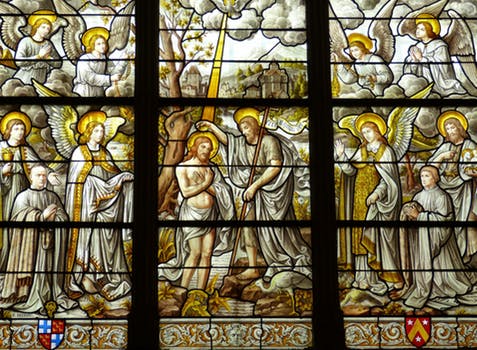
 Otherwise, what do people mean by being baptized on behalf of the dead?
If the dead are not raised at all, why are people baptized on their behalf?
— 1 Corinthians 15:29 —
Few passages in Scripture are more confusing than 15:29, with its language of “baptism for the dead” (βαπτιζόμενοι ὑπὲρ τῶν νεκρῶν). What is Paul trying to say? Is he addressing, or condemning, or condoning some strange practice in Corinth? Is he speaking of the traditional ordinance of water baptism, but using strange language? Should we read 1 Corinthians 15:29 with everything else Paul said about baptism? Or should we delimit this verse to the cultural context of Corinth?
For starters, we can clearly assert that Scripture in no way supports “proxy” or “vicarious baptism.” In the context itself, Paul is not giving instruction for baptism; he is using it as a rhetorical illustration: if many line up for baptism, which depends on the resurrection, why do you accept baptism but not resurrection. Again the focus of 1 Corinthians 15 is resurrection; “baptism on behalf of the dead” is in reference to that larger issue. Paul is not giving us any instructions for the ordinance itself
Rightly, the orthodox church has always understood Paul this way. Throughout church history, this passage was only used by heretical groups to implement such a practice; it has never found a place among true believers.[1] Among Mormons, there is a false doctrine built on this verse, that a Mormon priest must baptize someone for them to be born again—hence some are baptized today on behalf of earlier, unbaptized souls.[2] But among evangelicals there is no such practice.
What is present among biblical Christians is a wide variety of interpretations. In what follows I will attempt to list these interpretations and conclude with something of an approximation of what I believe Paul is saying. I say approximation, because this is one of those passages that we must hold with open hands. In other words, while we can confidently stress what this passage does not teach, we are in a more difficult position to lock down a precise definition of what Paul does mean. The context, the grammar, and the meaning are all difficult to us. Still, we should labor to understand his words, especially in the context of the book. But first, a list of possible interpretations. Continue reading
 Raised with Christ (part 2): The Unfolding Reign of Christ’s Resurrection
 For the first few years of my Christian life Our Daily Bread served as a vital part of my personal devotions. Each month or two, I’d pick up the short devotional in the church foyer, and each day I’d read it with accompanying Scripture references. About the same time, I began memorizing Bible verses. Behind my desk today is an index box full of the Scriptures I sought to memorize from that period.
 [I wrote the following article for the online journal
 What does 1 Corinthians teach about tongues?
 The Ten Commandments are listed twice in the Old Testament—once in Exodus 20; once in Deuteronomy 5. They are also explicated at least twice. After each list (Exodus 21–23 and Deuteronomy 12–25), Moses specifies and applies the Lord’s “ten words.” This means that we do not need to wait for Jesus’ Sermon on the Mount (Matthew 5–7) to get an inspired interpretation and application of these commands. There is, within the Torah itself, explanation and application.
 It is often argued that God’s absolute sovereignty disables or demotivates human responsibility. But I contend it is just the opposite: a biblical understanding of God’s sovereignty secures and strengthens human responsibility. In fact, the more we see how God’s sovereign actions work in human history, the more reason we have to trust God and move out in faith.
 Via Emmaus