
From Exaltation to Exile: The Tragic Fall of David’s House
In his chapter on the Psalms, Paul House writes of Book 3, Psalms 73–89:
Subtle shifts in tone, superscriptions and content leading up to historical summaries in Psalms 78 and 89 indicate that part three [Psalms 73–89] reflects Israel’s decline into sin and exile. This national demise occurs in about 930–587 B.C. and has been described previously in 1 Kings 12–1 Kings 25 as well as in Isaiah, Jeremiah, and the Twelve. The view of history found here matches that in the Prophets: Israel’s covenant breaking led God to rebuke, and then reject, the chosen people and to expel them from the promised land. These Psalms portray this rebuke and rejection against a background of the remnants faith struggles and the Lord’s patience. (Old Testament Theology, 413–14)
In Sunday’s message I attempted to show some of the history of Judah that stands behind the events of Book 3. I argued that by learning the history of David’s sons and listening to the priestly heralds of Book 3 we come to learn about Israel’s hope and our own hope. Whereas the sins of David’s sons led to the demise of their throne, God would ultimately remain faithful, as it evidenced throughout Book 3 and even more in Books 4 and 5.
While fulling getting our hands on the history and poetry of Israel challenges us—we are, after all, removed from Israel’s history by over 3,000 years and differing languages—it is evident that devastating fall afflicts David’s house and the house of the Lord between the end of Book 2 and the end of Book 3. Psalm 72 shows the exalted throne of David, now given to Solomon; Psalm 89 shows the crown of David thrown into the dust.
In the infographic, I try to show some of the probable connections that make up the details of Book 3, as it gives the soundtrack of David’s falling house. Discussion questions below focus on Psalm 89. And sermon audio and sermon notes are also available. (You can find a list of observations related to Psalm 74 and 2 Chronicles 10–12 here). Continue reading
 Now this was written allegorically: these women are two covenants.
 In his illuminating article on Galatians 4:21–31, Matthew Emerson shows how we should learn to read Moses from the Apostle Paul. In a passage that typically is used as an example for how to not read the Old Testament like Paul, Emerson makes the opposite case. And I believe he is exactly right.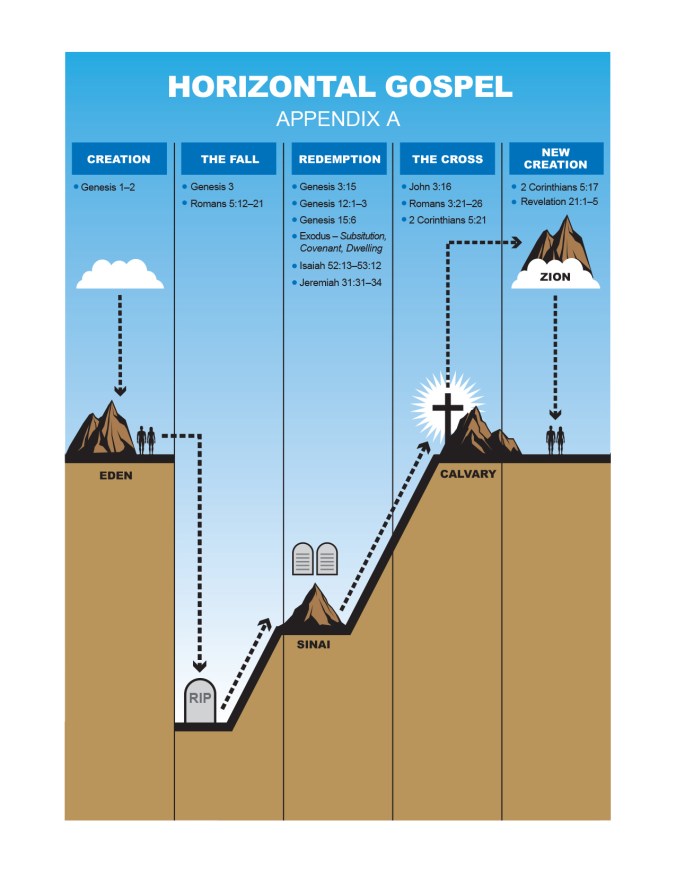

 How did we get the Psalms? And how do we get into the Psalms? Meaning, how do we apply the Psalms of ancient Israel to ourselves today? And in applying them, how do we avoid undisciplined allegory and mere historicism devoid of Christ?
 In his chapter ethics in
  When I teach hermeneutics, one of the key points I make is the need to read each passage with three horizons in mind.
 To read something canonically means reading something as a unified whole, instead of fragmenting the book or letter into dozens of independent (or worse, divergent) pieces. Reading canonically seeks to understand the author’s intention, by recognizing the literary shape of his document. It is aware of the genre of the composition, but even more it looks at the internal evidence to see what is there. When reading books in the Bible, this way of reading is challenging, but always well-repaid. By seeing the literary shape of the text, we come much closer to understanding the meaning of the message.
 Via Emmaus