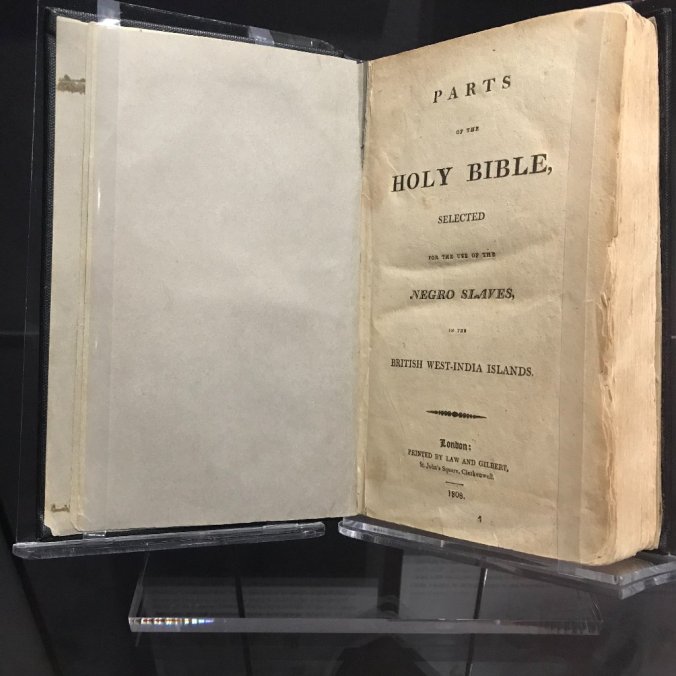
In Washington, D.C. the Museum of the Bible has an exhibit tracing the impact of the Bible on slavery, and the impact of slavery on the Bible. Tragically, as the artifact above reveals, slave holders invited God’s judgment on themselves (see Revelation 22:19), in order to control their slaves and defend their institution of slavery.
In another exhibit, Ephesians 6:5 (“Slaves/Bondservants, obey your earthly masters with fear and trembling, with a sincere heart, as you would Christ”) is cited as one verse among many that were used out of context to control God-fearing slaves. In reading this verse by itself, you can see how it could be misused to do horrendous damage. But how should we understand this verse? Did Paul condone slavery? Are his words to be ignored, rejected, or attributed to some cultural blindness of his day? Why didn’t he speak against slavery?
To be sure, questions like these need answering. But denying the veracity of God’s Word, as some like to do, is not the answer. Rather, we need to understand Paul’s words in their historical context and how his commitment to the gospel both liberated individuals from slavery to sin/death/hell and, in time, led to emancipation for slaves across the Mediterranean.
To get at his historical context, lets consider two questions:
- What did slavery look like in first century Ephesus?
- What did Paul think of slavery?
By getting a handle on these two questions, it will help us understand Paul’s words and how his witness shows how far pro-slavery Christians deviated from God and his Word. At the same time, by considering Paul’s unswerving commitment to the gospel, we will see how that message (alone) forms a foundation for all genuine pursuits of love and injustice, liberty and emancipation. Indeed, by understanding more clearly the way the gospel works, we can see more clearly the wisdom of God, the goodness of Paul’s words, and the reason why he, as God’s chosen apostle, addressed slaves and their masters as members of Christ’ church, rather than a class of people suffering under an unjust system. Continue reading
 In Ephesians 6:5–9 Paul finishes his “household codes” by addressing slaves/bondservants and masters and how they ought to work as unto the Lord. In fact, in five verses Paul makes five explicit references to Christ. Thus, as with marriage (Ephesians 5:22–33) and parenting (Ephesians 6:1–4), he gives hyper-attention to the way Christ motivates Christians in the marketplace.
 In Proverbs the ideas of wisdom, righteousness, and reward are prevalent. And as I highlighted

 In Ephesians 6:1–3 Paul calls believing children (i.e., children in the Lord) to obey (v. 1) and honor (v. 2) their parents. In verse 1, Paul gives the motivation, “for this is right,” and in verses 2–3, he motivates children with the fifth commandment, ‘the first commandment with a promise.’ And importantly, the promise says, “that it may go well with you and that you may live long in the land [or, on the earth].”
 Last week, I taught on the Mount of Transfiguration in Mark 9. And in my studies I discovered just how much this passage depends on the events of Sinai. In what follows, I will try to show a few of the connections and why reading these passages together is so fruitful for understanding the revelation of God’s glory in Christ’s transfiguration.
 Omniscience is a word that describes the reality that God knows everything—everything past, present, and future; everything in heaven or on earth; everything real and everything potential. Everything. But more than just having an encyclopedic knowledge of his creation—which God does—Scripture shows how God’s universal knowledge brings particular blessing and judgment to the world, to those people whom he knows particularly as his own.
 Among biblical theologians, Graeme Goldsworthy is a well-respected scholar with great passion for Christ and his church. His works on the
 Via Emmaus