 This summer our church looked at Jesus’s words concerning giving. In Sunday School, we studied Randy Alcorn’s helpful little book called The Treasure Principle. You can listen to the series here. And in our series on the Sermon on the Mount, we have looked at Jesus words about giving in Matthew 6:1–4, treasure in Matthew 6:19–24, and trusting God with our material needs in Matthew 6:25–34. You can listen to those sermons here:
- Watch Me Give, Watch Me Nae Nae (Matthew 6:1–4)
- The Truth About Treasure (Matthew 6:19–24)
- Separation Anxiety (Matthew 6:25–34)
Still, giving is not just something that Jesus talked about. It is something that goes back to the beginning of corporate worship. For in Exodus, when God redeemed his people from Egypt, he led them to contribute to the construction of the tabernacle. With the gifts God provided for Israel through the “plundering of the Egyptians,” God’s people gladly gave to the construction of God’s dwelling place.
Today, as the church has become the temple of the Holy Spirit, God’s people continue to give to its upbuilding, as the Lord moves our hearts. Jesus’s words about storing up treasure in heaven, and not on earth may even refer directly to this temple-directed giving (see Nicholas Perrin, Jesus the Temple), However, throughout the Bible there is a theme of God’s people giving to the upbuilding of God’s dwelling place because of the work of grace in their lives.
This is first seen in Exodus and continues until today. Accordingly, we can learn much by seeing the relationship between grace and giving, and how gospel-motivated giving is both similar and different from all other forms of philanthropy. Continue reading
 Tonight we begin our verse-by-verse study of Hebrews in
  If you could only take one book of the Bible with you on a deserted island, what would it be? Psalms? The Gospel of John? Hebrews? What about Deuteronomy?
 In the Bible we learn that preaching is not the only way God’s Word is communicated. In the Old Testament, the Levites are seen explaining the Law to the people of Israel (Nehemiah 8:7–8). And in the New Testament, Paul says of his ministry, “I did not shrink from declaring to you anything that was profitable, and teaching you in public and from house to house” (Acts 20:20).

 In the middle of the Sermon on the Mount, Jesus gives instructions about giving (vv. 2–4), praying (vv. 5–15), and fasting (vv. 16–18). In our church we have taken one sermon per “spiritual discipline,” but really in the structure of Matthew’s Gospel, we should read these three disciplines together. And in fact, when we do there are some observations we discover that we might not find on our own.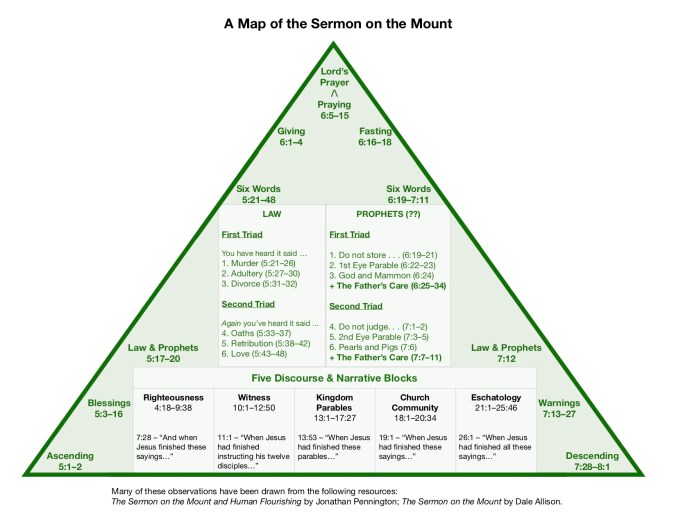
 Imprecatory psalms (e.g., Pss 5, 10, 17, 35, 58, 59, 69, 70, 79, 83, 109, 129, 137, 140) are those psalms which call upon God to destroy the enemies of God. They come from the anguished hearts of persecuted Israelites, and they include some of the most shocking words in the Bible. Take just a few examples.
 In Matthew 5:17 Jesus says that he has not come to abolish the Law or the Prophets, but to fulfill them. And as D. A. Carson has observed about these verses, “The theological and canonical ramifications of one’s exegetical conclusions . . . are so numerous that discussion becomes freighted with the intricacies of biblical theology” (“
 Yesterday, I
  Via Emmaus