Via Emmaus on the Road: Revelation 14

Further Resources


Revelation 14 (ESV)

The Lamb and the 144,000

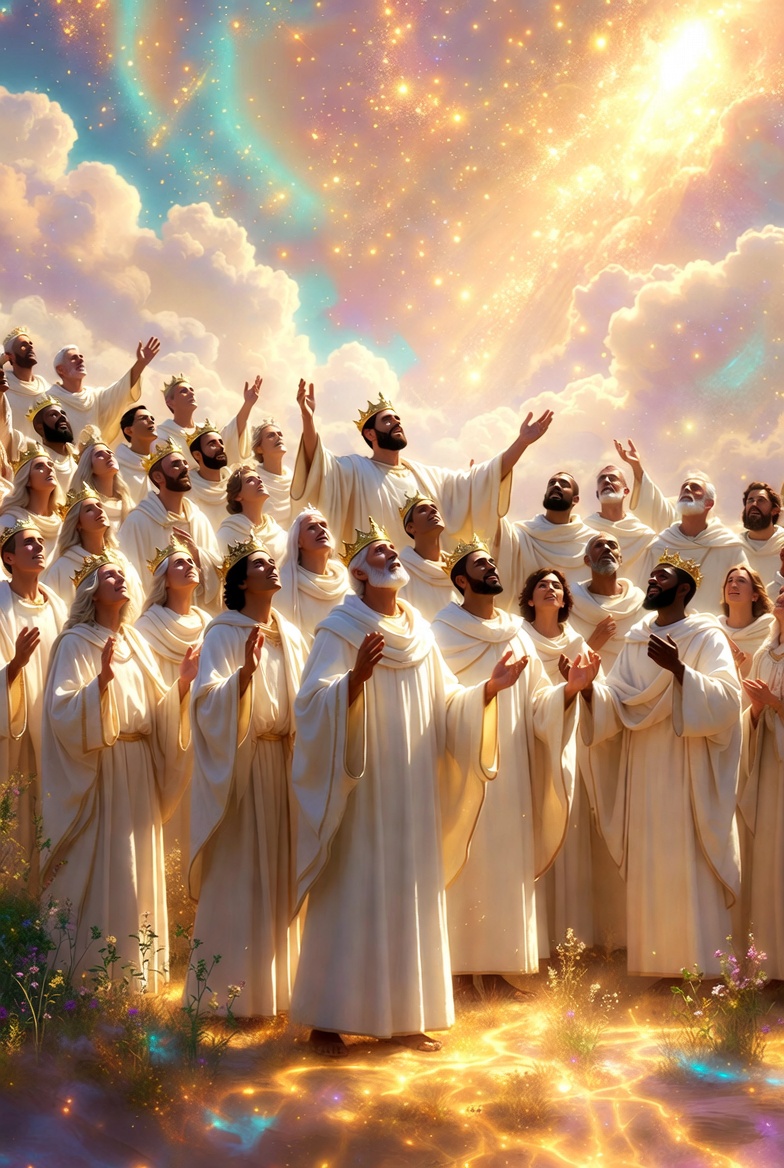
14 Then I looked, and behold, on Mount Zion stood the Lamb, and with him 144,000 who had his name and his Father’s name written on their foreheads. And I heard a voice from heaven like the roar of many waters and like the sound of loud thunder. The voice I heard was like the sound of harpists playing on their harps, and they were singing a new song before the throne and before the four living creatures and before the elders. No one could learn that song except the 144,000 who had been redeemed from the earth. It is these who have not defiled themselves with women, for they are virgins. It is these who follow the Lamb wherever he goes. These have been redeemed from mankind as firstfruits for God and the Lamb, and in their mouth no lie was found, for they are blameless.

The Messages of the Three Angels

Then I saw another angel flying directly overhead, with an eternal gospel to proclaim to those who dwell on earth, to every nation and tribe and language and people. And he said with a loud voice, “Fear God and give him glory, because the hour of his judgment has come, and worship him who made heaven and earth, the sea and the springs of water.”

Another angel, a second, followed, saying, “Fallen, fallen is Babylon the great, she who made all nations drink the wine of the passion of her sexual immorality.”

And another angel, a third, followed them, saying with a loud voice, “If anyone worships the beast and its image and receives a mark on his forehead or on his hand, 10 he also will drink the wine of God’s wrath, poured full strength into the cup of his anger, and he will be tormented with fire and sulfur in the presence of the holy angels and in the presence of the Lamb. 11 And the smoke of their torment goes up forever and ever, and they have no rest, day or night, these worshipers of the beast and its image, and whoever receives the mark of its name.”

12 Here is a call for the endurance of the saints, those who keep the commandments of God and their faith in Jesus.

13 And I heard a voice from heaven saying, “Write this: Blessed are the dead who die in the Lord from now on.” “Blessed indeed,” says the Spirit, “that they may rest from their labors, for their deeds follow them!”

The Harvest of the Earth

14 Then I looked, and behold, a white cloud, and seated on the cloud one like a son of man, with a golden crown on his head, and a sharp sickle in his hand. 15 And another angel came out of the temple, calling with a loud voice to him who sat on the cloud, “Put in your sickle, and reap, for the hour to reap has come, for the harvest of the earth is fully ripe.” 16 So he who sat on the cloud swung his sickle across the earth, and the earth was reaped.

17 Then another angel came out of the temple in heaven, and he too had a sharp sickle. 18 And another angel came out from the altar, the angel who has authority over the fire, and he called with a loud voice to the one who had the sharp sickle, “Put in your sickle and gather the clusters from the vine of the earth, for its grapes are ripe.” 19 So the angel swung his sickle across the earth and gathered the grape harvest of the earth and threw it into the great winepress of the wrath of God. 20 And the winepress was trodden outside the city, and blood flowed from the winepress, as high as a horse’s bridle, for 1,600 stadia.

Soli Deo Gloria!
Via Emmaus on the Road: Revelation 10

Further Resources


Revelation 10 (ESV)

The Angel and the Little Scroll

10 Then I saw another mighty angel coming down from heaven, wrapped in a cloud, with a rainbow over his head, and his face was like the sun, and his legs like pillars of fire. He had a little scroll open in his hand. And he set his right foot on the sea, and his left foot on the land, and called out with a loud voice, like a lion roaring. When he called out, the seven thunders sounded. And when the seven thunders had sounded, I was about to write, but I heard a voice from heaven saying, “Seal up what the seven thunders have said, and do not write it down.” And the angel whom I saw standing on the sea and on the land raised his right hand to heaven and swore by him who lives forever and ever, who created heaven and what is in it, the earth and what is in it, and the sea and what is in it, that there would be no more delay, but that in the days of the trumpet call to be sounded by the seventh angel, the mystery of God would be fulfilled, just as he announced to his servants the prophets.

Then the voice that I had heard from heaven spoke to me again, saying, “Go, take the scroll that is open in the hand of the angel who is standing on the sea and on the land.” So I went to the angel and told him to give me the little scroll. And he said to me, “Take and eat it; it will make your stomach bitter, but in your mouth it will be sweet as honey.” 10 And I took the little scroll from the hand of the angel and ate it. It was sweet as honey in my mouth, but when I had eaten it my stomach was made bitter. 11 And I was told, “You must again prophesy about many peoples and nations and languages and kings.”

Soli Deo Gloria!


Via Emmaus on the Road: Revelation 4

Further Resources


Revelation 4 (ESV)

The Throne in Heaven

After this I looked, and behold, a door standing open in heaven! And the first voice, which I had heard speaking to me like a trumpet, said, “Come up here, and I will show you what must take place after this.” At once I was in the Spirit, and behold, a throne stood in heaven, with one seated on the throne. And he who sat there had the appearance of jasper and carnelian, and around the throne was a rainbow that had the appearance of an emerald. Around the throne were twenty-four thrones, and seated on the thrones were twenty-four elders, clothed in white garments, with golden crowns on their heads. From the throne came flashes of lightning, and rumblings and peals of thunder, and before the throne were burning seven torches of fire, which are the seven spirits of God, and before the throne there was as it were a sea of glass, like crystal.

And around the throne, on each side of the throne, are four living creatures, full of eyes in front and behind: the first living creature like a lion, the second living creature like an ox, the third living creature with the face of a man, and the fourth living creature like an eagle in flight. And the four living creatures, each of them with six wings, are full of eyes all around and within, and day and night they never cease to say,

“Holy, holy, holy, is the Lord God Almighty,

who was and is and is to come!”

And whenever the living creatures give glory and honor and thanks to him who is seated on the throne, who lives forever and ever, 10 the twenty-four elders fall down before him who is seated on the throne and worship him who lives forever and ever. They cast their crowns before the throne, saying,

11  “Worthy are you, our Lord and God,

to receive glory and honor and power,

for you created all things,

and by your will they existed and were created.”

Soli Deo Gloria!

Via Emmaus on the Road: Hebrews 2

Further Resources


Hebrews 2 (ESV)

Hebrews 2 (ESV)

Warning Against Neglecting Salvation

Therefore we must pay much closer attention to what we have heard, lest we drift away from it. For since the message declared by angels proved to be reliable, and every transgression or disobedience received a just retribution, how shall we escape if we neglect such a great salvation? It was declared at first by the Lord, and it was attested to us by those who heard, while God also bore witness by signs and wonders and various miracles and by gifts of the Holy Spirit distributed according to his will.

The Founder of Salvation

For it was not to angels that God subjected the world to come, of which we are speaking. It has been testified somewhere,

“What is man, that you are mindful of him,

or the son of man, that you care for him?

You made him for a little while lower than the angels;

you have crowned him with glory and honor,

putting everything in subjection under his feet.”

Now in putting everything in subjection to him, he left nothing outside his control. At present, we do not yet see everything in subjection to him. But we see him who for a little while was made lower than the angels, namely Jesus, crowned with glory and honor because of the suffering of death, so that by the grace of God he might taste death for everyone.

10 For it was fitting that he, for whom and by whom all things exist, in bringing many sons to glory, should make the founder of their salvation perfect through suffering. 11 For he who sanctifies and those who are sanctified all have one source. That is why he is not ashamed to call them brothers, 12 saying,

“I will tell of your name to my brothers;

in the midst of the congregation I will sing your praise.”

13 And again,

“I will put my trust in him.”

And again,

“Behold, I and the children God has given me.”

14 Since therefore the children share in flesh and blood, he himself likewise partook of the same things, that through death he might destroy the one who has the power of death, that is, the devil, 15 and deliver all those who through fear of death were subject to lifelong slavery. 16 For surely it is not angels that he helps, but he helps the offspring of Abraham. 17 Therefore he had to be made like his brothers in every respect, so that he might become a merciful and faithful high priest in the service of God, to make propitiation for the sins of the people. 18 For because he himself has suffered when tempted, he is able to help those who are being tempted.

Soli Deo Gloria!

The Sons of God: Three Interpretations of Genesis 6:1–4

luigi-boccardo-OGSbrFW_dos-unsplashFigment. Absurd. Gross.

These are but three of the names John Calvin calls the position I hold on Genesis 6. And while, he doesn’t employ his most common insult (stupid!), I am sure he would have little trouble applying that label to the view that angels had sexual relations with women, such that the Nephilim (or giants) were the resultant offspring.

For indeed, when considering who the sons of God were in Genesis 6, he excoriates the ancient view that believed the sons of God (=angels) came from heaven to consort with the daughters of man. He writes in his commentary on Genesis 6, “That ancient figment, concerning the intercourse of angels with women, is abundantly refuted by its own absurdity; and it is surprising that learned men should formerly have been fascinated by ravings so gross and prodigious [strange or unusual].” [1]

Following this view, he adds another, namely, the idea that the sons of God were royal sons and the daughters of men were commoners. The problem in this case was the way that the nobility chased the commoners, resulting in offspring of mixed hereditary stock.[2] On this second view, whom he assigns to the “Chaldean paraphrast” (i.e., the Babylonian Talmud), we can agree that this interpretation fails to follow the terms of Scripture. (Yet, it is not far from another view that will be referenced below.)

In contrast to both views, Calvin then offers his—the idea that has become popular among so many evangelicals today. He sees the sons of God as the male heirs of Seth and the daughters of man as the female offspring of Cain. While Calvin frames this division in theological terms (i.e., the sons being chosen by grace and the daughters being left in their common condition), his reading is purely human, and wreaks nothing of gross absurdity.[3] Or, so he believes.

Historically, his view, which goes back to Augustine and before that to Julius Africanus (c. 160–240), can be summarized under the title of the Sethite position, while my position, which goes back to the Jewish interpreters of the Second Temple period might be titled the Fallen Angel position. Additionally, there is the view that understands the sons of God in royal terms, but not like that described by Calvin, what I’ll label the Kings of the Earth position.

In what follows, I want to lay out these three positions and begin to explain why I believe Calvin’s mockery of this position is wrong. As always, it is not a light thing to disagree with such an eminent theologian, but as a Baptist, Calvin’s insults don’t bother me. I’ve disagreed with him before, and here I will do so again. I will argue that his Sethite view is reasonable, but not ultimately persuasive. Better, we should read Genesis 6 in the context of the whole Bible, and when we do we will discover the fact that the angels of heaven left their proper abode, consorted with human women, and thus invited the judgment of God which led to the cosmic flood. Continue reading

What are the ‘Powers and Principalities’ in Ephesians?

wtsIn his overview of Ephesians, Guy Prentiss Waters, nicely summarizes what the spiritual powers are in that letter and in the world. Moreover, he explains what the presence and growth of the church means to the devil.

What does Paul understand the “powers” to be in Ephesians? He has several ways of describing them. They are “the rulers,… the authorities,… the cosmic powers over this present darkness,… the spiritual forces of evil in the heavenly places” (6:12). Paul mentions them in the same breath as “the devil” (6:11; cf. 4:27) and expressly sets them apart from “flesh and blood” (6:12), that is, human beings (cf. Gal. 1:16). We are therefore to regard these powers as unseen and angelic beings in league with and under the authority of Satan (cf. Eph. 2:2). They are not impersonal but personal. Paul locates them and their activities “in the heavenly places” (6:12; cf. 3:10), even as he documents their unceasing activity in the affairs of humanity.

Paul describes these powers in three ways.

  • First, they are malevolent (“evil”) and therefore hostile to Christ and his people.
  • Second, they possess an authority or power that is not localized but is universal (“cosmic”). The word “darkness” indicates a demonic authority that extends to all unbelieving persons, whether Jew or Gentile. “‘Darkness’ is the sphere in which these believers formerly belonged (Eph. 5:8)… and from which they were rescued by the Lord (Col 1:13).” It is, therefore, an authority that Paul associates with “this age” (Eph. 1:21; cf. 5:16; 6:13), the present Adamic order characterized by sin, corruption, curse, and death.
  • Third, the plurality of these demonic powers and their designation by terms of rank (“rulers,” “authorities”) suggests a gradation within their numbers. Earlier in the letter, Paul stresses that the “prince of the power of the air” is “the spirit that is now at work in the sons of disobedience among whom we all once lived in the passions of our flesh” (Eph. 2:2–3). Satan therefore stands at the head of a host of demonic powers who govern and influence all those who are in Adam (cf. 2 Cor. 4:4).

The “powers” constitute a genuine threat to believers’ well-being (Eph. 6:11–12). Even so, Paul is insistent that the Ephesians understand that these demonic authorities have been brought into subjugation to Jesus Christ. In his exaltation, the second Adam, Jesus Christ, was “seated… far above all rule and authority and power and dominion, and above every name that is named, not only in this age but also in the one to come. And he put all things under his feet” The cosmic, mediatorial dominion of Jesus Christ encompasses “all things,” even the Devil and his angelic allies.

The “rulers and authorities in the heavenly places,” furthermore, are perpetually reminded of their defeat and subjugation (3:10). The “manifold wisdom of God,” which denotes the eternal purpose of God to redeem sinners by the death and resurrection of Christ and to gather the redeemed into a united people under the benevolent reign of the Lord Jesus, is ever proclaimed to them. The instrument through which God makes this wisdom known to the powers is “the church.” The very existence of the church, in other words, is standing testimony to the powers’ defeat and subjugation to the Lord Jesus Christ. “Ephesians” in A Biblical-Theological Introduction to the New Testament: The Gospel Revealed (ed. Michael J. Kruger; Wheaton, IL: Crossway, 2016), 272–73. Formatting mine.

Ever wonder why the church is under constant attack from devil and his minions? It reminds them of Christ’s Lordship, their defeat, and coming destruction. Hence, the church which is loved by God is hated by Satan. For that reason we must press into the Lord and the power of his Spirit.

Soli Deo Gloria, ds

The Ways of Our God: God’s Order (1)

In The Ways of Our God: An Approach to Biblical Theology, Charles Scobie subdivides his multithematic approach into main four categories: God’s Order; God’s Servant, God’s People, and God’s Way.  Under each banner, he writes five chapters, and today we will consider his first section in his “sketch of biblical theology.”  For sake of space, let me list the headings and provide a few reflections.

  1. The Living God.  Scobie begins with God and His revelation in creation and history.  According to the Scriptures, Scobie argues that God is King, and taking his cue from the Decalogue and the Shema, he outlines his chapter with three concepts that establish “the very core of the OT understanding of God” (107).  These are the self-revelation of God’s Name(s), the unitive oneness of God, and the personal nature of God.  He examines each of these as they are initially proclaimed in the OT and more fully developed in the latter prophets and in the NT.  One of the highlights from this chapter is the way that each section (i.e. Proclamation, Promise, Fulfillment, and Future Consummation–also the framework of every other chapter) concludes with an explanation and affirmation of the Scripture’s canonical development at each stage of revelation.  In a chapter focusing on Theology Proper, he argues for Scripture’s essential role in revealing the one, true, and living God.  Additionally, Scobie emphasizes God’s relationship to both the created order and the historical order–this is expanded in chapters 2-3.
  2. The Lord of Creation.  Scobie writes this chapter out of a concern that biblical theology and recent biblical studies have devalued God’s relationship to creation, and have focused only on God’s role in the historical order.  He illustrates this by referring to those who begin their BT with Exodus and not Genesis; however, as he points out, this misses the way in which the canon is itself telling the story of God as Creator and Redeemer.  Scobie shows convincingly that God loves creation and has made creation for our enjoyment and his glory (cf. John Piper, “The Pleasure of God in His Creation” in The Pleasures of God).  He shows where creation is emphasized in the OT (Gen. 1-11; Pss. 8, 95, 104, 148; Isaiah; and the wisdom literature–Job 38-39; Proverbs 8), and argues that the NT maintains the same view of creation as the OT, only adding Jesus’ instrumental role in its creation and maintenance (John 1:1-3; Col. 1:15-20; Heb. 1:1-3).  He introduces the distinction between apocalyptic eschatology which is alligned with God’s created order and prophetic eschatology which corresponds with redemptive history.  Just as the Bible begins with creation (Gen. 1-2), it ends with new creation (Rev. 20-22), and thus all the Bible is looking forward to the renewal of this fallen world. 

    His concluding application section would make the editors of the “Green Letter Bible” happy; it shows how the Bible does address many environmental concerns, but in a Donald Miller, Blue Like Jazz, sort of way, Scobies goes too far concerning the ways in which consumerist evangelicals have neglected the environment and are in need of confessing our “guilt for the ecological crisis” (186-87).  The ‘guilt’ rests not with Western evangelicals, but with the whole Adamic race. In the end, this chapter is a helpful commentary on what the Bible says about creation and its place in biblical theology.

  3. The Lord of History.  Scobie begins with a cursory review of the books of the Bible, and then proceeds to walk through the stages of redemptive history, before highlighting six ways in which God has worked in history.  These six characteristics of salvation history are (1) divine intervention, (2) [appointing] divinely inspired leadership, (3) salvation & judgment, (4) providence, (5) blessing, (6) and suffering love (198-202).  Scobie does not retain God’s work in history to veiled acts of redemption, though, he also posits that God has worked in history through revealing himself by speaking to his people (202-04).  Thus, redemptive acts of God are only recognized and understood when God also inspires a biblical author to interpret the meaning of the event (i.e. the exodus, the Babylonian exile, or the crucifixion).  The chapter is a helpful summary of salvation history, though he is theologically imprecise when speaking of God’s “suffering love,” a term most often associated with Jurgen Moltmann, and more recently Richard Bauckham, that ascribes suffering to the divinity of the Godhead, instead of assigning suffering to Christ’s humanity.  (For more on this see my post, Can God Suffer?).
  4. The Adversary.  Scobie presents a very balanced survey from the biblical text that walks through the Scriptures highlighting the passages of Scripture that concern the enemies of God, reprobate angels, and Satan himself.  He avoids the two extremes of spiritual warfare fanaticism and the modern mindset that makes the devil a cartoonish fable.  He chastens those who like Greg Boyd attempt to say too much about Satan and are required to import ideas from other Ancient Near Eastern contemporaries.  However, he shows the reality of the demonic realm and of the antichrist.  Like all of his chapters I have read thus far, his biblical content presents a helpful catalog of all the applicable texts on the subject.
  5. The Spirit.  Scobie is open to the continuous presence of miraculous gifts today because there is no hermeneutical reason, he says, to deny their continuation (296).  However, in his explication of this subject, Scobie is unfortunately imprecise and inconsistent.  In one place he states that “Christian baptism confers the gift of the Spirit” (283), yet later as he makes his summary he says “all believers receive the gift of the Spirit when they become Christians” (296).  I guess you could ask, “What makes someone a Christian,” but it seems that he inconsistently attributes the giving of the Spirit to baptism, and blurs the transitional period of Acts with what is now normative in the church today.  Like in chapter 2, Scobie emphasizes the Spirit’s role in and with creation, appealing to the Eastern Ortohodox tradition which includes Psalm 104 in its daily liturgy (295).  He spends little time on the revelation of the Spirit and its inclusion in the Trinity, because as he believes, the Bible gives triadic data but not trinitarian doctrine (297).  On the whole, this chapter shows a developing continuity throughout the Bible for the doctrine of the Spirit, but its synthesis leaves a lot of questions unanswered because of such short statements on things like tongues, the gifts, and the relationship of baptism to the Spirit.

More than a quarter of the way through this massive volume, I am pleased to report that the reading has been edifying and that any serious student of the Bible would be rewarded by reading it.

Sola Deo Gloria, dss