Via Emmaus on the Road: James 2

Further Resources


James 2 (ESV)

The Sin of Partiality

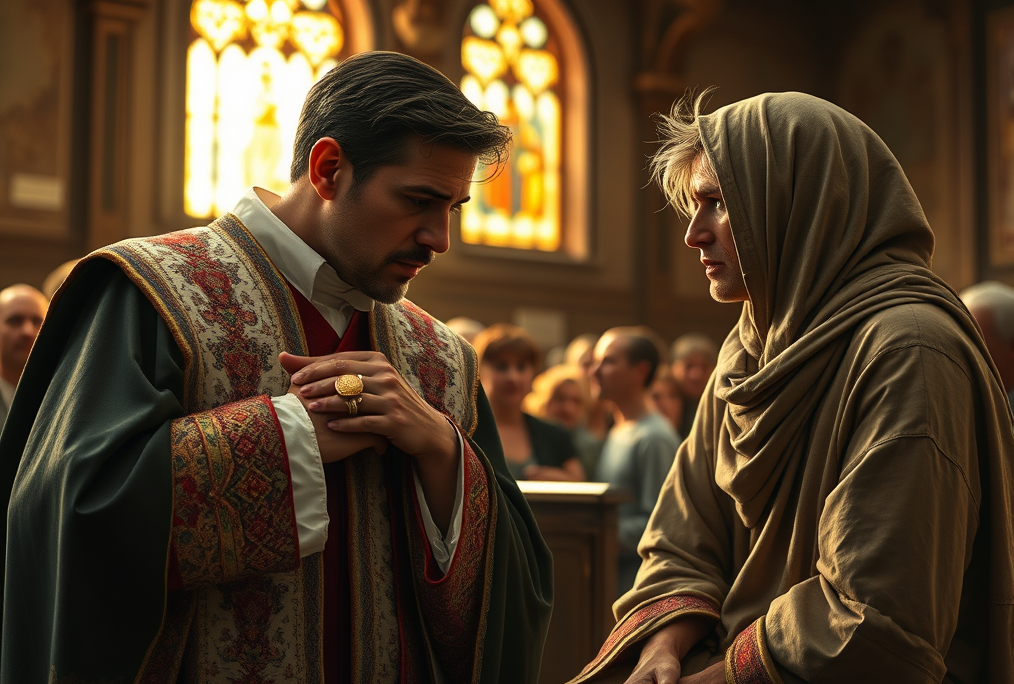
My brothers, show no partiality as you hold the faith in our Lord Jesus Christ, the Lord of glory. For if a man wearing a gold ring and fine clothing comes into your assembly, and a poor man in shabby clothing also comes in, and if you pay attention to the one who wears the fine clothing and say, “You sit here in a good place,” while you say to the poor man, “You stand over there,” or, “Sit down at my feet,” have you not then made distinctions among yourselves and become judges with evil thoughts? Listen, my beloved brothers, has not God chosen those who are poor in the world to be rich in faith and heirs of the kingdom, which he has promised to those who love him? But you have dishonored the poor man. Are not the rich the ones who oppress you, and the ones who drag you into court? Are they not the ones who blaspheme the honorable name by which you were called?

If you really fulfill the royal law according to the Scripture, “You shall love your neighbor as yourself,” you are doing well. But if you show partiality, you are committing sin and are convicted by the law as transgressors. 10 For whoever keeps the whole law but fails in one point has become guilty of all of it. 11 For he who said, “Do not commit adultery,” also said, “Do not murder.” If you do not commit adultery but do murder, you have become a transgressor of the law. 12 So speak and so act as those who are to be judged under the law of liberty. 13 For judgment is without mercy to one who has shown no mercy. Mercy triumphs over judgment.

Faith Without Works Is Dead

14 What good is it, my brothers, if someone says he has faith but does not have works? Can that faith save him? 15 If a brother or sister is poorly clothed and lacking in daily food, 16 and one of you says to them, “Go in peace, be warmed and filled,” without giving them the things needed for the body, what good is that? 17 So also faith by itself, if it does not have works, is dead.

18 But someone will say, “You have faith and I have works.” Show me your faith apart from your works, and I will show you my faith by my works. 19 You believe that God is one; you do well. Even the demons believe—and shudder! 20 Do you want to be shown, you foolish person, that faith apart from works is useless? 21 Was not Abraham our father justified by works when he offered up his son Isaac on the altar? 22 You see that faith was active along with his works, and faith was completed by his works; 23 and the Scripture was fulfilled that says, “Abraham believed God, and it was counted to him as righteousness”—and he was called a friend of God. 24 You see that a person is justified by works and not by faith alone. 25 And in the same way was not also Rahab the prostitute justified by works when she received the messengers and sent them out by another way? 26 For as the body apart from the spirit is dead, so also faith apart from works is dead.

Soli Deo Gloria!

 

Via Emmaus on the Road: Hebrews 6

Further Resources


Hebrews 6 (ESV)

Therefore let us leave the elementary doctrine of Christ and go on to maturity, not laying again a foundation of repentance from dead works and of faith toward God, and of instruction about washings, the laying on of hands, the resurrection of the dead, and eternal judgment. And this we will do if God permits. For it is impossible, in the case of those who have once been enlightened, who have tasted the heavenly gift, and have shared in the Holy Spirit, and have tasted the goodness of the word of God and the powers of the age to come, and then have fallen away, to restore them again to repentance, since they are crucifying once again the Son of God to their own harm and holding him up to contempt. For land that has drunk the rain that often falls on it, and produces a crop useful to those for whose sake it is cultivated, receives a blessing from God. But if it bears thorns and thistles, it is worthless and near to being cursed, and its end is to be burned.

Though we speak in this way, yet in your case, beloved, we feel sure of better things—things that belong to salvation. 10 For God is not unjust so as to overlook your work and the love that you have shown for his name in serving the saints, as you still do. 11 And we desire each one of you to show the same earnestness to have the full assurance of hope until the end, 12 so that you may not be sluggish, but imitators of those who through faith and patience inherit the promises.

The Certainty of God’s Promise

13 For when God made a promise to Abraham, since he had no one greater by whom to swear, he swore by himself, 14 saying, “Surely I will bless you and multiply you.” 15 And thus Abraham, having patiently waited, obtained the promise. 16 For people swear by something greater than themselves, and in all their disputes an oath is final for confirmation. 17 So when God desired to show more convincingly to the heirs of the promise the unchangeable character of his purpose, he guaranteed it with an oath, 18 so that by two unchangeable things, in which it is impossible for God to lie, we who have fled for refuge might have strong encouragement to hold fast to the hope set before us. 19 We have this as a sure and steadfast anchor of the soul, a hope that enters into the inner place behind the curtain, 20 where Jesus has gone as a forerunner on our behalf, having become a high priest forever after the order of Melchizedek.

Soli Deo Gloria!

Via Emmaus on the Road: Romans 4

Further Resources

Romans 4:1–25 (ESV)

Abraham Justified by Faith

What then shall we say was gained by Abraham, our forefather according to the flesh? For if Abraham was justified by works, he has something to boast about, but not before God. For what does the Scripture say? “Abraham believed God, and it was counted to him as righteousness.” Now to the one who works, his wages are not counted as a gift but as his due. And to the one who does not work but believes in him who justifies the ungodly, his faith is counted as righteousness, just as David also speaks of the blessing of the one to whom God counts righteousness apart from works:

“Blessed are those whose lawless deeds are forgiven,

and whose sins are covered;

blessed is the man against whom the Lord will not count his sin.” (Psalm 32:1–2)

Is this blessing then only for the circumcised, or also for the uncircumcised? For we say that faith was counted to Abraham as righteousness. 10 How then was it counted to him? Was it before or after he had been circumcised? It was not after, but before he was circumcised. 11 He received the sign of circumcision as a seal of the righteousness that he had by faith while he was still uncircumcised. The purpose was to make him the father of all who believe without being circumcised, so that righteousness would be counted to them as well, 12 and to make him the father of the circumcised who are not merely circumcised but who also walk in the footsteps of the faith that our father Abraham had before he was circumcised.

The Promise Realized Through Faith

13 For the promise to Abraham and his offspring that he would be heir of the world did not come through the law but through the righteousness of faith. 14 For if it is the adherents of the law who are to be the heirs, faith is null and the promise is void. 15 For the law brings wrath, but where there is no law there is no transgression.

16 That is why it depends on faith, in order that the promise may rest on grace and be guaranteed to all his offspring—not only to the adherent of the law but also to the one who shares the faith of Abraham, who is the father of us all, 17 as it is written, “I have made you the father of many nations”—in the presence of the God in whom he believed, who gives life to the dead and calls into existence the things that do not exist. 18 In hope he believed against hope, that he should become the father of many nations, as he had been told, “So shall your offspring be.” 19 He did not weaken in faith when he considered his own body, which was as good as dead (since he was about a hundred years old), or when he considered the barrenness of Sarah’s womb. 20 No unbelief made him waver concerning the promise of God, but he grew strong in his faith as he gave glory to God, 21 fully convinced that God was able to do what he had promised. 22 That is why his faith was “counted to him as righteousness.” 23 But the words “it was counted to him” were not written for his sake alone, 24 but for ours also. It will be counted to us who believe in him who raised from the dead Jesus our Lord, 25 who was delivered up for our trespasses and raised for our justification.

Soli Deo Gloria!

On the Hill of the Lord It Will Be Provided (Genesis 22)

1920x1080-it-is-finished

God said what?

He told his servant Abraham to go and sacrifice his son, only son, Isaac, the one whom he loved.

And did he? Is that what God requires? Why would God do that? And why would Abraham obey?

If the conversation about Genesis 22 is challenging, imagine how difficult the conversation between father and son was between aged Abraham and Isaac, his teenage son. As they walked for three days to the hill of the Lord:

Isaac: Father, where is the sacrifice?  

Abraham: The Lord will provide, son.

And gloriously, the Lord did provide—for Abraham, Isaac, Israel, and us!

In Genesis 22, we enter one of the richest passages in the Bible. Every verse says something to us about God, his demands on humanity, his provision for humanity, and the pathway of death that leads to life.

Indeed, if you are feeling tried and tested and on the verge of despair and death, Genesis 22 is for you. And in this sermon you will hear a message of gospel hope that begins in Genesis, leads to Christ, and comes to us. Even more, after seeing how Genesis 22 prepares the way for Christ’s death and resurrection, we also find model of obedience that every disciple of Christ is called.

You can find the sermon here. If you want to dig deeper into Genesis 22, you can also check out my dissertation. Start on page 71 (PDF p. 86) and you will find 20 pages on the typology of this glorious chapter. For more on the cross of Christ, stayed tuned to our most recent sermon series.

Soli Deo Gloria, ds

Genesis 24 and God’s Plan for the World

sylwia-bartyzel-9217-unsplashGenesis 24 is the longest chapter in Genesis. And rather than recounting some revelation about God or some aspect of his covenant with Abraham, it spins a tail of how Isaac got a wife. Indeed, the longest narrative event in Genesis is a love story, one that seems Dickens-like in its profusion of extraneous information.

Certainly, as the promises of God are given to Abraham and his offspring, the marriage of his son is no small matter. Yet, it seems as though the account of the servant traveling back to Mesopotamia to find a wife for Isaac is prolix detour from the rest of Genesis. At least, it is not as crisp as the equally-important, but shorter accounts of the Tower of Babel (Genesis 11:1–9) and the meeting with Melchizedek (Genesis 14:18–24).

So why the long drama of finding Isaac a wife? My answer is that this story reflects God’s story for the world, and the long-time-in-coming union between God’s beloved son with his bride. Let’s consider. Continue reading

The Four Seeds of Abraham: Natural, National, Christ, and “In Christ”

thibaut-marquis-97935-unsplash.jpg

Now the promises were made to Abraham and to his offspring.
It does not say, “And to offsprings,” referring to many, but referring to one,
“And to your offspring,” who is Christ.
— Galatians 3:16 —

Who is Abraham’s offspring? Or is it, Who are Abraham’s offspring? Is it one or many? Or both?

In the Bible one of the most important realities to grasp is how the Bible presents itself. In other words, because Scripture is the inspired interpretation of God’s actions in the world—even as God’s Word is itself a divine action—it is vital to see how God’s earlier revelation prepares the way for his later purposes.

Sometimes this is called an “eschatological” reading of Scripture. That may sound complicated, but it’s not. Eschatology means “the study of last things” (eschatos = last), and most of the time people immediately jump to what they perceive are the “last things” in the Bible. However, if we consider that God stands outside of time and created all things for the purpose putting them under his Son’s feet (see Ephesians 1:10), then we must read the Bible as one unified-but-unfolding plan of redemption.

In this way, eschatology doesn’t begin in Revelation, or Daniel, or Zechariah, it begins in Genesis. And from Genesis to Revelation, God is working all things for the purposes of his people—the offspring of Abraham.

But who is/are Abraham’s offspring? Continue reading

Bread and Wine at the Table of a Righteous King (A Meditation on the Lord’s Supper)

MelchizedekDear Church,

You have been invited to covenant meal—a table set in the midst of hostile enemies. Bread and wine are the food and drink of choice. The host is a righteous king who is lives in the holy city Jerusalem, and serves God Most High as a faithful priest.

When you look at your invitation, the RSVP calls you to renounce your idols and acknowledge the greatness of your host. This table, offered freely to you, is set for those who believe God’s promises and refuse to partner with the kings of this world. Indeed, this table does not communicate righteousness. Rather, it is for those who have been justified by faith in the promises of God Most High.

What is this invitation describing?

If you said, the Lord’s Supper, you’d be correct. And if you said Abram’s meal with Mechizedek, you’d also be right. But how can this be?  How can one description point to two events? The answer is that God ordained the Old Testament events of Genesis 14 to prepare the way for Jesus Christ and the covenant he sealed with his blood and celebrated on the night before his crucifixion.

Therefore, just as learning the history of Passover helps us appreciate and apply the Lords’ Supper today, so does learning the story of Melchizedek and his covenant meal. Continue reading

Common Grace: How God Blessed the Nations in the Age of Abraham

rainbowGod’s covenant with Noah is often described as the covenant of common grace, and rightly so. In the wake of God’s judgment on the earth, the heart of humanity remains unchanged (cp. Gen. 6:5 and 8:21), yet for God to bring redemption to the world, some measure of preservation must be granted. Therefore, with strong covenantal language—berith occurs 7 times (vv. 9, 11, 12, 13, 15, 16, 17) in Genesis 9—God promises to uphold creation: “While the earth remains, seedtime and harvest, cold and heat, summer and winter, day and night, shall not cease” (8:22).

These promises to Noah envelope all creation and articulate God’s common grace—his universal beneficence towards a world filled with sin. In other words, common grace is common because it encompasses all humanity universally, not because it is mundane. Common grace is distinct from saving grace in that the former does not atone for sins or grant eternal life. Rather, it grants “grace” to the righteous and the unrighteous (cf. Matthew 5:45) and provides a historical context for saving grace to operate.

That being said, common grace is not equally apportioned. It is not like the periodic table, where every element possesses the same atomic weight. Rather, common grace is specific in that it often depends upon the saving grace given to God’s chosen people. In other words, just as common grace is promised through the Noahic covenant, so common grace continues to be mediated through other covenantal mediators. In Scripture, the first instance of this is Abraham.
Continue reading

Typological Pairs: From Suffering to Glory

david solomonConcerning this salvation, the prophets who prophesied about the grace that was to be yours searched and inquired carefully, inquiring what person or time the Spirit of Christ in them was indicating when he predicted the sufferings of Christ and the subsequent glories. It was revealed to them that they were serving not themselves but you, in the things that have now been announced to you through those who preached the good news to you by the Holy Spirit sent from heaven, things into which angels long to look.
— 1 Peter 1:10–12 —

What does it mean that the Spirit of Christ foretold of the Messiah’s suffering and glory?

Surely, there were many ways, as Hebrews 1:1 indicates. Nationally, the people of Israel regularly experienced enemy oppression (after they sinned) followed by powerful deliverance that set God’s elect over his enemies. Individually, Joseph, Job, David, and Daniel all experienced humbling affliction before being exalted. Textually, there are some individual passages displaying a suffering-to-glory theme—e.g., Isaiah 53 speaks of the Servant’s humiliating death (vv. 1–9) only to close the chapter by announcing his glorious reward for his vicarious suffering (vv. 10–12). Or see the pattern in the Psalms; both the whole Psalter and some individual Psalms (see especially Psalm 22) reflect this pattern.

It seems that everywhere you look in the Old Testament you find (1) God’s people suffering, followed by (2) cries for mercy. In response, (3) God hears their prayers, and (4) responds with saving compassion in the form of a deliverer—a Moses, a Samson, or a David. The result is that (5) the people are saved and the mediator is exalted.

In the light of the New Testament, these incidents are illuminating shadows of Jesus Christ himself. In fact, in the words of Peter, it’s not too much to say that the Spirit of Christ is a cruciform spirit, who leads his people (under the Old Covenant and the New) through valleys of death to bring them into places of honor and service. This is the Christian way—to be brought low unto death, so that God can raise us up to life (see 2 Cor 1:8–9).

That being said, I am persuaded that there is another way in which suffering-unto-glory might be seen in the Old Testament. Instead of containing the pattern to the nation, individuals, or texts, there are some pairs of people who display the pattern. That is, repeatedly throughout the Old Testament, there are individuals related by kinship or ministerial calling whose composite lives function to display the pattern observed in 1 Peter 1. In other words, the Spirit of Christ was directing their lives such that the first person foreshadowed the sufferings of Christ and the second person reflected his subsequent glories.

Admittedly, I haven’t seen this proposal written down anywhere. So, I’d love your thoughts. Does it work? I think there is merit in the proposal and am writing it out (in part) to explore the idea. (That’s what blogs are for, right?) I think, in the end, such pairs may help reflect the binary nature of Christ’s ministry–first in weakness and humiliation, then in power and glory. Or at least, that’s what I will try to show below. Let me know what you think. Continue reading

The Gospel Preached Beforehand

Yesterday I preached a pair of messages on the “gospel preached beforehand.”  In Galatians 3:8, Paul writes, “And the Scripture, foreseeing that God would justify the Gentiles by faith, preached the gospel beforehand to Abraham, saying, “In you shall all the nations be blessed.”

I have thought much about what the contents of that ‘gospel message’ would have been, and yesterday I sought to explain from Genesis 12, 15, 17, and 22, how the Lord proclaimed the good news to the patriarch Abraham.  In short order, I argued that the content of the gospel can be witnessed in God’s promise of grace (Gen 12), justification by faith that results in a covenant relationship (Gen 15), circumcised citizenship in the kingdom of God (Gen 17), and the necessity of the Lord’s sacrifice, substitution, and resurrection (Gen 22).

Only when all of these elements are included do you have the full gospel message. Maybe I saw too much Christ in the Old Testament, maybe not enough. Tell me what you think.

Here is the sermon audio. The first message begins in Luke 24 and turns to look at Genesis 12, 15, and 17; the second message covers Genesis 22 with an introductory excursus asking this question: ‘Since we have the full gospel (Heb 1:1-4), why should we spend much time on the gospel preached beforehand?”

Soli Deo Gloria, dss