
Via Emmaus on the Road: 1 Peter 1

Further Resources


1 Peter 1 (ESV)

Greeting

Peter, an apostle of Jesus Christ,

To those who are elect exiles of the Dispersion in Pontus, Galatia, Cappadocia, Asia, and Bithynia, according to the foreknowledge of God the Father, in the sanctification of the Spirit, for obedience to Jesus Christ and for sprinkling with his blood:

May grace and peace be multiplied to you.

Born Again to a Living Hope

Blessed be the God and Father of our Lord Jesus Christ! According to his great mercy, he has caused us to be born again to a living hope through the resurrection of Jesus Christ from the dead, to an inheritance that is imperishable, undefiled, and unfading, kept in heaven for you, who by God’s power are being guarded through faith for a salvation ready to be revealed in the last time. In this you rejoice, though now for a little while, if necessary, you have been grieved by various trials, so that the tested genuineness of your faith—more precious than gold that perishes though it is tested by fire—may be found to result in praise and glory and honor at the revelation of Jesus Christ. Though you have not seen him, you love him. Though you do not now see him, you believe in him and rejoice with joy that is inexpressible and filled with glory, obtaining the outcome of your faith, the salvation of your souls.

10 Concerning this salvation, the prophets who prophesied about the grace that was to be yours searched and inquired carefully, 11 inquiring what person or time the Spirit of Christ in them was indicating when he predicted the sufferings of Christ and the subsequent glories. 12 It was revealed to them that they were serving not themselves but you, in the things that have now been announced to you through those who preached the good news to you by the Holy Spirit sent from heaven, things into which angels long to look.

Called to Be Holy

13 Therefore, preparing your minds for action, and being sober-minded, set your hope fully on the grace that will be brought to you at the revelation of Jesus Christ. 14 As obedient children, do not be conformed to the passions of your former ignorance, 15 but as he who called you is holy, you also be holy in all your conduct, 16 since it is written, “You shall be holy, for I am holy.” 17 And if you call on him as Father who judges impartially according to each one’s deeds, conduct yourselves with fear throughout the time of your exile, 18 knowing that you were ransomed from the futile ways inherited from your forefathers, not with perishable things such as silver or gold, 19 but with the precious blood of Christ, like that of a lamb without blemish or spot. 20 He was foreknown before the foundation of the world but was made manifest in the last times for the sake of you 21 who through him are believers in God, who raised him from the dead and gave him glory, so that your faith and hope are in God.

22 Having purified your souls by your obedience to the truth for a sincere brotherly love, love one another earnestly from a pure heart, 23 since you have been born again, not of perishable seed but of imperishable, through the living and abiding word of God; 24 for

“All flesh is like grass

and all its glory like the flower of grass.

The grass withers,

and the flower falls,

25  but the word of the Lord remains forever.”

And this word is the good news that was preached to you.

Soli Deo Gloria!
Live Not By Feelings: Three Ways to Love and Live the Moral Life (1 Peter 1:13–19)

image001To feel good or to be good. That is the question. And in Sunday’s sermon, I considered the difference between the moral life that God commands (and grants by the power of his grace) and the therapeutic life that our world gives us (with no lasting grace).

As countless cultural commentators have observed, there has been in our culture “the triumph of the therapeutic” (see Philip Rieff’s book by that title). And unfortunately, this way of thinking and living has shaped the church for the last two generations, a point David Wells makes in his book Losing Our Virtue: Why the Church Must Recover Its Moral Vision. More recently, Carl Trueman has chronicled how this addiction self-oriented, inner-directed, immanent (not transcendent), feelings-obsessed way of living has consumed our world. And while understanding its origins takes time, seeing its effects does not. It’s everywhere.

And in Sunday’s sermon, I showed how 1 Peter 1:13–19 calls the followers of Christ to live by a different moral calculus and to throw off the idle and idolatrous ways of our fathers. In our case, that means rejecting a way of life controlled by our feelings.

Bought by the blood of Christ, Christians are to be holy as their Heavenly Father is holy. And this means rejecting a therapeutic worldview and the gospel of grievance that comes with it. And in its place we must learn afresh how to walk as children of God, clothed in his holiness, set apart for his glory, and satisfied with grace.

That’s what Sunday’s sermon sought argue from Peter’s first letter. You can watch that message here, or listen to it here. On these issues, a few other resources may be helpful. You can find them below.

Soli Deo Gloria, ds

From Initial Joy to Joy Everlasting:How Elect Exiles Suffer, Believe, Love, and Endure (1 Peter 1:6–9)

image001Are we going to make it? How are we going to make it? What will it take to make it? And what is ‘it,’ anyways?

If you were an elect exile living in Asia Minor during the first few decades of the church, you might ask these questions? Or, if you were a Protestant living in England during the reign of Bloody Mary, you might ask them too? Today, if you are a Christian living in China, or if you are Christian living anywhere that the cultural elites are pressing against biblical truth, or if you are confronted with an unknown, but serious, medical diagnosis, you might be asking this kind of question: How are we going to keep the faith and abide in joy, when the trials come?

Fortunately, Scripture is not silent on this issue. And in 1 Peter 1:6–9 we find a number of truths related to salvation, joy, faith, trials, and perseverance. Writing to a people whose faith was being tested and lives being threatened, Peter teaches us how we can have abiding joy in our salvation and hope of eternal glory. In Sunday’s sermon, we considered these truths, and you can listen to the sermon here. You can also watch the sermon or read a few related resources. 

Soli Deo Gloria, ds

True Religion Consists in Holy Affections: Jonathan Edwards’ Reflections on 1 Peter 1:8

peter-lewis-D1kher2Zx2U-unsplashTrue religion, in great part, consists in holy affections.
— Jonathan Edwards —

In his classic treatise on nature of the Christian experience, Jonathan Edwards begins Religious Affections with a brief and fruitful examination of 1 Peter 1:8. As this verse stands in the middle of this Sunday’s sermon, I share the opening pages from the abridged and updated version.  As many have experienced, Edwards writing is challenging, but his vision of God is glorious. Thus, it is always worth wrestling with words. Here, however, we find in language more accessible to modern readers an explanation of the way trials purify believers and enlarge our love for Christ and our joy in Christ. The section is not long and I share it as an introduction to Edwards, Religious Affections, and some of the themes we will see on Sunday.

8 Though you have not seen him, you love him. Though you do not now see him,
you believe in him and rejoice with joy that is inexpressible and filled with glory,
— 1 Peter 1:8 —

With these words the apostle demonstrates the state of mind of the Christians to whom he wrote. In the two preceding verses, he speaks of their trials: *the trial of their faith*, their *being in heaviness through manifold temptations*. These trials benefit true faith in three ways.

First, above all else, trials like this have a tendency to distinguish between true faith and false, causing the difference between them to be evident. That is why in the verse immediately preceding the text, and in innumerable other places, they are called trials because they try the faith of people who profess to be Christians, just as apparent gold is tried in the fire to see whether it is true gold or not. When faith is tried this way and proved to be true, it is “found unto praise and honour and glory” (1 Pet. 1:7). Continue reading

The New Birth: The Source of Our Living Hope (1 Peter 1:3–5)

image001

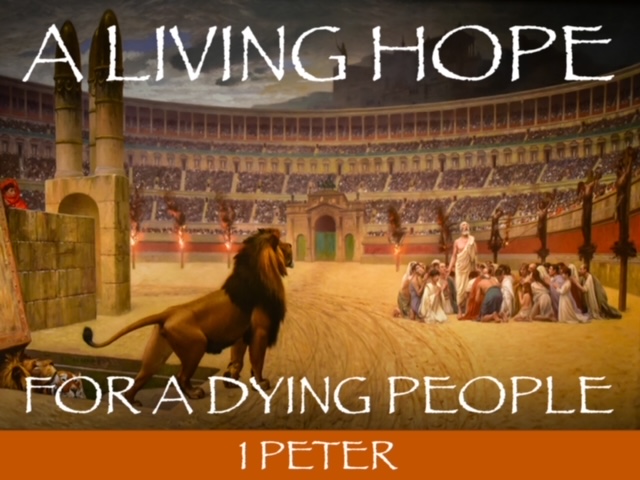
In a dying world we need a living hope. Thankfully, those who have been born again through the resurrection of Jesus Christ have such a hope. As I preached on Sunday, this hope cannot be thwarted by death, neither ours nor those whom we love. In fact, when we are confronted and crushed by death, the life God gives us in Christ guards and actually enlarges our faith. As a result, outward circumstances cannot destroy the one who has been raised to life in Christ, such perilous conditions only prove the strength of God’s resurrection life.

With that truth in mind, let me encourage to find help and hope in 1 Peter 1:3–5. You can listen to the sermon or watch the sermon below. You will also find below a few helpful articles to encourage your faith.

Soli Deo Gloria, ds