Via Emmaus on the Road: 1 Corinthians 12

Further Resources

1 Corinthians 12 (ESV)

Spiritual Gifts

12 Now concerning spiritual gifts, brothers, I do not want you to be uninformed. You know that when you were pagans you were led astray to mute idols, however you were led. Therefore I want you to understand that no one speaking in the Spirit of God ever says “Jesus is accursed!” and no one can say “Jesus is Lord” except in the Holy Spirit.

Now there are varieties of gifts, but the same Spirit; and there are varieties of service, but the same Lord; and there are varieties of activities, but it is the same God who empowers them all in everyone. To each is given the manifestation of the Spirit for the common good. For to one is given through the Spirit the utterance of wisdom, and to another the utterance of knowledge according to the same Spirit, to another faith by the same Spirit, to another gifts of healing by the one Spirit, 10 to another the working of miracles, to another prophecy, to another the ability to distinguish between spirits, to another various kinds of tongues, to another the interpretation of tongues. 11 All these are empowered by one and the same Spirit, who apportions to each one individually as he wills.

One Body with Many Members

12 For just as the body is one and has many members, and all the members of the body, though many, are one body, so it is with Christ. 13 For in one Spirit we were all baptized into one body—Jews or Greeks, slaves or free—and all were made to drink of one Spirit.

14 For the body does not consist of one member but of many. 15 If the foot should say, “Because I am not a hand, I do not belong to the body,” that would not make it any less a part of the body. 16 And if the ear should say, “Because I am not an eye, I do not belong to the body,” that would not make it any less a part of the body. 17 If the whole body were an eye, where would be the sense of hearing? If the whole body were an ear, where would be the sense of smell? 18 But as it is, God arranged the members in the body, each one of them, as he chose. 19 If all were a single member, where would the body be? 20 As it is, there are many parts, yet one body.

21 The eye cannot say to the hand, “I have no need of you,” nor again the head to the feet, “I have no need of you.” 22 On the contrary, the parts of the body that seem to be weaker are indispensable, 23 and on those parts of the body that we think less honorable we bestow the greater honor, and our unpresentable parts are treated with greater modesty, 24 which our more presentable parts do not require. But God has so composed the body, giving greater honor to the part that lacked it, 25 that there may be no division in the body, but that the members may have the same care for one another. 26 If one member suffers, all suffer together; if one member is honored, all rejoice together.

27 Now you are the body of Christ and individually members of it. 28 And God has appointed in the church first apostles, second prophets, third teachers, then miracles, then gifts of healing, helping, administrating, and various kinds of tongues. 29 Are all apostles? Are all prophets? Are all teachers? Do all work miracles? 30 Do all possess gifts of healing? Do all speak with tongues? Do all interpret? 31 But earnestly desire the higher gifts.

And I will show you a still more excellent way.

Soli Deo Gloria!

Via Emmaus on the Road: 1 Corinthians 10

Further Resources

1 Corinthians 10 (ESV)

Warning Against Idolatry

10 For I do not want you to be unaware, brothers, that our fathers were all under the cloud, and all passed through the sea, and all were baptized into Moses in the cloud and in the sea, and all ate the same spiritual food, and all drank the same spiritual drink. For they drank from the spiritual Rock that followed them, and the Rock was Christ. Nevertheless, with most of them God was not pleased, for they were overthrown in the wilderness.

Now these things took place as examples for us, that we might not desire evil as they did. Do not be idolaters as some of them were; as it is written, “The people sat down to eat and drink and rose up to play.” We must not indulge in sexual immorality as some of them did, and twenty-three thousand fell in a single day. We must not put Christ to the test, as some of them did and were destroyed by serpents, 10 nor grumble, as some of them did and were destroyed by the Destroyer. 11 Now these things happened to them as an example, but they were written down for our instruction, on whom the end of the ages has come. 12 Therefore let anyone who thinks that he stands take heed lest he fall. 13 No temptation has overtaken you that is not common to man. God is faithful, and he will not let you be tempted beyond your ability, but with the temptation he will also provide the way of escape, that you may be able to endure it.

14 Therefore, my beloved, flee from idolatry. 15 I speak as to sensible people; judge for yourselves what I say. 16 The cup of blessing that we bless, is it not a participation in the blood of Christ? The bread that we break, is it not a participation in the body of Christ? 17 Because there is one bread, we who are many are one body, for we all partake of the one bread. 18 Consider the people of Israel: are not those who eat the sacrifices participants in the altar? 19 What do I imply then? That food offered to idols is anything, or that an idol is anything? 20 No, I imply that what pagans sacrifice they offer to demons and not to God. I do not want you to be participants with demons. 21 You cannot drink the cup of the Lord and the cup of demons. You cannot partake of the table of the Lord and the table of demons. 22 Shall we provoke the Lord to jealousy? Are we stronger than he?

Do All to the Glory of God

23 “All things are lawful,” but not all things are helpful. “All things are lawful,” but not all things build up. 24 Let no one seek his own good, but the good of his neighbor. 25 Eat whatever is sold in the meat market without raising any question on the ground of conscience. 26 For “the earth is the Lord’s, and the fullness thereof.” 27 If one of the unbelievers invites you to dinner and you are disposed to go, eat whatever is set before you without raising any question on the ground of conscience. 28 But if someone says to you, “This has been offered in sacrifice,” then do not eat it, for the sake of the one who informed you, and for the sake of conscience— 29 I do not mean your conscience, but his. For why should my liberty be determined by someone else’s conscience? 30 If I partake with thankfulness, why am I denounced because of that for which I give thanks?

31 So, whether you eat or drink, or whatever you do, do all to the glory of God. 32 Give no offense to Jews or to Greeks or to the church of God, 33 just as I try to please everyone in everything I do, not seeking my own advantage, but that of many, that they may be saved.

Soli Deo Gloria!

A Plate Full of Faithfulness: How Food Reveals and Reforms Our Faith (1 Corinthians 10:23–11:1)

sermon photo“God is most glorified in us when we are most satisfied in him,” is John Piper’s famous dictum fusing God’s passion to be worshiped and man’s passion to be happy. Yet, spoken into our hyper-individualistic culture, this glorious truth might lead some to think glorifying God is an individual’s task.
In truth, God is glorified as we use our freedom to serve others. We cannot glorify him if we care nothing for our neighbors or God’s creation. This is the point of 1 Corinthians 10 where Paul concludes his instruction about food sacrificed to idols by saying we are not to seek ourselves, but the good of others. God is glorified in eating and drinking that aims to strengthen others, not just ourselves. Likewise, if eating and drinking are shaped by the gospel, then it stands to reason (once again) that every area of life must be gospel-shaped.

In this week’s sermon, we consider a theology of food and drink and all of life as Paul finishes his discussion about food sacrificed to idols in 1 Corinthians 10:23–11:1. You can listen to the sermon here and read the sermon notes here. Discussion questions and resources for further study are below. Continue reading

Get a Rhythm with Christ and his People: Communion, Culture, and Co-Mission (pt. 2) (1 Corinthians 10:14–22)

sermon photoLast week we saw the covenantal nature of communion and how the Lord’s Table not only creates a thick relationship with Christ but also with one another. This week’s sermon furthered that discussion looking at ways we must resist the pulls of demonic-inspired idols. In an applicational message on 1 Corinthians 10:14–22, I argued

  1. Communion creates culture—for good or bad; therefore,
  2. Gospel culture reinforces communion with Christ; and
  3. Godless culture resists communion with Christ; so
  4. We resist the table of demons by taking our gospel culture public.

From these four points, we considered further how to recognize and resist modern temples, false gospels, and demonic idols. Specifically, we looked at the way iPhones function as modern-day temples with gospel promises, inviting us to make them our functional idols.

Sermon audio can be found here and sermon notes here. Discussion questions and further resources can be found below. Continue reading

Liturgical Lathes: Idolatry, Imagination, and James K. A. Smith’s ‘Homo Liturgicus’

jkasFew books have been more illuminating for me in 2016 than Desiring the Kingdom: Worship, Worldview, and Cultural Formation by James K. A. Smith, professor of philosophy at Calvin College. In fact, his anthropological observations have provided much background to the dangers of idolatry that we find in 1 Corinthians 10 (our church’s current sermon series).

In what follows, I will trace a few of his main points, to show how Christians who don’t want to worship idols yet create them through the rhythms of their lives. This post is the first in a brief series to interact with Desiring the Kingdom and the modern challenge of identifying idols and the liturgical lathes that create them.

Homo Liturgicus

In biology, the human species is called homo sapiens. Sapiens, or sapient, is a term for wisdom and intelligence (e.g., God is omni-sapient, all-wise). Compared to all other species, humans possess a higher degree of rationality and intelligence, hence we are called homo sapiens. 

Smith takes this idea and shows how philosophers and theologians have defined humanity in terms of rationality (“I think, therefore I am”) and belief (“I believe, therefore I am”) (40–46). In contrast, he argues we should understand humans as basically affective–“the human person as lover” (46ff). He critiques purely-cerebral anthropologies, and argues we must consider the human body and the heart: “If humans are conceived almost as beings without bodies, then they also are portrayed as creatures without histories, without any sense of unfolding and development over time” (47).

While his argument may, at first, sound as if he is denying the place of the intellect, it must be remembered that this philosopher (whose vocation trades on the intellect) is offering a corrective to disembodied anthropologies which forget how much our bodies impact our thinking, feeling, and believing. In fact, Smith’s taxonomy of thinking, believing, and loving anthropologies helps us recover an Augustinian view of humanity, with its attention to affections and desires. In our hyper-visual, über-sensual world, we desperately need this corrective. So, let’s dig in. Continue reading

Let the Reader Understand: Interpretation That Sanctifies (1 Corinthians 10:1–13)

sermon photoTypology. Intertexuality. Biblical interpretation. Sanctification.

Those are esoteric subjects for a nerdy few, right? Well, I don’t think so. At least, according to 1 Corinthians 10, we see how the Apostle Paul cites ten different events in Israel’s history, which he says were written down for the church, as a means of instruction and sanctification.

In a section of 1 Corinthians where Paul continues to confront idolatry, Paul teaches us how to read the Bible and what ongoing purpose the Old Testament Scripture has for New Testament churches. You can listen to or read this week’s sermon. Below are discussion questions and resources for further study.  Continue reading

Communion as a Community Meal

bread

Because there is one bread,
we who are many are one body,
for we all partake of the one bread.
– 1 Corinthians 10:17 –

The Lord’s Supper is a treasury of Christ-remembering, kingdom-anticipating, church-unifying, soul-stirring symbolism. As Jesus said of the bread in Luke 22, “This is my body, which is given for you” (v. 19) and of the fruit of the vine, “This cup . . . is the new covenant in my blood” (v. 20). Laden with spiritual significance, both of these statements are symbolical. The bread represents the body of Christ (and more specifically the death of Jesus); the cup represents the blood of Christ (and more specifically the promise of new covenant pardon). Together they form the two elements Christians “take” and “eat” (Matthew 26:26).

However, these edibles do not exhaust the symbolism of the Lord’s Supper. Far from it, in fact. Consider Paul’s words in 1 Corinthians 10:17. Calling the Corinthians to flee from idolatry (10:13), he cautions them about their practices of eating from the Lord’s table and the demons’ table (v. 20). In this context, he teaches us a twofold lesson about the nature of the Lord’s Supper. Continue reading

What Good is the Book of Numbers?

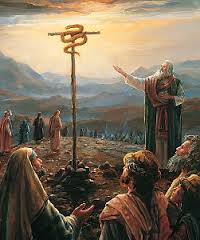
serpentFew books in the Bible hide their riches better than the book of Numbers. Concealed by an accountant’s title (‘Numbers’) and begun with a lengthy census (ch. 1), the casual reader of Numbers may come to the honest, but mistaken, notion that this is a boring, impractical book.

However, Paul has the exact opposite feeling. In 1 Corinthians 10, he says that the events of Numbers (along with everything in the five books of Moses) “were written down for our instruction, on whom the end of the ages has come” (v. 11). Specifically, Paul lists Israel’s sexual immorality at Baal-Peor in Numbers 25 (vv. 7–8), the incursion of serpents in Numbers 21 (v. 9), and the grumbling of Israel which occurred throughout the exodus journey (v. 10).

In truth, Paul reminds us that these ancient words are ever true and that in God’s wisdom they were written down for me and you. To put it more generally, the book of Numbers is not simply a book of Jewish history, a record of priestly duties, and medicinal wound care for scabs and leprosy victims. Oh no. It is more. It is a book of Christian Scripture that points us to Christ. Continue reading