 When Paul was taken to Rome, Luke describes the harrowing sea journey to Italy in Acts 27. Embarking on a ship from Adramyttium, a seaport in Asia Minor (v. 2), Paul crossed the Mediterranean. From Myra (v. 5), Paul and his guard found passage on a ship of 276 men, complete with many other soldiers (v. 31) and prisoners (v. 42). While Paul doubted the safety of the journey, based on the time of year (vv. 9–10), the centurion and the majority of the crew decided to head out (vv. 11–12).
This perilous journey sets up the dramatic events at sea, the near drowning of the passengers, and the eventual sinking of the ship. Verse 13 begins with gentle breezes as the ship sets sail, but all turns stormy in verses 14. Verses 14–20 recount the evasive actions taken by the crew (e.g., turning the ship out of the wind, lowering the gear, jettisoning cargo), and verses 21–26 introduces Paul’s “I told you so” coupled with gracious promise from the Lord.
21 Since they had been without food for a long time, Paul stood up among them and said, “Men, you should have listened to me and not have set sail from Crete and incurred this injury and loss. 22 Yet now I urge you to take heart, for there will be no loss of life among you, but only of the ship. 23 For this very night there stood before me an angel of the God to whom I belong and whom I worship, 24 and he said, ‘Do not be afraid, Paul; you must stand before Caesar. And behold, God has granted you all those who sail with you.’ 25 So take heart, men, for I have faith in God that it will be exactly as I have been told. 26 But we must run aground on some island.”
In these words, we find two doctrinal lessons—the first, an illustration of eternal security as Paul later tells the passengers they must remain on the boat to receive “salvation.” In Acts 27, salvation (defined as the preservation of life) is secured by means. Thus, it serves as handy illustration of how God provides eternal security through God-provided means. Or as Thomas Schreiner and Ardel Caneday explain in their book The Race Set Before Us: A Biblical Theology of Perseverance and Assurance, “Acts 27 illustrates well the fact that exhortations and warnings are a signficant means by which God moves humans to act so that his promises to them will be fulfilled” (212). This is the first illustration, well covered Schreiner and Caneday (pp. 209–212).
The second doctrinal lesson pertains to God’s common grace and the variety of ways grace is conveyed to unbelievers through the lives of Christians. I will consider this below. Continue reading
 As we begin 2017, our church has taken January to focus on a handful of spiritual disciplines—personal and public. The first in our series is prayer. But instead of just commending its importance and techniques to help, I took the route of seeing how God forms desire for prayer in our hearts.
 Often, when we come to spiritual disciplines we list them, plan for them, and then labor to perform them. In the best scenario, we realize—sooner rather than later—we can’t do them apart from the power of the Holy Spirit. And so we pray and ask God to help us.
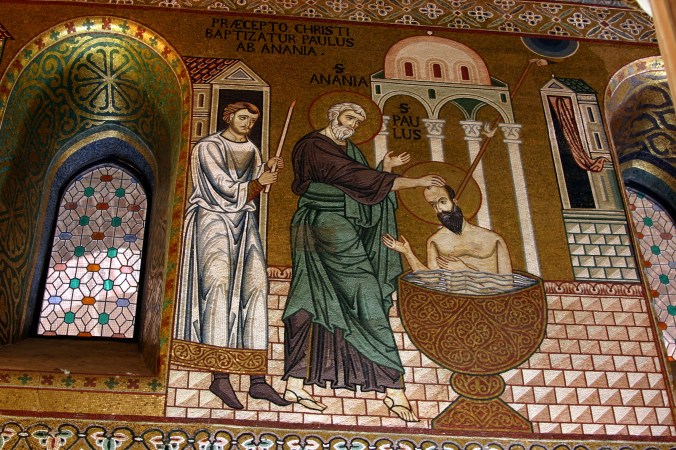 The book of Acts is pivotal for understanding the nature and function of the church. It is also challenging, because it presents a church that is “born” on Pentecost, at first contained to Jerusalem, but later expanded to Judea and Samaria and finally unleashed the ends of the earth. At the same time, it’s founding members were believers before receiving the Spirit and yet the gift of the Spirit is one of the distinguishing marks of the church as it spreads from Israel to Italy. In four instances (Acts 2, 8, 10, 19), the Spirit is given, but in no two instances are the exact events the same. For instance, speaking in tongues accompanies the Spirit in Acts 2, 10, 19, but not Acts 8. Likewise, water baptism precedes the Holy Spirit in Acts 8, but follows in Acts 10.
 Any alert reader of Matthew’s Gospel will notice the tax collector-turned-evangelist is regularly quoting from the Old Testament. To him, the events of Jesus birth, life, death, and resurrection “fulfill” the prophecies of the Old Testament. What may be less evident is that the other Gospel writers who are less explicit in their citations are equally informed and shaped by the Old Testament.
 There is a story from WWI that reminds us that in the worst of times, there’s still hope. Nearing the end of December 1914, 5 months after WWI began, British soldiers heard their German foes singing Christmas Carols after a day of fighting.
 Few passages of Scripture are heavier than Matthew 2:16–18, the historical account of Herod’s slaughter of the innocent children in Bethlehem. But few passages are also able to reach the depths of human loss and comfort the grieving in their deepest pain.
 In your Law it is written that the testimony of two people is true.
 When I was in college and a young believer, one of the first Christian books I read was Bill Bright’s
  Via Emmaus