Preaching to the Late Modern Mind: Five Cultural Narratives to Know

preachingIn his book Preaching: Communicating Faith in an Age of Skepticism, Tim Keller addresses how Christianity confronts culture. Wisely he speaks of the way we must (1) affirm truth in culture, (2) confront idols in culture, and (3) show how truth in culture is derived from and only satisfied by the Christ who reigns supreme over all cultures. Thus, instead of just being for or against culture, Keller describes a “Yes, but no, but yes” approach for preaching Christ to culture.

Approaching culture in this nuanced way means understanding the modern world in which we live. In a chapter entitled “Preaching and the (Late) Modern Mind,” he describes the difference between the pagan, pre-Christian world and the way in which Christianity brought dignity and personal value to the West. In other words, before Christianity emerged in the West, the pagan world with its philosophers conceived of the world as an impersonal universe. Belief in a tri-personal God, sovereignly directing history and seeking to redeem humanity changed all of that. And the bounty of the Western world, therefore, is a byproduct of Christianity’s influence.

In one place, Keller nicely summarizes five differences between the pre-Christian world with the Christian West. He then goes on to explain how secularism has taken Christian values to the extreme, making them idolatrous falsehoods. But in explaining how Christian values have gone rogue, he doesn’t include them in his compact table. On page 128, there is one column missing (that would help flesh out his argument on pp. 128–33).

So, I added the third column to the table below to help show the way in which the West has left Christianity behind and distorted many of the values it provided. By seeing in our culture post-Christian culture the traces of Christian thought, we can as Keller points out, begin to lead people back to the source of the values (e.g., science, individualism, personal choice) they embrace today. Indeed, if you value and enjoy science, justice, or personal choice today, it is worth noting where those cultural gifts derive. Keller’s chapter on preaching Christ to culture is an excellent place to begin thinking about that relationship.

Five Chief Narratives of Western Thought[1]

Before Christianity Emerged [in the West] After Christianity Came to the West After Christianity ‘Left’ the West
The body and material world are less important and real than the realm of ideas The body and material world are good. Improving them is important. Science is possible. Science is absolute. Materialism is absolute. Technology is sufficient to solve our problems.
History is cyclical, with no direction. History is making progress. Progress means history is unimportant. Everything novel is superior to the past.
Individuals are unimportant. Only the clan and tribe matter. All individuals are important, have dignity, and deserve our help and respect. Individuals are supremely important. Individualistic expression should never be questioned, even when detrimental to the group.
Human choices don’t matter; we are fated. Human choices matter and we are responsible for our actions. Choice is sancrosanct and must be guarded and guaranteed at all costs.
Emotions and feelings should not be explored, only overcome. Emotions and feelings are good and important. They should be understood and directed. Emotions and feelings are determinative. To feel authentic I must express my desires and never suppress them.

In sum, these “five axes,” which Keller adapts from Charles Taylor (The Secular Age), help diagnose some of the challenges in front of us. Together these five narratives can be classified as follows:

  • rationality (and an explanation of where the world came from and what we can know about it),
  • history (and the meaning of life),
  • society (and the relationship of individuals to groups),
  • morality (and who gets to determine right and wrong), and
  • identity (and where we get our sense of value and purpose).

To be sure, these realities do not drive our exegesis of the biblical text, but in communicating that text to others we must be aware of these ideas. Knowing these cultural baselines helps us affirm and deny the beliefs we find in individuals and in our surrounding culture. Preachers must be aware of these realities to wisely apply God’s Word.

Indeed, all Christians should have a growing awareness of cultural presuppositions. Why? So that we will not be ensnared by them, and so we can communicate the gospel by rightly affirming some cultural desires as finding their telos in Christ and by confronting others cultural idols as errant promises that ultimately lead to death (Prov. 14:12).

In short, Keller’s sections on preaching Christ in a post-Christian culture are worth considering. They challenge the faithful witness to love his neighbor(s) by knowing what his neighbor believes and loves. Therefore, while planting ourselves in God’s unchanging Word, we must also learn how to share Christ with others who embrace various aspects of the aforementioned narratives.

To that end, let us continue to give ourselves the Word and the world, so that we can take the good news of the former to meet the dire needs of the latter.

Soli Deo Gloria, ds

_________________

[1] Timothy Keller, Preaching: Communicating Faith in an Age of Skepticism (New York: Viking, 2015), 128. First two columns are verbatim; the last column summaries Keller’s prose.

Trust the Process: Learning to Make Disciples and Develop Leaders like Jesus

fireIf you go to church, I’m sure you’ve experienced the “foghorn announcement.” What’s the foghorn announcement, you say? It’s the long, droning, monotonous, unenthusiastic call for workers in the nursery, volunteers at the picnic, or helpers with an outreach event. It goes something like this:

Hi, the pastor asked me to make an announcement. So, here it goes. I know you are busy—we are all are busy, aren’t we—but we have an event coming up and we need help. We’ve made this announcement for the last three weeks. But we still don’t have enough help. It won’t take too much time and anyone can do it. Just sign up in the back as you head out today. 

Okay, this might be a bit overly dramatic—or underly dramatic. But these announcements are as common in well-meaning churches as foghorns on the coast of Maine. They begin with an apology; they make some non-descript invitation for everyone to do something; they often motivate with guilt, ease, or fear; and they fail to capture the wonder that the God of the universe who is building his church permits us to be a part of his work.

Surely, Jesus didn’t recruit leaders this way, did he? Therefore, the question hangs in the air: How do we recruit people to serve in the church? And how, especially, do we call leaders to follow us as we follow Christ? Continue reading

Working Smarter: Five Personal Reflections from David Murray’s ‘Reset’

resetLast week our family took time to decompress and visit the beautiful mountains around Gatlinburg, Tennessee. While there I read Reset: Living a Grace-Paced Life in a Burnout Culture by David Murray. For those in ministry or committed to serving in the local church on top of work, family, and all else, this is an important book. In ten “repair bays” Murray gives practical steps to recovering from burnout and finding rest in the midst of serious labor. I commend the book as a whole and found a number of things particularly applicable. Here are five of them. Continue reading
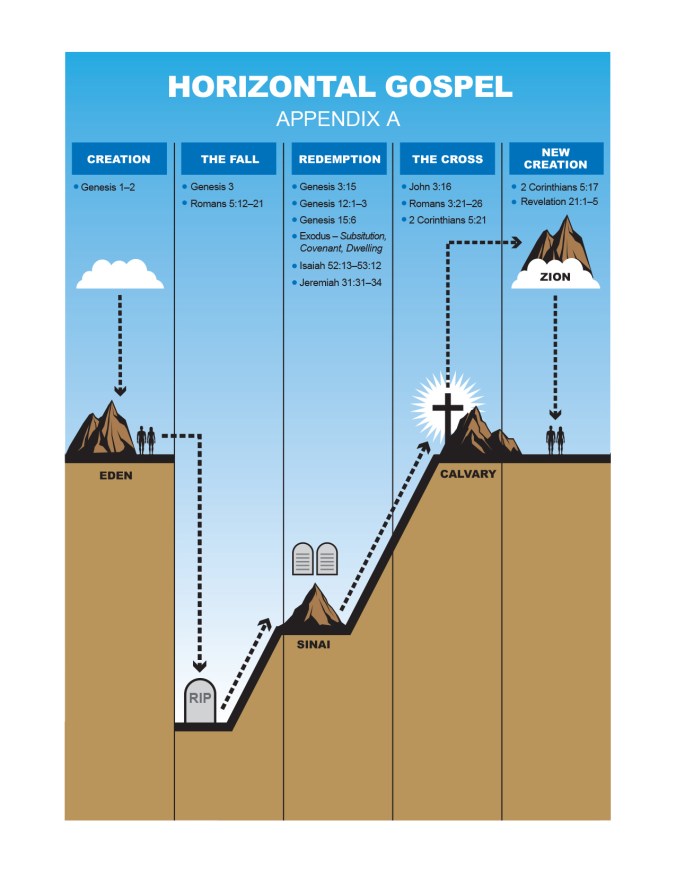
The Horizontal and Vertical Gospel

When I share the gospel at our Discover OBC Class—our new members class—I usually talk about the gospel from two angles. One follows the contours of the ‘horizontal’ storyline of Scripture (Creation — Fall — Redemption — New Creation); the other focuses on the ‘vertical’ relationship with God (Holy God — Man Dead in Sin — Christ — Response). For me, this has been a helpful way to present the gospel, as it sets the person and work of Jesus into the storyline of the Bible.

Typically, I draw these two aspects of the gospel on a whiteboard or a napkin. But this week one of our elders put those presentations into two graphic designs—far better than any napkin I’ve drawn. Here they are. I think they speak for themselves, but feel free to ask questions or suggest enhancements. But even better, go share the gospel with someone—from the whole storyline of the Bible and its centerpiece the person and work of Jesus Christ.

horizontal02vertical01

Soli Deo Gloria, ds

The Soundtrack of Salvation (pt. 2): The Family Tree of David in Psalms 42–72

the-psalms

How do you know who you are?

For all of us stories, especially family stories, define who we are. While the world tells us we can define ourselves however we want, the truth is we need an overarching story to set the context for our lives. Apart from Christ, we seek to write a story with our lives that satisfies our cravings and bolsters our self-confidence.

When we come to faith in Jesus Christ, however, we not only receive the Lord’s righteousness and life, we also receive his name, his family, and his history. Importantly, Jesus’ family history does not begin in a Bethlehem stable, it goes back to Ruth and Boaz—another family in Bethlehem. And in the birth of their great-grandson David, we find the foundational patriarch who defines the royal family of King Jesus and all of human history. In the Psalms David is the central figure. In Book 1 he is the author and centerpiece of (almost) every psalm. And now in Book 2, he continues to have the leading role.

This week, building on the message from last week, we consider how the sons of Korah, Asaph, and Solomon all factor into David’s later life. As I argue in the sermon, Book 2 begins with the highpoint of David’s life in Psalms 45–46; it then plummets into the conflicts that arise following David’s sin with Bathsheba in Psalms 51–71; it concludes with God intervening to save David and establish David’s son Solomon on the throne in Psalm 72. In this story we find the family story of David, of Jesus, and of every child of God who has entered into David’s story by way of trust in David’s Son.

You can listen to the sermon online or read the sermon notes. But perhaps most helpful are two infographics that display the story of Psalms 1–72. Here are the infographics, also in PDF (Book 1 and Book 2). Below are discussion questions and resources for further study.

Continue reading

Reading the Psalms Canonically: Neither Undisciplined Allegory nor Christ-less Historicism

psalmsHow did we get the Psalms? And how do we get into the Psalms? Meaning, how do we apply the Psalms of ancient Israel to ourselves today? And in applying them, how do we avoid undisciplined allegory and mere historicism devoid of Christ?

These are important questions for reading the Psalms. And few have answered these questions better than Bruce Waltke.

In his essay, “A Canonical Process Approach to the Psalms” (found in Tradition and Testament: Essays in Honor of Charles Lee Feinberg, 3–18) he observes four historical phases in the development of the Psalms. And rightly, I believe, he helps us to see (1) how individual authors wrote Psalms, (2) how these Psalms were gathered into various collections (perhaps stored in Solomon’s temple), (3) how these collections were arranged at a later period by a (Levitical?) editor, and (4) how this collection of Psalms serves to point forward to the Messiah, the Lord Jesus Christ, who has now come and fulfilled the Law, the Prophets, and the Psalms (Luke 24:44–47). Continue reading

The Soundtrack of Salvation (pt. 1): Walking the Hills and Valley of Psalms 1–41

the-psalms

The Psalters is comprised of 150 Psalms, divided into five books. Is this incidental? Or should we seek to discern the message of the Psalms by examining the five books?

Last week, we started our journey through the Psalms, as we considered the way Psalms 1–2 introduce the whole book. This week, we looked at the first 41 Psalms. In particular we traced, what I called three hills and a valley. You can see the arrangement in this PDF. I argued that each grouping of Psalms can be observed by careful attention to the literary structure and that each hill or valley has a unique message related to the overarching theme(s) of the book

You can listen to the sermon online or read the sermon notes. Discussion questions are below, as well as a few sources I consulted to help ‘see’ the shape of Book 1.  Continue reading

Four Exegetical Commitments to Doing Biblical Ethics

ethicsIn his chapter ethics in Progressive Covenantalism, Stephen Wellum lists four commitments necessary for doing biblical ethics. These principles for doing ethics take into account the progressive revelation of Scripture, the progression of biblical covenants, and the unity and diversity of ethical commands in the Bible. In short, they are commitments we should make whenever we seek to be ‘biblical’ in our ethical formulations.

This approach to ethics fits with a larger vision of how to put the Bible together and provides a helpful, “thick” reading of Scripture with regards to Christians ethics. Below are the four commitments drawn from his chapter. I commend them to you and further consideration on how every topic of ethics requires a whole-Bible approach to the subject.

(For two examples of how this approach might be worked out, you can see how I sought to handle racial reconciliation and transgenderism in two recent sermons). Continue reading

On the Need for Exegetical Typology: Circumcision as a Test Case

bookLast month the Southern Baptist Journal of Theology (SBJT) published an article I wrote. In “From Beelines to Plotlines: Typology That Follows the Covenantal Topography of Scripture,” I argued that (most, if not all) typological structures begin in creation, move through the undulating contours of Israel’s covenant history (hence, covenant topography), until they find their terminus in Christ. Then, after being fulfilled by the person and work of Jesus Christ, they are continued in the new covenant people of God. My test case, or textual proof, was the typology of the priesthood. If you are interested, you can read the article online. I’d be interested in your feedback.

Today, however, I’m interested in looking at another test case, namely the typology of circumcision found in the Bible. I believe that the only way we can understand circumcision (and its relationship to baptism) is by looking at its development in the canon. And thankfully, instead of making that case, John Meade has already done so (far better than I could) in his chapter, “Circumcision of the Flesh to Circumcision of the Heart,” in Progressive Covenantalism: Charting a Course between Dispensational and Covenantal Theologiesedited by Stephen Wellum and Brent Parker.

Building on his earlier work on circumcision and its cultic origins and priestly intentions in Egypt, Meade shows how circumcision from the start was a sign, with in-built tension designed to lead to a greater reality—namely, circumcision of the heart. Indeed, as one follows the narrative of the Old Testament we can see how, long before the New Testament applies this sign to Christ (Colossians 2:11–12) and the people of faith (Philippians 3:3), the sign of circumcision is already shifting. From a careful reading of Deuteronomy, Jeremiah and the Prophets, Meade makes this point, and I share a few of his conclusions below. Continue reading

Textual, Epochal, Canonical: Do The Three Horizons of Interpretation Apply to the Psalms?

horizonWhen I teach hermeneutics, one of the key points I make is the need to read each passage with three horizons in mind. These horizons have been labeled by Edmund Clowney and Richard Lints as the textual, epochal, and canonical horizons. And careful attention to them help the interpreter keep an eye on the the grammatical structure of any given text, the relationship of that ‘text’ to the larger context of the book or covenant in which it is found, and the final connection between that text and the whole of the Bible—hence, textual, epochal, and canonical horizons respectively.

In books like Exodus, Ezekiel, and Ephesians, it is makes sense to read the Bible at these three horizons. But what about the Psalms? Does this approach apply to them? Indeed, if the Psalms are a book purposefully arranged, it does. And so, I do believe we should employ these three horizons when reading any given Psalm.

Reading the Psalms Textually, Epochally, and Canonically

As we study the Psalms, we should look not only at the immediate Psalm, but where it fits into the Psalter and the storyline unfolding in this eschatologically-charged book. On this point, Psalm scholar John Crutchfield has rightly observed that a faithful reading of the Psalms must consider three levels of interpretation. Under a section entitled ‘Methodology and Presuppositions” (Psalms in Their Context: An Interpretation of Psalms 107-118), here’s what he says: Continue reading