Politics According to the Bible (1): Five Wrong Views

[This is the first in a series of posts on Wayne Grudem’s Politics According to the Bible: A Comprehensive Resource for Understanding Modern Political Issues in Light of Scripture].

Wayne Grudem begins his discussion of politics and the Bible by outlining five wrong views.  These include: (1) Government Should Compel Religion, (2) Government Should Exclude Religion, (3) All Government Is Evil And Demonic, (4) Do Evangelism, Not Politics, and (5) Do Politics, Not Evangelism.  Lets look at each of these unbiblical approaches.

Government Should Compel Religion

First, Grudem appeals to the State Church’s that have arisen in Christendom where citizenship and religious affiliation are coterminous.  He relates these to the similar models of government found in Islamic nations today.  He shows that these are not Scriptural as he points to Jesus making significant distinction between the sphere of Caesar’s kingdom and the sphere of God’s kingdom (Matt 22:20-21).  He argues that this view is not tenable according to the Bible, nor does it result in the kind of faith and repentance, that Christ requires.

Government Should Exclude Religion

Second, he argues against the kind of secular government that denies any place to faith.  This is the kind of government promoted by the ACLU and Americans United for Separation of Church and State.  In the United States, this view is often grounded on the misunderstood statement about separation of church and state made by Thomas Jefferson in his letter to the Danbury Baptist Church (Danbury, CT).  It demands religion to be voiceless in the public sector and it “changes freedom of religion to freedom from religion.”  Yet, this was not Jefferson’s intention in 1802, nor is it compatible with the Bible which features numerous examples of God’s people influencing kings and rulers (Joseph, Daniel, John the Baptist, and Paul, to name a few).  This kind of regime is also seen in other countries that have persecuted Christians.  It is clearly unbiblical.

All Government Is Evil and Demonic

Third, the view that demonizes government does so from a misreading of Luke 4:6 which quotes Satan as saying, “To you I will give all this authority and their glory, for it has been delivered to me…” Proponents of this view include Gregory Boyd, who argues that every form and function of government is evil.  However, as Grudem points out, Boyd and his ilk, fail to consider the whole counsel of Scripture.  For explicitly in Romans 13 and 1 Peter 2, Paul and Peter instruct Christians to submit to governing authorities who are discharging God’s ‘ministry’ of government.  Moreover, Grudem points out that this view depends on the reliability of Satan’s description of his own authority in Luke 4:6, which is a highly speculative reality based on the deceitful character of Satan (cf. John 8:44).

In the end, Grudem points out that this view fails to recognize the difference between good and evil systems of government, and by extension it calls good evil and evil good.  Thus, it leaves citizens paralyzed and unable to resist or reform governmental structures for the good.  It results in an insipid pacifism that is not what the Bible requires.

Do Evangelism, Not Politics

Fourth, Grudem challenges evangelicals who distance themselves from political engagement due to the ‘hopeless’ enterprise that it is.  He suggests that those who advocate evangelism over against politics “narrow an understanding of ‘the Gospel’ and the kingdom of God” (45).  He warns that those who take this approach undervalue the effect that political involvement has for the gospel.  He provides a helpful illustration of the difference between heavily evangelized South Korea and repressive North Korea, and the resulting effect this has had in their respective countries.  He writes,

Governments can allow churches to meet freely and evangelize or they can prevent these things by force of law (as in Saudi Arabia and North Korea). They can hinder or promote literacy (the latter enabling people to read a Bible). They can stop murderers and thieves and drunk drivers and child predators or allow them to terrorize society and destroy lives. They can promote and protect marriages or hinder and even destroy them. Governments do make a significant difference for the work of God in the world, and we are to pray and work for good governments around the world (46).

While agreeing with his main objection, I think Grudem shows uncharacteristic imprecision on this point.  He argues that “the whole Gospel includes a transformation of society” (47).  I am not convinced this is “necessarily” true.  For instance, in countries where Christianity is outlawed, societal transformation may not come to fruition, because Christians may be martyred before they are ever able to transform their nation.  Even in situations where the blood of the martyrs brings change in time, it may take generations, so that to say the gospel “includes a transformation” is a little misleading.

On this point, he continues, “Forgiveness of sins is not the only message of the Gospel” (47).  But is that biblically the best way to say it?  If Grudem had said, “Forgiveness of sins is not the only message of the Bible,” or “Forgiveness of sins is not the only ministry of the church,” I would agree.  The Bible certainly teaches Christians how to love their families, serve their employers, and fight for justice.  Likewise, the ministry of the church does include caring for orphans, widows, and the unborn.  So then, in these ways, the Bible says more than “Believe on Jesus Christ, and you will be saved.” However, when the gospel is defined as “forgiveness” and “societal transformation,” it enlarges the gospel in unbiblical ways.

In fact, Mark Dever preached against this very thing in his 2008 Together For the Gospel message, “Improving the Gospel: Exercises in Unbiblical Theology,” when he warned of making the gospel more than the salvation of sinners (see his chapter in Proclaiming a Cross-Centered Theology, pp. 106-109).  Grudem seems to make the gospel message coterminous with the whole counsel of Scripture, and by implication he includes gospel entailments within the message of the gospel.

I think Grudem, when he argues against  the “Do evangelism, Not politics” view, but his treatment of the gospel in this section needs more attention. (For more on the central tenets of the gospel, see Greg Gilbert, What is the Gospel?)  Within this section, however, Grudem does present some other helpful points, namely that God has intended the church and the government to work in tandem to effect positive change against the evil that is resident in our society.

Another point worth pondering in this section is the way that church history has demonstrated countless ways that Christians have influenced government for good.  He cites from Alvin Schmidt’s book How Christianity Changed the World, and lists dozens of social improvements from the discontinuation of the Roman gladiatorial games to the prohibition of burning widows alive in India.  Then Grudem names a number of Christians who have effected social justice in the world to show how has positively shaped our country (50).

Still, it would be helpful at this point to make a distinction that not all these “Christians” were orthodox, gospel-believing brothers in Christ.  No doubt, Martin Luther King, Jr. was used by God to bring about civil rights throughout the United States, but it must be asked, “Was Dr. King’s doctrine orthodox and evangelical?”   Grudem doesn’t make that distinction, which is an unfortunate lacuna.

Do Politics, Not Evangelism

Finally, his fifth wrong view is the one that says “Do Politics, Not Evangelism.”  According to Grudem, few respected evangelicals hold this Social Gospel view (53), however pastors Rob Bell and Brian McLaren are two influential proponents of a sub-standard gospel message who are advocating political and social change.  Their popular books and speaking tours are infecting many with a “New Kind of Christianity” that aims to advance the kingdom of God through social and political involvement and that denudes the gospel of its saving message.

Overall, Grudem’s first chapter is a helpful taxonomy of wrong views of government and politics.  It sets the stage for chapter 2, where he will develop “a better solution,” one that urges “significant Christian influence on government” (54). Preparing for this view, he closes his first chapter with a balanced statement on politics according to the Bible.

Genuine, long-term change in a nation will only happen (1) if people’s hearts change so that they seek to do good, not evil; (2) if people’s minds change so that their moral convictions align more closely with God’s moral standards in the Bible; and (3) if a nation’s laws change so that they more full encourage good conduct and punish wrong conduct. Item 1 comes about through personal evangelism and the power of the Gospel of Jesus Christ. Item 2 takes place through personal conversation and teaching and through public discussion and debate. Item 3 comes about through Christian political involvement. All three are necessary (54).

Soli Deo Gloria, dss
Politics and the Bible

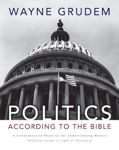
Wayne Grudem has come out with a massive volume on politics and the Bible (619 pages).  It is entitled Politics According to the Bible: A Comprehensive Resource for Understanding Modern Political Issues in Light of Scripture, and it contains biblical exegesis, theological reflection, and ethical discussion about ‘everything’ that one may encounter in the world of politics.

It is a great resource for someone who likes to read but has done little reading in the area of politics–someone like me!  Moreover, it is a tremendous guide for Christians to think through the matter of politics–a subject many Christians discuss with regularity and passion–with the light and wisdom of the Bible, and not simply conservative or progressive rhetoric.

Thus in an attempt to learn more about “politics according to the Bible,” I am going to endeavor to read a chapter a day between now and election day (Nov 2) to better understand a biblical view of politics and to discern how and where a pastor should be involved in the process (see Grudem pp. 71-73).  And as a measure of discipline, or self-inflicted perspiration, I am aiming to catalogue my thoughts from each chapter as I go, giving a synopsis of each chapter and the helpful biblical analyses provided by Professor Grudem.

I hope this may help others think through political matters biblically (especially those in my own church) and that others may be encouraged to pick up and read, or reference, Grudem’s new book.  At this point, I cannot commend or condemn Politics According to the Bible, I can only suggest it as an important subject (especially at this time) and Grudem as a reliable teacher–he is a conservative, Bible-believing, advocate of sound doctrine (see his Systematic Theology).  I anticipate it being a helpful book, and one that certainly has the right foundation on which to build–the word of God.

I hope you will join me in thinking through these matters biblically, so that we would better understand what the whole counsel of God says concerning the political enterprise.  And maybe, if you are so inclined, you will pick up Grudem’s volume and read along– right now it is 40% off at the WTSBookstore.

Soli Deo Gloria, dss

William Wilberforce: A Factory of Good Works

I love the way politician William Wilberforce united his faith to his legislative action.  For those who don’t know Wilberforce, he was the single driving force in England to end the slave trade.  He was a peer of John Newton, pastor and author of the hymn “Amazing Grace.”  He was a bold advocate for public justice, but one who spent countless hours in personal meditation on the truth of God’s word.  In other words, his appeals for justice were fruit the Spirit at work in his life.

Consider John Piper’s description of Wilberforce in his biographical sermon, “Peculiar Doctrines, Public Morals, and the Political Welfare.”  He shows how good works overflowed from this man who was filling his mind with Christian truth and walking in the power of the Spirit.

What made Wilberforce tick was a profound Biblical allegiance to what he called the “peculiar doctrines” of Christianity. These, he said, give rise, in turn, to true affections – what we might call “passion” or “emotions” – for spiritual things, which, in turn, break the power of pride and greed and fear, and then lead to transformed morals which, in turn, lead to the political welfare of the nation. He said, “If . . . a principle of true Religion [i.e., true Christianity] should . . . gain ground, there is no estimating the effects on public morals, and the consequent influence on our political welfare.” [1]

But he was no ordinary pragmatist or political utilitarian, even though he was one of the most practical men of his day. He was a doer. One of his biographers said, “He lacked time for half the good works in his mind.” [2] James Stephen, who knew him well, remarked, “Factories did not spring up more rapidly in Leeds and Manchester than schemes of benevolence beneath his roof.” [3] “No man,” Wilberforce wrote, “has a right to be idle.” “Where is it,” he asked, “that in such a world as this, [that] health, and leisure, and affluence may not find some ignorance to instruct, some wrong to redress, some want to supply, some misery to alleviate?” [4] In other words, he lived to do good – or as Jesus said, to let his light shine before men that they might see his good deeds and give glory to his Father in heaven (Matthew 5:16).

But he was practical with a difference. He believed with all his heart that new affections for God were the key to new morals (or manners, as they were sometimes called) and lasting political reformation. And these new affections and this reformation did not come from mere ethical systems. They came from what he called the “peculiar doctrines” of Christianity. For Wilberforce, practical deeds were born in “peculiar doctrines.” By that term he simply meant the central distinguishing doctrines of human depravity, divine judgment, the substitutionary work of Christ on the cross, justification by faith alone, regeneration by the Holy Spirit, and the practical necessity of fruit in a life devoted to good deeds. [5]

Wilberforce’s public service is not only a model for Christian politicians, but a model for all Christians.  He was a factory of God works, as his friends attested, and in this way he shows the kind of worldly good the gospel can effect when a man is gripped by the “peculiar doctrines” of Jesus Christ.

May we consider his life and imitate his faith.  (Piper’s biography is available online and in print.  I would encourage you to read or listen to it).

Soli Deo Gloria, dss

A Spiritual Fruit Inventory

Most church-going Christians have participated in a Spiritual Gifts Inventory (SGI).  You know, the one where you sit down to fill out a paper-and-pencil test of things you like, don’t like, are good at, bad at, and don’t know.

Personally, I am not a fan.  It is a fleshly way of discerning the Spirit’s work in your life.  I believe these forms are well-intended and have catapulted many vibrant Christians into active church ministry, but they may have also wrongly directed people away from genuine gifts of the Spirit.   Rather, I have found that the best SGI is found in the honest and loving people of God who are called to judge fellow believers with grace and truth.  Serving in the church is the best Spiritual Gift Inventory.

With that caution in mind, what I offer below, may be just as fleshly and unhelpful…but I hope not.

In preparing for Sunday’s message, I found a Spiritual Fruit Inventory (SFI), that I tweaked and will hand out on Sunday.  Unlike its cousin, the SGI, the SFI, is designed not to lead us down a path to ministry, but down a path to the cross, because it will either show the absolute deficiency of fruit in the life of the believer, in which a true believer has but one response: repentance and gratitude for Christ’s atoning blood.  Or second, it will prompt overwhelming gratitude that the Spirit is at work.  I suspect, as I see in my own life that it is both.  (One other note: it could lead a “believer” to realize that by the conspicuous absence of the Spirit’s fruit that he is not in fact saved; see Matthew 13:1-23).

When I look at Galatians 5:22-23, I see 9 qualities that are present in my life, but oh how anemic is the fruit.  Yet, I take heart that this is the Spirit’s work, not mine.  The only imperative in Galatians regarding the Spirit is to “Walk in the Spirit” (Gal 5:16, 25).  As we do that, fruit will come.  It has to; born again believers bear fruit!  So, as I contemplate the questions below, I go to the cross with sorrow and gladness, and I return to keep walking with the Spirit, praying to the Father to grow in me the life characteristics of Christ–love, joy, peace, patience, kindness, goodness, gentleness, faithfulness, and self-control.

Here is the Spiritual Fruit Inventory.  Feel free to use it for your personal devotion or for your corporate ministry.

Soli Deo Gloria, dss

SPIRITUAL FRUIT INVENTORY

On a scale of 1-5 (bad-good), rate your spiritual fruit.  Then after you have done that, ask a friend, spouse, or family member to do the same.  Compare notes.  Go to God and thank him for the Cross, the Power of the Spirit, and the Promise of Progressive Sanctificaiton.  Continue to walk in the Spirit, by Faith in Christ’s atoning work on Calvary and his sanctifying work in you.

Love: Are you obedient to God’s word?  Do you delight in spending time with God? Does your love for God reflect in love for others?  Would others describe you as loving?  Do you love the unlovable? Or just the likeable?  

Joy: Is your joy based on circumstances?  Have you found joy in the midst of trials?  When you are discouraged, is Scripture your source of joy?  If not, why not?

Peace: Do you know the peace that passes understanding? When alone, are you at peace? When anxious, do you set your mind on God in Christ?  If not, why not?

Patience: Do you accept interruptions and delays with grace and peace? Do you see God’s larger plan at work in your life? How do you view people: as hindrances to be avoided or hurting people to be loved?

Kindness: Would your family call you “kind”?  Are your words refreshing & life-giving? Or sarcastic & mean? Do you seek ways to encourage others?

Goodness: Do you invent ways to help others?  Or do you relish putting others down?  Is your goodness forced or free?  Are you ‘good’ to please others or God?

Faithfulness: Do you keep your word? Do you finish what you start?  Are you a hard worker? Does your church attendance reflect faithfulness?

Gentleness: Are you quick to listen? Slow to speak? Slow to anger? Do your moods swing?  Is your language abrasive or harsh?  Do others confide in you?

Self-control: Are you free from addictions—illegal or legal? Do you have mastery over your thoughts, speech, actions? Do you think before you act?  Are your decisions governed by Scripture? Is your discipline lawful or loving?

A Man’s Spiritual Toolbox

A few weeks back, I had the privilege of speaking to the men of Terrace Lake Community Church, a sister SBC church, in our association.  We had a great time considering what Scripture teaches about manhood, and I wanted to lay out a few books, resources, and websites that would help them (and anyone else) continue to grow in masculine godliness.  Consider it a Man’s Spiritual Toolbox.

MANHOOD

# 1 : Manly Dominion (book)

Don’t be a passive, purple 4-ball!  In a world of chaos and disorder, Pastor Mark Chanski challenges men from Scripture (specifically, Genesis 1:26-28) to live with the God-given mandate to take dominion in their spheres of influence.  He addresses a variety of subjects, ranging from decision-making, to vocation, to the pursuit of romance.  We are using this book in our monthly men’s breakfast our church (Calvary BC in Seymour, IN).  If 1 Corinthians 16:13grips you– “Be watchful, stand firm in the faith, act like men, be strong”– than this is a great book to motivate you to forsake passivity and pursue manly dominion under the Lordship of Jesus Christ.

# 2 : Masculine Mandate (book)

Richard Phillips is a gifted exegete and author who continues to write books for the edification of the church.  This book, however, did not come from his pulpit ministry, but from a passion to reach men.  He takes his “masculine mandate” from Genesis 2:15, which instructs Adam to cultivate and guard the garden.  By extension, he argues from Scripture that men are to embrace this work of cultivation in everything they do, especially in the home, in the workplace, and in the church.  This book is similar to Manly Dominion, but has enough biblical exposition and different material that it is worth reading, as well.

# 3 : The Council For Biblical Manhood and Womanhood (website)

This ministry promotes the biblical view that men and women are made equally in the image of God, but with different roles.  This “complementarian” view of men and women is expressed most fully in the Danvers Statement, drafted in 1988 to counter the rise of evangelical feminism permeating North American churches.  CBMW’s website has countless biblical resources and practical guides for cultivating a complementarian view of men and women in the church and Christian homes.

MARRIAGE, WORK, CHILDREN

# 4 : Married For God (book)

A few years ago, in a research project, I read through about 20 different books on marriage.  There are many good books out there on marriage (John Piper’s This Momentary Marriage, Geoffrey Bromiley’s God and Marriage, and Dave Harvey’s When Sinners Say I Do are at the top of the list), but Christopher Ash’s was, in my opinion, the best.  It takes many of the Edenic principles laid out in Genesis 1-2 and shows how marriage is not an end in itself.  It is not simply designed to ameliorate loneliness or quench the burn or youthful desires–though it does both of these–rather it is designed by God to radiate his glory and to catalyze his gospel.  Be fruitful and multiply undergirds the Great Commission mandate to “Go and disciples” and Ash’s books shows from Scripture how husbands and wives can live for something bigger than their own marriage–namely the glory of God–and thus in the process their are more united and satisfied in their own nuptial union.

# 5 : A Biblical Theology of Work (blog post)

Justin Taylor, as always, provides a bevy of resources to motivate men to work hard for the glory of God.  Piper’s chapter from Don’t Waste Your Life is the place I would begin, and then to look at all the other resources to show how a man’s work is not disconnected from the work of God in the world.  Another resource for Christian businessmen is Wayne Grudem’s Business for the Glory of God. For anyone who devotes minimally 40 hours a week to a job, and more likely the number is like 50-60 hours, it is vitally important to understand how to pursue your vocation in a way that please God and pushes you towards Christ, not away.

# 6 : Shepherding A Child’s Heart & Instructing a Child’s Heart (books)

In these two books, Tedd Tripp outlines a number of biblical strategies for raising children in the fear and admonition of the Lord.  They contain both biblical truths which will renew your mind and practical tips to help implement things like discipline.  They have age graded sections as well to help shepherd children in all phases of life.  Stuart Scott and Martha Peace’s book The Faithful Parent is another excellent resource.  See my review of that book at TGCReviews.

WARRIOR-SHEPHERDS WHO WIELD THE SWORD WELL

Finally, in our weekend retreat, we talked about the need to think biblically and intelligently about events that are occurring all around us.  For instance, how should one think about the recent slew of homosexual teenagers who killed themselves because of harassment and bullying?.  Parents, particularly fathers, must be able to help lead their families to think “Christianly” about such things.  Pastors have the burden of helping their congregations interpret the world, but so do fathers.  Every father is the pastor in his own home.  Too many men have abdicated this role, but men who take seriously their masculine mandate will not just be strong providers or able defenders, they will also be warrior who ably wield the sword to defend their families from Satanic error, and gentle shepherds who know how to feed their families the promises of God’s word.

It is with this image of a warrior-shepherd that I include the 4 final tools for the toolbox.

# 7 : ESV Study Bible (book)

More than any other single resource today, the ESV Study Bible is a wonderful tool and study guide to help you understand the Bible better.  It has excellent study notes on every chapter of the Bible, compiled by many of today’s best evangelical scholars.  It has an online feature that is second-to-none.  You can adjust the settings to how you like them, you can store your personal study notes online, you do advanced searches in each book of the Bible or across the whole Bible, and all of its articles on doctrine, archaeology, ethics, and dozens more are available online.  It is a must-have for every serious churchman (and pastor).

# 8 : New Bible Commentary (book)

Going one step beyond the Study Bible, this single-volume commentary is a resource worth owning.  It provides solid exegetical commentary from an evangelical position.  The comments are not lengthy, but are illuminating.  It would be a worthwhile addition to your personal library–something every Christian man should develop over time for the sake of his family.  Listen to Rick Warren as he talks about building a Christian library in his Desiring God National Conference talk, “The Battle For The Mind” (less than 3 minutes from -37:30 to -35:00).

# 9 : Systematic Theology or Bible Doctrine (books)

Wayne Grudem’s Systematic Theology is a modern classic in theological and devotional literature, but despite its daunting size, it is not beyond the reach of any maturing Christian.  Rather, it is simply phase 2 spiritual training.  It is for those mature men (and women) who already possess an established pattern of Bible Reading.  If that describes you, than this book is for you!

Reading a volume of systematic theology is like preparing for a marathon or losing 75 pounds.  It takes planning and a Spirit-empowered determination to conquer the opposing challenge–if this is a problem (see # 1-2 above).  To be honest, Grudem’s book is a massive undertaking.  Still, its biblically-saturated contents are worth the investment.  They will take you through every major doctrine in the Bible and present you with a systematic presentation of the Bible that will help you navigate circumstances in life with a more thorough grasp of God’s word.

The facts:  Systematic Theology is 57 chapters in length, broken into 7 sections, which include sections on the Word of God, God (Theology Proper), Humanity and Sin, Christ and the Holy Spirit, Salvation, the Church, and the Future.  A simple reading plan could be 1 chapter a week for 57 weeks.  In 13 months, you could finish this book that would open your eyes to behold the wisdom and beauty of God stored in his word.  Don’t read it alone; recruit 3 or 4 or 30 likeminded brothers and challenge each other to read it together.  Just like working out with football team in high school, this biblical workout will strengthen your faith and trim the fat of your theological error– Yes!  Right now, you and I have theological error crouching in our hearts and minds that need biblical excision.  If the 1100+ page Systematic Theology is too much, check out Grudem’s slimmer version, Bible Doctrine (34 chapters and less than 500 pages).

# 10 : Albert Mohler and his Daily Briefing (podcast / website)

Albert Mohler is the president of Southern Seminary in Louisville, Kentucky.  He is committed to the inerrancy of Scripture and to interpreting the world in light of the Bible.  Among all the things that he does, sometime in wee hours of the morning, he records a 10-15 podcast that provides cultural commentary from a Christian perspective.  I try to make this a regular stop each day, to listen to his reflections on the political, cultural, educational, legal, and other social fronts that are regularly endanger the church and Christian families.  Mohler’s “Daily Briefing,” along with other resources on his webpage, AlbertMohler.com, would be a weekly stop  to help you think biblically about issues that you and your family will face.

There are so many other resources available and things that could be on this list (maybe, that should be on this list), but this is a start.  If someone takes seriously their “masculine mandate,” they will sacrifice to get such resource.  Acquiring these resources means intentionality and investment (time and money), but ask yourself: “What is more important?”

I would posit that there is nothing more important.  Some day, we will stand before the judgment seat of Christ (1 Cor 3:1-5; 2 Cor 5:10), and every word we ever spoke will be examined by our great King (Matthew 12:36).  In that moment, what will matter is the time we spent getting to know Jesus and the time we spent learning to walk in a manner worthy of his calling and sharing his good news with others.

For men, devoting yourself to a lifetime of growth in godliness as a husband, father, grandfather, employee, employer, company president… whatever, requires that you pursue it by the renewing of your mind.  God calls us to excellence and he provides us with everything we need for life and godliness.  Too many men, make up their masculinity as they go, instead of learning from the wisdom (and mistakes) of others– others who have learned from the Scriptures and will help us better apply God’s truth to our lives.

These resources will serve you well as men, husbands, fathers, and laborers for Christ. I pray God will make you strong and fruitful men, who do everything in the love of Christ.

Soli Deo Gloria, dss

Martin Bucer on Christ as Prophet, Priest, and King

This fall I am writing a paper on the atoning work of Jesus the Christ as (1) Prophet, (2) Priest, and (3) King and how these relate to the church and the world.  So as I come across rich quotes, I will be putting them up. I hope they will encourage any who take the time to meditate on their truths.

The first is that of 16th Century, German theologian and contemporary of Martin Luther and John Calvin, Martin Bucer.  In his commentaries on the gospels, he makes two quotes worthy of contemplation.

Christ was anointed, so that he might be our king (rex), teacher (doctor), and priest (sacerdos) for ever.  He will govern us, lest we lack any good thing or be oppressed by any ill; he will teach us the whole truth; and he will reconcile us to the Father eternally.

And again…

Just as they used to anoint kings, priests and prophets to institute them in their offices, so now Christ is king of kings (rex regum), highest priest (summus sacerdos), and chief of prophets (prophetarum caput). He does not rule in the manner of an external empire; he does not sacrifice with brute beasts; he does not teach and admonish only with an external voice.  Rather, by the Holy Spirit he directs minds and wills in the way of eternal salvation; by the Spirit he offered himself as an acceptable offering to God; and by the same Spirit he teaches and admonishes, in order that those destined for his kingdom may be made righteous, holy and blessed in all things (Quoted from the combined version of Bucer’s commentaries on the first three Gospels and on John: M. Bucer, In sacra quator evangelia, Enarrationes (Basel, 1536), pp. 9 and 606; quoted by Geoffrey Wainwright, For Our Salvation: Two Approaches to the Work of Christ [Grand Rapids: Eerdmans, 1997],104).

Soli Deo Gloria, dss

Eyes To See Him

Starting this week, a bunch of friends from Southern Seminary started a new Twitter account, and I hope it will be one worth ‘following.’

EyesToSeeHim is a Twitter venture designed to help others read the Bible better.  In particular, it is designed to help see the glory of Christ in every page of the Bible, 140 characters at a time.

Each of the guys who contribute to this “hermeneutical ministry” have a commitment to reading the Bible with Christ in view–some call this “Christocentric,” others call it “Christotelic.”  Either way, the aim is read Scripture with ‘Eyes To See Him.’

We read the Bible this way because this is how Jesus taught us to read the Scriptures (John 5:39; Luke 24:27).  It is the way that the Apostles read the Bible (Acts 28:23; Col 2:17).  And it is the way that most of us were assisted to the read the Bible while we studied at Southern Seminary.  I think it is fair to say that each of us did not arrive at this method of interpretation on our own–we were  helped immensely by our professors and teachers who themselves were taught.

In truth, none of us read the Bible well by ourselves.  The Spirit leads us into all truth (1 John 2:27), but he does so through the means of gifted teachers (Eph 4:11-16).  Left to our own devices we will put ourselves into the story of the Bible in the wrong places, and will be tempted to “moralize” the Scripture instead of believing the gospel message of the Bible and then responding with obedient faith.  Too many pulpits and Christian bookstores fail to put Christ in his proper place, as the telos of the Bible, and thus my hope is that we might help others read the Bible better, so that the gospel of Jesus Christ might grip the hearts of more and more Christians.  This is not an esoteric reading of the Bible, but one that reads each page in light of the full revelation of Jesus Christ (Heb. 1:1-3).

I hope you will benefit from this Twitter ministry and that it will help you read the Bible better.  Here are some of the contributors. I love these guys and am thankful for their ministry of the word. I would encourage you to keep up with them at their respective Twitter accounts, blogs, and/or ministries as they model Christ-centered ministry that renounces moralism and exalts the Messiah.

Phillip Bethancourt is a doctoral student at Southern Seminary working on the theme of warrior in Scripture.  He also works at the seminary and preaches regularly.

Jedidiah Coppenger is doctoral student at Southeastern Seminary who is working on a dissertation in area of gender studies and the church.  He also works for LifeWay and helps lead Baptist21.

Chip Dean is the hyper-active young pastor at Capshaw Baptist Church (near Huntsville, AL).  His youth ministry is a model for anyone wanting to bring biblical and systematic theology to local church ministry at the student level.

Sam Emadi is a Masters student at Southern Seminary and the youth pastor at Calvary Baptist Church (Seymour, IN).

Grant Gaines is a doctoral student at Southern Seminary who is researching local church ecclesiology.  He pastors Brushey Fork Baptist Church (Canaan, IN).

Trent Hunter is a graduate of Southern Seminary (M. Div.) who now works as a pastoral assistant to Ryan Kelly at the Desert Springs Church (Albuquerque, NM).

Robbie Sagers is a doctoral student at Southern Seminary researching the area of the Church and the Kingdom of Christ.  He is special assistant to Russell Moore at SBTS.

Justin Sampler is a graduate of Southern Seminary and a gifted preacher.  If you know of a good church in need of a good pastor, Justin is your guy.

Luke Stamps is a doctoral student at Southern Seminary researching the person of Christ.

The most important thing about each of these guys is their love for Christ, His Word, and their families–their wives and children, as well as, the family of God gathered in their local churches.   I have benefitted immensely from their insights into the Scriptures and their friendships and I hope others will too.

Soli Deo Gloria, dss

A Christ-Centered Walk Through the Old Testament

Since January, I have been teaching the Bible, book-by-book.  Last week, I finished the Old Testament.  It has been a joy and a challenge to understand, synthesize, and communicate each book of the Old Testament.  I am thankful for the receptive congregants who attend each week.  We have had some wonderful questions and conversations, and I believe have seen how relevant the Old Testament is for 21st Century Christians.

Here are my notes for the first 39 books of the Bible.

Pentateuch
Genesis 1-11: The Beginning of It All (January 13, 2010)
Genesis 12-50: Four Families Under the Faithfulness of God (January 20, 2010)
Exodus 1-15: Salvation Through Substitution & Conquest (January 27, 2010)
Exodus 16-40: Moving Into the Presence of God (February 3, 2010)
Leviticus: Sinners in the Presence of a Holy God: (February 17, 2010)
Numbers: In the Wilderness (February 24, 2010)
Deuteronomy: God’s Royal Covenant with Israel (March 3, 2010)

History
Joshua: Into the Land
(March 10, 2010)
Judges: A People in Need of a King (March 17, 2010)
Ruth: A Painful & Pleasant Providence (March 24, 2010)
1 Samuel: The Good, The Bad, and the Ruddy (March 31, 2010)
2 Samuel: The Rise and Fall of King David (April 7, 2010)
1 Kings: Redemptive History is a Royal Mess–Part 1 (April 14, 2010)
2 Kings: Redemptive History is a Royal Mess–Part 2 (April 21, 2010)
Ezra: Return, Rebuild, Renew, Repent (May 5, 2010)
Nehemiah: Rebuilding God’s City and Reforming God’s People (May 12, 2010)
Esther: Seed Warfare (May 19, 2010)

Wisdom
Job: Knowing God In The Crucible Of Satanic Suffering
(May 26, 2010)
Psalms: Redemption in the Key of D(avid) (June 3, 2010)
Proverbs: Wisdom is the Way to the Obedient Son (June 10, 2010)
Ecclesiastes: To Work Wisely is Futile, To Fear Faithfully is Wise (June 17, 2010)
Song of Songs: More Than Just an Old Fashioned Love Song (June 24, 2010)

Prophets
The Prophets (1): Hearing the Spirit of Christ in the Days of Elijah
(June 31, 2010)
The Prophets (2): Putting the Prophets in their Place: Before the Exile (July 7, 2010)
The Prophets (3): Putting the Prophets in their Place: During and After the Exile (July 14, 2010)
Isaiah: The Servant-King Will Lead His People Into a New Creation (August 18, 2010)
Jeremiah: A New Heart For An Idolatrous People (August 25, 2010)
Ezekiel: That You Might Know the Lord (September 1, 2010)
Daniel: Keep the Faith! The Sovereign LORD Reigns In History (September 8, 2010)
The Twelve: Judgment and Salvation is a Major Theme in the Minor Prophets (September 15, 2010)

The unifying feature of each study is Jesus Christ.  As the New Testament authors and Jesus himself make plain, the Old Testament is all about Jesus.  I hope these handouts can help you see Christ in and throughout the Old Testament.

Soli Deo Gloria, dss

Beware of ‘Airy Nothings’: Hugh Martin on the Atonement

Anyone who has spent time studying the nature of the atonement knows that there is much debate around the unpopular notion of  penal substitution.  Even in the last few decades, “crucicentric” evangelicals have begun questioning the atonement and its penal nature, along with its substitutionary role in salvation. In its place have arisen a bevy of Christus Victor and Christus Exemplar theories.  Thus, a defense of penal substitution is always needed.  Yet, sometimes the best defense comes not from our own day, but from centuries gone-bye.

Such is the case with Hugh Martin.  In his work entitled simply, The Atonement, Martin, a Scottish Presbyterian from the nineteenth century, does a masterful job unpacking the biblical presentation of the cross “as it relates to the covenant, the priesthood, and the intercession of our Lord.”  He argues for penal subtitution and particular redemption and presents a robust understanding of the cross.

In a world of competing theories of atonement, Martin’s biblical logic is much appreciated and instructive.  While many like Steve Chalke, Denny Weaver, and Thomas Finger offer a reductionistic approach to the cross, Martin incorporates all the biblical data and secures it to the penal substitution of the cross.  He argues that if you “get” the primary nature of the cross, you will be able to keep the other secondary and tertiary benefits; but if you misunderstand penal substitution, you will let go of everything else too.  His quote is worthy of consideration and meditation.

(1) It was by the atonement of a substitutionary sacrifice for sin, satisfying Divine justice, that Christ had scope for that unmurmuring patience by which He left us an ‘Example’ that we should follow His steps (1 Pet. 2:21-24)

(2) It was by dying a substitutionary and atoning death that He underwent ‘Martyrdom’ as a witness for the truth (John 18:37).

(3) It was in setting His face as a flint to go to Jerusalem, there to fill up with antitypical reality all Jerusalem’s priestly services, by offering Himself without spot to God a curse-bearing sacrifice for sin, that He denied Himself and took up His cross, and commended ‘Self-denial’ to His followers.

(4) It was when he proffered Himself to the sword of offended justice, awakened against Him, according to His own covenant arrangement, by the Father, that He illustrated ‘Self-surrender.’

(5) With Him, ‘Self-sacrifice’ was specifically sacrifice for sin, a satisfaction and a reconciliation.

(6) There is indeed in His Cross a ‘Governmental Display.’  It ‘declares the righteousness of God for the remission of sins;’ but only because Christ is there ‘set forth a propitiation through faith in His blood’ (Rom 3:25).  And it declares, manifests, [and] displays the love of God; but only in that God ‘sent forth His Son to be the propitiation for our sins’ (1 John 4:10).

(7) A ‘Moral Influence,’ also, undoubtedly flows from the cross of Jesus.  But it is a fountain of moral influence; — moral influence without spiritual power were needlessly exerted on men dead in trespasses and sins; — it is a fountain both of Moral Influence and of regenerating energy to turn us unto righteousness, only because He there gave Himself in justice-satisfying substitution, ‘the just for the unjust, that He might bring us unto God’ (1 Pet 3:18).

Secure the intrinsic and essential nature, and the primary and direct design of the atoning death of Christ, and all the secondary results—flitting otherwise as mere shades in dream-land, vainly claiming the reality of fact—become real and true, and are secured.  But when they claim to be of the essence of the atonement, they fight against their realization… In the hands of those who plead them as explanations of the cross, they are at the best but ‘airy nothings;’ ‘their local habitation,’ and only home of life—their source of truth, reality, and power—is just that same old doctrine which they malign and would subvert.  As if sunbeams revile the sun! (The Atonement [Greenville, SC: Reformed Academic Press, 1997], 69-71).

Soli Deo Gloria, dss

The Briefing: Albert Mohler’s New Podcast

“In your hearts honor Christ the Lord as holy, always being prepared to make a defense to anyone who asks you for a reason for the hope that is in you.” (1 Peter 3:15).

Part of the Christian’s responsibility is to give a defense of the gospel to anyone who asks.  This is the task of evangelism–proclaiming the good news of the hope we have in Christ–and the task of Christian apologetics–making a defense of the faith in a world of competing worldviews.

The challenge for most hurried Christians is finding ways to keep up to date on current events that threaten Christianity.  Likewise, finding biblical answers to the problems posed by these attacks can be daunting.  How should we cultivate our Christian worldview in a world that aims to erode our faith and that denies Truth?

Enter Albert Mohler.  Dr. Mohler is the president of Southern Seminary who has spent more than 20 years defending the faith in public forums.  Recently, his nationally syndicated radio program came to an end, but in its place he has begun producing a daily podcast that looks to be incredibly helpful for thinking Christians and those involved in Christianity ministry.  It is called The Briefing, and it is a 10 minute program devoted to helping Christians think biblically about current events.

In the last week, I have benefitted immensely from its contents.  I encourage you to check it out.  Subscribe to it on iTunes or just stop by Mohler’s website to find illuminating commentary on all the things you will find pressing against Christianity in the news.

Soli Deo Gloria, dss