Our Sovereign God

sovereign

Compatibilism is the term of choice for how God’s absolute sovereignty rules in the universe without stripping man’s responsibility to choose and make decisions that have real, live consequences. Like ‘Trinity,’ ‘inerrancy,’ and ‘homoousia,’ compatibilism is not a ‘Bible word,’ but it summarizes what the Bible teaches about God’s sovereignty and man’s responsibility.

Today, I want to look at a sampling of Scriptures to help explain how the Bible talks about God’s sovereignty and man’s responsibility. To begin with, it might be helpful to state exactly what compatibilism is. Here is D. A. Carson’s definition from his book on suffering: How Long, O Lord? Reflections on Suffering and Evil.

(1) God is absolutely sovereign, but his sovereignty never functions in such a way that human responsibility is curtailed, minimized, or [negated].

(2) Human beings are morally responsible creatures—[we] significantly choose, rebel, obey, believe, defy, make decisions… but this characteristic never functions so as to make God absolutely contingent.­[1]

With this definition in place, lets consider from Scripture how the Bible describes the relationship between God’s exhaustive, meticulous sovereignty and man’s freedom to choose.  Continue reading

The Doctrine of the Trinity: Three Distinct Persons

Trinity_3Over the weekend I presented the first part of a ‘bare-bones’ outline of the Trinity. In short order, I argued that the doctrine can be sub-divided into two basic assertions, which each require a healthy dose of explaining.  The first proposition is God is one God. The second proposition is God is three Persons. Under those headings I added the following points.
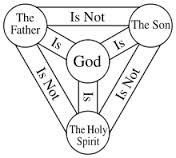
God is One God

  1. The Father is God.
  2. The Son is God.
  3. The Holy Spirit is God.
  4. The Father, Son, and Holy Spirit are Uncreated, Co-Eternal, Inseparable, and Perfectly Equal in Essence.

God is Three Persons

  1. God is Father, Son, and Holy Spirit.
  2. The Father Sends the Son and the Spirit.
  3. The Son is Sent by the Father, and Sends the Spirit.
  4. The Spirit is One Sent by Father and Son.
  5. Father, Son, and Holy Spirit works together to create the cosmos, sustain life, and redeem the church.
  6. God’s visible actions in history reveals his invisible triune nature.

Because of the difference in classification (God and persons) there is no logical inconsistency between saying God is ‘one’ and God is ‘three.’ Still, there is natural difficulty (not too mention the effect of sin on our thinking) in trying to understand how God is one and three. On the one hand, natural man cannot grasp an infinite God—even with God’s inspired word. On the other hand, God’s revelation under the guidance of the Holy Spirit guides Christians to a true but incomplete knowledge of him.

Keeping our creatureliness and Godward-dependence in mind as we approach this doctrine, this outline aims to help us put some of the pieces together.  Since, I’ve already laid out a defense of God as one God, the  next step is to pick up the second proposition—God is three persons—and  consider the first four points. Continue reading

The Doctrine of the Trinity: God is One God

TrinityThere is nothing bare-bones about the Trinity. But sometimes when introducing this doctrine it helps to give a brief, ‘bare-bones’ outline to help young believers or novice theologians understand the parameters of orthodox belief about Scripture’s deepest mystery.

With such an intention, let me lay out a bare-bones doctrine of the Trinity. In its shortest and most incomplete delineation, the Christians doctrine affirms two things: (1) God is One God and (2) God is Three Persons. This denies modalism (one god in three forms) and tritheism (three gods), and gets on the way to a right view of the doctrine. Continue reading

Postmodernity and Evangelical Thought (5): A Post-Script for Postmodernism

Over the course of this week, I’ve noted some of the tenets of modernism that have led to a postmodern view of the world, I’ve suggested some of the major trademarks of postmodernism, and I’ve posited an approach that calls evangelicals to wisely and selectively appropriate some of postmodernism’s better features. To conclude, let me offer a post-script for evangelicals that both warns and commends. Continue reading

Postmodernism and Evangelical Thought (4): A Wise and Selective Appropriation

After surveying many of the key figures and concepts that make up postmodern thought, the question becomes: Is postmodernism salubrious or toxic for evangelical theology?

The answer, not surprisingly, differs depending on who is speaking.  In what follows, I will list three postures to take towards postmodernism.  In today’s evangelicalism, some like Stanley Grenz, John Franke, and Roger Olson have gladly appropriated postmodern thought, others like Douglas Geivett and Scott Smith have rejected it. Still others, most sensibly, have selectively and wisely incorporated some but not all aspects of postmodernism.  We will consider these in turn as they explain how postmodernism has impacted evangelical theology. Continue reading

How Can We Know an Invisible God?

Colossians 1:15 says that Jesus is the image of the invisible God. Set in the context of a hymn worshiping Christ for his works of creation, providence, and salvation, Paul reflects on this sublime truth: The invisible God who dwells in unapproachable light has made himself known in the identity of Jesus Christ.

Set at the center of the Christian gospel, the incarnation of Jesus Christ, ties at least three truths about God together. If you are wondering how you can know an invisible God, perhaps this biblical meditation might help. Continue reading

Postmodernity and Envangelical Thought (3): The Basic Tenets of Postmodernism

Yesterday, I outlined a number of the basic features of modernity. Today, I pick up by looking at the shift from modernity to postmodernity.

Postmodernism’s Progenitors: Jacques Derrida and Friedrich Nietzsche

It has been said that in the history of Western thought there have been two French Revolutions that gave birth to modernism and postmodernism.  In the Enlightenment, Frenchmen Rene Descartes brought about a new way of thinking when his Cogito turned Western thinking towards the subject.  Instead of keeping God at the center, now all centered on man.  This was the first French Revolution.  The second was the rise of Jacques Derrida, who not only questioned the Author of the universe, he questioned every single author who rose in his place.  Derrida has rightly been esteemed as the forefather of postmodern thought, and for good reason. Continue reading

Postmodernity and Evangelical Thought (1): An Introduction

Postmodernism (PM) can be defined as a mood that questions authority, denies absolute truth, and locates meaning in the language of local communities.  While PM is the product of twentieth century thought, its precursors go back much further in history.  For instance, Friedrich Schleiermacher espoused a view of doctrine that was impermanent and always changing relative to the community in which it was experienced.  While situated more than a century before the likes of Derrida, Lyotard, and other philosophers of language, Schleiermacher’s liberal theology anticipates the postmodern turn.

Still, the question of authority, truth, and community predates Schleiermacher, too.  In John 18:38 Pilate, in a discussion about kingdoms, authority, and truth, asks Jesus, “What is truth?”  The relativism in his question comes not from a philosophical system of Western thought; it comes from the human condition that stands outside of the Garden.

Ever since Adam and Eve ate of the forbidden fruit, their offspring has sought to assert their own authority, to make up their own laws, and to live in their own cities of men.  Over time, as Western Civilization once again threw off the constraints of God’s Word and church tradition, the question of the hour is that of Pilate: What is truth?

This series of blog posts aims to give an answer to the postmodern mood that undergirds our ambient culture.  To answer the question about postmodernism we must first consider modernism, as post-modernism stands in direct relationship to his period of time and thought.  Second, I will survey postmodernism and its major contributing voices.  And third, this series will consider the effect postmodernism has had on evangelical theology, and what evangelicals must do to wisely and selectively appropriate the tenets of postmodernity.

As we go along, let me know what you think.

Soli Deo Gloria, dss

Psalm 89: A Covenantal Problem . . . and Its Resolution

Psalm 89 presents the Bible reader with a covenantal problem. Located at the end of Book 3 (Psalms 73-89), it prepares the way for a new movement of God in Books 4 and 5 (Psalms 90-106 and 107-50). It stresses God’s unilateral promise to David that God will keep his covenant. For instance, read verses 28, 34-37.

My steadfast love I will keep for him forever, and my covenant will stand firm for him.

I will not violate my covenant or alter the word that went forth from my lips. Once for all I have sworn by my holiness; I will not lie to David. His offspring shall endure forever,his throne as long as the sun before me. Like the moon it shall be established forever, a faithful witness in the skies.” 

Yet, it also laments that God has renounced the covenant (v. 38-39).

But now you have cast off and rejected; you are full of wrath against your anointed. You have renounced the covenant with your servant; you have defiled his crown in the dust.

Hence the problem. Continue reading

The Image of God and Public Theology

Earlier this week, I considered the personal effect of meditating on and living in the truth of being made in God’s image. Today, I want to show how the image Dei should inform our public theology and social ethics. In a sentence, the image of God should inform the way we look at the world, because only when we keep the image of God at the forefront of our mind will we rightly be able to glorify God in all of life.  Here are five ways the image of God should inform our ethics—four specific, one generic. Continue reading