Last month I attended a Charles Simeon Trust workshop with about 40–50 pastors in Indianapolis, Indiana. As a preacher unapologetically-committed to expositional preaching, I was deeply encouraged to join such large number of other ‘expositors.’
In the three-day seminar, we walked through the whole book of 2 Timothy and ‘worked out’ with a number of hermeneutic tools (i.e., reading strategies) for understanding and preaching epistles. Space doesn’t permit me to share all the highlights of seminar, but one thing is worth mentioning: In defining expositional preaching, David Helm reshaped my thinking about exposition with his emphasis on “empowered preaching.” He defined expositional preaching as “empowered preaching that rightfully submits the shape and emphasis of the sermon to the shape and emphasis of a biblical text.”
Helm’s point is that “expositional preaching” is not just limpidly restating the truths of Scripture. Empowered preaching is Spirit-filled preaching that reveals the living Christ through the faithful exposition of God’s Word. And this kind of preaching comes not just from solid hermeneutics; it comes from the Spirit of God and prayer—a point he well explains in his compact book on preaching, Expositional Preaching. Continue reading →
O foolish Galatians! Who has bewitched you? It was before your eyes that Jesus Christ was publicly portrayed as crucified. 2 Let me ask you only this: Did you receive the Spirit by works of the law or by hearing with faith? 3 Are you so foolish? Having begun by the Spirit, are you now being perfected by the flesh? 4 Did you suffer so many things in vain—if indeed it was in vain? 5 Does he who supplies the Spirit to you and works miracles among you do so by works of the law, or by hearing with faith—6 just as Abraham “believed God, and it was counted to him as righteousness”? (Galatians 3:1–7)
In keeping with his whole letter, Paul boldly rebukes the churches of Galatia for their turn from the true gospel (see 1:6–9). In this section, he recalls their reception of the Holy Spirit and how God’s Spirit came to them—by works of the flesh or by hearing with faith? The answer is plain in the text: the Galatians received the word with faith.
Theologically, this passage has much to say about the order and operations of the Holy Spirit, and I’d like to make a couple observations that will help us to see how the Spirit’s indwelling is different from his work of regeneration. Continue reading →
Could it be that Christ-centered Christians can all too easily forget that the God of the cross is also the God of creation?
Not long ago I was visiting with some church leaders and the topic of transgender persons came up. While a number of good strategies were mentioned about sharing the gospel with them (and all people who sinfully rejected God’s moral norms for their sex lives) there were questions about what is wrong with a man desiring to be a woman, or the reverse. “Which verse does a transgender person violate?” was the question.
The short answer (and this again goes for all persons) is “all of them.” In Adam, all of us are guilty before our maker (Rom 5:12, 18–19). By nature, we are inveterate rebels. We don’t need a verse addressing our specific manifestation of sin, although there are plenty. The whole Bible speaks to the sinful condition of mankind—transgender persons included. Just read Romans 1:18–32 or Albert Mohler’s insightful “Biblical Theology and the Sexuality Crisis.” Sexual morality is far more than keeping all the laws.
But specific answers aside, I think there is a larger need in evangelical churches—namely, the remembrance that we do not worship God as Redeemer only, but also as Creator. In fact, in biblical revelation he is first Creator first, then Redeemer. And even in redemption, the goal is new creation—personal (2 Cor 5:17) and cosmic (Matt 19:28; Revelation 21–22).
In sharing the gospel, we must not forget that sin is not just law-breaking; it is anything that opposes or deviates from God’s created design. But we will only remember this doctrine of creation, if we give ourselves to worship God as Creator.
And for that reason, I offer give you six ways God’s creation should move you to worship and evangelize. Continue reading →
What do you do when you come to a passage of Scripture that is out of sequence? Like in the case of Genesis 10, which speaks of various tongues (v. 5) before God confused human language in Genesis 11?
Do you challenge the authority and intent of the author, presuming that there is some kind of error?Do you simply ignore it, pretending that the problem is not that large? Or do you stop and assess what the author is doing? How you proceed in those cases will, in large part, determine (over the course of time) how well you read the Bible.
Biblical Authors Write Selectively . . . Which Includes Order and Arrangement
When an inspired author of Scripture records a collection of events he naturally delimits his account with some measure of selectivity. In conveying his inspired message, he is not just rehashing history. He is exercising his office as prophetic messenger. This kind of intention is confessed in places like Luke 1:1–4 and John 20:30–31, but it is also seen in the warp and woof of the biblical text itself. Continue reading →
Concerning this salvation, the prophets who prophesied about the grace that was to be yours searched and inquired carefully, inquiring what person or time the Spirit of Christ in them was indicating when he predicted the sufferings of Christ and the subsequent glories. It was revealed to them that they were serving not themselves but you, in the things that have now been announced to you through those who preached the good news to you by the Holy Spirit sent from heaven, things into which angels long to look.
— 1 Peter 1:10–12 —
What does it mean that the Spirit of Christ foretold of the Messiah’s suffering and glory?
Surely, there were many ways, as Hebrews 1:1 indicates. Nationally, the people of Israel regularly experienced enemy oppression (after they sinned) followed by powerful deliverance that set God’s elect over his enemies. Individually, Joseph, Job, David, and Daniel all experienced humbling affliction before being exalted. Textually, there are some individual passages displaying a suffering-to-glory theme—e.g., Isaiah 53 speaks of the Servant’s humiliating death (vv. 1–9) only to close the chapter by announcing his glorious reward for his vicarious suffering (vv. 10–12). Or see the pattern in the Psalms; both the whole Psalter and some individual Psalms (see especially Psalm 22) reflect this pattern.
It seems that everywhere you look in the Old Testament you find (1) God’s people suffering, followed by (2) cries for mercy. In response, (3) God hears their prayers, and (4) responds with saving compassion in the form of a deliverer—a Moses, a Samson, or a David. The result is that (5) the people are saved and the mediator is exalted.
In the light of the New Testament, these incidents are illuminating shadows of Jesus Christ himself. In fact, in the words of Peter, it’s not too much to say that the Spirit of Christ is a cruciform spirit, who leads his people (under the Old Covenant and the New) through valleys of death to bring them into places of honor and service. This is the Christian way—to be brought low unto death, so that God can raise us up to life (see 2 Cor 1:8–9).
That being said, I am persuaded that there is another way in which suffering-unto-glory might be seen in the Old Testament. Instead of containing the pattern to the nation, individuals, or texts, there are some pairs of people who display the pattern. That is, repeatedly throughout the Old Testament, there are individuals related by kinship or ministerial calling whose composite lives function to display the pattern observed in 1 Peter 1. In other words, the Spirit of Christ was directing their lives such that the first person foreshadowed the sufferings of Christ and the second person reflected his subsequent glories.
Admittedly, I haven’t seen this proposal written down anywhere. So, I’d love your thoughts. Does it work? I think there is merit in the proposal and am writing it out (in part) to explore the idea. (That’s what blogs are for, right?) I think, in the end, such pairs may help reflect the binary nature of Christ’s ministry–first in weakness and humiliation, then in power and glory. Or at least, that’s what I will try to show below. Let me know what you think. Continue reading →
A few weeks ago, I enumerated the greatest misunderstanding many have with evangelical Calvinism—namely that Calvinism kills evangelism and missions. Today, I want to pick up two more objections that were often raised at my last church, but which have little basis in historical fact.
1. Five-Point Calvinists are Hyper-Calvinists
One of the largest confusions in the discussion about Calvinism is the term “Hyper-Calvinism.” Historically-speaking, “Hyper-Calvinism” is different than Five-Point Calvinism. The former has minimized or denied the universal offer of the gospel, the latter has not. The former denies duty-faith—the idea that all are commanded to repent and believer—the latter affirms the universal nature of the gospel call and the duty of every man to repent and belief. Thus, the former has neglected evangelism, missions, and sharing the gospel with all men. The latter, has never minimized the evangelistic work of the Great Commission and its corollary endeavors.
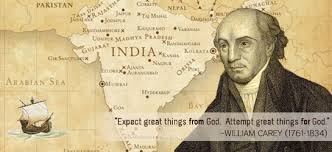
In fact, many Calvinists (e.g., William Carey, Andrew Fuller, and Charles Spurgeon) have argued against Hyper-Calvinism. For instance, William Carey (1761–1834), largely started the modern missions movement when he preached his sermon “An Enquiry into the Obligations of Christians to Use Means for the Conversion of the Heathen.” In this sermon, preached to a gathering of particular Baptists in England (1792), he outlined how and why “means” were necessary to the advancement of the gospel. He compared the Christian mission to that of a trading company and challenged his comrades to support such an endeavor. With his appeal, he contested the notions of Hyper-Calvinism, which were prevalent at that time, and he soon became the first foreign missionary sent these Baptist churches. Carey was a Baptist and a Calvinist, one who strongly rejected Hyper-Calvinism.
Andrew Fuller is another Calvinistic Baptist who argued vehemently against Hyper-Calvinism. Coming out of a Hyper-Calvinistic background, Fuller took to task those preachers who denied a universal offer of the gospel. At that time, many were following the sentiment that claimed that one needed to observe grace before they would pronounce the gospel. It required the minister to have a kind of omniscient clairvoyance. Yet, with his forceful pen, Andrew Fuller rejected the Hyper-Calvinism in his classic work, The Gospel Worthy of All Acceptation. In this work, he articulated a view of the gospel that commended limited atonement and yet declared that the gospel was to be proclaimed to all men.
Significantly, at this time, Congregationalists, Presbyterians, and Baptists all suffered from the “Modern Question” (Nettles, The Baptists, 1:248), which proposed that a man was never responsible for that which he could not do. In the case of those with Calvinistic leanings, this meant that if a man was unable to believe in the gospel (due to his spiritually dead and depraved standing), then he was not culpable. Hence, many falsely taught that the gospel need not go to all men, but only the elect. The folly in this is assuming one could discern who those were. Ironically, Pelagians/Semi-Pelagians/Arminians fall prey to the same confusion when they argue that men, in and of themselves, are capable of responding to the gospel because God would not give a command that man was incapable obeying.
Finally, Charles Spurgeon is another Calvinist who rejected Hyper-Calvinism. Iain Murray has treated this in his book, Spurgeon and Hyper-Calvinism (Banner of Truth, 1995). In the book Murray, writes why this book is important,
Hyper-Calvinism only arises whenever and wherever the truth of the sovereignty of God in salvation is firmly believed. The reason why Spurgeon’s first controversy has been so little thought of in these last hundred years is not that the subject is insignificant. It is rather that doctrinal Christianity as a whole has been too largely ignored. At the present time, when evangelical Calvinism is again being recovered in many parts of the earth, the danger of Hyper-Calvinism is once more a possibility and the lessons to be drawn from this old controversy have again become relevant.
Spurgeon’s reasoning against Hyper-Calvinism coheres with Andrew Fuller—the Hyper-Calvinists deny “duty-faith,” Spurgeon rightly affirms it. Consequently, Spurgeon is a trustworthy preacher of the gospel, who calls all men to faith in Christ.
Anyone who mislabels Five-Pointers with Hyper-Calvinism must redefine their terms, or do their homework in history. The two are not the same.
2. Calvinism is Incompatible with Baptist Doctrine
In church history, Presbyterians and Reformed (the denomination, that is) have been predominately Calvinistic. In the last century, mainline Presbyterians in the Presbyterian Church-USA have become liberal and are not constrained by the Bible at all. This denomination is vastly different from the Presbyterian Church of America (PCA). The former questions the Bible and mutes the gospel; the latter defends the Bible and cherishes the gospel. The former is Calvinistic in tradition only; the latter adheres to a covenantal theology that leads to infant baptism. In this, they fail to understand the difference of the New Covenant and they important many Old Testament notions for being God’s people. They would do well to see the Old Testament symbol of circumcision as a type fulfilled in Christ, not a type that has been transferred into paedo-baptism.
As far as Baptists go, there have always been Calvinistic Baptists and Non-Calvinistic Baptists. Sometimes the first group has been called separate or particular or reformed Baptists; the latter group has been called general or regular Baptists. Some of the most significant figures in the early centuries of Baptist life were Calvinistic. For instance, British Baptists Benjamin Keach (1640–1704), John Gill (1697–1771), Andrew Fuller (1754–1815), and William Carey (1761–1834) were all Calvinistic in their doctrinal stance. In America Isaac Backus and John Leland (who was the pastor in conversation with Thomas Jefferson concerning the separation of church and state[1]), Richard Furman from which Furman College gets its name, Shubal Stearns[2], Adoniram Judson, Luther Rice[3], and the founders of Southern Seminary (James P. Boyce, John Broadus, Basil Manly, Jr., William Williams) were all Calvinistic in their doctrine. Moreover, when the Southern Baptist Convention was begun (1845), every representative at the first convention came from churches that held to Calvinistic confessions of faith. One in particular was P.H. Mell. Mell served as SBC President for more than fifteen years (1863–71, 1880-87). Of the five points of Calvinism, he wrote, “These doctrines [are] the basis of all our pulpit ministrations.”[4]
In most recent years—from the mid-twentieth century until the turn of the century—the SBC has been decidedly Non-Calvinistic. During most of those years, liberalism and modernism pervaded the seminaries (until the 1990’s)[5], and Calvinism was virtually unheard of, except in a few rare exceptions.
Systematically, there is nothing in the belief system of Baptists that must deny Calvinist thinking. Many of the first Baptist confessions are Calvinistic (e.g., 2nd London [1689], Philadelphia). Today, the Baptist Faith and Message is a document that has a historic trail to these earlier confessions. In 1833, the New Hampshire Confession was drafted, modifying the staunchly Calvinistic confessions with a much more moderate Calvinism. The article concerning the “Purposes of Grace” is agreeable to Calvinist and Non-Calvinists. While Calvinists would say more, this document permits Calvinist and Non-Calvinist to retain gospel-centered fellowship in Baptist life (churches, missions, denomination).
In the end, the statement that Baptists are not Calvinistic is short-sighted. It may be the experience of many today, but historically there have been many Baptists of the Calvinistic stream. In fact, some of the most influential apparently” non-Calvinists” are also surprisingly committed to the doctrines of grace—I have in mind here the interview John Piper had with Rick Warren.
Of course, Calvinism is not proved by clarifying its historical moorings. However, if we are going to rightly talk about such doctrinal matters and historical terms, it is vital clarify that Calvinism is not the same thing as Hyper-Calvinism and that Calvinism has held a long and faithful position in the history of Baptists. For those engaged in such discussions, let’s remember our history as we formulate theology in the present.
Soli Deo Gloria, ds
________________
[1]The original intent of Jefferson and Leland was the assurance that the state could not interfere with the church, not the reverse as it has been misused today.
[2]Stearns is the founder Sandy Creek association which makes up one of two importants streams flowing into Southern Baptist life. While Sandy Creek has usually been associated with revivalistic preachers and churches, a feature that has sometimes excluded Calvinistic doctrine, Tom Nettles shows that Stearns has Calvinistic-leanings (The Baptists, 2:162-73).
[3]Judson was converted to Baptist belief on the boat ride to his missionary outpost. Luther Rice was another missionary who believed in the doctrines of grace.
[4]Quoted in Nettles, The Baptists, 2:342. There is room for debate about how the five-points of Calvinism relate to preaching; however, the point is clear, the SBC began with a large influence from Calvinists.
[5]Southwestern being the exception. It was never as bad as the other seminaries.
The sinfulness of sin, to borrow Ralph Venning’s language, is beyond our natural comprehension. Born in sin (Ps 51:4), we are unable to see the sinfulness that engulfs our hearts, minds, decisions, and daily activities. Because we love sin so much, we do not even realize the way we manufacture and fondle our idols. Only with the light of God’s Word can we begin to see what sin is, and only as the Spirit illumines our minds do we begin to see our darkness.
Indeed, simply to know truth about sin does in no way eviscerate the presence of sin in our lives, but it is a start. Truth about sin is necessary for putting sin to death. Such knowledge is not sufficient to grow in holiness, but it is necessary for sanctification. With that hope in mind, I have listed out five points regarding the (1) prevalence, (2) power, (3) pervasiveness, (4) partnership, and (5) pleasure of sin.
May God use these biblical truths to help you and I understand the enemy that lives within that we might cry out with greater earnestness for the grace that pardons sin and the power to say no to sin. Continue reading →
Today, we finish our three-part series on “theological triage.”
In part 1, I suggested genuine Christians stand united in mere Christianity against those who deny the Trinity, the deity of Christ, and justification by faith. At the same time, I explained in part 2 how churches and individuals must pursue unity in the gospel, even when we differ on matters of church government, church ordinances, or charismatic gifts. This gospel unity that overlooks ecclesial differences does not deny the importance of these secondary matters, but it keeps in mind that some doctrines are more essential than others. Some doctrines separate Christians from non-Christians (first-level), some separate genuine believers into different congregations (second-level), and others remain points of disagreement even in the same local church (third-level). This tripartite division has been labeled “theological triage,” and it is this third section we consider today.
The Doctrinal Core
Members of any orthodox church must share the core convictions delineated in the first level (e.g., the Trinity, the Incarnation, the resurrection of Christ, salvation by grace alone, and so on). Likewise, every church must also come to biblical conviction about baptism, the Lord’s Supper, church polity, etc. In most churches, these doctrines (first and second level) are found in their statement of faith.
The practical function of such a confession (or statement of faith) is that when the church gathers there is no need to debate why the Bible is central, why men lead, and why babies are not “baptized.” The confession functions as a general consensus—a doctrinal core if you will—of what the church believes the Bible to teach about the most important tenets of the faith. Still under the banner of a church’s confession (which derive it’s ministerial authority from the Scriptures themselves), there are other doctrines that are not defined. Wisely, confessional statements are abbreviated statements of faith that do not attend to every doctrine. Accordingly, there are other views, beliefs, or questions that members may hold differently.
Some of these doctrines include the doctrines of grace, the way spiritual gifts continue in the church today, and the timing of the millennium. The point of this post is not to address these doctrines, nor to suggest what to include or exclude in the confession. The point to be made here concerns how to handle these third-level doctrinal disagreements in the local church. Continue reading →
On Monday, I considered the idea of theological triage—the process of holding different Christian beliefs at different levels of importance—and how the first level differentiates “mere Christianity” from errant cults and false religions. Today I will continue to consider theological triage as it relates to second-level Christian beliefs, those doctrines on which gospel-believing churches agree to disagree.
Recognizing and Affirming Historical and Doctrinal Differences Increases Unity
Within orthodox Christianity, second level doctrines separate genuine believers. Points of division at this level include baptism (What does it signify and who is the proper candidate?), the Lord’s Supper (What do the elements represent?), and the use of spiritual gifts (Do tongues continue today?)—to name a few prominent ones. How such doctrines are espoused and questions are answered causes the need for different assemblies of worship. Historically, it has often been disagreement on one of these issues that have separated (or created) different churches (or denominations).
For Baptists, our pedigree originates about 400 years ago, when a growing number of Protestants began to realize from Scripture that baptism by immersion was the proper mode for professing believers. Stepping away from state churches, local Baptist congregation were free and responsible to God for their actions, and on their biblical conviction they recovered the practice of believer’s baptism. Because of its historical roots, Baptist churches share much with other evangelical denominations (e.g., all the matters agreed upon in the first level), but there are enough distinctives that make it impossible for Baptists to congregate with paedobaptists. Continue reading →
It is not a word that we often associate with church life, or if we do, the connotation is probably not positive. However, I think the word has great potential for helping us understand and promote unity in the church—local and universal.
In its original context, triage “means the process of sorting victims to determine medical priority in order to increase the number of survivors.” While the term is usually placed on the battlefield or in the wake of a natural disaster, it also has an important application in the church for knowing how to rightly hold the doctrines we believe.
Applied to biblical doctrines, the term has been labeled by Albert Mohler as “theological triage,” and it basically indicates that we should sort out three different kinds of biblical belief—(1) those that separate Christians from non-Christians, (2) those that separate different churches and denominations, and (3) those that individuals may disagree about but which are overcome by greater unity on more primary matters.
Today, I will consider the first level, and later this week days I will follow up with the second and third levels to help us think about our relationship with other faiths, other churches, and other individuals in our church. Continue reading →
 Last month I attended a Charles Simeon Trust workshop with about 40–50 pastors in Indianapolis, Indiana. As a preacher unapologetically-committed to expositional preaching, I was deeply encouraged to join such large number of other ‘expositors.’






 Via Emmaus