From Creation to New Creation: A Seven Day Pattern in Genesis 1–3

time lapse photo of stars on night

Both James Jordan and Alistair Roberts have made a case that the literary structures of Genesis 1 and Genesis 2 mirror one another.[1] As evidenced in Genesis 1:1–2:3, creation took place over the course of seven days—six days of work, one day of rest. Equally, Genesis 2:4–25 follows a similar pattern, as observed below, as does Genesis 3, which Jordan develops in his book Trees and Thorns: Studies in the First Four Chapters of Genesis.

If this reading is correct, then the first three chapters of Genesis give us three parallel events—three weeks that speak of the same creation week. To put it in temple terms, Genesis 1 gives us the creation of the macro-temple, the cosmos; Genesis 2 gives us the formation of the micro-temple, the garden; and Genesis 3 gives us the defilement of the garden which leads to the de-creation of the cosmos, what I might call the massacred-temple.

If this approach is correct, then it not only stresses the seven day pattern of creation, with each chapter following the same basic pattern (see below). But it also situates the first three chapters as following.

  • Genesis 1 outlines the full, seven-day creation week (Gen. 1:1–2:3),
  • Genesis 2 returns to Day 6 to detail how God created man at the beginning of the day and woman at the end of the day (Gen. 2:4–22),
  • Genesis 2:23–25 develops the glory of God’s good creation, as the woman comes to the man when he awakes on Day 7. But it continues to watch that glory turn to shame, as the rest of Day 7 follows the tragic sin of humanity to believe the serpent, eat the fruit, and rebel against God. As a result, man’s first disobedience results in him being cut off from the Tree of Life (Gen. 3:1–24; cf. Rom. 5:12, 18–19).[2]

Following Jordan and Roberts, therefore, I offer the following seven day outline of Genesis 1–3. Let me know what you think and how it might be improved. At the end, I’ll share why reading these chapters in this way matters. Continue reading

So You Want to Start a Church: Four Words to Impassioned Church Planters

ian-schneider-TamMbr4okv4-unsplashNow Barnabas wanted to take with them John called Mark. But Paul thought best not to take with them one who had withdrawn from them in Pamphylia and had not gone with them to the work. And there arose a sharp disagreement, so that they separated from each other. Barnabas took Mark with him and sailed away to Cyprus, . . .

– Acts 15:37–39 –

In my computer files, I have a folder titled “New Covenant Baptist.” And within its contents, I have a handful of articles, agendas, and ideas dating back to April and May 2015. In those uncertain months, I gathered with a handful of earnest Christians who had just decided to leave the church where I pastored.

For nearly six years I served as the senior pastor of a church in small town Indiana. But for reasons I have shared elsewhere, my doctrinal convictions did not find a happy home in that assembly of the saints. Moreover, as I look back, there were elements of my ministerial passions that did not make my service a good fit. Almost a decade later, I am grateful for the time I spent at that church, and for the relationships the emerged from that season. All the same, I recognize that their new pastor is a much better fit.

This is how ministry goes and how churches grow.

Just as God planted a garden in Eden, so he plants churches all over the world, and in these churches, he guards and grows his saints. Sometimes, those branches abide in Christ and in a specific local church for generations. But sometimes, he uproots the Christian and grafts him or her into another garden (i.e., another local church). This is true for members, as well as pastors. And it is all part of God’s wise plan to mature his saints.

When Sharp Disagreements Lead to Church Plants

At the same time, this seasonal change is not always as easy as seeds blown on the wind,  finding fertile soil, and beginning to bear fruit. No, as the story of Paul and Barnabas illustrates (Acts 15:36–41), there are often painful separations that divide genuine believers. And in 2015, that is what happened. And in response, a handful of earnest Christians began to meet and pray and talk about the need for starting a new church—one that, in their mind, would be better and more biblical.

At that time, those of earnest Christian were looking for a church that could not be found in the town we lived. And so we began asking the Lord if we should start a new church, and along the way we asked other questions, too. Are there churches in our area that preach the gospel? That practice biblical membership? That have a plurality of elders? Are there churches that would help us plant, or, would this be a solitary effort? And most importantly, what are we, under God, hoping to create? And, what makes this church different?

Looking at my notes, we didn’t ask two critical questions: How would this church impact other local churches? And how might our recent departure from another church misshape the planting of this church? More on that below.

More introspectively and missionally, we sought to take an honest look at what was motivating us. And so we discussed things like sources of influence, books/ministries that shaped our thoughts, and the priorities that would shape this church. In short, we began to consider the possibility of covenanting together to plant a church in, what we believed at the time, was an area bereft of faithful churches. Whether our assessment was correct or not, the Lord clearly had other intentions, and within a couple months, we did not start a new church.

Nevertheless, I believe there are at least four lessons that can be learned from our consideration of starting a church at a time. When pain fueled our passion for a new church, it caused us to miss a number of critical aspects of church planting. And so, I share those here for those considering a church plant that comes on the heels of a sharp disagreement. Continue reading

Who is in Charge? Two Competing Visions of Church Authority

pexels-photo-272254.jpeg

In recent years and hours, lots of discussion has been given to the subject of authority. Who has authority to close the Southern border? Who has authority to mandate vaccines? Who has authority to teach children about the birds and the bees? Who has authority to close churches or constrict their practices? And in the church, who has authority to rule the congregation (1 Tim. 5:17). Is it the congregation? The elders? One elder? The most vocal or influential members? Or some combination?

Who has authority?

Of all the books I have read on the subject, the one that is most promising (I’m still reading it) is David Innes’ book, Christ and the Kingdom of Men: Foundations for Political LifeIn a section on understanding differing spheres of authority, Innes describes authority in the church. He writes,

[C]hurch government has its authority from Christ. The apostles of Christ appointed the original elders in the first churches. The apostle Paul instructed his legate Titus to “appoint elders in every town” (Titus 1:5). They are ministers of Christ who must give an account to Christ (Heb. 13:17). In the first centuries of the Christian church, civil governments were pagan, as they are today in many lands where Christ has gathered his people, and so they could not have had an organizing or overseeing role in the formation of the churches. (32)

Underscoring the source of church authority coming from Christ, Innes turns to the way churches should not receive their authority from the state. “Over many centuries, churches have had to resist civil authorities’ attempts to exert control over church leadership” (32). Indeed, in our day this is a lesson we have had to relearn. As Western civilization has rejected Christ, other gods have filled the void. And we have already seen how the god of statism is rising to power.

At the same time, however, challenges between church and state are not the only place we have a conflict in authority. We also find difficulty in understanding how the church and the self are to be related. Interestingly, Innes includes the “individual person” in his list of spheres. He explains,

It is odd to think of each individual person as a sphere of authority, but there is a God-given authority that one has over oneself. God’s creation mandate for everyone without distinction of rank or role to exercise dominion in vice-regency communicated God’s moral expectation that people would govern themselves and their personal affairs in righteousness. Self-government at this level is the moral responsibility of every human being and thus the moral right of every adult. (30)

While we mostly think about authority at the level of institutions (e.g., family, church, state), self-governance, or what Scripture labels “self-control,” is a sphere of sovereignty. God has given each image-bearer a body, and those bodies can be used as instruments of righteousness or wickedness (Rom. 6:12–23), and thus we must learn to glorify God with our bodies (1 Cor. 6:20). Such glorification certainly includes sexual purity (1 Cor. 6:12–20), but it would also include the way we use our tongues (James 3), minds (Rom. 8:7; 12:1–2), shoulders (Ezek. 34:21), and fingers (see all the bodily features of sin in Romans 3:10–19). Long story short, we must learn to govern ourselves and to say no to the sinful impulses that rise up within us (James 1:13–15). Yet, this is exactly where the modern church is struggling. Continue reading

Applying Progressive Covenantalism to the Errant Demands for Corporate Confession: My 2023 ETS Paper

Dividing-the-Faithful-cover

ETS Paper Link:

Waking Up to Corporate Confession:
What Scripture Does and Does Not Say
About Corporate Guilt and Repentance

It has been some time since I have posted here. Actually, it has longer than I remembered (May 2023). But that does not mean writing has slowed. You can find regular content that I am writing and/or editing at Christ Over All, where for the last six months we have looked at a number of pertinent issues, including

At the same time, my new book Dividing the Faithful: How a Little Book on Race Fractured a Movement Founded on Grace released in September. This book responds to Michael Emerson and Christian Smith’s book Divided by Faith. I believe their sociological study surveying black and white relations in the American church is poison pill. Undergirded by progressive views of culture and liberal theology, it leeched Critical Race Theory into the evangelical water supply. And churches, pastors, and scholars have been trying to catch up since.

At the same time that I wrote Divided by Faith, I also wrote an article on the demand for white churches and their pastors to publicly confess their white supremacy and complicity in racism. These demands reached fever pitch in 2020, and to help our church think about these matters I wrote up the attached paper. It just so happens that my paper followed very closely to the progressive covenantalism advocated by Stephen Wellum and Peter Gentry. And so today, at the Evangelical Theological Society, I am reading this paper—or at least, a portion of it.

You can find the whole thing here. And if you read it, let me know what you think. For a teaser, here’s the opening page:

In 2020, the death of George Floyd touched off a series of questions about racism and corporate guilt, not to mention justice and the justice system. In churches across the country, decisions split as to the right public response. Similarly, academics took up the issue, albeit often in more popular platforms. For instance, Michael Rhodes asked online, “Should We Repent of Our Grandparents’ Racism?” And Kyle Dillon wrote for The Gospel Coalition, “Are We Held Accountable for the Sins of Our Forefathers?” In both articles, biblical theology was used to affirm the need for modern individuals to identify with the sins of their fathers.

What can be appreciated in these articles was the way these men applied Scripture, especially the Old Testament, to contemporary questions. What was problematic, however, was the way they made applications that did not address the covenantal differences between Israel and today. As Stephen Wellum has demonstrated in his chapter on doing ethics from the perspectives of Progressive Covenantalism, the Old Testament remains needful for instruction, correction, reproof, and training in righteousness (2 Tim. 3:16–17), but biblical ethicists must recognize covenantal differences when they apply God’s Word.

In this paper, I will pick up where Wellum left off and apply progressive covenantal categories to questions about corporate guilt and repentance. In particular, I will seek to answer some of the following questions:

    • Are new covenant believers responsible for the sins of their ancestors?
    • How should we apply Leviticus 26:40–44, which calls for the need to confess the sins of our fathers?
    • Do the corporate confessions of Daniel, Ezra, and Nehemiah call us to do the same?
    • How does the New Testament understand confession in the corporate sense?
    • And most specifically, if we were to turn the clock back to 2020, what might we say from Scripture about the practice of corporate confessions.

In what follows, I will answer these questions and show how progressive covenantalism provides a more robust biblical answer to ethical questions concerning corporate guilt, generational sin, and corporate repentance.

Again, you can keep going here.

For now, I will keep working on writing and editing at Christ Over All. But Lord willing, in the near future, I will be back on this site to add more biblical and theological reflections. Until then . . .

Soli Deo Gloria, ds

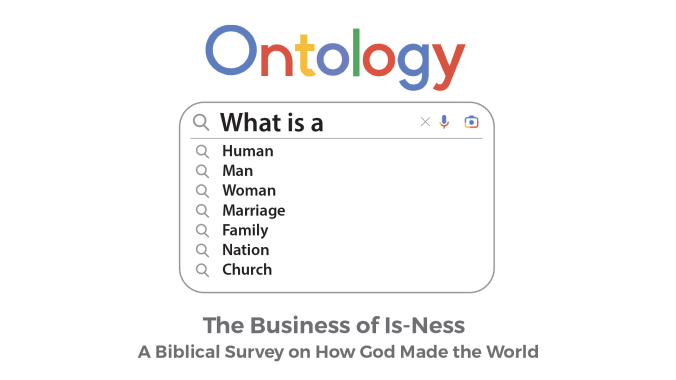
Ontology 101: What is Humanity?

ontology1920x1080-1Since 2013, I have taught the doctrine of humanity a half a dozen times. And in each class, I have put this question on the final exam: What is the most important doctrine for the twenty-first century?

I ask the question because in every era of the church there are unique theological challenges. For instance,

  • In the second and third centuries, the church had to grapple with the relationship between the Old and New Testaments, as well as the errors of Gnosticism.
  • In the fourth and fifth centuries, the church had to defend the deity and humanity of Christ, the proper understanding of the Trinity, and the divinity of Holy Spirit.
  • During the Reformation, the church recovered the doctrine of justification by grace alone through faith alone in the person and work of Christ alone.
  • And nineteenth and twentieth centuries, the doctrine of Scripture had to be clarified, because scientific claims and critical methods of interpretation sought to make the Bible a book like any other.

These are but a few doctrinal disputes that have arisen in church history. By identifying doctrines with decades (or centuries), I am not denying the perpetual need to declare and defend all doctrines, but there are certain pressures in culture that cause the church to reassert or reinforce biblical doctrines. And when it comes to the twenty-first century, there is no more important doctrine than the doctrine of humanity.

That’s why I ask that question on my theology exam, and here is the reason. Continue reading

Ontology 101: A New Sermon Series

ontology1920x1080-1“It depends on what the meaning of ‘is’ is.” Those infamous words, uttered by Bill Clinton under oath in 1998, should have told us that the world and everything in it was already succumbing to the deconstructive forces of postmodernism. Postmodernism claims that meaning is no longer found in what a human author intends or what the Author of life declares. Rather, meaning is decided by individuals or groups interpreting, or in most cases reinterpreting, the words others.

In college after college, postmodern ideas have sprung to life since the 1960s, and by 1998 such epistemic redefinitions and verbal deconstructions were emerging in the public square. Bill Clinton’s elusive response to a question about his relations with Monica Lewinsky was not abnormal for a culture celebrating transgression (think: the Hippies of the 1960s), raised on MTV (think: the teens of the 1980s), or enslaved to self-expression instead of submission to the truth (every generation since WWII).

Fast forward 25 years, add two decades of social media, a handful of contested elections, one global pandemic, and endless woke crusades in public schools and city streets, and it is not just language that has come under assault, it is everything that God upholds by the word of his power. To be certain, Christ the Lord reigns in heaven. But on earth, all is not well. And in our day, our cultural elites can’t even figure out what a man is, why women’s sports should only include women, or why children should not be exposed to drag queens at the public library.

In a word, the world has gone mad. And its insanity began when words could mean anything, or nothing, or something at one time and not another. Continue reading

What Is the Mission of the Church in a Racialized World?

Gospel,+Race,+&+the+ChurchLast year, I joined Nicholas Piotrowski, Charles Ware, and Gus Pritchard for an event in Indianapolis called “Gospel, Race, and the Church.” Through six short messages and six panel discussions, plus a Q & A we worked through many subjects related to contemporary discussions on race and justice in the church. While this subject is fraught with landmines, the overall tenor of the event was positive, biblical, and prayerfully helpful.

To encourage candidness in the moment, the audios were not made public, so I can’t link to those. But what follows is an updated version of my second message. You can find the manuscript of the first message (Is Racial Justice a Gospel Issue?) here.

***********

Here is the thesis that I want to argue: Your race is more important than your ethnicity.

When defined biblically and not sociologically, one’s race is more important for identity formation than one’s ethnicity. And by extension, the mission of the church is to help you make that statement true. Which raises the question. What is race? And do you know what your race is?

As insulting as that question may sound at first, I am going to suggest it is an easy question to mistake—especially if we have fused biblical ideas with worldly ideologies. At the same time, if we can answer this question from the Bible and the Bible alone, then we have hope for knowing and growing the mission of the church. This is the point that I will argue here, and here is how I will proceed.

  1. I will show why the concept of racialization in America is popular and pervasive, but ultimately unhelpful—if not harmful.
  2. I will attempt to draw the lines of race and ethnicity according to the Bible.
  3. With those lines in place, I will demonstrate that the mission of the church helps men and women, who hold PhD’s in ethnic Partiality, ethnic Hostility, ethnic Discrimination, grow up into Christ, who is the head of a new chosen race, redeemed from nation (ethnē).

So that’s we are going. Continue reading

The Priesthood of All Believers: A Call for All to Proclaim the Gospel

b02007a106a73b935c8de8eeb4be056cab88c37fLast year I wrote a book on the priesthood, and tonight I will teach a lesson on the priesthood of believers in Romans 15. And so in preparation for that lesson, I am dusting off a piece of my dissertation (edited) and posting it here. It’s on the priesthood of believers.

*********

When we think of the priesthood of believers, we often think of 1 Peter 2:5, 9–10, and rightly so. In addition to defiling the high priest’s servant when he cut off his ear (N.B. Jesus does not heal Malchus in John’s Gospel), Peter also picked up the sword of the Spirit to positively articulate a vision of the church as a royal priesthood. And in what follows, I will reflect on his thoughts from his first epistle.

At the same time, Paul too had a vision for the priesthood–a vision for priesthood that is often under-appreciated. And so, in the second portion below, I will highlight the one place where he uses the word “priest,” actually “priestly” (hierourgounta). From his usage, and Peter’s, we learn a key lesson, that the priestly ministry of the church means evangelism for all. Let’s consider. Continue reading

Salvation from Judgment: A Survey of John’s “Good News”

eskay-lim-nhPSp2wB5do-unsplashA number of years ago, a church I know purchased something like 100,000 copies of the Gospel of John. Why? So that they could share the message of salvation with everyone in their Chicago suburb. That is to say, by putting a copy of John’s Gospel in everyone’s mailbox, they hoped to share the good news of salvation with all their neighbors.
I don’t know the fruit of that endeavor, but I know it was motivated by a commitment to the Word, a passion to sow the seeds of the gospel, and a prayerful desire to see their neighbors know God and find salvation in the Son. And the use of John makes sense. As John tells us, the Evangelist wrote his book so that his audience would believe in Christ. As John 20:30–31 reads,

Now Jesus did many other signs in the presence of the disciples, which are not written in this book; but these are written so that you may believe that Jesus is the Christ, the Son of God, and that by believing you may have life in his name.

“Life in his name” is another way of saying salvation (John 3:16) or entrance into the kingdom of God (John 3:3–5). And so, John’s Gospel is rightly associated with the theme of salvation. And more, it is usually not associated with judgment. Jesus even says as much. “For I did not come to judge the world but to save the world” (John 12:47).

Case closed. Jesus has come to save, not to judge, and so let’s print up the Gospel of John and send it to everyone who needs salvation. So good, so far. Except, we haven’t answered the question: Saved from what? Saved from death? From sorrow? From sin? From what? Well, that’s what brings us back to judgment—a theme ignored or despised by many who offer Christ today.

The answer to the question about salvation in John’s Gospel is inextricably related to Jesus’s testimony regarding his judgment and the role of the Spirit who brings to completion the judgment of Christ reigning in glory (cf. Psalm 110). To show this, and to better appreciate what salvation is, I will show from John’s Gospel how the theme of judgment develops. And in its development, it may be surprising how prominent judgment is and how important it is for John’s message of salvation. Continue reading

Consider Jesus . . . According to the Scriptures: Why He Gives the Spirit to Us is Better Than “He Gets Us”

gift-habeshaw-QDP10NbwcyE-unsplashConsider Jesus.

Those two words are a simple command found in the book of Hebrews. More completely they read.

Therefore, holy brothers, you who share in a heavenly calling, consider Jesus, the apostle and high priest of our confession, who was faithful to him who appointed him, just as Moses also was faithful in all God’s house. (Heb. 3:1–2)

In Hebrews, Jesus is the main subject. And his person and work are compared and contrasted to everything in the Old Testament. Jesus is like Moses, only better. Jesus is like Abraham, only better. Jesus is like Adam, Aaron, Joshua, Melchizedek—only better.

Jesus is the true and lasting high priest, the king whose throne will never end, the Son who speaks a better word than all the prophets, and the sacrifice who ended all sacrifices. Indeed, Jesus is better. And therefore, we who possess a holy calling must consider Jesus.

But importantly, when we consider Jesus, we must do so in the way Scripture speaks and not just in the way the world speaks or we thinks.

He Gets Us Remakes Jesus in Our Own Image

Right now there is an evangelistic campaign called He Gets Us, and if you watch the Super Bowl, you may see some of their commercials. Even if you don’t watch that game, you should know about this movement that plans to spend one billion dollars marketing Jesus and has made connections with Southern Baptists, until Kevin Ezell reversed course. Long story short, this is not a small movement, which makes their truncated gospel not a small problem. Continue reading