Seven Pastoral Cautions for Bringing Biblical Theology to Church

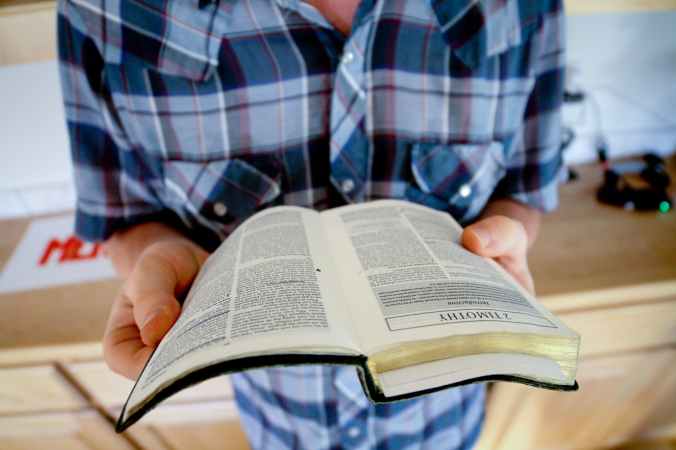
person reading book

Recently, I received an email asking how to incorporate biblical theology in the church. If you are familiar with this blog, you know the value I place on this discipline and how it impacts so much of what I do in preaching, writing, and all of ministry.  (If you want an introduction to biblical theology, read this.)

What follows here are seven pastoral cautions for bringing biblical theology to church. Tomorrow, I’ll add seven pastoral admonitions for bringing biblical theology to church Continue reading

Churches Are Gathering Again: Here’s Why It Matters So Much

caution03

. . . so that through the church the manifold wisdom of God might now
be made known to the rulers and authorities in the heavenly places.
This was according to the eternal purpose that he has realized in Christ Jesus our Lord,

— Ephesians 3:10–11 —

This Sunday our church plans to regather again . . . outside . . . with appropriate spacing.

Approaching this Sunday, it is worth recalling that it has been more than two months since our congregation assembled to worship Christ, sing praises to God, and hear his Word. This means, it has been more than two months, that our church has fulfilled its calling to be a public witness to the resurrected Christ. Maybe your church has been closed for just as long?

As we prepare for service on Sunday, we are excited to meet again, to take the Lord’s Supper, and declare the excellencies of him who called us out of darkness and brought us into his light. We have been grieved by the loss of fellowship and the chance to see our family of faith. But even more, we have—or, at least, I have—been even more grieved that our non-assembly means that God’s life-size billboard of grace, the church, has not been seen in our region for nearly a quarter of the year. With that reflection in mind, I preached the last two sermons on Joel.

While Joel addressed a people whose physical temple had been closed by God, there is an analogy to the church. The local church is the living temple of God, where Spirit-born, Spirit-filled living stones gather to testify to the Lord’s excellencies (1 Peter 2:9–10). The church, as Paul says in Ephesians 3, is the means by which God glorifies his grace on the earth, before the watching eyes of angels and men.

Keeping this in mind recalls why not gathering is such a big deal, and why it is something that cannot go on indefinitely. Christian discipleship means more than getting our weekly sermon fix via Zoom, it means gathering with the saints, testifying to the resurrection of Christ, and being the light of the world which invites others to come out of the darkness. This is perhaps the greatest loss during the days of COVID-19, and one that we may have missed along the way.

In our church, we have prayed much for church to open again. And we rejoice that we will, by God’s grace, gather this Sunday. Joel’s message to a closed temple has been a help to see the need we have to gather. If you are still uncertain about gathering, take time consider Ephesians 3:10–11, 1 Peter 2:9–10, and the book of Joel. I am persuaded that they give us strong medicine to combat the complacency of non-gathering brought about in these days.

May these sermons encourage you and challenge you to consider the essential place of gathering with the saints. For indeed, the church (the assembly of God) can’t be the church when it doesn’t church (=assemble). To that end, let us continue to pray and pursue every opportunity to assemble, until the church is once again meeting with regularity with all the saints.

Soli Deo Gloria, ds
The Theological Message of the Twelve

worms eye view of spiral stained glass decors through the roof

In his book The Unity of the TwelvePaul House argues that sin, judgment, and restoration are three themes extant in each prophet. He argues these themes also organize the Twelve (i.e., the Minor Prophets), where the first six books stress sin, the next three judgment, and the last three judgment. For him, this is the plot line that puts the Twelve together.

Complementing that vision, while not completely affirming, Richard Alan Fuhr and Gary E. Yates, in The Message of the Twelvepresent four themes that repeat through the Twelve: (1) repentance and return, (2) the Day of the Lord, (3) a new covenant, and (4) the coming messiah can be found in the Twelve. I will outline these below. Continue reading

Woman, Behold Your Son . . . : A Good Friday Meditation on Jesus’s Third Saying from the Cross (John 19:26–27)

goodfriday0426 When Jesus saw his mother and the disciple whom he loved standing nearby, he said to his mother, “Woman, behold, your son!” 27 Then he said to the disciple, “Behold, your mother!” And from that hour the disciple took her to his own home.

— John 19:26–27 —

This week our church did a series of devotions on Holy Week. You can find them here. Here’s my message on Jesus’s third saying from the cross.

Found in John 19:26–27, Jesus said to his mother, “Woman, behold your son,” and to John, his beloved disciple, he said, “Behold your mother.”

While this verse shows how Jesus care for his mother, it does more than that. It shows how Jesus is forming a new family from all those who will trust in him. If you trust in Christ, this is your family—a family that is created by shared faith in the crucified Christ and resurrected Lord.

On Good Friday, our good news is found in this fact: Jesus died alone on the cross, receiving in his body the wrath of God, so that we would spend eternity together with him, as children forgiven by his sacrifice. In light of our world’s current pandemic and its associated self-isolation, this news is exceedingly good. What we experience now—isolation from one another—is what Jesus came to take away for all those who trust him. Though we taste the bitterness of disease, death, and distance, Jesus is going to one day remove all of these effects of sin.

On this Good Friday, may our hearts find rest in Christ and his finished work. And may his words to Mary and John teach us how to find a place in God’s family, so that for all of eternity we will be with him and all those who love the appearing of the Son of God.

Soli Deo Gloria, ds


The Light is Dawning on Those Whom God is Saving: 10 Things about John 3:1–21

hence-the-boom-vbQsU3kVVPI-unsplashFor God so loved the world that he gave his only begotten Son, 
that whoever believes in him shall not perish but have everlasting life.
— John 3:16 —

John 3:16 is a glorious diamond, but it only one jewel in the crown of John 3.

Many times we quote, hear, and share John 3:16 without its context in John’s Gospel. This is not a bad thing. A single diamond is beautiful, but set in an engagement ring or on a king’s crown, the placement makes the diamond better. The same is true when we put John 3:16 back into the Bible and see what comes around it.

In what follows, I outline ten things about John 3:1–21 to help us better understand this whole section of John’s Gospel.

1. The flow of John 2–4 moves from light to darkness.

It is well recognized that John’s Gospel turns on the themes of light and darkness. Already in John 1:9 we heard John say, “The true light, which gives light to everyone, was coming into the world.” Later, Jesus will say, “I am the light of the world” (8:12). But what about in between? Is there a theme of light dawning in chapters 2–8? I believe there is, or at least we see a progression of light in John 2–4. Consider this outline: Continue reading

Do You See Jesus? Does Jesus See You? 10 Things about John 1:35–51

hence-the-boom-vbQsU3kVVPI-unsplashIn John 1:35–51 we move from John the Baptist’s testimony about Jesus to Jesus’s own testimony. Here are ten things we find about Jesus in those verses.

1. John’s introduction (1:19–51) culminates in Christ’s testimony about himself.

Last week we observed that John 1:19–51 is organized around four days. Each of these days serves as a “window pane” to see Christ.

With John 2:1 speaking of the “third day,” we see how John introduces Jesus in his first week. These six or seven days (depending on how you count John 2:1), add to the creation theme of John 1 (see vv. 1–3, 32). And in chapter 1 they organize John’s introduction to the Word of God made flesh around the testimonies of John, John’s disciples, other disciples, and finally Jesus.

More specifically, John 1:35–51 brings the testimony of John and his disciples to Jesus himself. Whereas John’s testimony (v. 19) is the focus of the first two “window panes” (vv. 19–28, 29-34), now attention shifts away from John. First, John points his disciples to Jesus (vv. 35–37), so that some leave him. These disciples who follow Jesus then begin to invite others to follow Jesus (vv. 41–42, 46). Finally, Jesus himself bears testimony to himself (vv. 50–51). This is the climax of John’s four days and prepares us for all that follows. Continue reading

Behold, the Lamb of God: 10 Things about John 1:19–34

hence-the-boom-vbQsU3kVVPI-unsplashJohn 1:19–51 begins the multi-faceted book of signs (John 1:19–12:50). In the first chapter, we find the testimony of John (v. 19) and wide variety of titles that are assigned to Jesus. These titles give us a panorama of who Jesus is and help us to know the Son of God who is presented in John’s Gospel. Here are ten things from verses 19–34 to better understand who this Jesus is.

1. John 1:19–51 is organized around four days.

John uses four days to arrange four “pictures” of Jesus. More exactly, he lays out John’s testimony in four days, with each day the glory of John fading and the glory of Jesus’s rising. Which is to say, John 1:19–28 focus on John and his greatness; John 1:29–34 records John’s own understanding of Jesus’s greatness; John 1:35–42 show how John “gives” his disciples to Jesus; and John 1:43–51 concludes with no trace of John. Like a fading shadow John decreases across these four pictures, but only so that Jesus might increase (John 3:30).

In order we can see how each picture develops along similar lines:

Picture #1: John 1:19–28

WHAT: What John is not!
WHEN: The first day . . . (cp. vv. 29, 35, 43; 2:1)
WHO: Jewish Leaders, Priests and Levites, Pharisees, and John the Baptist

John the Baptist

    • is not the Christ
    • is not Elijah
    • is not the Prophet
    • is the one who prepares the way for the LORD
    • Jesus is the LORD

Old Testament

    • The Messiah: All the Law and the Prophets (v. 45)
    • Elijah: Malachi 4:5 (vv. 21, 25)
    • Prophet: Deuteronomy 18:15–18 (vv. 21, 25)
    • The Voice: Isaiah 40:3 (v. 23)

Summary: Jesus is the Lord . . . the One greater than John, whose greatness led the Jewish leaders to inquire. Continue reading

That You May Believe That Jesus is the Messiah, the Son of God: 10 Things about John’s Gospel

john03

This Sunday we begin a new sermon series on the Gospel of John. As we prepare for that series here are ten things to keep in mind as we enter this incredible book.

1. John has a simple four-part arrangement.

If you want to understand a book’s message, begin with its structure. And in John, we find a simple, four-part organization.

  • Prologue (1:1–18)
  • Book of Signs (1:19–12:50)
  • Book of Glory (13:1–20:31)
  • Conclusion (21:1–25)

In this basic outline, the prologue and epilogue balance the book with two interior sections. The first interior section, the book of signs, introduces who Jesus is through a series of extended narratives that identify him with many Old Testament shadows. The second interior section, the book of glory, shows the events leading to Christ’s death on the cross—the event that displays the pinnacle of his glory.

Setting up these two “books,” the prologue introduces us to the Son of God, who is the Word of God Incarnate. With a highly tuned chiastic structure, John opens his book by focusing on how the Divine Son will bring children into the Father’s family (v. 12).  Additionally, the prologue introduces themes about the Son of God—his eternality, his deity, his dwelling with humanity, and his fulfillment of history—which will be found throughout the book.

Finally, the epilogue closes the book with the events that took place after Jesus’s resurrection. In this final section, the purpose of the book has already been disclosed (John 20:30–31), and now Jesus is sending his disciples out to bear witness to Christ. It is with great symmetry, that the book opens and closes with men bearing witness about Christ—John the Baptist is the witness who prepares the way; John and Peter are the witnesses who find greatest attention in John 21. Interestingly, this focus on witnessing is found throughout the book too and indicates the way that the Spirit blows through these pages.

As we study this book, we will look more carefully at the organization of this book. But for now, these four sections give us a place to begin. If you want to see a more detailed outline of the book, watch these two videos by the Bible Project.

Continue reading

Judgment Then Salvation: Seeing the Good News in Isaiah 13–27

jon-tyson-XmMsdtiGSfo-unsplashIsaiah 13–27 is perhaps the most challenging portion of Isaiah to read and understand. Yet, it plays a significant role in impressing the weight of God’s glory on the reader. Jim Hamilton has rightly argued that God’s glory is found salvation and judgment, and no book confirms that argument better than Isaiah.

Indeed, to feel the weight (N.B. In Hebrew, the word glory, kavod, comes from the word heavy, kavēd) of God’s glorious salvation, we need to come to grips with God’s holy judgment. And no part of Isaiah presses us down into God’s judgment like Isaiah 13–27. That may be one of the reasons why these chapters are difficult, but I would suggest there are others too.

In what follows I want to look at why this section is hard to understand. Then I want to show how these chapters fit together and what we can gain from them. May these reflections help us to read Isaiah and see the glory of God in his salvation and judgment. Continue reading

The Gospel of Peace: Hearing the Message of ‘Shalom’ in the Book of Isaiah

peaceIsaiah has sometimes been called ‘the fifth gospel,’ and for good reason. It is filled with good news about the salvation God will bring in Christ. And the more time we spend in the book, the more we discover themes of salvation, justice, righteousness, and peace.

On this note, we can learn much about the message of Isaiah by tracing various themes through the book (e.g., Zion/Jerusalem, kingdom, servant, etc.). Today I want to trace the theme of shalōm (peace, well-being). By keeping an eye on this theme, we can see how the whole book hangs together and how God, the maker of light and darkness, shalom and calamity (Isa. 45:7), has brought peace to a people who have rejected peace in their pursuit of wickedness.

In fact, as we will see, the way that God makes peace with rebellious sinners in Isaiah follows the contours of the gospel. Or perhaps, stated better, the gospel we come to know from the apostles finds it origins in the promise of peace in Isaiah. Let’s take a look. Continue reading