Getting to Know God’s Foreknowledge: A Survey of the New Testament

silhouette of mountain under starry night

To God’s elect, exiles scattered throughout
the provinces of Pontus, Galatia, Cappadocia, Asia and Bithynia,
who have been chosen according to the foreknowledge of God the Father,
through the sanctifying work of the Spirit,
to be obedient to Jesus Christ and sprinkled with his blood.
— 1 Peter 1:1–2 NIV —

On Sunday, I preached the first message in sermon series on 1 Peter. Considering the opening salutation, we spent most of our time getting to know Peter, his audience (the elect exiles scattered in Asia Minor), and the triune God—Father, Spirit, and Son. As with many of Paul’s letters, Peter packs a robust theology into his greeting. And one phrase in particular is worth noting: “according to the foreknowledge of God the Father.”

More fully, we have Peter addressing elect exiles who are “chosen” (see 1 Peter 2:4, 9) “according to the foreknowledge of God the Father.” In the ESV, the distance between the addressees and the source of their election stands in relative distance, with the five regions of Asia listed in between. This matches the way that Greek reads, but it can miss how Peter is qualifying “elect exiles” with verse 2. For this reason, the NIV supplies a repetition of elect, when it says “those who are chosen.” See above.

Still, the translation of the Greek is not as difficult as understanding what “according to foreknowledge” means. Is this a tacit admission that God chooses his elect based upon their future faith (an Arminian view)? Or is it a case where God chooses his elect based upon his free and sovereign grace without any consideration of what his creatures will later do (a Calvinistic view)? Or is it something else?

However one interprets this phrase, we can acknowledge this is one of those places in the New Testament where Christians do disagree on how to understand the biblical doctrine of election and predestination. I have written on this subject (here and here), preached on it (Ephesians 1 and Titus 1), and you can find an excellent treatment on this topic in Robert Peterson’s biblical theology, Election and Free Will: God’s Gracious Choice and Our Response.  

Still, the particular question of foreknowledge deserves a particular answer, and in what follows here, I will survey the use of the word “foreknowledge” (proginoskō) in the New Testament to see what we can learn. As we go, I will show why the best way to understand this word, and its use in 1 Peter 1:1–2, is to affirm God’s sovereign, eternal, and unconditional election of individuals to salvation. In other words, foreknowledge, as I will show below, should be understood as a word that conveys “loved beforehand” or even “loved by God before the world began.” Thus, 1 Peter 1:1–2 should be read as Peter addressing God’s elect, who were predestined in love before the foundation of the world. That’s the conclusion of the matter, now let’s consider the biblical support.  Continue reading
Redemption, Covenant, and Dwelling: Seeing the Three-Fold Pattern of Salvation in the Book of Exodus

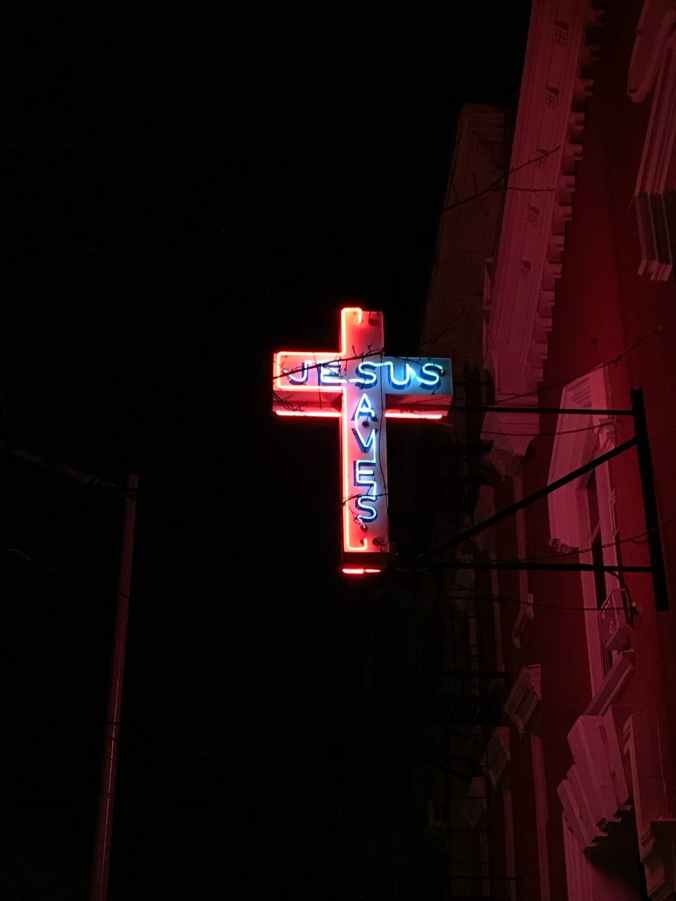
jesus saves neon signage

Patterns are everywhere. In aviation, you have flight patterns; in economics, you have patterns in the stock market, in detective work, police look for patterns of suspicious behavior; and in sports, defensive coordinators look for patterns in the offensive schemes of opposing teams. In short, we live in a world full of patterns!

And these patterns are just one hint that behind the created order, there is a Creator who has stamped his design on creation. Similarly, in the Bible we learn that there are patterns in redemption. And nowhere is this more true than in the book of Exodus. In Exodus we are introduced to God’s pattern of redemption—substitution, conquest, covenant, and glorious dwelling. These patterns repeat again and again in Scripture, and they are so important that even Jesus says to Moses and Elijah in Luke 9:31 that he is soon going to lead his own New Exodus. So today, as we begin to look at Exodus, we do so by recognizing the pattern of salvation found therein. Continue reading

Reading God’s Word and Seeing God’s World through the Lens of Two Biblical Ages

eyeglass with gold colored frames

For salvation is nearer to us now than when we first believed.
Romans 13:11b 

Redemptive history has two overlapping ages. And unless you grasp how the new age brings the future into the present, without entirely swallowing up the old age—yet!—you will have a difficult time understanding how the Bible fits together and how God is working in the world. To say it differently, your doctrine, especially your eschatology, will shift off-center if you don’t consider both ages as described in Scripture. Either you will see too much of God’s kingdom present today, or you will withhold too much of the kingdom until some later time period. This approach to the kingdom of God is sometimes called inaugurated eschatology and I have discussed that here.

In what follows, I want to sketch out how necessary it is to see both ages and how the entirety of the Bible depends on rightly grasping this two-age perspective. First, we will consider how the Old Testament teaches us to look forward to a new age. And instead of considering this in the abstract, we will note at least twelve specific expectations given by the prophets, such that when the authors of the New Testament describe them as fulfilled in Christ, they are telegraphing the way that the new age has come. Continue reading

Jubilee Bells: A Christmas Meditation on God’s Redemption in Christ

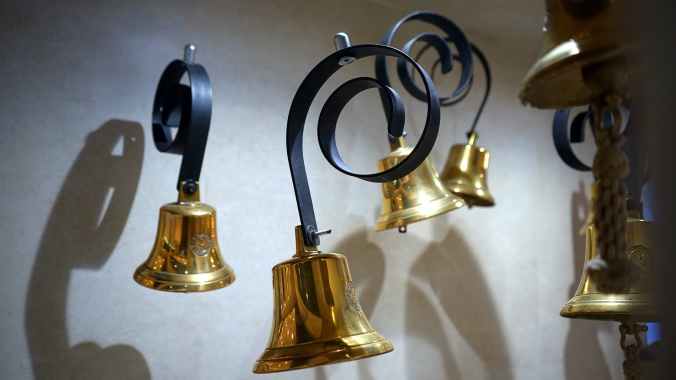
gold colored and black hanging bells near wall

  Blessed be the Lord God of Israel, for he has visited and redeemed his people.
Luke 1:68 

And coming up at that very hour she began to give thanks to God and to speak of him to all who were waiting for the redemption of Jerusalem.
Luke 2:32

27 And then they will see the Son of Man coming in a cloud with power and great glory.
28 Now when these things begin to take place, straighten up and raise your heads,
because your redemption is drawing near.”
Luke 21:27–28 

But [the two disciples] had hoped that he was the one to redeem Israel . . .
And beginning with Moses and all the Prophets, [Jesus] interpreted to them
in all the Scriptures the things concerning himself.
Luke 24:21, 27

Since I was a child I have heard and sung Jingle Bells too many times to count. At Christmas, that song is a staple. Yet, until this year I had never considered the place that Jubilee Bells, or rather a Jubilee trumpet might play at Christmas. And as we prepare to celebrate the birth of Christ I want to share a few reflections on Christ’s birth that relate to the Jubilee told in Leviticus 25, retold in Isaiah 61, and folded into the swaddling cloths that held Jesus.

Indeed, Jubilee is not just a part of the Levitical law, nor a planned redemption of Israel’s land and people. Jubilee is a part of God’s revelation that prepared the way for Christ. In Luke 4, Jesus announced his ministry with the words of Isaiah 61, which tell of the redemption God was planning for his people. Clearly, Jesus had an understanding of his role in redemption, as one who was fulfilling the prophetic word. Yet, Isaiah 61 goes back to Leviticus 25, and the redemption of redemptions promised in the Jubilee.

Even more, as we read Luke’s account of Christ’s birth with the light of Leviticus 25, we can see how the Evangelist portrayed the birth of Christ as indicating the coming of Jubilee and the restoration of all things. While this biblical theological meditation would require a full consideration of Leviticus 25, Isaiah 61; Daniel 9, as well as Luke and Hebrews, in the spirit of Christmas, I will focus on what we see in Luke’s Gospel. For in itself, Luke shows in at least four ways how Christ, from his birth to his death and resurrection, fulfills the ancient promise of Jubilee.

With that in mind, let’s consider how Christmas requires us to sing not Jingle Bells, but a carol of the bells celebrating Israel’s long-awaited redemption. Continue reading

What Does It Mean That Jesus is the ‘Son of David’? Nine Stars in the Constellation of Jesus’s Kingdom

three kings figurines

This month, Track 2 in the Via Emmaus Reading Plan—which is going to get a refresh before the new year—takes us through the book of Luke. And as I reading Luke this month, I am also looking at Volume 6 in the Scripture and Hermeneutics Series, Reading Luke: Interpretation, Reflection, Formation. In one essay, “Kingdom and Church in Luke-Acts,” Scott Hahn traces the theme of Jesus’s Davidic kingship in Luke and Acts. Then bringing order to his observations, he identifies a “constellation of concepts, locations, and institutions that were immediately related to David, his legacy, and [to] one another” (299).

For those interested in studying the theme of Jesus as the Son of David, or knowing what Jesus kingship and kingdom are like, it is imperative to see how Scripture speaks of David, Jesus, and the Jesus relationship to David. As the New Testament declares with great emphasis and repetition, Jesus is David’s son and thus, it teaches us to see Jesus’s kingship as a fulfillment of David’s, only greater.

Thus to know Jesus as Scripture presents him requires a growing knowledge of David. In his essay, Hahn does the exegetical work in Luke-Acts to show where Luke identifies Christ with David (297–99, cf. Luke 1:27, 32–33, 69; 2:4, 11, 8–20; 3:21–22, 23–28; 6:1–5; 9:35; 18:35–43; Luke 22:29–30; 23:37–38; Acts 2:14–36, esp. vv. 25–36; 13:16–41. esp. vv. 22–23, 33–37; 15:13–21). Then, he outlines eight stars in the constellation of Christ’s kingship. Below, I share those with you, as they present in short order what David’s/Jesus’s kingdom is like. Then, I will add one more star to the constellation—the oft-neglected priestly nature of David’s kingship. From this ninth star, we will see why Christ’s kingship stands out against all the other kingdoms of the earth.

Continue reading

What Can We Learn from God’s Quarantine Laws? Four Truths for Today from Leviticus 13–15

cdc-jRI67r_u-Jg-unsplashSo here we are, watching COVID-restrictions fall into place like dominoes, and many of us are wondering if these are the best protocols or not. Since around March of this year, they have become a “normal” part of life in our state and around the world. Yet, it is worth asking, are they effective? Are they just? Where did they come from? Will they work this time? And what if anything does Scripture say about quarantines?

Earlier this week, I pointed to an article by Brian Tabb on a biblical view of diseases. If you haven’t read that, you should. Today, I want to follow up with a summary of an article from Old Testament scholar, Roy Gane. Gane has written extensively on the Old Testament, but especially on Leviticus and its purification laws. More recently, in response to COVID-19, he has written up a short piece (“God’s Guidance for Controlling Contagions“) outlining things we can learn from the Law of Moses regarding quarantine laws today. And it’s this piece that I want to consider today. Continue reading

Weighing Obedience and Resistance: What Romans 13 Does and Does Not Affirm about Governing Authorities

tingey-injury-law-firm-DZpc4UY8ZtY-unsplashIn his commentary on Romans, Colin Kruse observes that in Romans 13 “Paul is drawing upon teaching in Jewish literature about God’s sovereignty over the rise and fall of earthly rulers” (Paul’s Letter to the Romans, 493). Supporting that claim, he lists a handful of key passages from the Old Testament, the Jewish Apocrypha, and Josephus. Here’s his list.

By me kings reign and rulers issue decrees that are just; by me princes govern, and nobles—all who rule on earth. (Prov 8:15–16)

In the Lord’s hand the king’s heart is a stream of water that he channels toward all who please him. (Prov 21:1)

With my great power and outstretched arm I made the earth and its people and the animals that are on it, and I give it to anyone I please. Now I will give all your countries into the hands of my servant Nebuchadnezzar king of Babylon; I will make even the wild animals subject to him. All nations will serve him and his son and his grandson until the time for his land comes; then many nations and great kings will subjugate him. (Jer 27:5–7)

He changes times and seasons; he deposes kings and raises up others. (Dan 2:21)

The Most High is sovereign over the kingdoms on earth and gives them to anyone he wishes. (Dan 4:17, 25, 32)

For your dominion was given you from the Lord, and your sovereignty from the Most High; he will search out your works and inquire into your plans. (Wis 6:3)

The government of the earth is in the hand of the Lord, and over it he will raise up the right leader for the time. (Sir 10:4)

He will for ever keep faith with all men, especially with the powers that be, since no ruler attains his office save by the will of God. (Josephus, Jewish Wars 2.140)

Standing upon this biblical worldview is important not only for understanding Paul’s argument in Romans 13, but also for understanding its limits. In other words, as Paul commands believers to willingly submit to governing authorities (Rom. 13:1, 4), he does not mean that governing authorities have absolute autonomy or unchecked authority. As Romans 13:4 says, they are “God’s servants,” hence subject to God himself. And it’s this point of reference—the relationship between governing authorities and God—that we need consider more fully.

Far too many have a simplistic, even child-like, understanding of Romans 13. And if the church is going to survive our post-modern, post-Christian world, we need to think more carefully (read: more biblically) about Romans 13. Continue reading

Reading Mark 13 in Context: Seeing 16 Connections between Jesus’s Olivet Discourse and His Death and Ascension

robert-bye-6PLB5SKWiIY-unsplashI saw in the night visions, and behold, with the clouds of heaven there came one like a son of man, and he came to the Ancient of Days and was presented before him. 14 And to him was given dominion and glory and a kingdom, that all peoples, nations, and languages should serve him; his dominion is an everlasting dominion, which shall not pass away, and his kingdom one that shall not be destroyed.
— Daniel 7:13–14 —

On Sunday, I preached a message on Daniel 7:13–14, how it is understood by the New Testament authors and why Christ’s ascension is such good news for us today. You can listen to the sermon here. And if you do, you will find that the longest part of the message is located in Mark 13–14.

The reason for that long meditation is that Mark cites Jesus referencing Daniel 7:13–14 in two places. First, answering his disciples’ question about the destruction of the temple and when these things will be (Mark 13:1–2), Jesus says, “And then they will see the Son of Man coming in clouds with great power and glory” (Mark 13:26). Second, after his arrest, Jesus is  interrogated by the high priest. In response to a question of his identity, Jesus again references Daniel 7, “I am, and you will see the Son of Man seated at the right hand of Power, and coming with the clouds of heaven.” (Mark 14:62)

Following the lead of Daniel itself, I interpreted these two passages as a reference to Jesus’s ascension in relationship to his impending crucifixion. Instead of reading these references of the clouds to something still future or his second coming from heaven to earth, I recalled the original meaning of Daniel 7:13–14 and explained how Jesus is speaking about his ascension and entrance into heaven.

As you might expect, this led to some questions. In our community group that followed Sunday’s sermon, there were more than a few questions about this reading, as it stands in contrast to more popular readings of Mark 13 and its parallel accounts in Matthew 24–25 and Luke 21. In what follows, I will restrict my focus to Mark and try to explain how we might read his Gospel with greater attention to his own words and the meaning of Jesus’s words in Mark 13. By paying attention to the literary connections between Mark 13 and Mark 14–15 (#4 below), I believe we can see how Jesus is preparing his disciples and Mark is preparing his readers for understanding a heavenly perspective on Christ’s death, resurrection, and ascension, with (perhaps) ongoing implications for the destruction of the temple in AD 70.

Continue reading

A Theology of the Face: How Endless Mask-Wearing Hides the Image of God and Hinders the Church

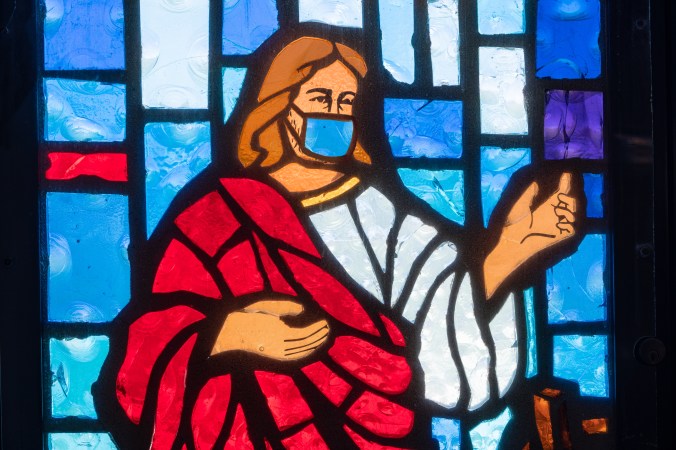
Christian themed stained glass, Freeport, Grand Bahama, Bahamas

And we all, with unveiled face, beholding the glory of the Lord,
are being transformed into the same image from one degree of glory to another.  For this comes from the Lord who is the Spirit.
– 2 Corinthians 3:18 –

For God, who said, “Let light shine out of darkness,” has shone in our hearts to give the light of the knowledge of the glory of God in the face of Jesus Christ.
– 2 Corinthians 4:6 –

We are in the season of that ancient of holidays, the one where humans put on masks and pretend to be lions, ghouls, super heroes, and villains. This year, however, Halloween’s game of dress up has become ubiquitous. It has been going on ever since “social distancing” became 2020’s favorite neologism. And there is no end in sight. Masks, it seems, are here to stay long past Halloween, and it is worth asking—to what effect?

What are the consequences of wearing masks? And what are the consequences of not wearing masks? The latter question is easy to answer; just read the regular updates on the CDC website or visit your local grocery store. State regulations, governors’ orders, and local business practices have converged to declare with legal force—no mask, no service.

Following this line of thinking many churches have pursued the same approach. With good intentions, especially in the early stages of COVID-19, many sought to love their neighbor by wearing a mask. Yet, as masking as become the new normal, I want to ask: What are the not-so-hidden consequences of hiding the face for months on end? And what are the consequences for churches who are called to live distinct from the world and who are to proclaim the glory of God in the face of Christ?

While medical experts continue to debate the efficacy of preventing COVID-19 with a cloth mask and doctors demonstrate the inefficiencies of various masks, I want to approach this subject theologically. Opinions continue to change about masks, but with the exception of a few articles (e.g., They Don’t Own Your Face You Know), I have seen little consideration for the theological impact covering the face has on humanity and the church who gathers to worship God.

With that in mind, I want to answer a few questions: What does Scripture say about the face? What impact does hiding the face on a regular basis have on humanity, the glory of God, and the gathering of God’s people? In particular, can we worship God face-to-face with masks constantly on? And if so, what implications do that have on the church?

As we will see from Scripture, the veiling of the face, with no certain change forthcoming, distorts our ability to embrace the knowledge of God, and hinders the community of faith created to reflect the image of Christ. More than that, masking as a normative practice in worship services runs into multiple New Testament commands. In other words, the commands of God are strained, if not violated, by making mask-wearing the normative practice.

What follows is not the only line of argument we need to consider when making decisions about gathering God’s people in these days and wearing or not wearing masks. Loving our neighbor (Romans 12), obeying civil magistrates (Romans 13), and considering weaker brethren and not violating conscience (Romans 14) must all play a part in our decisions. Yet, we must not forget that Romans 12–14 follows an expansive description of the gospel (Romans 1–11), and is followed by Paul’s description of the gospel ministry.

Thus, setting Romans 12–14 in context, it is my contention that in recent application of Romans 12, 13, and 14 for mask-wearing without end, we are picking up habits of heart and face that may interfere with the clearest declaration of God’s mercies (Rom 12:1) in the gospel (Romans 1–11 and 15). In that vein, I offer this God-centered argument, that seeing and showing the face matters. And I ask Christians to consider the impact of endless masking on the spiritual health of image bearers and Christ’s Church.

Continue reading

A Neglected but Necessary Doctrine: How Christ’s Ascension Clarifies Our Theology and Comforts Our Souls

clouds and blue sky

And when he had said these things, as they were looking on, he was lifted up, and a cloud took him out of their sight. And while they were gazing into heaven as he went, behold, two men stood by them in white robes, and said, “Men of Galilee, why do you stand looking into heaven? This Jesus, who was taken up from you into heaven, will come in the same way as you saw him go into heaven.”
— Acts 1:9–11 —

   He ascended to heaven
      and is seated at the right hand of God the Father almighty.
— The Apostles Creed — 

In Acts 1:9–11 Luke reports the ascension of Jesus from earth to heaven. This event has been a staple in orthodox confessions, as listed in the Apostle’s Creed, but it has also been spiritualized by some (like Origen and Rudolph Bultmann) and overlooked by others (too many to count!). But what about you, how do you think about the ascension?

Do you think about it all? Does it form your theology (especially your eschatology), or do you skip from Christ’s resurrection to his return? What about your daily life, how does ascension bring the good news of heaven to your earthly struggles? If the ascension is absent in your thoughts, you are missing a chief way that we know and experience the presence of Christ. For that reason, we need to go back and see what Scripture says about this  vital doctrine. Continue reading