Twelve Ways to Order Your Week by the Son (Part 2)

Last week, in application of a recent sermon, I outlined six ways to set your watch by the Son. In order, these included.

  1. Start your day with God.
  2. Consume God’s Word on the way and make plans to feed on his faithfulness.
  3. Pray without ceasing.
  4. Make a midweek gathering a priority.
  5. Preserve and protect the altar.
  6. Make space in your calendar to meet with other Christians.

By and large, these six orientations were given as guides for making the most of the time between the time you gather for worship on the Lord’s Day. Today, I am adding six more ‘Helio’-centric orientations. Here they are.

  1. Enter the darkness of the city with the light of Christ.
  2. Lead others (family, friends, peers, strangers) to the altar of God on the Lord’s Day.
  3. When home (on Sundays), look for ways to bless the people who gather at your altar.
  4. When traveling (on Sundays), look for other faithful altars to visit and encourage.
  5. When sick (on Sundays), lament your absence.
  6. In each season, solidify your schedule and guard your time with God.

As you can tell, four of these orientations are directly related to the Lord’s Day (8–11). And three of them are directed to ways to make the best use of the Lord’s Day (9–11). In all, I hope these 12 orientations help you reflect on the best ways to order your week in a way that is centered on Christ. For a further reflection on these twelve points, you can listen to my Sunday School lesson.

Continue reading

Twelve Ways to Order Your Week by the Son (Part 1)

Last Sunday I preached a sermon entitled, “Keeping Time at the Altar By Setting Your Watch by the Son.” That sermon was part two of series of sermons explicating Genesis 8:20–9:7. You can find the introduction here. In all, my aim is to help members of my church, who are new creations in Christ (2 Cor. 5:17), order their lives by the pattern that comes in the New Creation. And, because Genesis 8:20–9:7, offers a glimpse of the new creation and that pattern, we are looking at each part. (For an overview of the whole pattern see this sermon on Genesis 8–9).

In the first sermon in this series, I argued that Christians should arrange their lives around the altar, which today occurs when the saints gather on the Lord’s Day to worship Christ. Yet, what do those saints do for the other six days of the week? That is what I attempted to answer in the second sermon. And in that sermon, I took three steps to move from (1) Israel’s calendar in Leviticus 23, to (2) Christ’s fulfillment of that calendar, to (3) our lives that should center themselves on Christ. If you want to see how this biblical theology moves to Christ, listen to the sermon. Yet, in that sermon I left out what I am writing here (in two parts)—12 ways to order your week by the Son.

Truly, if Christ has purchased us (1 Cor. 6:20), we are not free to do with our time whatever we want. Instead, as Paul puts it in Galatians 5:13, “you were called to freedom, brothers. Only do not use your freedom as an opportunity for the flesh, but through love serve one another.” Paul’s focus in this verse relates to the law, but part of that law relates to time—i.e., the Sabbatical Calendar (see Exod. 23:10–19; Lev. 23:1–44; Deut. 15:1–16:17).

Israel, as God’s son, was too immature to rightly define their own time. Rather, as Galatians 4:1–2 tells us, God’s children were treated as slaves and put under a guardian (the law) until the proper time. Jesus himself was born under the Law (Gal. 4:4) and had to keep the entire law, including all the commands related to the Sabbath. Yet, in keeping the Sabbath, he not only became the Sabbath-giver (cf. Matt. 11:28–30) but also reordered the calendar, such that annual feasts (like Passover) and mid-year rituals (like Yom Kippur) were all fulfilled in him.

In the New Testament, the consequence of this eschatological change was that the people of God now worshiped on the Lord’s Day, as found in 1 Corinthians 16:1–2; Acts 20:7; and Revelation 1:10. Indeed, as Jesus fulfilled and transmogrified the Passover into the Lord’s Supper, this became a weekly feast to be enjoyed everywhere God’s people gathered (1 Cor. 1:3; cf. Mal. 1:11), not just an annual feast celebrated in Jerusalem. To that end, the New Testament, as I understand it, defines Sunday (the Lord’s Day) as one day in seven to gather and worship. And this should be both the high point of the week and the central point of the Christian calendar.

Historically, liturgically, and confessionally this “Christian Sabbath” has been defined, specified, and applied in all sorts of ways. And at some point in the near future, I hope to say more about that. For now, I want to talk about the other days of the week and what Christians should do to orient themselves from and toward worship on the Lord’s Day.

Admittedly, these twelve orientations have to be general principles, not specific commands. And, if I am honest, these principles will need qualification that this article won’t have time to specify. Also, there are other principles that could be added to. So, don’t take this list as exhaustive or overly prescriptive. I am not trying to over-regulate what a Christian life looks like. Clearly, seasons in life, differing vocations, divergent interests, and various family dynamics will force these principles to form in asymmetrical ways. Over time, they will change in our lives, as well. That said, I am trying to offer wise counsel for those who are moving from the altar of God’s of worship to the city of their work.

In that way, take what is helpful. Retrofit what is partially helpful. And reject anything that stands in the way of walking faithfully with the Lord. Hopefully, however, there will be little rejection and much reflection. And so, to that end, here are twelve ways to order your week by the Son. Continue reading

Rejoicing in Christ’s Royal Priesthood: The 2024 Bauman Lectures (Toronto Baptist Seminary)

In 2022, I wrote a book entitled The Royal Priesthood and the Glory of GodThis book clarified, synthesized, and streamlined my doctoral dissertation. In 2013, I finished a biblical theology of the priesthood which sought to answer the question: For whom did Christ die? Looking at the priesthood from Genesis to Revelation I argued for a definite atonement. In that large volume I came to love the theme of priesthood in the Bible and what that means for knowing Christ and for imitating Christ.

Since 2013, I have written a handful of articles on the priesthood, and in the last few weeks I have spoken twice on the subject. The first series of lectures took place at Eden Baptist Church in Burnsville, Minnesota, and the second lecture series is taking place this weekend at Toronto Baptist Seminary and Jarvis Street Baptist Church in Toronto, Canada.

To assist students, faculty, church members, and guests of the Bauman Lectures, I am posting notes here. I will add to them as the weekend goes on, and in the end, I hope this post will link to all the priestly things I have written to date.

The Bauman Lectures (2024)

  • Lecture 1: Building a Kingdom of Priests — In this lecture, I survey the way in which the institution of the Levitical Priesthood came into being. This lecture simplifies my larger SBJT article and puts into lecture form the second chapter of my book, The Royal Priesthood and the Glory of God.
  • Lecture 2: In Search of a Priest-King Like Melchizedek (Genesis 14, Psalm 110, Hebrews 5–7) –In this lecture, I examine the context, content, and concepts found in three places where Melchizedek is named. Together, this helps us understand who Jesus is, as a royal priest.
  • Lecture 3: Seeing Melchizedek in the Book of 1–2 Samuel: An Exploration in Typology — In this lecture, I have written a working manuscript (with limited annotation) to show how Melchizedek is a figure found in the book of 1–2 Samuel. This reading depends upon a careful comparison between Bera, king of Sodom, and Melchizedek, king of Salem. It also explains how David saw his own son as a priest after the order of Melchizedek.
  • Sunday Morning Sermon: Getting to Know Our Great High Priest (Exodus 28–30; Hebrews)
  • Sunday Evening Sermon: A Kingdom of Priests: Washed, Worshiping, Working, Witnessing (Exodus 19:5–6; 1 Peter 1:22–2:10)

More to come . . .

Soli Deo Gloria, ds

What Should We Do With 1 Enoch? A Biblical Approach to Extra-Biblical Literature

konrad-hofmann-XFEqU_bf5nA-unsplashIn Genesis 6 we find the curious introduction to a group of people (?) called the Nephilim. In verse 4, the ESV reads, “The Nephilim were on the earth in those days, and also afterward, when the sons of God came in to the daughters of man and they bore children to them. These were the mighty men who were of old, the men of renown.”

Thus concludes one of the strangest passages in all the Bible. For centuries, the four verses that begin Genesis 6 have occasioned debate on whom the Nephilim are, who the sons of God are, who the daughters of man are, who the mighty men of old were, the men of renown, and how these characters all fit together. Are these all descriptions of human beings, sons and daughters of Adam? Or, is something more nefarious afoot? Are the sons of God fallen angels? And if so, who are their offspring?

To these questions and more, I will attempt to give an answer in this post and three more to come. Below, I will consider what it means for Christians to use extra-biblical sources, and how we can properly benefit from reading 1 Enoch. In the next post, I will lay out the options for reading Genesis 6, and explain the strengths and weaknesses of various positions. Then third, I will make a canonical argument for understanding the sons of God as fallen angels and the Nephilim/mighty men as giants. Fourth, I will draw some theological conclusions related to Genesis 6 but also to Christ and his rule over the cosmos. Continue reading

The Hill of Eden: Seeing the Topography of Genesis 2–4

mountainous valley with evergreen forest against misty sky

In recent weeks, my sermons on Genesis 3–4 have made much of the fact that the Garden of Eden is found on a mountain. In recounting the drama of Adam, Eve, the Serpent, and the Lord (Genesis 3), as well as Cain and Abel (Genesis 4), I have argued that the topography of Eden plays an important role. For example, when Cain’s face was downcast (Gen. 4:5), I have argued that he is looking down the mountain and away from God. Equally, when God told Cain to look for the sin offering, lying at the door of the Garden, he was calling him to look up the mountain from where his help would come (cf. Psalm 121).

Long story short, the theme of mountains in the Bible cannot be underestimated. Just this morning, I was pondering the way mountains play a role in Matthew (cp. Matt. 4:8; 17:1; 28:16). Maybe I’ll write something on that soon. For now, however I want to help studious Bible readers to see how Genesis 2–4 should be read with topography in mind.

So, in nine strokes, I will attempt to demonstrate why I believe Scripture presents Eden as a mountain sanctuary, and also why this matters for understanding the events of Genesis 2–4 and beyond.

First, the Bible explicitly calls Eden the Mountain of God.

In Ezekiel 28, the Lord addresses the King of Tyre, and in his oracle of judgment, the Lord identifies the wicked king with Adam in priestly garments. In vv. 13–14 he writes,

You were in Eden, the garden of God; every precious stone was your covering, sardius, topaz, and diamond, beryl, onyx, and jasper, sapphire, emerald, and carbuncle; and crafted in gold were your settings and your engravings. On the day that you were created they were prepared. 14 You were an anointed guardian cherub. I placed you; you were on the holy mountain of God; in the midst of the stones of fire you walked. . . .

He continues in verse 16, saying, “so I cast you as a profane thing from the mountain of God, and I destroyed you, O guardian cherub, from the midst of the stones of fire.”

Now, there is debate about who this figure is. Who did God cast down from the mountain? Is it a reference to Adam or to one of the guardian cherubs? That’s a good question, and I generally follow the line of thinking offered by the NET translation.[1] But for now, that question is not the point.

The point at issue is that Ezekiel makes it unmistakable: the Garden of Eden resides on a mountain. And the Prophet of Israel understood it this way because Genesis 2 makes it evident that the Garden stands below the spring of living water (at the top of the mountain) and above the fields, which enjoy the water of four rivers. Continue reading

Jesus is Prophet, Priest, and King: A Good Friday Meditation

Into Thy HandsOn this Good Friday, I want to share a meditation from Alexander Watson (1815?–1865) related to the cross of Christ and the way Jesus’s death brought to fulfillment his triple office of prophet, priest, and king. But first, a little background.
Seven Sayings and Seven Sermons

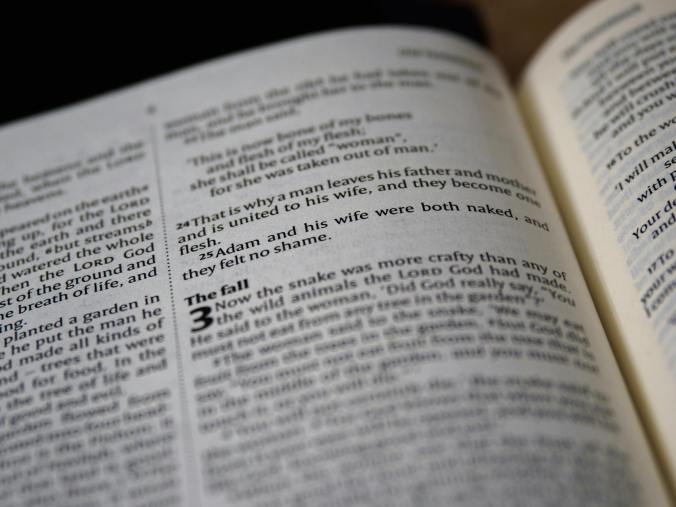
For the last six years (beginning in 2018), I have preached a Good Friday sermon that has focused on one of Jesus’s words from the cross. In all, there are seven statements found across the four gospels. Here they are in order.

  1. Father, forgive them, for they know not what they do. (Luke 23:34)
  2. Truly, I say to you, today you will be with me in paradise. (Luke 23:43)
  3. Woman, behold your son . . . Son, behold your mother. (John 19:26–27)
  4. My God, My God, why have you forsaken me? (Matthew 27:46; Mark 15:43)
  5. I thirst. (John 19:28)
  6. It is finished. (John 19:30)
  7. Father, into your hands I commit my spirit (Luke 23:46)

You can also listen to these songs in Andrew Peterson’s Tenebrae.

For the last six years, I have preached six sermons. And you can find them here.

  1. Father, Forgive Them (2018)
  2. Today, You Will Be With Me In Paradise (2019, no audio)
  3. Woman, Behold Your Son (2020, Covid year)
  4. My God, My God, Why Have You Forsaken Me? (2021)
  5. I Thirst (2022)
  6. It is Finished (2023)
  7. Father, Into Your Hands I Commit My Spirit (2024)

Along the way, I have found great help in preparing these messages and thinking about the cross of Christ by reading Alexander Watson, The Seven Sayings on the Cross; Or, The Dying Christ Our Prophet, Priest, and King. Continue reading

The First Day of the Lord (Genesis 3): Seven Reasons the Fall Occurred on the Seventh Day

close up photo of bible

A few weeks ago, in a sermon on Genesis 3:8–13, I made the case that the events of Genesis 3 took place on the seventh day of the creation week, not some undefined time after the creation week. Instead of seeing Adam and Eve having days or weeks of communion with God in the Garden of Eden, I argued that Adam and Eve sinned against God on their very first day.

Just as Genesis 2 expounds the events of Day 6 (Gen. 1:24–31) in the creation week, so Genesis 3 develops the events of Day 7 (Gen. 2:1–3). At the end of the seventh day, God came down from heaven onto his mountain in order to rest on his holy hill. Yet, because he found two unclean sinners hiding in the garden, and a serpent standing there triumphant, God’s response was one of covenantal judgment, with an eschatological promise of salvation.

Genesis 3:14–19 is the centerpiece of the chapter, where God issues a curse on the serpent and on creation. And as a result, the first week of creation ends with the need of a new creation. Indeed, just as the eighth day, which is the first day of the week, will become in redemptive history the day of new creation, so Genesis 3 ends looking for this new creation. Or, at least, that is the implication of reading Genesis 3 as the seventh day of the creation week.

Yet, it may take some convincing to prove that Genesis 3 is the seventh day. After all, many commentators imagine a backstory to Genesis 3, which includes a series of “daily chats” occurring in the Garden before the Serpent arrives. Yet, such a backstory cannot be found in the text of Genesis 1–3.

Instead, what is found is the immediate entrance of the Serpent in Genesis 3:1. There is no “intertestamental period” between the union of man and woman (Genesis 2:24–25) and the arrival of the Serpent (3:1). And to create such an apocryphal tale is to go beyond the text. Nevertheless, the absence of backstory doesn’t automatically prove that Genesis 3 is the seventh day, unless there are others evidences in the text. And that is what I aim to argue in the seven points below.

Today, I will argue that Genesis 3 occurs on the seventh day of the creation week. And next week, I will return for at least four more reasons related to understanding the “Spirit of the Day” for proving the same point. Continue reading

The Test of Wisdom: Which Path Will You Take?

alex-shute-QnRDKNbKl9k-unsplash6 Go to the ant, O sluggard; consider her ways, and be wise.

7 Without having any chief, officer, or ruler,
8 she prepares her bread in summer and gathers her food in harvest. 

In Proverbs 6, the Word of God tells us to go to the ant and find wisdom. In the ant, we learn principles of initiative, preparation, and hard work. Indeed, by looking at this little creature, an insect found everywhere and anywhere, we are told to look and learn her ways.

In fact, Proverbs 6 is one of many places where we find wisdom from the animals. In Proverbs 30, we find four animals in direct order: there is the ant, the rock badger, the locust, and the lizard. And from each we can gain insight into the way we ought to live.[1]

If we go further, the whole Bible teaches us to gain wisdom from nature. From the sparrows who fall from the sky, to the sheep who follow their shepherd, and from the lions who prowl the hills, to the Leviathan who roams the sea, all of these animals were created by God to give us wisdom.

And in Genesis, we have already seen the way that animals are used to teach Adam. For in Genesis 2:19 we find this report,Now out of the ground the Lord God had formed every beast of the field and every bird of the heavens and brought them to the man to see what he would call them. And whatever the man called every living creature, that was its name.”

God tasked the man with naming the animals, but he also tasked these animals to teach the man that no suitable helper would be found for him among their ranks, as verse 20 indicates. Indeed, the man would need God to make a helper suitable for him, and that is what the rest of Genesis 2 reveals—the glorious formation of the woman and the establishment of the first marriage.

As Genesis 2:24–25 concludes the chapter, “Therefore a man shall leave his father and his mother and hold fast to his wife, and they shall become one flesh. And the man and his wife were both naked and were not ashamed.” Continue reading

Of Weddings and Witnessing: The Evangelistic Pressure to Stay Positive in a Negative World

wedding reception

For even if I made you grieve with my letter, I do not regret it—though I did regret it, for I see that that letter grieved you, though only for a while. As it is, I rejoice, not because you were grieved, but because you were grieved into repenting. For you felt a godly grief, so that you suffered no loss through us.

– 2 Corinthians 7:8–9 –

In a world without sin, sermons on marriage would not be needed.

In fact, without sin, pastors might not be needed either. Or at least, they would not be needed to condemn sin, preach repentance, or offer grace. They might be needed to organize the worship of God in Christ—for God, the almighty, good, and glorious Creator would still be praised. Or, they might be needed to study the history of God’s world and to report their findings.

But, in a world without sin, heralds of the gospel would not be called to preach Christ crucified for wicked sinners, for there would be no sin. Nor would such pastors have the task of identifying idols and destroying every false idea that stands against Christ. Instead, they could just be unswervingly cheerful.

Tragically, in a world overrun with sin, many preachers have taken this path. Famously, when Larry King asked Joel Osteen about the eternal condition of Jews, Muslims, and other unbelievers, Osteen said he didn’t like to talk about sin, only about love and what the Bible says about Jesus.

Yet, what does the Bible say about Jesus? And what does Jesus say about sin? Quite a bit, actually.

The whole reason the Son of God became man was to climb the hill of Calvary and put an end to sin and death. Jesus’s whole ministry consisted of preaching about the kingdom of God and calling sinners to repent (Mark 1:14–15). Thus, it is a misnomer to speak of Christ’s love without addressing man’s sin (cf. 1 John 4:10). Unless we address the wrath of God, we cannot understand his grace or preach his gospel. Continue reading

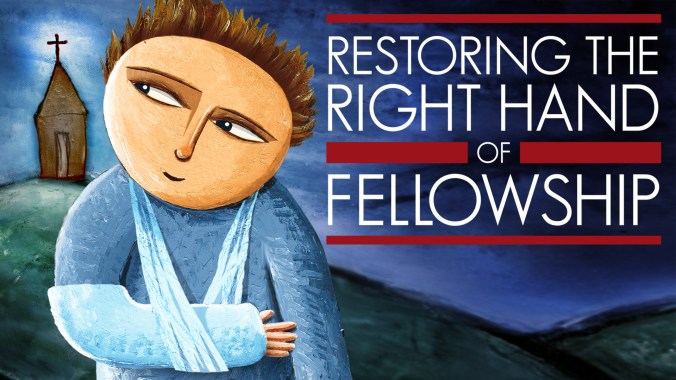
Situational Awareness: Restoring Fellowship with Truth and Love (A Sermon on 3 John)

Unknown

Situational Awareness: Restoring Fellowship with Truth and Love
(A Sermon on 3 John)

In 3 John, we move from the universal church of 1 John, to the local church of 2 John, to an individual Christian by the name of Gaius. Interestingly, if we titled 3 John the way we title 1–2 Timothy and Titus, this letter would actually be called Gaius, not 3 John. And though I don’t think we need to rename this letter, recognizing this name change helps us see how personal this letter is.

In fact, across its 15 verses, there are four individuals named (the Elder, Gaius, Diotrephes, and Demetrius), plus a group of traveling evangelists, who serve as faithful reporters to John, who in turn writes this letter to encourage Gaius and to communicate his intentions to come and address Diotrephes.

Long story short, this letter is filled with personal relationships. And as we think about fellowship, it is necessary to get into the specific details of such relationships. For in truth, not all relationships are equally good, healthy, or true.

Just the same, with fellowship focused on the Lord and his church, there are questions that Christians must ask about the relationships they form. How do we decide with whom to spend time? What is a healthy relationship? What is harmful? And how can we tell the difference?

On Sunday, I addressed those questions and more, as we finished our mini-series on “Restoring the Right Hand of Fellowship.” You can find the sermon here, and below are the twelve points of application I drew from 3 John. Continue reading