Discipling Every Nation (Matthew 28:18–20): Sermon Notes by Ben Purves

sowingThis morning Ben Purves, our pastor for student ministers, preached a thorough message on the Great Commission. He began by showing the biblical-theological links from Psalm 2 and 2 Chronicles 36 to Matthew 28, then moved to explain how the grammar of the passaged emphasizes the command to ‘disciple’ the nations, and finished with a practical exhortation for how we can enlarge our hearts for the work of making disciples near and far.

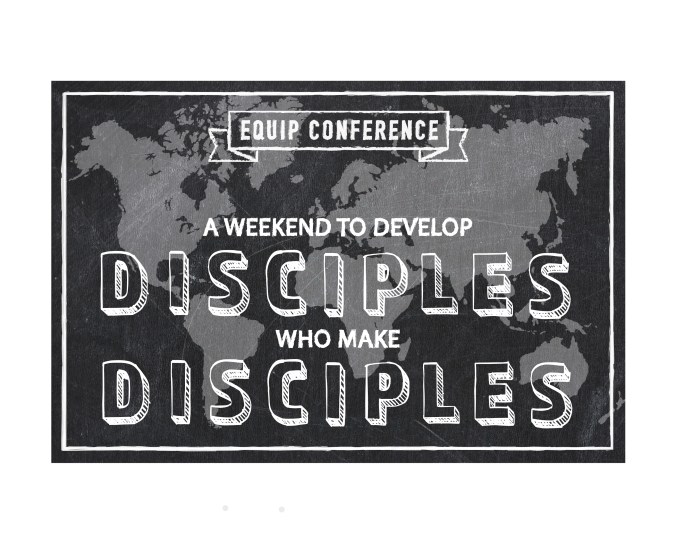
Below you can find discussion questions to his sermon and further resources on the subject of discipleship. You can also sign up for our upcoming EQUIP Conference (September 23–25), where we will consider how marriage and evangelism work together to bolster discipleship in the church. Continue reading

Resting in a Received Ministry

batonYears before receiving a call to serve as pastor, I received one of the most helpful lessons on ministry from Eddie Rasnake and the pastoral staff of Woodland Park Baptist Church.

In 2002 I moved to Chattanooga, Tennessee to go through the SALT Institute. SALT stands for Servant Approach Leadership Training. And this two-year cohort program—which continues to serve the people of WPBC—equipped (aspiring) church leaders with sound principles for Bible study, disciple-making, and ministry. Nearly fifteen years later, the things I learned in SALT continue to shape my approach to ministry. That said, one of them, stands above the rest—ministry is received, not achieved.

What is an Achieved Ministry?

Have you ever met someone whose singular aim is to convince you they are called to ministry? Maybe they give away scores of Vista Print business cards inviting you to invite them to your church; maybe they email you regularly to convince you why they should speak or sing or play at your next youth event; or maybe they give as much attention to networking as to prayer and the study of God’s Word. All of these are symptoms of an achieved ministry.

To be sure, Christians ought to be zealous in using their gifts (Romans 12:8, 11). We ought, as William Carey once said, “Expect great things from God,” and “attempt great things for God.” But while God honors such passion, we must admit there are plenty of zealous people not named Carey. In other words, not every zealous minister is equally pleasing to God. Too many are driven by impure motives. And here, I’m not just talking about others. I know my own heart and the conniving ways I seek to assert myself.

So what is the solution? My answer, the answer I received from the SALT Institute, is to crucify self-achieved ministries and pursue, with a patient heart, a received ministry. Continue reading

Gospel-Motivated Giving

givingThe Lord said to Moses,  “Speak to the people of Israel, that they take for me a contribution. From every man whose heart moves him you shall receive the contribution for me.
— Exodus 25:1–2 —

But who am I, and what is my people, that we should be able thus to offer willingly? For all things come from you, and of your own have we given you.
— 1 Chronicles 29:14 —

Old Covenant Giving: A Legal Requirement in the Land

From the opening pages of Scripture God has called his saints to give. Providing the first sacrifice when he made skins to clothe Adam and Eve (Genesis 3:21), God modeled for his children the kind of animal sacrifice that would please him. Abel followed in faith (Genesis 4:4; Hebrews 11:4), as did Noah (Genesis 8:20–22), Abraham (22:16–18), Moses (24:4–5; 40:29), and the priests of Levi (when they kept the Law). Throughout the Old Testament, God’s people were called to give.

Echoed in every other world religion, giving is a necessary part of worship. In Israel, tithes, offerings, and sacrifices—atoning and festive—were a normal part of worship. Likewise, the Old Testament testifies that every demon-inspired deity demanded gifts and every culture offered sacrifices—sometimes even giving up their children to the flames of Molech (Leviticus 18:21; Jeremiah 32:35). In short, from a cursory reading of Scripture or a survey of the world, mankind is people who worship, and giving is a necessary part of that worship. Still, in that worship there are right and wrong ways to worship, which means there are right ways and wrong ways to give.

Continue reading

Considering the Conscience: A Book Review

conscienceAlready in this election cycle we’ve heard a great deal about the conscience. Religious liberty stands or falls with ones ability to speak and act according to conscience. Likewise, many political commentaries have spoken about the conscience with regards to voting. Some, like Wayne Grudem, have made a matter of moral obligation to vote for Donald Trump. Others, like Andy Naselli, have explained why his conscience cannot vote for the not-so-conservative “conservative” choice.

In truth, we are going to hear a great deal more about the conscience. But what is it? And how does a biblical understanding of the conscience help us in these difficult times—in our voting and more to be at peace with brothers or sisters in Christ who hold different views of the political landscape. Again, Naselli is helpful, as he and J.D. Crowley have written a book on the subject: Conscience: What It Is, How to Train It, And Loving Those Who Differ.

In what follows I provide an overview of their book that both encapsulates some of their key points and hopefully whets your appetite to consider further this important topic. Continue reading

Are You Equipped? Announcing OBC’s EQUIP Conference (Sept 23–25)

equip . . . to equip the saints for the work of ministry,

for building up the body of Christ . . .”– Ephesians 4:12 –

In the 1980s edutainment games were coming of age and infiltrating American schools. Leading the way was a game called Oregon Trail. Perhaps you remember playing the game, shooting Buffalo, fording rivers, and fighting off dysentery. In truth, for most 20th and 21st century children such rugged adventures are things of the past, experienced only in pixels and museums.

In our modern world, it can seem that such explorations ended generations ago. Like our entertainment-oriented education strategies, our world tells children and adults that free time is best spent playing, gaming, or escaping the hard edges of life by conjuring up some fantasy world.

The Bible, however, confronts us with a different reality, one far more adventurous and exciting than anything created by Pixar, Pokemon, or a Carnival pleasure cruise. It calls us to scour the earth, making disciples from every nation teaching them to obey all that God has commanded us.

This is God’s great calling—to follow Christ as eager disciples and lead others to know him through our various stations of life. This is why God made us (to glorify him); this is humanity’s greatest task (to increase his glory by multiplying children who reflect his image). This was Jesus’ final word, to follow him in the world’s greatest commission (Matthew 28:18–20).

But how? Continue reading

God at Work: Learning About the Doctrine of Vocation from Gene Veith (and Martin Luther)

work“Vocation” is a word that comes from the Latin word for “calling” (vocare). In modern vernacular it often is an unimpressive synonym for work, i.e.,  vocational training. However, in Scripture, the word is filled with significance, even dignity. God calls us to himself, out of darkness and death, into the life and love of his beloved Son. Therefore, Christians must understand “vocation” not as a mundane description of work, but rather a dignified “calling” to serve God and the creatures who bear his image. Truly, to ignore or minimize this vocation is to miss a significant facet of the Christian life.

When the Reformers like Martin Luther threw off the shackles of Rome, they restored the doctrine of justification by faith alone. However, contesting the clergy-laity divide, they also esteemed the priesthood of all believers and the doctrine of vocation. In fact, in church history any study of vocation must consider his writings, for he wrote so much and so well about this doctrine.

workTaking this into consideration, Gene Veith an evangelical Lutheran has captured much of Luther’s doctrine, make that the biblical doctrine, in his excellent book God at Work: Your Vocation in All of Life. Introducing his topic, he writes, “When God blesses us, He almost always does it through other people” (14). This, in a sentence, is the doctrine of vocation. Or more exactly, this is the fruit of the gift of vocation.

In what follows I’ve traced the themes of his book and encapsulated a number of his best quotes. I hope it piques your interest in this topic, even as it paints a picture of why vocation is so important for the Christian.  Continue reading

Discipleship in the Local Church: What Has Preaching to Do With Discipleship?

discipleshipDiscipleship programs.

Discipleship pastors.

Discipleship pressure.

Following Jesus means obeying the Great Commission, with its command to make disciples of all the nations. But what does that mean? And how do we do it?

In a few other posts I’ve answered what it means to be a disciple and who makes disciples. But today, I want to begin to address the question: How do we disciple?

A Brief Introduction

Many helpful books have been written on discipleship. My (old) favorite is Robert Coleman’s Master Plan of Evangelismmy (new) favorite might be Discipling: How to Help Others Follow Jesus by Mark Dever. Both are simple reads. The former tracing Jesus’ pattern of discipleship; the latter giving practical instructions on “helping others follow Jesus,” which is Dever’s simple definition of discipling. If you have never read a book on discipleship, I’d recommend you pick up one of these two—then read the other.

In the meantime, let’s try to put a few how-to’s in place, with or without any prerequisite reading. Without limiting or listing the number of ways discipleship can be carried out, here are three ways we might conceive of discipleship. Continue reading

On Religious Liberty and the Freedom to Worship

declaration

But seek the welfare of the city where I have sent you into exile, and pray to the Lord on its behalf, for in its welfare you will find your welfare.
— Jeremiah 29:7 —

Today marks the 240th anniversary of the signing of the Declaration of Independence—a day that marks the birth of our nation and reminds us of the wonderful liberties we have in America. In celebration our family read that founding declaration this morning and praised God for placing us in this country.

At the same time, though, my praise is mixed with pain and petition.

America is not what it was when it was founded. In many wonderful ways the liberties that were not afforded to all men have been extended. But in other less admirable ways, the liberties constituent in the Declaration, Constitution, and Bill of Rights have devolved into a libertine version of hyper-individualism. (On this point listen Albert Mohler’s recent discussion with Yuval Levin). Whereas rights were once understood to be endowed by our creator, rights have become things which men can create or castrate as they—or the Supreme Court–wish.

One of the greatest differences the founders vision of liberty and today’s is found in the increasing distinction between the “freedom of worship” and the “freedom of religion.” The former is the freedom of personal belief and private religious assembly; the latter is the constitutional right—the very first right—which says in the Bill of Rights: “Congress shall make no law respecting an establishment of religion, or prohibiting the free exercise thereof; . . .”

In our day, the change in language to “freedom of worship” is altering the understanding of this first amendment right, and with societal pressure Christians are being forced to mute their beliefs—especially with regards to marriage, sex, and lifestyle choices (a clever euphemism in and of itself). For that reason, on this day of liberty I am both grateful and grieved.

But perhaps, as a pastor, I am most concerned about the way some Christians and Christian leaders celebrate the Fourth of July without voicing any concern for these changes. Can we watch fireworks, grill hotdogs, and eat apple pie, assuming all is well? I think not. As Os Guiness (A Free People’s Suicide: Sustainable Freedom and America’ Future) and Eric Metaxas (If You Can Keep It: The Forgotten Promise of America’s Liberty) have observed, America’s liberty is under threat from within. And therefore, this holiday leads me in two directions regarding religious liberty and the freedom to worship. Continue reading

Not Hardening Our Hearts Against the Hard-Hearted: A Pastoral Meditation on Hebrews 3:12–14

heart12 Take care, brothers, lest there be in any of you an evil, unbelieving heart, leading you to fall away from the living God. 13 But exhort one another every day, as long as it is called “today,” that none of you may be hardened by the deceitfulness of sin. 14 For we have come to share in Christ, if indeed we hold our original confidence firm to the end.
— Hebrews 3:12–14 —

Until the day when Christ returns, churches will be faced with the mystery of iniquity. And more, we will be faced with the challenge of responding to erring church members with grace and truth.

Hebrews 3:12–14 gives us a number of things to consider when a Christian acts upon their hardness of heart. What follows is a five-fold meditation on how to address the hard-hearted without hardening our own hearts.

1. We must read Hebrews as speaking to Christians.

The threat of Christians being led astray by sin, the devil, and the world is very real. Verse 12 crushes any notion that salvation makes Christians impervious to sin. The author addresses “brothers,” meaning his words are for Christians, not some other spiritually-mixed community.

Accordingly, we learn the new birth doesn’t—in this age—make us sin-free, even as it frees us to fight sin. Even so, there are times when sin deceives us, ensnares us, and we need the help of the church to free us. Conversely, the church needs to patiently endure the words and actions of its members. It must preach the gospel to them and bear with them as God’s truth brings change. Continue reading

A Brief Meditation on the Minister’s Rest

farmerWhen I lived in Indiana I was surrounded by fields and farmers. From spring planting to fall harvesting, these men and women worked hard to bring fruit from the soil. As Paul indicates in 2 Timothy 2:6, “It is the hard-working farmer who ought to have the first share of the crops.” In Paul’s day, like ours, farmers are known for their hard work. The same is true for those who sow and water with the word of God. Like the farmer, early mornings, long nights, and constant concern for the Lord’s harvest are a heavy burden.

Fortunately, God gives seasons to farmers. In the winter months, hard-working farmers receive a time of rest and recovery. But at the same time, these hard-working farmers take time to plan for the next year, for the increase of the harvest. I remember talking to them in the winter months as they would be making their seed orders, learning more about new techniques, and equipping themselves with the latest machinery. Sure, there were trips to the beach, holiday celebrations, and the ability to take an afternoon nap. But far more, these men and women spent their time preparing for the upcoming harvest.

This imagery is helpful when we think about a sabbatical. In the Old Testament, Israel was commanded to take a sabbatical from the land every seven years (Exodus 23:10–11). Following in the footsteps of their heavenly father (Genesis 2:1–3), they were called to rest. Rest in the Bible is never a time of inactivity or lethargy. Rather it is a time when God and his people enjoy one another. Such is the background for ministers of the gospel who occasionally take a season of rest and refreshment. The goal is not to pull away from the church, the Lord, or his work. But rather, it is a time of reflection, rest, and refreshment for future ministry.

Indeed, Charles Spurgeon spoke of the necessity for “holy inaction and consecrated leisure.” In his Lectures to My Students, the London pastor said,

It is wisdom to take occasional furlough. In the long run, we shall do more by sometimes doing less. On, on, on for ever, without recreation may suit spirits emancipated from this ‘heavy clay’, but while we are in this tabernacle, we must every now and then cry halt, and serve the Lord by holy inaction and consecrated leisure. Let no tender conscience doubt the lawfulness of going out of harness for a while.” (161)

This principle of rest is true for all Christians, and especially those who labor to feed and tend the flock.

Personally, rest is a difficult practice for me. That being said I am growing to see my need to schedule “holy inaction” and “consecrated leisure.” Though my go-go-go mentality fights against it, taking time to periodically unstring the bow and sharpen the axe does not steal away from productivity. It actually does the opposite—it ensures that I trust in God to give the growth (1 Corinthians 3:7), even as I labor in the strength he provides (Colossians 1:28–29). Yes, he gives spiritual strength, but such grace is not divorced from our responsibility to care for our physical body’s.

While the work of the ministry is a spiritual endeavor, it is not immaterial. Lest we deny our own created-ness or become neo-Platonists who pit the spirit against the flesh, we must learn how to pace ourselves as we run God’s race. This includes scheduling physical rest, sometimes even a prolonged sabbatical like we recently gave to one of the pastors at our church. Because we are vessels of clay, we must establish a rhythm of work and rest, lest we invite physical exhaustion and spiritual/emotional collapse.

Therefore, as we strive to abide in his rest (Hebrews 4:11), may God grant us strength through the appointed means of holy inaction and the spiritual discipline of consecrated rest. May we find Sabbath rest in Christ (Hebrews 3–4) and take time to let our physical bodies recover for more fruitful service.

Soli Deo Gloria, ds