
Marveling at the Lord’s Teaching: A Meditation for Bible Teachers

ben-white-128604Marveled.

Astonished.

Amazed.

In Luke 4, these three words are used to describe the effect Jesus’ teaching had on people. First, in response to Jesus’ reading of Isaiah 61, coupled with his announcement that “this Scripture has been fulfilled in your hearing” (v. 21), Luke record, “all spoke well of him and marveled at the gracious words that were coming from his mouth” (v. 22). Second, verse 32 says of Jesus teaching on the Sabbath (v. 31), “and they were astonished at his teaching, for his word possessed authority.” And third, verse 36 reports “they were all amazed” because with his words “he commands the unclean spirits, and they come out.”

In these reports, Luke uses three words to express the effect Jesus had on people. And more specifically, the effect Jesus’ words had on people. First, Jesus words amazed (θαυμάζω) people. That is, people were “extraordinarily impressed or disturbed” (BDAG) by his speech. This word is often used to speak of supernatural miracles (Luke 8:25), healings (Luke 11:4), and eventually the resurrection (Luke 24:41). But in this case, they were amazed at the graciousness of his words. Continue reading


Lordship from the Start: A Meditation on Saving Grace

francesco-gallarotti-72602.jpg

Updated: I’ve included a few quotes from Charles Ryrie and Robert Wilkin to demonstrate my concerns with their truncated understanding of faith.

Although it has been some time since John MacArthur’s The Gospel According to Jesus launched a biblical salvo into the Free Grace Movement, every now and again I come across people who believe in Non-Lordship Salvation. I have Charles Ryrie’s book So Great Salvation book on my shelf—a book that argues against Lordship Salvation—because a friend who denied Lordship salvation gave it to me as a free gift.

But the trouble with Ryrie’s position is the way in which Scripture itself speaks of faith. In one place he writes, “it seems that many believers do not settle the matter of personal, subjective lordship of Christ over the years of their lives until after they have been born again” (68). Aside from the convoluted grammar of that sentence, he essentially suggests a faithless faith, a belief that may never bear the fruit of faithfulness. As Robert Wilkin, the executive director of the Grace Evangelical Society, puts it, “Christians can fail to endure, fall away, and prove to have been wicked,” and thus “salvation is based on faith in Christnot faithful service for Christ(Four Views of the Role of Works at the Final Judgment, 29, emphasis his).

If this sounds like amazing grace to you, it doesn’t ring true with all Scripture says. Because in the Bible, faith is qualified by terms like obeying the truth, following Christ, feeding on Christ, honoring the Son, and keeping God’s commands. For instance, in both Romans 1:5 and 16:26, Paul speaks of securing the “obedience of faith” in the gospel. What does that mean? In short, it means that saving faith is more being convinced or giving creedal affirmation of the gospel, which is Ryrie’s stated definition of faith (So Great Salvation, 144).

By contrast, a new covenant understanding of the question describes faith as the life and breath of a man or woman made alive by the Spirit. Thus, from the beginning, faith in Jesus Christ has eyes to see who Christ is (2 Corinthians 4:5), a desire to turn from all other idolatrous lords (Acts 3:19; 26:20), and a willingness to submit oneself to him. This is what a full examination of Scripture indicates and what  Luke 7 demonstrates. Continue reading

Spiritual Blindness Takes Jesus Time to Cure: A Scriptural Meditation on Mark 8

lightWhen I put glasses on for the first time, it made a world of difference. The fuzzy signs on the other side of the parking lot became clear, and instantly my ‘blindness’ was cured. The same is not true for spiritual blindness, however. As we see in Scripture, spiritual blindness is not cured with prescription lens, nor is it fixed instantly. Instead, what we find is multi-step process in the hands of our gracious God. Let’s consider.

Jesus and a Two-Part Healing

In Mark 8 Jesus heals a blind man at Bethsaida. There, some people brought this blind man to Jesus as he begged Christ to touch him (v. 22). By this point in Mark’s Gospel, Jesus had already healed “a man with an unclean spirit” (1:21–28), a leper (1:40–45), a paralytic (2:1–12), and many others (3:1–6; 5:1–20, 21–43; etc.). Thus, by this time in Mark’s Gospel the body of evidence for Jesus’ power in healing is great. Still, this healing is unique because of the way it foreshadows and interprets the events that follow.

In the case of the blind man at Bethsaida, we find the only instance in the Gospels where Jesus must heal the same man twice. Verses 23–25 read,

23 And he took the blind man by the hand and led him out of the village, and when he had spit on his eyes and laid his hands on him, he asked him, “Do you see anything?” 24 And he looked up and said, “I see people, but they look like trees, walking.” 25 Then Jesus laid his hands on his eyes again; and he opened his eyes, his sight was restored, and he saw everything clearly.

Notice, after Jesus causes the man to have sight in v. 23, the man’s vision is still impaired. Jesus, in response to the man’s cloudy vision (people who look like trees), must lay hands on him again to fix the man’s vision. Only after Jesus’ second attempt is the man’s vision “restored.”

What is going on here? Did Jesus lack power on the day he strolled into Bethsaida? Was he “unable” to heal the man fully on this day? Or was something else going on? Could it be that this unique healing—again, no other healing takes two attempts—is meant to teach us something about the way God heals, especially with regards to spiritual blindness? I think so. Continue reading

Trust the Process: Learning to Make Disciples and Develop Leaders like Jesus

fireIf you go to church, I’m sure you’ve experienced the “foghorn announcement.” What’s the foghorn announcement, you say? It’s the long, droning, monotonous, unenthusiastic call for workers in the nursery, volunteers at the picnic, or helpers with an outreach event. It goes something like this:

Hi, the pastor asked me to make an announcement. So, here it goes. I know you are busy—we are all are busy, aren’t we—but we have an event coming up and we need help. We’ve made this announcement for the last three weeks. But we still don’t have enough help. It won’t take too much time and anyone can do it. Just sign up in the back as you head out today. 

Okay, this might be a bit overly dramatic—or underly dramatic. But these announcements are as common in well-meaning churches as foghorns on the coast of Maine. They begin with an apology; they make some non-descript invitation for everyone to do something; they often motivate with guilt, ease, or fear; and they fail to capture the wonder that the God of the universe who is building his church permits us to be a part of his work.

Surely, Jesus didn’t recruit leaders this way, did he? Therefore, the question hangs in the air: How do we recruit people to serve in the church? And how, especially, do we call leaders to follow us as we follow Christ? Continue reading

Working Smarter: Five Personal Reflections from David Murray’s ‘Reset’

resetLast week our family took time to decompress and visit the beautiful mountains around Gatlinburg, Tennessee. While there I read Reset: Living a Grace-Paced Life in a Burnout Culture by David Murray. For those in ministry or committed to serving in the local church on top of work, family, and all else, this is an important book. In ten “repair bays” Murray gives practical steps to recovering from burnout and finding rest in the midst of serious labor. I commend the book as a whole and found a number of things particularly applicable. Here are five of them. Continue reading
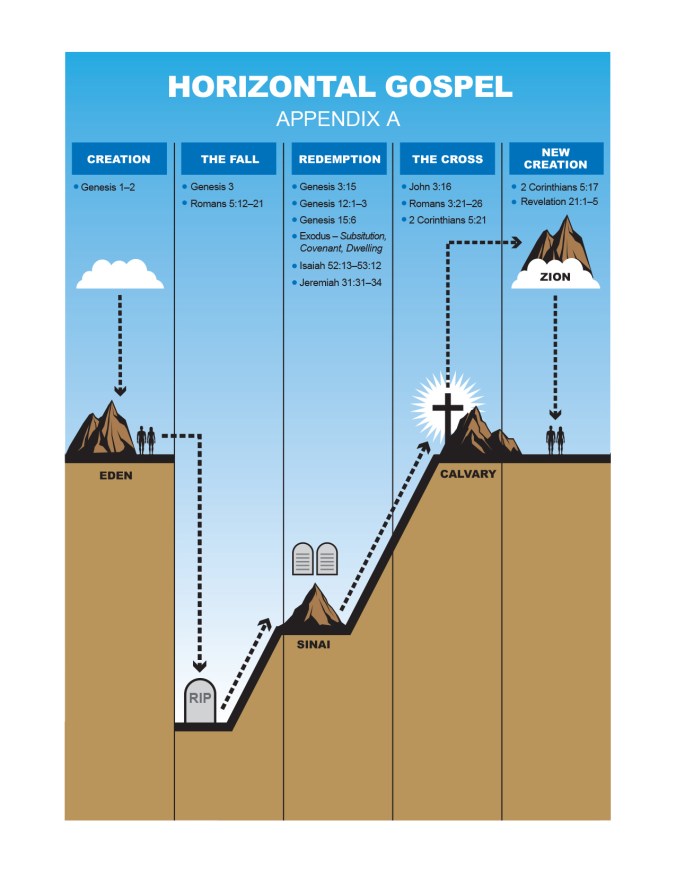
The Horizontal and Vertical Gospel

When I share the gospel at our Discover OBC Class—our new members class—I usually talk about the gospel from two angles. One follows the contours of the ‘horizontal’ storyline of Scripture (Creation — Fall — Redemption — New Creation); the other focuses on the ‘vertical’ relationship with God (Holy God — Man Dead in Sin — Christ — Response). For me, this has been a helpful way to present the gospel, as it sets the person and work of Jesus into the storyline of the Bible.

Typically, I draw these two aspects of the gospel on a whiteboard or a napkin. But this week one of our elders put those presentations into two graphic designs—far better than any napkin I’ve drawn. Here they are. I think they speak for themselves, but feel free to ask questions or suggest enhancements. But even better, go share the gospel with someone—from the whole storyline of the Bible and its centerpiece the person and work of Jesus Christ.

horizontal02vertical01

Soli Deo Gloria, ds

Four Exegetical Commitments to Doing Biblical Ethics

ethicsIn his chapter ethics in Progressive Covenantalism, Stephen Wellum lists four commitments necessary for doing biblical ethics. These principles for doing ethics take into account the progressive revelation of Scripture, the progression of biblical covenants, and the unity and diversity of ethical commands in the Bible. In short, they are commitments we should make whenever we seek to be ‘biblical’ in our ethical formulations.

This approach to ethics fits with a larger vision of how to put the Bible together and provides a helpful, “thick” reading of Scripture with regards to Christians ethics. Below are the four commitments drawn from his chapter. I commend them to you and further consideration on how every topic of ethics requires a whole-Bible approach to the subject.

(For two examples of how this approach might be worked out, you can see how I sought to handle racial reconciliation and transgenderism in two recent sermons). Continue reading

God’s Design for Marriage: A Story and a Song

marraige

Then I heard what seemed to be the voice of a great multitude, like the roar of many waters and like the sound of mighty peals of thunder, crying out, “Hallelujah! For the Lord our God the Almighty reigns. Let us rejoice and exult and give him the glory, for the marriage of the Lamb has come, and his Bride has made herself ready; it was granted her to clothe herself with fine linen, bright and pure”— for the fine linen is the righteous deeds of the saints. And the angel said to me, “Write this: Blessed are those who are invited to the marriage supper of the Lamb.” And he said to me, “These are the true words of God.”
— Revelation 19:6–9 —

What is marriage supposed to look like? What is its design? Who gets to set the standard? And how do we test whether one’s marriage is a good or not, let alone pleasing to God?

These, and dozens of other questions, haunt us today. They haunt us because marriage has been redefined and repackaged into a million different Do-It-Yourself romantic projects. Yet, the original still remains—one man and woman woman united by covenant until death.

The reason the original design remains intact is because the shifting shadows of marriage on earth cannot alter the substance in heaven. And it is the heavenly marriage to which all history lunged toward—namely, the blessed union of Christ and his Bride.

On Sunday, I will preach on the good design of marriage and how the future vision of marriage protects us from the erasure of marriage in our day. To help prepare my heart and yours for that message, I share a story and a song that should fire our moral imaginations for what marriage lived in light of eternity should be—indeed, can be when we let Scripture shape our affections. Continue reading

Hospitality is Not Optional: Five Ways to Pursue Other People

welcome

Welcome one another as Christ has welcomed you, for the glory of God.
— Romans 15:7 —

A few months ago I wrote about the importance of hospitality and five ways to show hospitality in the church. Today, I want to offer five more.

While much hospitality focuses on individuals or families opening their homes to others, a vital practice which enables “house churches” to meet (e.g., Romans 16:5; 1 Corinthians 16:19), I am focusing attention on churches gathering outside of the home. Thus, spring-boarding from 1 Corinthians 16, a passage overflowing with gospel labor, here are five more ways we can pursue hospitality in the church.

Five Ways to Pursue Hospitality

Continue reading

Glorifying God with Our Technology: Four Questions to Ask


Discipleship in Digital AgeIn one sense, discipleship in any age concerns certain common disciplines in order to become like Christ so that we no longer live to ourselves (2 Corinthians 5:14), but to Christ (Galatians 2:20). If we want to grow into Christ, we must discipline ourselves for godliness (1 Timothy 4:7). But the question remains: In light of our increasing, whirling (digital) technology what additional disciplines might we need to embrace to walk by faith amidst pings, apps, and notifications?

Too often, we know Christ should be our focus and that we become like what we worship (Psalm 115, 135), but still technology pushes back on us—retraining, rewiring, and reshaping us in the process. And this is not unintentional, apps are designed by programmers to encourage certain behaviors. We recognize that there are certain beneficial, helpful, and fitting uses of technology that help us in our spiritual walk and in spreading the Gospel. Yet, there are also ways in which our hearts and habits are being reshaped by the devices we hold. So how do we take the principles found in Scripture and apply them to an ever-changing digital age?

For five weeks our church, in Sunday School, has considered Discipleship in a Digital Age. We have given attention to biblical, theological, and practical truths to help us think about technology, but now we need to put truth into action. We need to think practically about the way smart phones and social media, apps and artificial intelligence impact us, and better how we can use them to the glory of God.

And so, this Sunday we will consider a couple of “case studies,” where we can think about how our technology impacts us and how we can best use technology. We will look at smart phones and Facebook to consider how we engage technology with discernment and discipline. If we do not consider such applications, we will not be able to spur one another on towards love and good deeds with our technology. By default we will only  find ourselves following the patterns given to us by the inventers of the technology.

Four Questions to Ask About Any ‘Tool’

Continue reading