Theological Triage (pt. 2): Unity in the Gospel, Separation in the Church

t4gOn Monday, I considered the idea of theological triage—the process of holding different Christian beliefs at different levels of importance—and how the first level differentiates “mere Christianity” from errant cults and false religions. Today I will continue to consider theological triage as it relates to second-level Christian beliefs, those doctrines on which gospel-believing churches agree to disagree.

Recognizing and Affirming Historical and Doctrinal Differences Increases Unity

Within orthodox Christianity, second level doctrines separate genuine believers. Points of division at this level include baptism (What does it signify and who is the proper candidate?), the Lord’s Supper (What do the elements represent?), and the use of spiritual gifts (Do tongues continue today?)—to name a few prominent ones. How such doctrines are espoused and questions are answered causes the need for different assemblies of worship. Historically, it has often been disagreement on one of these issues that have separated (or created) different churches (or denominations).

For Baptists, our pedigree originates about 400 years ago, when a growing number of Protestants began to realize from Scripture that baptism by immersion was the proper mode for professing believers. Stepping away from state churches, local Baptist congregation were free and responsible to God for their actions, and on their biblical conviction they recovered the practice of believer’s baptism. Because of its historical roots, Baptist churches share much with other evangelical denominations (e.g., all the matters agreed upon in the first level), but there are enough distinctives that make it impossible for Baptists to congregate with paedobaptists. Continue reading

Theological Triage (pt. 1): Rightly Dividing Truth from Error

TriageTriage.

It is not a word that we often associate with church life, or if we do, the connotation is probably not positive. However, I think the word has great potential for helping us understand and promote unity in the church—local and universal.

In its original context, triage “means the process of sorting victims to determine medical priority in order to increase the number of survivors.”  While the term is usually placed on the battlefield or in the wake of a natural disaster, it also has an important application in the church for knowing how to rightly hold the doctrines we believe.

Applied to biblical doctrines, the term has been labeled by Albert Mohler as “theological triage,” and it basically indicates that we should sort out three different kinds of biblical belief—(1) those that separate Christians from non-Christians, (2) those that separate different churches and denominations, and (3) those that individuals may disagree about but which are overcome by greater unity on more primary matters.

Today, I will consider the first level, and later this week days I will follow up with the second and third levels to help us think about our relationship with other faiths, other churches, and other individuals in our church. Continue reading

Reconsidering “Above All”: How Hermeneutics Must Intersect with and Inform Our Hymnody

aboveallYesterday, I raised concerns with the popular song “Above All” by Michael W. Smith. For some time, I have taken theological issue with the central lyric of the song:

Like a rose / Trampled on the ground
You took the fall / And thought of me
Above all.

Those last two lines have always made me stumble because of the way they seem to eclipse God with humanity. I’ve always heard them as making the claim that Christ thought more of me than he did of God—which I argued reverses the God-centered nature of the universe and the cross.

For that reason, I was theologically opposed to the song. While I could sing the rest of the song with delight, I always cringed as the chorus neared. Hence, I set out to write these reflections so as to expose the errant chorus. However, a funny thing happened along the way—I read the lyrics again (and again) and this time in context.

Unlike any time before, I read the chorus in light of the whole song. Not surprisingly, reading it context provided greater light. But surprisingly, I had to adjust my thinking for I realized that if I (or we) let the song define its own terms—a principle of general hermeneutics—it does not ascribe humanity to a place higher than God. In fact, the song rightly retains a high view of God’s sovereignty and the dignity assigned to humanity, as the pinnacle of creation. Continue reading

Above All, Who Did Christ Die For?

crossCrucified / Laid behind a stone
You lived to die/ Rejected and alone
Like a rose / Trampled on the ground
You took the fall/ And thought of me
Above all


These words, the chorus of the song “Above All,” have echoed in evangelical churches far and wide. On the whole I like the song, it’s first two stanzas testify to the universal sovereignty of God. However, as it enters the chorus, the sweeping sovereignty of God appears to be displaced by a form of sentimentalized love that is all too common in our self-exalting century.

The theological problem that some have with this song comes at its climax, the point that the whole song drives towards. In that final line, “Above All” ostensibly leaves the high ground of God’s sovereignty (“above all kingdoms / above all thrones / above all wonders the world has ever known”) to frolic in the marshes of ego-boosting self-esteem (God “thought of me above all”).

Intended to express breadth, length, height, and depth of God’s unfathomable love, Michael W. Smith’s lyrics come close to severing the root of God’s love by leading the chorus to sing that God in his love thought about me “above all.”  I say close, instead of actually committing the act, because I think upon closer inspection “above all” in the chorus should be delimited by the earlier “all” statements.

Tomorrow, I will show how I think “Above All” can serve as a God-exalting worship song, but today let me unpack the theological truth that has led many to take issue with this song, namely that the highest purpose of the cross is not directed towards man, but towards God himself. Continue reading

On Baptism and Children

baptism1A recurring question that all pastors will face is this: Pastor, will you baptize my child? With the (all-too-common, but misguided) pressure to please parents and their young child, it is vital for pastors and churches to know what they believe about baptism and children. For parents too, when little Johnny shows interest in baptism, what should you do?

These are vital questions and ones that have received no little attention among Christians committed to believer’s baptism. To find good answers, we don’t need to recreate the wheel. We simply need to know where to turn. Therefore, in what follows, I have listed a number of helpful articles to help you and I think through this important issue.

A Biblical, Pastoral, Denominational, and Parental Perspective by Jason Allen

In a recent blog, Jason Allen (President of Midwestern Baptist Theological Seminary) urges pastors and parents (and the SBC, as well) to “joyfully and wholeheartedly press the accelerator on the gospel while tapping the brakes on the baptistery.” He rightly affirms the fact that it is wise and pastorally-sensitive to affirm children in their desires to follow Christ but to be slow in moving them towards baptism. Since “we must remember it requires more than agreeing to facts about Jesus to be saved,” it is unwise to baptize a young child, simply because they might be able to affirm the plan of salvation. Let me encourage you to read the whole thing.

“Reforming Baptism and Church Membership” by John Hammett (in Biblical Foundations for Baptist Churches)

In his excellent book on Baptist ecclesiology, John Hammett, professor of Systematic Theology at Southeastern Baptist Theological Seminary gives sage counsel on baptism as it relates to children. He writes,

Caution is especially appropriate in the case of very young children. Anyone who works with children knows that five-year-olds will readily ask Jesus into their hearts, but until very recently Baptist would never have considered baptizing them. Believers baptism was seen as virtually synonymous with adult baptism. To request baptism was regarded as a decision requiring a fair degree of maturity. For a church to grant it was to welcome the person into the responsibilities of church membership, which would include participation in the governance of the church, which seems inappropriate in the case of preschoolers. Overseas most Baptists delay baptism until the teenage years, but it is difficult to avoid arbitrariness in setting any specific minimum age for baptism. (Biblical Foundations for Baptist Churches, 122)

While it is true that delaying baptism does add a measure of subjectivity, if not arbitrariness, he lists at least four reasons for delaying.

Continue reading

Book Notes: Church Planting is for Wimps

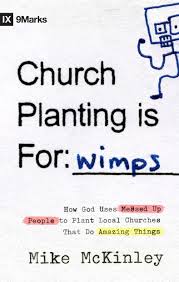
plantMike McKinley, Church Planting is for Wimps (Wheaton, IL: Crossway, 2010).

Church Planting is for Wimps by pastor Mike McKinleyis an encouraging look into the life of a new church planter / revitalizer.

Writing at the four year mark of a church revitalization in the suburbs of Washington, DC, Mike McKinley gives a look into the work God had done through his efforts. Discipled under Mark Dever and sent out from Capitol Hill Baptist Church, Mike’s approach to church revitalization puts a premium of expositional preaching, followed by attention to meaningful membership, elder leadership, the church constitution, and personal evangelism.

While not a long or heavily annotated book, Church Planting is for Wimps gives a winsome look at church planting / revitalization. In fact, one of the most illuminating parts of the book is his short analysis of those two approaches to “planting” a new church. Continue reading

Confronting Falsehood in the Church

falseIt is striking how often Jesus’ apostles warn the church about false teachers and divisive persons. In the Pastoral Epistles Paul calls Titus and Timothy to beware of false teachers in Crete and Ephesus, respectively. But it’s not just these two pastors who are to address falsehood, the entire New Testament calls out the darkness resident in the church. Because of the cosmic conflict between Christ’s church and Satan’s hordes, false doctrine and false living are regular threats to Christ’s kingdom.

Since many churches face such internal and internecine threats, we need to steel our minds with God’s Word so that we might boldly address the darkness around us. Continue reading

Singing the TULIP from the Baptist Hymnal

baptist

One of the saddest effects of the Calvinism debate among Southern Baptists has been the way the discussion about predestination, etc. has moved from the realm of praise to that of polemics. Truly, the faith we hold must be defended. Christians are a people who are called to contend for the faith once for all delivered to the saints (Jude 3). Nevertheless, when we find election in the Bible it is often  a source of praise (Ephesians 1:4–6), a motivation for missions (John 10:16, 26; Acts 18:9–10), and a reason for comfort and assurance (Romans 8:29–39). Rarely, if ever, is election up for debate in the Scripture.

For this reason, discussions about “the TULIP,” which only swim in the pond of argument and persuasion, miss the genre and the goal of biblical election. While I cannot speak for all Calvinists, I can say the ones I know are far more interested in worship and winning the lost than winning the debate about “Calvinism.” For those who hold to the doctrines of grace, the doctrines of grace increase our affections for God and his mission to reach the world for Christ.

For Calvinists, unconditional election is a source of sheer amazement that God would set his love on such a worm as me. Limited atonement becomes a risk-empowering confidence that the cross will accomplish the salvation of all God’s sheep. And irresistible grace is the power God employs to free sinners, so that they can freely follow him.

To be sure, each of these points need sub-points, but the doctrines of grace—to those who delight in them—are not mere theological shibboleths; they are invitations to worship the omni-benevolent and all-powerful God. With this in mind, it is not surprising to find that the Baptist Hymnal (the old one) is filled with songs that not only touch on the TULIP, but praise God for the very doctrines espoused in that acronym.

Now, maybe you’ve never noticed just how many (not all) hymns are written by Calvinists. Once you begin to learn the backdrop to the Baptist Hymnal, however, it is hard to miss the rich hymnody produced by the likes of Isaac Watts, John Newton, William Cowper, and others who affirmed the TULIP. It is my hope that by drawing attention to the following songs, you might see the doctrines of grace in their native habitat—the praise and worship of the church. My prayer is that God may open your eyes to behold the beauty of his multi-faceted grace, what sometimes goes under the acronym TULIP. Continue reading

From Performing in the Flesh to Panting for the Spirit

vinePerforming in the flesh is shorthand for doing work unto the Lord in your own strength, by your own wisdom, and with your own will power. In short, it is service without spiritual grace, and Satan loves to seduce you with it. Such Spirit-less service may be outwardly beautiful, relationally effective, or even successful, but because it is done without faith, it displeases God (Rom 14:23; Heb 11:6) and bears no lasting fruit. Sadly because our hearts are deceitful we may even call such unbelieving service good, when God does not. For that reason, it is always right to return to the Word and ask: What does God say?

What service does God find pleasing? What counterfeit performances originate in unbelief? And how can we tell the difference? Continue reading

Putting the Resurrection on Display: Walking and Talking as Witnesses of the Gospel’s Power

witnessesWhen Jesus told his disciples to stay in Jerusalem until the power from on high came (Luke 24:49), he said that they would be “my witnesses in Jerusalem, and in all Judea and Samaria, and to the end of the earth” (Acts 1:8). Ten days later, the Father sent the Holy Spirit and innervated the church with Christ’s power (Acts 2).

Since then, Christ’s pilgrim people have traveled the globe, witnessing to the resurrection of Jesus Christ (cf. Acts 1:22; 2:32; 3:15; etc.) and upsetting those who refuse to submit to Christ’s lordship (17:6). In every place the gospel has gone, local churches have sprung up to give a permanent witness to the kingdom of Christ.

As one of those churches, it behooves us to ask the question: In what way or ways should we witness to Christ’s kingdom? And how well do we do it?

Believing the Bible to answer such questions, we see that the lives we live and the words we speak play a significant role in Christ’s ability to work through us. In truth, it is not just the church who preaches the gospel. Ephesians 2:17 says Christ himself preaches the gospel of peace. But seated in heaven he preaches by proxy; it is his Spirit and his bride that say, “Come!” (Rev 22:17). Therefore, the effectiveness of Christ’s evangelism is contingent upon the purity of our lives. As we continue to consider what Jesus’s evangelism program looks like, let’s see how our lives contribute to the power of our witness. Continue reading