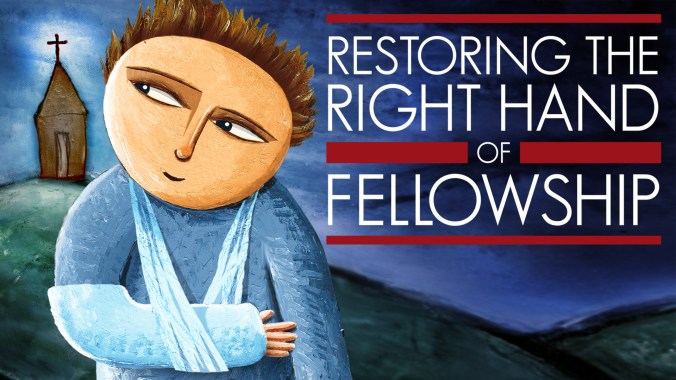
Situational Awareness: Restoring Fellowship with Truth and Love (A Sermon on 3 John)

Unknown

Situational Awareness: Restoring Fellowship with Truth and Love
(A Sermon on 3 John)

In 3 John, we move from the universal church of 1 John, to the local church of 2 John, to an individual Christian by the name of Gaius. Interestingly, if we titled 3 John the way we title 1–2 Timothy and Titus, this letter would actually be called Gaius, not 3 John. And though I don’t think we need to rename this letter, recognizing this name change helps us see how personal this letter is.

In fact, across its 15 verses, there are four individuals named (the Elder, Gaius, Diotrephes, and Demetrius), plus a group of traveling evangelists, who serve as faithful reporters to John, who in turn writes this letter to encourage Gaius and to communicate his intentions to come and address Diotrephes.

Long story short, this letter is filled with personal relationships. And as we think about fellowship, it is necessary to get into the specific details of such relationships. For in truth, not all relationships are equally good, healthy, or true.

Just the same, with fellowship focused on the Lord and his church, there are questions that Christians must ask about the relationships they form. How do we decide with whom to spend time? What is a healthy relationship? What is harmful? And how can we tell the difference?

On Sunday, I addressed those questions and more, as we finished our mini-series on “Restoring the Right Hand of Fellowship.” You can find the sermon here, and below are the twelve points of application I drew from 3 John. Continue reading


Forgive One Another: A Simple Introduction to a Challenging Command

winding road warning sign near the forest

Forgive. One. Another.

Those three words are easy to say; less easy to understand; and sometimes nearly impossible to practice. Truly, for as simple as forgiveness should be, seeking and receiving forgiveness is often the things that brings us to our knees.

Who knew that sins forgiven in heaven could be so difficult to forgive on earth?

Yet, that is often the case. Forgiveness is often a misunderstood doctrine, as well as a misapplied practice. Therefore, Christians who seek forgiveness, demand forgiveness, or seek to help others forgive, often find that the Christian practice of peace-making is more difficult than they might first imagine.

In response, genuine believers may grow frustrated—with themselves, with others, with God, or with the church. How can the cross of Christ not have its full effect? It seems so simple.

And yet, I might offer a different perspective. Continue reading

Who is in Charge? Two Competing Visions of Church Authority

pexels-photo-272254.jpeg

In recent years and hours, lots of discussion has been given to the subject of authority. Who has authority to close the Southern border? Who has authority to mandate vaccines? Who has authority to teach children about the birds and the bees? Who has authority to close churches or constrict their practices? And in the church, who has authority to rule the congregation (1 Tim. 5:17). Is it the congregation? The elders? One elder? The most vocal or influential members? Or some combination?

Who has authority?

Of all the books I have read on the subject, the one that is most promising (I’m still reading it) is David Innes’ book, Christ and the Kingdom of Men: Foundations for Political LifeIn a section on understanding differing spheres of authority, Innes describes authority in the church. He writes,

[C]hurch government has its authority from Christ. The apostles of Christ appointed the original elders in the first churches. The apostle Paul instructed his legate Titus to “appoint elders in every town” (Titus 1:5). They are ministers of Christ who must give an account to Christ (Heb. 13:17). In the first centuries of the Christian church, civil governments were pagan, as they are today in many lands where Christ has gathered his people, and so they could not have had an organizing or overseeing role in the formation of the churches. (32)

Underscoring the source of church authority coming from Christ, Innes turns to the way churches should not receive their authority from the state. “Over many centuries, churches have had to resist civil authorities’ attempts to exert control over church leadership” (32). Indeed, in our day this is a lesson we have had to relearn. As Western civilization has rejected Christ, other gods have filled the void. And we have already seen how the god of statism is rising to power.

At the same time, however, challenges between church and state are not the only place we have a conflict in authority. We also find difficulty in understanding how the church and the self are to be related. Interestingly, Innes includes the “individual person” in his list of spheres. He explains,

It is odd to think of each individual person as a sphere of authority, but there is a God-given authority that one has over oneself. God’s creation mandate for everyone without distinction of rank or role to exercise dominion in vice-regency communicated God’s moral expectation that people would govern themselves and their personal affairs in righteousness. Self-government at this level is the moral responsibility of every human being and thus the moral right of every adult. (30)

While we mostly think about authority at the level of institutions (e.g., family, church, state), self-governance, or what Scripture labels “self-control,” is a sphere of sovereignty. God has given each image-bearer a body, and those bodies can be used as instruments of righteousness or wickedness (Rom. 6:12–23), and thus we must learn to glorify God with our bodies (1 Cor. 6:20). Such glorification certainly includes sexual purity (1 Cor. 6:12–20), but it would also include the way we use our tongues (James 3), minds (Rom. 8:7; 12:1–2), shoulders (Ezek. 34:21), and fingers (see all the bodily features of sin in Romans 3:10–19). Long story short, we must learn to govern ourselves and to say no to the sinful impulses that rise up within us (James 1:13–15). Yet, this is exactly where the modern church is struggling. Continue reading

Four Loves: The Path to True Fellowship

Unknown

Four Loves: The Path to True Fellowship (A Sermon on 2 John)

In 2020, ESPN published a ten-part series call The Last Dance. The series followed the 1998 Chicago Bulls, the team led by Michael Jordan. This was the sixth and final championship series, the one that ended the dynasty.

As a basketball player growing up in the 1990s, this series was pure nostalgia. Every episode brought back memories and added backstories. It was the best of the old and the new. It returned me to a period of basketball glory, and it scratched a prevalent modern itch—the need to know all the details of what happened behind the scenes.

It’s funny a thing that today we live at a time when people think they need to know everything. Undercover surveillance, tell-all documentaries, and best-selling books by whistle-blowers are all uber-popular, and all of these feed the belief that we deserve all the facts.

Yet, such a god-like desire to know everything is confronted by the fallout of The Last Dance. That is to say that by bringing everything out the open, The Last Dance did untold harm. For not only did it reveal tensions and troubles from the 1990s, but it also started new fires. Continue reading

Willingly and Truthfully: How a Pastor Demonstrates His Love

herd of sheep on focus photography

The elder to the elect lady and her children, whom I love in truth, . . .
– 2 John 1 –

In 2 John 1, the Beloved Apostle declares his love for the church. This love is for the church (“the elect lady”), as well as for her members (“her children”), and it sets the tone for his whole letter. As John expresses it, his love motivates him to write, and his love leads him to warn the church against false teachers. Indeed, such is the love of a pastor. Love that is biblical must lead others to the truth. And any love devoid of truth is not truly loving.

Throughout the New Testament love and truth are joined as one. For example, Paul says that love always rejoices in the truth (1 Cor. 13:4). Likewise, John’s love for the church moves him to rejoice when God’s children are walking in truth (2 John 4). The author of Hebrews urges us to spur one another on towards love and good deeds (Heb. 10:24–25)—good deeds defined by the truth of Scripture. And even Jesus is identified as the one who is fullness of grace and truth (John 1:14, 17), or, as these two words come from the Hebrew pair hesed (lovingkindness) and emet (truth/faithfulness), he is full of love and truth. Just as John highlights in 2 John 3 reads, “Grace, mercy, and peace will be with us, from God the Father and from Jesus Christ the Father’s Son, in truth and love.

In short, those leading the church are to love the people of God in truth. Yet, to echo Pilate: What is truth? Or, for that is matter: What is love? In this blogpost, I will begin to explore that question: What does it mean for a pastor to demonstrate love?

Love Must Truth

In our modern age, love is defined by unbounded affirmation and the willingness to celebrate self-expression, whatever that expression may be. Accordingly, those who love in truth, or attempt to love others with the truth, may not be well-received. They may be hated!

For those catechized by the world and its therapeutic ideas of self-esteem, challenging someone may be received as harsh or even hateful. And more, any pastor who dares to disciple a church or a church member in ways that the recipient does not esteem acceptable may easily be assigned as unloving or even unsafe. In such a world, the truths of God’s Word do not change, but appreciation for them do. And thus, Christians face the difficulty of returning to the old paths.

In generations gone by, generations forged by Christian convictions, correction was received, if not pursued; authority was respected; and love was evidenced by service, sacrifice, and selflessness. Today, vestigial remains of true love remain, but not without careful attention to what love actually is and isn’t. And if this is true in general; it is especially true for pastors.

How do pastors love God’s church? What should congregations expect of those who lead them? And what does Scripture say about the pastor and his responsibility to love the flock? Those questions could easily invite a book on the subject, The Pastor and His Love perhaps. Yet, short of that project, let me offer two answers. And in the days to come, as the Lord allow, I’ll add more. Continue reading

A Dangerous Calling (pt. 2): Five Steps to Self-Promotion

gray and white concrete staircase

Throughout the Bible we find a divide between wisdom and folly, righteousness and sin, givers and takers, children of God and children of the devil. As Jesus said, he did not come to bring peace, but a sword (Matt. 10:34–35). And that sword not only divides humanity, which provides the context of his words in Matthew’s Gospel, it is also a sword that judges the thoughts and intentions of men. Indeed, God’s Word does more than declare behavior right and wrong; it does surgery on the heart, exposing why we do what we do.

In the Bible, and in the church, few things are more difficult to discern than motivations for ministry. For truly, as many good motivations as there are, there are also bad motivations. There is ambition that is godly and ambition that is anything but godly. And in every child of God who serves faithfully, there will be both impulses.

Just consider the Apostle Peter, who could confess Jesus as the Christ at the same time that he would deny him his cross (see Matt. 16:13–23). Indeed, at one time or another, all the disciples had a mixture of true and false ambitions, which is why Jesus had to correct their views on greatness (Mark 10:42–45). Truly, we are fickle creatures. And the best of men is both taught by God and tempted by the devil. Again, read Matthew 16.

So, knowing that, we should always be open to examining our motivations for ministries, and that is what this series is about. It aims to address false ambitions and to set a course towards true ambitions for ministry.

In Part 1, I offered two lessons from the life of Adonijah.

  1. We should not seek positions in ministry; we should seek the righteousness to receive such a place of service.
  2. We should abide by the word, and wait for an invitation to serve.

And now, in Part 2, I will suggest a third lesson from Adonijah’s life:

  1. When kingdom-seekers exalt themselves, their ambition follows a discernible pattern.

This pattern consists of five actions that Adonijah pursued in his attempt to be king in Israel. And, as the story goes, he nearly succeeded. What ultimately prevented him from claiming the throne illicitly is that genuine servants of God stood to oppose him. His false ambitions were thwarted because the ambitions of others were rooted in God’s Word.

Sadly, this sort of conflict continues today.

In truth, only when righteous men and women stand against falsehood will truth prevail. Yet, this is exactly why it is vital to learn the pattern of those who exalt themselves. For in ministry, when good works are pursued with bad motives, it can be very difficult to discern. Often, the falsehood of good works takes years, even decades, to discern. Yet, Scripture does give us light, if we are willing to look. And that is what we find in Adonijah’s play for David’s throne. Continue reading

How Fellowship Works: Cain, the Cross, and the Command to Love One Another

UnknownHow Fellowship Works: Cain, the Cross, and the Command to Love One Another (A Sermon on 1 John 3:11–18)

Love. One. Another. If you type those three words into your search engine, you’ll find a dozen references.

The first two are found in John 13:34–35, when Jesus tells his disciples to love one another, just as he has loved them.  Next, “love one another” repeats in John 15:12 and 17, as Jesus connects the love of God with the love of God’s children.

Paul uses these same three words, when he says in Romans 12:10, “Love one another with brotherly affection.” And Peter echoes Paul’s brotherly instruction in 1 Peter 1:22, when he says, “Having purified your souls by your obedience to the truth for a sincere brotherly love, love one another earnestly from a pure heart.”

Those are the first six uses of “love one another.” Then the last six are found in John’s Epistles. One is found in 2 John 5 and five in 1 John 3–4 (1 John 3:11, 23; 4:7, 8, 12).

From this basic survey, then, we can conclude two things. First, the command to love one another is always a command to members of one body (Rom. 12:5) to love one another with brotherly affection. This command is not an abstract instruction for individuals to do loving things. It is a mutual command for the body of Christ to love those in Christ.

That’s the first thing. The second thing is that the passage that most fully details how to love one another is 1 John 3–4. And yesterday, as I preached again on the theme of fellowship, I looked at three things.

  1. The Command to Love One Another is a command fulfilled in the body of Christ.
  2. The Command to Love One Another is a command that rejects the violent competition of Cain.
  3. The Command to Love One Another is a command that finds life in the cross of Christ.

In short, to love another as God commands we must reject the spirit of Cain’s violent competition and embrace Christ and his willingness to put others ahead of himself. This is the key to abiding fellowship with God and one another. And yesterday, this is what I tried to show from 1 John 3:11–18. You can find that sermon here.

Check back later this week too, as I share parts 2 and 3 of “A Dangerous Calling: Two Ways to Seek Ministry.”

Soli Deo Gloria, ds

A Dangerous Calling: Two Ways to Seek Ministry

boy wearing crown statue

Adonijah the son of Haggith exalted himself, saying, ‘I will be king.”
– 1 Kings 1:5 – 

But seek first the kingdom of God and his righteousness,
and all these things will be added to you.
– Matthew 6:33 –

There is nothing wrong with seeking the kingdom of God, or in seeking a place in that kingdom. In fact, it is absolutely right. Yet, with every good intention, there is the possibility to go astray, to take something good and to seek it badly. And for this reason, it is not sufficient to seek the kingdom. We must seek the kingdom and his righteousness.

In other words, seeking God’s kingdom is not the whole command. We must seek God’s kingdom righteously, which is to say, we must seek to be righteous in God’s kingdom. And this is the point that I want to pursue here and in the next two blogposts.

Unfortunately, too many followers of Christ have seen ministers who have sought the kingdom without righteousness. Likewise, too many who are now serving the Lord can reflect on the ways (multiple ways?) we have pursued ministry for vain reasons or with wrong motivations.

For instance, I learned of pastor last fall whose church had served as a money laundering front for his financial dealings. Clearly, he was seeking a kingdom, but not the Lord’s. Yet, as he stood in the pulpit each week, his vain pursuits were not seen. It took years for his self-interest to come to light. As Paul writes to Timothy, “The sins of some people are conspicuous, going before them to judgment, but the sins of others appear later” (1 Tim. 5:24).

So too, the fruit of ministry takes time to discover. Sometimes what looks like good fruit is not genuine. Similarly, for every ministry aspiration that is good, there are other aspirations that are corroded by pride, selfish ambition, and vain glory. As Paul David Tripp declared, ministry is A Dangerous Calling. How dangerous? So dangerous that three of the men who endorsed his book are no longer in ministry.

Accordingly, we should both be slow in seeking ministry (James 3:1). And we should be slow to affirm the ministries of others (1 Tim. 5:22). At the same time, we should be quick to learn from Scripture, what God says about seeking the ministry and a place of service in his kingdom. And to help us, I want to return to the book of 1 Kings and the story of Adonijah, the self-promoting son of David. For in him, and in comparison to Solomon, we can learn much about ministry. Continue reading

Restoring the Right Hand of Fellowship: A New Sermon Miniseries

jack-sharp-ShCVvQbQBDk-unsplashFour Truths About Fellowship: A Sermon on 1 John 1:1–2:6

As we know all too well, sin always separates. And thus, when fellowship breaks, there is, lurking somewhere, sin unconfessed. In those times, it is tempting to fix the problem(s) with our own wisdom and to work overtime to recreate the fellowship that was had before. Yet, in times when fellowship is lost, we must remember that God alone can “fix” it. And accordingly we should seek him first and all his righteousness.

To put it seasonally, before the Lord gives his church spring rains, he often makes us feel the bitterness of winter’s cold. This coldness may have known sources, or its chilling drafts may strike us without ever revealing the source of their cold. Yet, whatever the source of winter, we should remember that God is working, and that spring is coming. As Hosea 6:1–3 tells us, we must remember that the Lord is the one who breaks us, so that he can bind us; he hurts us (or permits us to feel pain), so that he can heal us (see Psalm 105). Then, from this place of weakened condition, we are invited to return to know the Lord.

This is the promise: God will sanctify his people, and he will bring them to confess their sins. And until sin is confessed, joy will be withheld. Yet, when we seek his light and see our darkness, it will prompt true confession, repentance, forgiveness, and grace. And this grace will bring a new season of fellowship, all provided by the Lord. Continue reading

Fellowship 101: Five Truths To Move Beyond Bubba’s Shrimp Scampi

erika-giraud-7KhbREQPFD4-unsplashWhat does fellowship mean?

In Christian circles the word fellowship, and its Greek equivalent (koinōnia), is used for all kinds of things. There are fellowship meals, fellowship events, fellowship coordinators, fellowship halls, and even internship experiences called fellowships. Additionally, you have a ministry called Bible Study Fellowship, which labors to distinguish themselves from being a church, even as some individuals treat that ministry as their church. At the same time, there are churches who go by the name Bedrock Baptist Fellowship, or something like that. And you can find all sorts of resources aimed to improve fellowship.

With all its various uses, “fellowship” is the equivalent to Bubba’s endless array of Shrimp Dishes. Indeed, like shrimp kabobs, shrimp creole, shrimp gumbo, etc., fellowship goes with everything. Yet, by going with everything, its utility has permitted Christians to do many things with fellowship that go beyond the bounds of the Bible.

Again, what does fellowship mean?

If we open our concordances, we find the word koinōnia (fellowship, partnership) 19 times in the New Testament: Acts 2:42; Romans 15:26; 1 Corinthians 1:9; 10:16 [2x]; 2 Corinthians 6:14; 8:4; 9:13; 13:14; Galatians 2:9; Philippians 1:5; 2:1; 3:10; Philemon 6; Hebrews 13:16; and 1 John 1:3, 6, 7. From these uses, we might begin to see what God says about fellowship.

Clearly, any time we restrict ourselves to a word to form a doctrine or a practice we miss related concepts, metaphors, stories, and more. Yet, because this word is used so often to justify so many types of Christian activities, we would do well to examine the word. Do we have a faithful understanding of the word? And do we abide by it? Continue reading