‘Cardiac Discipleship’: Five Ways to Pursue the Heart in Spiritual Formation

you-areYou Are What You Love is a needed corrective to overly cerebral approaches to discipleship. It is a challenge to followers of Christ to evaluate how ‘secular liturgies’ are training our hearts to love things other than God and our neighbor. And it presents a vision of discipleship that does more than just cement spiritual disciplines in new believers; it calls us seek first the kingdom and to live with hearts enlarged for Christ and his glory.
In what follows I share a few quotes where Smith speaks directly about discipleship. I hope they will whet your appetite for your book and pique your interest in how discipleship is a matter of heart cultivation.

1. Discipleship cultivates the appetite and curates the heart.

While discipleship is a matter of learning, it is more like learning how to cook than to read code. Disciples hunger and thirst for the things of God and know how to feed on him, and good ‘disciplers’ seek to cultivate cravings in the heart of new believers. So,

Discipleship is more a matter of hungering and thirsting than of knowing and believing. Jesus’s command to follow him is a command to align our love and longings with his—to want what God wants, to desire what God desires, to hunger and thirst after God and crave a world where he is all in all—a vision encapsulated by the shorthand ‘the Kingdom of God.’ (2) Continue reading

Seeking God in His Word (Psalm 119:9–16)

rhythms-of-holinessYesterday, Ben Purves, our Pastor for Student Ministries at Occoquan Bible Church, continued our series on spiritual disciplines. What follows are some discussion questions and resources to go deeper in Psalm 119.

**********

Psalm 119 is one of my favorite Psalms. Both the longest chapter and prayer in the Bible, this 22 stanza psalm is a literary masterpiece. Written as an alphabetic acrostic, it is a beautiful celebration of God’s Word. The psalmist calls the reader to delight and rejoice in God. This last Sunday we looked at the second stanza (vv. 9-16) and considered how we might treasure God’s Word as we head into the New Year. You can listen to the sermon here.

Psalm 119:9-16

How can a young man keep his way pure?
By guarding it according to your word.
10  With my whole heart I seek you;
let me not wander from your commandments!
11  I have stored up your word in my heart,
that I might not sin against you.
12  Blessed are you, O Lord;
teach me your statutes!
13  With my lips I declare
all the rules of your mouth.
14  In the way of your testimonies I delight
as much as in all riches.
15  I will meditate on your precepts
and fix my eyes on your ways.
16  I will delight in your statutes;
I will not forget your word.

Discussion Questions

  1. What words are used to describe the Scriptures, and how do they open up different dimensions of God’s Word?
  2. What attributes of God are revealed in the text?
  3. What are the two petitions of the psalmist in vv. 9-16? What does each petition reveal about the psalmist?
  4. Practically — what does it look like to guard our hearts with the Word of God?
  5. What should the relationship be between our love for God, his word, and sharing the gospel?
  6. How would you characterize the heart of the psalmist?
  7. How does one get his heart to be like that of the psalmist?
  8. How might your heart become a treasure storehouse of the Word of God?
  9. What steps might you take to increase your joy in God and His Word in 2017?

Further Resources

Articles

Books

Soli Deo Gloria, ds

Eternal Security and Common Grace: Two Doctrinal Lessons from Acts 27

boatWhen Paul was taken to Rome, Luke describes the harrowing sea journey to Italy in Acts 27. Embarking on a ship from Adramyttium, a seaport in Asia Minor (v. 2), Paul crossed the Mediterranean. From Myra (v. 5), Paul and his guard found passage on a ship of 276 men, complete with many other soldiers (v. 31) and prisoners (v. 42). While Paul doubted the safety of the journey, based on the time of year (vv. 9–10), the centurion and the majority of the crew decided to head out (vv. 11–12).

This perilous journey sets up the dramatic events at sea, the near drowning of the passengers, and the eventual sinking of the ship. Verse 13 begins with gentle breezes as the ship sets sail, but all turns stormy in verses 14. Verses 14–20 recount the evasive actions taken by the crew (e.g., turning the ship out of the wind, lowering the gear, jettisoning cargo), and verses 21–26 introduces Paul’s “I told you so” coupled with gracious promise from the Lord.

21 Since they had been without food for a long time, Paul stood up among them and said, “Men, you should have listened to me and not have set sail from Crete and incurred this injury and loss. 22 Yet now I urge you to take heart, for there will be no loss of life among you, but only of the ship. 23 For this very night there stood before me an angel of the God to whom I belong and whom I worship, 24 and he said, ‘Do not be afraid, Paul; you must stand before Caesar. And behold, God has granted you all those who sail with you.’ 25 So take heart, men, for I have faith in God that it will be exactly as I have been told. 26 But we must run aground on some island.”

In these words, we find two doctrinal lessons—the first, an illustration of eternal security as Paul later tells the passengers they must remain on the boat to receive “salvation.” In Acts 27, salvation (defined as the preservation of life) is secured by means. Thus, it serves as handy illustration of how God provides eternal security through God-provided means. Or as Thomas Schreiner and Ardel Caneday explain in their book The Race Set Before Us: A Biblical Theology of Perseverance and Assurance, “Acts 27 illustrates well the fact that exhortations and warnings are a signficant means by which God moves humans to act so that his promises to them will be fulfilled” (212). This is the first illustration, well covered Schreiner and Caneday (pp. 209–212).

The second doctrinal lesson pertains to God’s common grace and the variety of ways grace is conveyed to unbelievers through the lives of Christians. I will consider this below. Continue reading

Praying with Passion (Psalm 126)

rhythms-of-holinessAs we begin 2017, our church has taken January to focus on a handful of spiritual disciplines—personal and public. The first in our series is prayer. But instead of just commending its importance and techniques to help, I took the route of seeing how God forms desire for prayer in our hearts.

By drawing near to God, by remembering the promises of his Word, and by desiring with increasing anguish Christ’s kingdom to come, we grow more passionate in our prayer. Indeed, passion is not a word that simply means “with heighten emotion.” Rather, its original sense relates to suffering (hence “Christ’s passion”), and this is what we do when we pray—we entering into the sufferings of Christ and weep for his will to be done.

At first glance, this kind of praying may seem off-putting, but I believe, Scripture—Psalm 126 especially—teaches us that this is the kind of prayer that endures. So if you want to grow in prayer in 2016, consider what Psalm 126 says and how it fuels prayer. You can read the sermon notes or listen online. Discussion questions and resources are below. Continue reading

Spiritual Desire: The Key to Cultivating Spiritual Disciplines

sun-heartOften, when we come to spiritual disciplines we list them, plan for them, and then labor to perform them. In the best scenario, we realize—sooner rather than later—we can’t do them apart from the power of the Holy Spirit. And so we pray and ask God to help us.

Yet, such approach may go wrong from the start. Why? Because we put the law (and its list) in front of the gospel (and its power). In other words, when we devote ourselves to discipline, we “covenant” with a bank of rules we trust to make us better—better people, better Christians, better (you fill in the blank). But of course, the law never brings life and can only be a delight after God has written his law on our heart.

The problem with any law-full approach to discipline, however, is not that it contains laws. The gospel is not antinomianlawless. The third use of the law is a gift to the growing disciple. The problem is when we call upon the Spirit to assist us after OUR plan is put in place. Now granted, if you set out to read the Bible, pray, and fast, you have already taken your cues from the Spirit’s inspired Word—especially, on that last discipline. But still the root cause of burnout remains. What is that? The problem of desire. Continue reading

Another Step Toward a Biblical Ecclesiology: Acts 9 on Baptism, Membership, and the Church

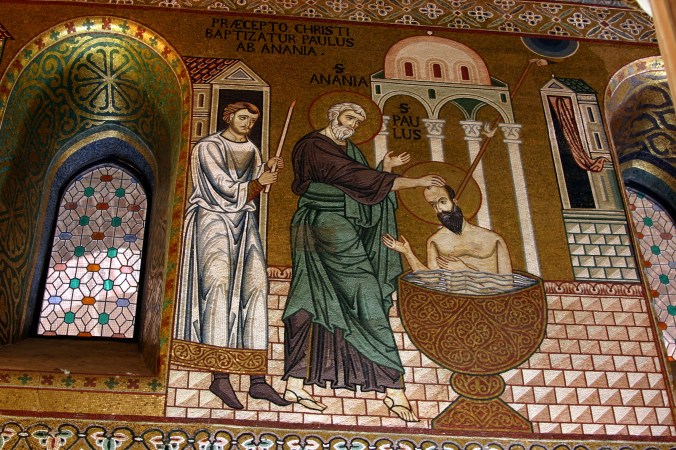
baptism_of_st_paul_-_capela_palatina_-_palermo_-_italy_2015-2The book of Acts is pivotal for understanding the nature and function of the church. It is also challenging, because it presents a church that is “born” on Pentecost, at first contained to Jerusalem, but later expanded to Judea and Samaria and finally unleashed the ends of the earth. At the same time, it’s founding members were believers before receiving the Spirit and yet the gift of the Spirit is one of the distinguishing marks of the church as it spreads from Israel to Italy. In four instances (Acts 2, 8, 10, 19), the Spirit is given, but in no two instances are the exact events the same. For instance, speaking in tongues accompanies the Spirit in Acts 2, 10, 19, but not Acts 8. Likewise, water baptism precedes the Holy Spirit in Acts 8, but follows in Acts 10.

From just a sampling of evidences, the book of Acts is both foundational and frustrating for understanding the nature of the church. It is foundational because of the patterns we see in how churches are formed—the Word of God is preached, Jews then Samaritans than Gentiles repent and believe, they are baptized, and then gathered into churches. Yet, it is frustrating because not everything in Acts is reproducible today. The personal visitations by Jesus, the miracles of healing, the speaking in tongues, and the survival of snake bites are all incidents that we might say have discontinued—unless one believes otherwise. For now my point is not to defend or deny cessationism, but to merely highlight how that debate among others finds difficulty in Acts.

Any point of ecclesiology, therefore, needs to be aware of Acts transitional nature. It should take into account how the Holy Spirit has given us this book to teach us about the founding of the church, but it is not a manual for every point of doctrine. That being said, where else do we turn in Scripture to find how to plant, revitalize, and shepherd churches? Therefore, we do need to watch for patterns and principles in Acts, but always with awareness of some discontinuity between Acts period of transition and our own day.

Clearing Up Two Points of Ecclesiology

With this approach to Acts in mind, I want to clear up two points of ecclesiology from Acts 9. From this chapter, I have heard two statements about the church:

  1. Paul’s baptism by Ananias suggests a local church is not (absolutely) needed for a legitimate baptism.
  2. The Church is fundamentally a universal concept, as Acts 9:31 describes the church regionally, not locally (i.e., in one spatio-temporal location).

While there is truth in these statements, ultimately I think we are on more solid ground to say

  1. Paul’s baptism was unique, but not so unique as to break from the normative pattern of the New Testament. We should exercise caution when making application from his experience, but at the same time, we can see how his unusual experience fits the larger pattern of baptism and “church membership” in Acts.
  2. The universal Church “throughout all Judea and Galilee and Samaria . . .” is a located in spatio-temporal “locales” (something I’ve tried to describe elsewhere).

In what follows, I will argue that Paul’s baptism is both a unique point in redemptive history and one that follows the pattern of baptism and church membership (i.e., association with other disciples in a local church). Exploring the relationship of Paul’s baptism to the churches in Damascus and Jerusalem will also prove the corollary: life in the universal church is experienced through local assemblies. In the end, I will list seven points of application from this chapter related to ecclesiology. Continue reading

Matthew, Mark, Luke, and John: Reading Each Evangelist on Their Own Terms and Seeing How Each Reads the Old Testament

arc.jpegAny alert reader of Matthew’s Gospel will notice the tax collector-turned-evangelist is regularly quoting from the Old Testament. To him, the events of Jesus birth, life, death, and resurrection “fulfill” the prophecies of the Old Testament. What may be less evident is that the other Gospel writers who are less explicit in their citations are equally informed and shaped by the Old Testament.
In a previous post, I suggested interpreters of the Bible should keep in mind that the authors of Scripture demonstrated various approaches to reading the Old Testament. Today, I want to catalog a few of those approaches, drawing again from the exegetical insights of Richard Hays’ and his careful study of the four Gospels, Echoes of Scripture in the Gospels. (A larger study of approaches would include Paul and Peter’s use of the Old Testament. We must save that for another day).

Reading the Gospels on Their Own Termsgospels

In the introduction to Echoes of Scripture in the Gospels, Richard Hays rightly observes:

Jesus and his followers were Jews whose symbolic world was shaped by Israel’s Scripture: their ways of interpreting the world and their hopes for God’s saving action were fundamentally conditioned by the biblical stories of God’s dealings with the people Israel. Therefore, it is not surprising that as the earliest Christian communities began to tell and retell stories about Jesus, they interpreted his life, death, and resurrection in relation to those biblical stories (i.e., the texts that Christians later came to call the Old Testament). (5)

Contesting the “unconscious Marcionite bias” of many modern readers, Hays writes his book to “offer an account of the narrative representation [read: re-presentation] of Israel, Jesus, and the church in the canonical Gospels, with particular attention to the ways in which the four Evangelists reread Israel’s Scriptures—as well as the ways in which Israel’s Scriptures prefigures and illuminates the central character in the Gospel stories” (7).

I believe he hits his mark, helps students better see what each biblical author is doing with the Old Testament, and proves why it is necessary for us to understand intertextuality, in general, and how each author employs various methods of intertextuality to show how Jesus fulfills the Old Testament storyline of Israel and thus sheds light backwards on the Hebrew Scriptures and forward to Christians who worship to God of Abraham, Isaac, Jacob, and Jesus.

What follows, then, is a brief—well, it’s not as long as Hays volume—summary of points concerning each Gospel writer. Continue reading

Peace To End All Wars: What Christ’s Birth Has Done and Will Do

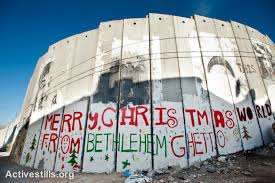
christmasThere is a story from WWI that reminds us that in the worst of times, there’s still hope. Nearing the end of December 1914, 5 months after WWI began, British soldiers heard their German foes singing Christmas Carols after a day of fighting.
In the dark, huddled in their cold trenches, the British soldiers wondered what to make of this. But soon, they joined in, singing well-known and well-loved Christmas carols. And so, through Christmas Eve, the two warring armies celebrated the birth of their Messiah.

Amazingly, the Christmas spirit continued the next day, as “some German soldiers emerged from their trenches and approached the Allied lines across no-man’s-land, calling out “Merry Christmas” in their enemies’ native tongues.” For the rest of the day, these sworn enemies traded gifts, played soccer, and celebrated the peace that only Christ can bring.

More than a century later, with the bloodiest century on record standing between us, the Christmas Truce of 1914 flickers a light of hope that only Christ can bring. Only between two nations with Christian heritages could such an armistice be considered. Still, the peace Christ brings intends to do more than foster temporary cease fires. As Micah 4:3 says of the Lord,

He shall judge between many peoples,
and shall decide disputes for strong nations far away;
and they shall beat their swords into plowshares,
and their spears into pruning hooks;
nation shall not lift up sword against nation,
neither shall they learn war anymore. 

What a day that will be when all wars cease, when the peace of our Lord is fully realized, when Micah’s prophecy comes to fruition. But for now, we still in a world filled with threat, hostility, violence, and war. Therefore, it is worth asking in what way does Christ bring peace? And how can we know that peace this Christmas? Continue reading

Typology and Typologies

gospels

Typology is typically considered as a unified whole, or at least, when discussing the subject, we speak of typology and not typologies. And with regards to hermeneutics and its application to systematic theology, this is appropriate. We must be able to synthesize our findings in Scripture and draw certain principles and conclusions (however, tentative) from the whole corpus of Scripture. Because the Bible is a unity (John 10:35), inspired by the one, triune God (2 Peter 1:19–21), we can and must seek to understand how typology works in the Bible.

At the same time, not all biblical authors do typology in the same way, and thus we need to take into consideration how each writer employs Scripture. Most recently, Richard Hays has made this point in this magisterial volume, Echoes of Scripture in the Gospels. Working carefully through the four Gospels, Hays makes the conclusion that each Evangelist uses the Old Testament in different ways. After engaging the text of each book, he provides general conclusions about Matthew, Mark, Luke, and John and how typology, what he calls a figural reading, is employed by each.

Without denying the field of typology, i.e., the general study of types and anti-types, I think his observations are worth making careful consideration. Could it be that many disagreements about the nature of typology are due to the fact that various interpreters are beholden to different approaches in Scripture itself? Could it be that one reason typology is debated so frequently (not to mention vehemently) is that we do not appreciate Scripture’s own variety of typologies? Continue reading

What Death Steals, the Lord Can Restore: Remembering Easter at Christmas (Matthew 2:16–18)

advent03Few passages of Scripture are heavier than Matthew 2:16–18, the historical account of Herod’s slaughter of the innocent children in Bethlehem. But few passages are also able to reach the depths of human loss and comfort the grieving in their deepest pain.

When read in conjunction with Jeremiah 31:15, which Matthew quotes in verse 18, we find in Matthew’s Gospel a promise of resurrection—even at Christmas time. In other words, God promises that what death steals, the Lord has recover through the death and resurrection of Jesus Christ. And all who trust in him can experience his resurrection life.

If you are feeling the soul-crushing effects of sin and death, I pray this message might bring you encouragement. You can listen to or read the sermon notes online. Discussion questions are below, along with some further resources. But first, let me encourage you to take eleven minutes to watch this video by John Piper. In it Piper the theologian-poet reads from his story of the Innkeeper, a fictitious but faithful story of the effects of Herod’s rage on the residents of Bethlehem.

As much as we want to turn away from such pain, we need to embrace the power of the resurrection to heal us and help us in our loss. May God be pleased to use these resources to bring comfort to you.

Continue reading