A Better Way to do Church Missions

David Prince and Jeremy Haskins, pastors at Ashland Avenue Baptist Church in Lexington, KY, were recently interviewed in The Towers at Southern Seminary.  They were asked to describe their leadership philosophies and how they have led change at their church.  Their interview is steeped with wisdom, but one section concerning corporate, Gospel-centered ministry stood out.

“A lot of people do ministry in a way that self-consciously segments the entire congregation,” Prince said. “What we try to do is never allow that. If these things matter to the congregation as a whole for the sake of the Gospel then we are all committed to them.

“For example, when we send a mission team out, we don’t say that we are sending a certain group of people out on a mission trip. We say, ‘Ashland Avenue Baptist Church is involved in this mission trip. Some people have involvement here and some have involvement there; the people there are our eyes, hands and mouths for the Gospel.’”

Well said!  May our churches adopt such a “together for the gospel” mindset.  Moreover, may we have a united missional drive that sees whole churches involved in Christ’s mission, so that ‘missions’ is what everyone does, not just those who are leaving American soil.

Until All Hear, dss

What is the Gospel?

On the The Gospel Coalition website is a short explanation of the gospel by D.A. Carson.  In his concise chapter on “The Biblical Gospel” from For Such a Time as This: Perspectives on Evangelicalism, Past, Present and Future (p. 75-85), Carson defines the gospel by its connection to the entire corpus of the biblical narrative.  He writes,

Thus the gospel is integrally tied to the Bible’s story-line. Indeed, [the gospel] is incomprehensible without understanding that story-line. God is the sovereign, transcendent and personal God who has made the universe, including us, his image-bearers. Our misery lies in our rebellion, our alienation from God, which, despite his forbearance, attracts his implacable wrath. But God, precisely because love is of the very essence of his character, takes the initiative and prepared for the coming of his own Son by raising up a people who, by covenantal stipulations, temple worship, systems of sacrifice and of priesthood, by kings and by prophets, are taught something of what God is planning and what he expects. In the fullness of time his Son comes and takes on human nature. He comes not, in the first instance, to judge but to save: he dies the death of his people, rises from the grave and, in returning to his heavenly Father, bequeaths the Holy Spirit as the down payment and guarantee of the ultimate gift he has secured for them—an eternity of bliss in the presence of God himself, in a new heaven and a new earth, the home of righteousness. The only alternative is to be shut out from the presence of this God forever, in the torments of hell.6 What men and women must do, before it is too late, is repent and trust Christ; the alternative is to disobey the gospel (Romans 10:16; 2 Thessalonians 1:8; 1 Peter 4:17).

As usual, Carson hits the nail on the head, and helps us see that the “simple gospel” can only be understood and proclaimed against the backdrop of the whole counsel of Scripture. This has import for personal evangelism, preaching, counseling, and everyday decision-making.

In his chapter, Carson also shows that the gospel not only presents a positive message about Jesus Christ; it also denies any and all pseudo-gospels that plague our churches today (and throughout church history for that matter).  He cites the ‘evangelical’ trend towards psychology as one of the greatest causes for distorting the gospel.

A litany of devices designed to make us more spiritual or mature or productive or emotionally whole threatens to relegate the gospel to irrelevance, or at least to the realm of the boring and the primitive. The gospel may introduce you to the church, as it were, but from that point on assorted counseling techniques and therapy sessions will change your life and make you happy and fruitful. The gospel may help you make some sort of decision for God, but ‘rebirthing’ techniques—in which in silent meditation you imagine Jesus catching you as you are born from your mother’s womb, imagine him hugging you and holding you—will generate a wonderful cathartic experience that will make you feel whole again, especially if you have been abused in the past. The gospel may enable you to be right with God, but if you really want to pursue spirituality you must find a spiritual director, or practise asceticism, or discipline yourself with journalling, or spend two weeks in silence in a Trappist monastery.

Tomorrow I will preach on Galatians 1:6-9: What the gospel is and what the gospel is not.  Carson’s short essay, like Paul’s excited admonition to the Galatians, reminds me that the gospel is something that is easily distorted and too often assumed.  Consequently, there are dozens of half-gospels that are tempting us to turn from the pure gospel of Jesus Christ.  So, I am praying that for our church and for myself, that we will trade in our own personal narratives for the gospel-narrative of Jesus Christ and that we will eschew any vision of Jesus that makes him less than the eternal Son of God, sent to earth to be the bleeding sacrifice, who takes away the sin of the world, and delivers all those who trust in him from this evil age.

I am praying that we will know what the gospel is and what the gospel is not!

(For more on this subject see Greg Gilbert’s new book: What is the Gospel?)

Soli Deo Gloria, dss

Via Emmaus: A Christ-Centered Walk Through the Bible

On Wednesday nights, I am teaching through the Bible book-by-book.  So far, it has been an amazing and challenging process to study, synthesize, and articulate the contents of each book of the Bible.  And after a slow start, we are beginning to make headway.  We just finished 2 Samuel.

Each week, I prepare an outline for the study–sometimes with blanks, sometimes without, but I thought I would link to the first few to give an idea of what we are doing, in case it may spur someone else to do the same.  Here are the outlines for the Pentateuch (Genesis-Deuteronomy).

They may make no sense to you without my accompanying commentary, which at this point I decided not to record, maybe next time through.  Nevertheless, if they can help you think through teaching the Bible, book-by-book, with an intentional aim of showing Christ, than I pray that they will serve you well.

Introduction: An Overview of the Bible (January 6, 2010)
Genesis 1-11: The Beginning of It All (January 13, 2010)
Genesis 12-50: Four Families Under the Faithfulness of God (January 20, 2010)
Exodus 1-15: Salvation Through Substitution & Conquest (January 27, 2010)
Exodus 16-40: Moving Into the Presence of God (February 3, 2010)
Leviticus: Sinners in the Presence of a Holy God: (February 17, 2010)
Numbers: In the Wilderness (February 24, 2010)
Deuteronomy: God’s Royal Covenant with Israel (March 3, 2010)

Also, for those who would ever teach on this subject in a pastoral context, I have found listening to Mark Dever‘s overview sermons very helpful, as well as the lectures available at Covenant Theological Seminary.  As far as reading goes, I have been well-served by reading the biblical texts in my ESV Study Bible, and reading The Faith of Israel by William Dumbrell (this is only for the OT portion).

When I started I had grand intentions of reading Waltke, Kaiser, and other books along the way, but time has not permitted.  If you have done something like this in your ministry context, I would love to hear how you did it.

For all the handouts to date, see my Handouts Page.

Soli Deo Gloria, dss

March Madness

One of the great diseases of our day is trifling.  The things with which most people spend most of their time are trivial.  And what makes this a disease is that we were meant to live for magnificent causes.  None of us is really content with the trivial pursuits of the world.  Our souls will not be satisfied with trifles.  Why is there a whole section of the newspaper devoted to sports and almost nothing devoted to the greatest story in the universe–the growth and spread of the church of Jesus Christ?  It is madness that insignificant games should occupy such a central role in our culture compated to the work of God in Christ.  (John Piper, A Sweet & Bitter Providence, 120).

Growing up as a basketball fanatic, March was my favorite month.  “One Shining Moment” was my favorite song.  And many were the days that I day-dreamed of playing college basketball and going to the ‘Big Dance.’ 

Today if you go to my boyhood home, you can find cases of VCR-recorded tapes of college basketball games.  Duke vs Kansas (1991) and  Duke vs Michigan (1992) come to mind right now–yes, I was a Duke fan.  In short, in those days I lived for basketball! 

But in the mercy and providence of God, He showed me in high school that being a success on the basketball court was not entirely satisfying.  In fact, it was altogether depressing.  Despite any relative accomplishments that came on the hardwood, I was always left empty.  What I didn’t know then, but have come to learn is that this is how idols always work (Ps 115).  They promise great things and deliver very little.  They take and take and take and offer diminishing returns.   They take the God-given and good desire to worship, to adore, and to devote our lives to something and they put before our hearts and minds an object unworthy of our worship.  Indeed idolatry is trifling and maddening.

In my life basketball was an idol.  And each year in the month of March, I am reminded of my past, and I am thankful that God delivered me from my enslavement to a game.  With Paul in 1 Corinthians 6, I agree and affirm in my life:  “Do not be deceived: …. idolaters…will [not] inherit the kingdom of God.”  Yet, he goes on to say, “And such were some of you.  But you were washed, you were sanctified, you were justified in the name of the Lord Jesus Christ and by the Spirit of our God.”

Today, I am just as prone to idolatry because of the sinfulness of my heart and the temptations of the evil one.  I believe that my heart is an idol-making factory, and that apart from the overpowering grace of god  I would clutter my life banal and joy-depleting things.  I am tempted to trifle with so many things–even this very blog!  And yet, the Word of God calls us to reject trifling and to live for the imitable glory of God in the face of Christ and the upbuilding of his kingdom. 

This weekend marks one of the largest Final Fours in history, with 71,000+ fans filling Lucas Oil Stadium and millions more crowding around HDTV’s in bars, homes, and student unions.  As they do, I pray that they, and you and me too, will see the madness of march as it truly is, that it is spiritual insanity that leads people to care more about one shining moment than an eternity of light and love.  This weekend we will see three heart-broken schools and one temporary victor, but for those anchored by joy in Jesus Christ, victory is eternally secure, and win or lose in the trifles of life, all of them pale in comparison to the eternal weight of glory promised for those who have the Son, the one who we must remember does more than put a leather ball through an iron hoop, Jesus Christ rules with a rod of iron and gives unspeakable joy to all those who ask. 

Soli Deo Gloria, dss

Feeding on the Word

But [Jesus] answered, “It is written,‘Man shall not live on bread alone,
but by every word that comes from the mouth of God.’”

Matthew, quoting Jesus, quoting Moses, quoting YHWH
Matthew 4:4; Deuteronomy 8:4

Words, words, words. The world is filled with words. Words inform. Express. Empower. Kill. Make peace. And give life.  Proverbs 18:21 says that ‘death and life are in the power of the tongue’ and Proverbs 15:23 tells us, “To make an apt answer is a joy to a man, and a word in season, how good it is!”  In a word, words matter! Words are immeasurably powerful!  And they matter and hold power, because of their origin and purpose. God is a Speaking God (Jn 1:1-3), and in his image, we were given words to rule the world (Gen. 1:26-28; 2:19).

In fact, God himself rules and redeems through words. God spoke the world into existence (Gen 1:3; Ps 33:6).  Jesus upholds the world by the power of his word (Heb 1:3).  God’s word never fails (Isa 55:10-11); it speaks to the ends of the universe (Ps 19:1-7; Rom 10:18) with absolute perfection (Ps 19:7-11).  And for those made in His image, salvation and sanctification depend on His word (Heb 6:13ff; Jn 17:17) So central are words to God, that it is impossible to know Him without them, and thus he has commanded his church to ‘preach the word’ in season and out, unto the ends of the earth.

The word of God is pleasant and life-giving. But our world, and indeed our own hearts, resist God’s word. As Christians should be able to recall the joy of God’s word in our lives, but we surely we can bear testimony to the parched results of its absence.   

Matthew 12:36 tells us that at the end of our lives, we will give an account for every single word we speak, and what God is listening for in our words is an echo of His word.  So, how do your words measure up?  Do they reflect the grace and truth of the God who gave you the gift of speech?  Or do they reflect the worldliness and futility of the world?  God wants to fill your heart with his Word, and indeed our souls long for this more than we know.  This month, may we be those who feed on God’s word, so that our words are life-giving, because we are filled with the Word of God (Col 3:16-17).

Soli Deo Gloria, dss

Book Review: Deep Church by Jim Belcher

Jim Belcher, Deep Church: A Third Way Beyond Emerging and Traditional (Downers Grove, IL: InterVarsity Press, 2009).

Jim Belcher has written an irenic and constructive proposal for charting a course somewhere between traditional churches and emerging churches.  He calls it “deep church,” and it is his proposal for a “third way” to do church. 

Belcher’s personal bio is interesting.  He is personal friends with nearly all the emergent/emerging leaders, yet his denominational affiliation with the PCA is far more confessional than many of his peers.  As he puts it, he is both an insider and an outsider (23-31).  This makes him an ideal candidate for drafting a conciliatory “third way.”  His writing shows his intimate acquaintance and appreciation for the emerging church, something that stands out against sea of criticism; yet, his theological convictions frame his acceptance of the emerging church. 

After introducing his story in Chapter 1, Belcher ‘defines’ the emerging church in Chapter 2.  He lists seven protests commonly made by “emergents.”  These seven responses to the traditional church outline the rest of the book (see chapters 4-10).   

In Deep Church, Belcher appeals to the likes of C.S. Lewis and calls for a return to “mere Christianity,” or more particularly, “mere ecclesiology.”  Leaning on the early church creeds, he sets out to define ‘two tiers’ of theology—one that “divides the essentials of orthodoxy from the particularities of differing traditions within the boundaries of orthodoxy” (60).  In making this critical distinction, Belcher supposes that churches can improve unity while still recognizing differences.  His point is well made, however his two-tier system lacks a necessary third distinction.  He equates unity within churches to the unity between churches.  However, there must be more unity within a congregation for the church to live in harmony than between two gospel-believing congregations. 

For instance, a Baptist church could clearly partner in an evangelistic campaign with a Presbyterian church, but try to unite these two churches constitutionally and differences concerning (paedo)baptism and church government will erupt.  Many other illustrations could be supplied.  All that to say, Albert Mohler’s theological triage (three-levels of doctrinal distinction) would improve Belcher’s argument, without taking away from the aim of his entire book.

Chapters 4-10 are the core of Deep ChurchThe format of each chapter is approximate: he takes up a specific EC protest, considers its validity and it problems from both sides, and then appeals to a particular “expert” on the matter (e.g. Francis Schaeffer on evangelism, Nicholas Wolterstorff on truth, Richard Mouw on the gospel, to name a few).  Then, Belcher concludes with practical steps towards the Deep Church and often illustrates his point with an example from his own experience. 

Overall, Deep Church offers a number of salient points with much food for thought.  Yet, its lack of biblical exposition added to an unwise neglect of 1500 years of church history weakens his argument immensely.  Favoring the church fathers, Belcher disregards the theological advances that have come from the likes of Protestant Reformers, Puritan divines, and congregational theologians.

In sum, Deep Church is orthodox and advances the conversation on twenty-first century ecclesiology.  It will stretch and challenge both traditional and emerging pastors to contextualize the gospel and to think deeply about the church.  But, at the end of the day, because Deep Church grounds its arguments in human authorities and promotes an outdated, Fifth Century ecumenism, I am hesitant to recommend it to church members looking for Biblically-saturated help.  For thoughtful pastors, it is a stimulating book, but for the inquisitive layman books by Clowney, (The Church), Carson (The Church in the Bible and the World; Becoming Conversant with Emerging Church; , Dever (What is a Healthy Church?; Deliberate Church), Stott (The Living Church) and especially J.L. Dagg would be better.

(Other Reviews: Deep Church has gotten a lot of attention in book reviews.  If Belcher’s book interests you, check out the balanced review by Kevin DeYoung  and an excoriating one by Greg Gilbert.  I appreciate Greg’s concern for Belcher’s light treatment of penal substitution–I share his concern with any model of the atonement that truncates the legal and vicarious nature of the cross–but I think DeYoung’s review is more helpful in evaluating Belcher’s third way, which DeYoung describes as the traditional way mediated through Tim Keller.)

 Soli Deo Gloria, dss

Hungry for the Word?

“Behold the days are coming,” declares the Lord God, “when I will send a famine on the land–not a famine of bread, nor a thirst for water, but of hearing the words of the Lord.  They shall wander from sea to sea, and from north to east; they shall run to and fro, to seek the word of the Lord, but they shall not find it” (Amos 8:10-11).

Such was the condition of Israel in the days of Amos.  Is it the case today? 

Christians flock from one side of the country to the other, in order to hear men who are committed to expounding the word of God.  Consider the number of Bible conferences that will go on this year and next: The Gospel Coalition, Ligonier, Shepherds, T4G, Give Me an Answer,  to name but a few.  It would seem based on our frenetic chasing of Bible teachers and the dearth of biblical substance in so much popular Christianity, that there are hungry people out there–whether they know it or not. 

On that issue, Albert Mohler points to a tragic development in Western evangelical churches–a disinterest in the Word of God.  He cites Mark Galli’s CT article, ‘Yawning at the Word’ and warns that without the word of God, the power of the gospel is lost.  He writes:

In many churches, there is almost no public reading of the Word of God. Worship is filled with music, but congregations seem disinterested in listening to the reading of the Bible. We are called to sing in worship, but the congregation cannot live only on the portions of Scripture that are woven into songs and hymns. Christians need the ministry of the Word as the Bible is read before the congregation and God’s people — young and old, rich and poor, married and unmarried, sick and well — hear it together. The sermon is to consist of the exposition of the Word of God, powerfully and faithfully read, explained, and applied. It is not enough that the sermon take a biblical text as its starting point.

What does Mohler suggest in its place?  He points to the only solution for biblical lethargy–the Bible.  It alone is our cure.  That which bores people is simutaneously what heals them, which means that God has to do a work in the heart of the hearer in order to receive the word.  “Let him who has ears to hear: HEAR!”   But this is not new.

From Moses delivering the law of God, to Josiah reading the law to the people in Jerusalem, to the revival with Ezra after the exile, to the founding of the church in Ephesus, the word of God has been central!   “Give yourself to the public reading of Scripture” (1 Tim 4:13); “preach and teach the word of God in season and out of season” (2 Tim. 4:2); “read from the book, from the Law of God, clearly, and [give] the sense,” so that people might understand the reading. (cf. Nehemiah 8:1-8).  The life of the church is sustained by nothing else, for it is the Word of God alone that tells us of our Maker and Redeemer, Jesus Christ (cf. John 5:39; Heb 4:12).  Knowledge of God comes through no other means!

May the Bible fill the pulpits, classrooms, and hallways of our churches.  If it does not, we know that the judgment of God is upon us, and the people of God will dwindle, and those remaining will perish.  For it is the Bible alone that promises us life.  If you are a pastor, may you do no less; if you are a church member may you pray for and expect nothing else. 

God, give your people, starting with me, a fresh hunger for your word.  It is the bread on which we live (Deut 8:3; Matt 4:4).

Soli Deo Gloria, dss

Jim Hamilton’s Forthcoming Biblical Theology

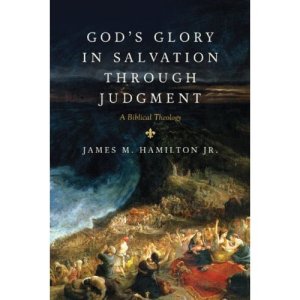
I am not sure where Matthew Montonini found the following description of Jim Hamilton’s new book, God’s Glory in Salvation Through Judgment.  Was it bootlegged?  Its not on Crossway‘s site, but regardless, I am excited to know that it is coming out this year.  I have heard much about its release, and believe the thesis is right on. 

Now that an announcement of the book is out, the cover alone draws me in, but even more the content: After sitting in Dr Hamilton’s “Messiah in the Old Testament” class at SBTS and reading some of his work on the subject, it promises to be a must-have biblical theology.  The best since Geerhardus Vos?  Time will tell.

Here is how Crossway sets it up.  (HT: New Testament Perspectives)

God’s Glory in Salvation through Judgment: A Biblical Theology (480 pages) [m]oves through the Bible book by book to demonstrate that there is a theological center: God’s glory in salvation through judgment.

In Exodus 34 Moses asks to see God’s glory, and God reveals himself as a God who is merciful and just. James Hamilton Jr. contends that from this passage comes a biblical theology that unites the meta-narrative of Scripture under one central theme: God’s glory in salvation through judgment.

Hamilton begins in the Old Testament by showing that Israel was saved through God’s judgment on the Egyptians and the Caananites. God was glorified through both his judgment and mercy, accorded in salvation to Israel. The New Testament unfolds the ultimate display of God’s glory in justice and mercy, as it was God’s righteous judgment shown on the cross that brought us salvation. God’s glory in salvation through judgment will be shown at the end of time, when Christ returns to judge his enemies and save all who have called on his name.

Hamilton moves through the Bible book by book, showing that there is one theological center to the whole Bible. The volume’s systematic method and scope make it a unique resource for pastors, professors, and students.

Until November, if you are looking to get a feel for what Hamilton’s book will include, check out some of his prepatory work:

The Glory of God in Salvation Through Judgment: The Centre of Biblical Theology?Tyndale Bulletin 57.1 (2006), 57-84.

The Center of Biblical Theology in Acts: Deliverance and Damnation Display the Divine,” Themelios 33.3 (2008), 34-47.

Soli Deo Gloria, dss

Biblical Theology in the Life of the Church

The ‘Second Mark’  of a “Healthy Church” is Biblical Theology (see Nine Marks of Healthy Church), but because of its sweeping synthesis of the Bible, Biblical Theology is also one of the most confusing disciplines to church members.  At least, this has been my experience introducing the ‘Big Picture’ of the Bible to the churches I have served.

Enter Biblical Theology in the Life of the Church.  In April, Michael Lawrence’s new book will come out, and hopefully serve as a tool introduce and clarify this critically-important discipline.  Here is Crossway‘s description:

Capitol Hill Baptist Church associate pastor Michael Lawrence contributes to the IXMarks series as he centers on the practical importance of biblical theology to ministry. He begins with an examination of a pastor’s tools of the trade: exegesis and biblical and systematic theology. The book distinguishes between the power of narrative in biblical theology and the power of application in systematic theology, but also emphasizes the importance of their collaboration in ministry.

Having laid the foundation for pastoral ministry, Lawrence uses the three tools to build a biblical theology, telling the entire story of the Bible from five different angles. He puts biblical theology to work in four areas: counseling, missions, caring for the poor, and church/state relations. Rich in application and practical insight, this book will equip pastors and church leaders to think, preach, and do ministry through the framework of biblical theology.

This forthcoming book looks like an excellent tool for introducing biblical theology to church members who have questions on why Biblical Theology is important and how to put the Bible together.  It goes beyond just the basics too, relating the big picture of the Bible to everyday life– ‘counseling, missions, caring for the poor, and church/state relations.’  Since biblical illiteracy is one of the church’s greatest obstacles for making mature disciples, encouraging biblical theology (read: a comprehensive understanding of the Bible) should be a priority of every pastor, church leader, and church member.

April 30, 2010 is its anticipated release date.  Mark it down!  

Soli Deo Gloria, dss

Pascal on the Glory and the Garbage of the Universe

Graham Cole quotes Blaise Pascal in his chapter, “The Glory and Garbage of the Universe” (God the Peacemaker).  With arresting language, Pascal bemoans of our condition:

What sort of freak then is man!  How novel, how monstruous, how chaotic, how paradoxical, how prodigious!  Judge of all things, feeble earth-worm, repository of truth, sink of doubt and error, glory and refuse of the universe… Man’s greatness and wretchedness are so evident that the true religion must necessarily teach us that there is in man some great principle of greatness and some great principle of wretchedness!  (Quoted in from Pascal’s Pensees in God the Peacemaker: How Atonement Brings Shalom [Downers Grove, IL: IVP Academic, 2009], 53).

So too, the ‘true religious’ preacher must preach on the wages of sin that lead to death and deform our lives, and the glorious possibilities of life found in Christ, led by his re-creative Spirit.  May we consider Pascals words and grow downward in humility and upward in adoration of the God who made us and makes us anew in Christ.

Soli Deo Gloria, dss