Getting the Atonement Right: Three Important Reviews of Some Popular But Misguided Evangelical ‘Books’

tim-marshall-76166-unsplash.jpgI am concerned that currently evangelical theology is not doing a very good job with the cross of Christ. Why do I say that? Because some of the most popular works on the cross of Christ are distorting, denying, or just plain ignoring the penal substitutionary nature of the atonement.

Don’t believe me? Just consider the following three reviews of (1) The Bible Project, a beautiful video graphic series by Tim Mackie that helps us read Scripture and understand the Bible; (2) The Crucifixion by Fleming Rutledge which won Christianity Today’s 2017 Beautiful Orthodoxy Book of the Year; (3) The Day the Revolution Began by N.T. Wright whose prolific pen continues to drip theology into evangelical churches.

In each of these reviews, we find much to appreciate in the works of Tim Mackie, Fleming Rutledge, and N.T. Wright, but even more we find hidden (and not so hidden) in their work a deep disinterest and even denial of the wrath of God, penal substitution, and all theological realities that make this doctrine of the atonement necessary. Continue reading

A Mountain, A Map, and a Mercy Seat: An Introduction to the Sermon on the Mount (Matthew 4:23–8:1)

sermon05

A Mountain, A Map, and A Mercy Seat (Matthew 4:23–8:1)

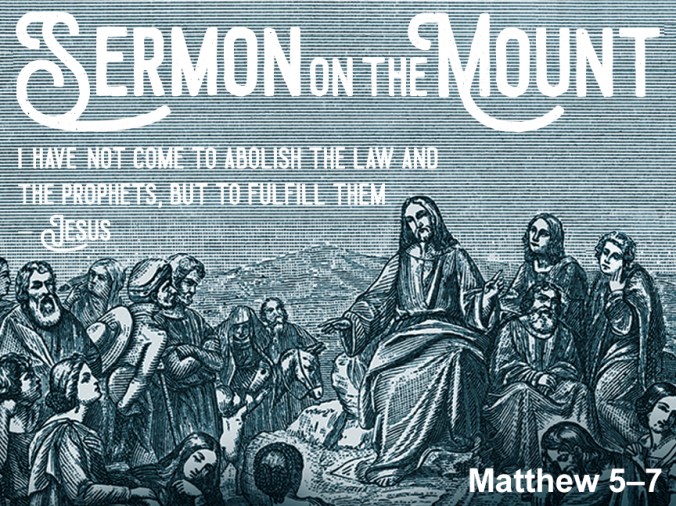
This Sunday we started a new series on the Sermon on the Mount. In this introductory message, I sought to outline the whole message and to highlight the center section, where Jesus gives us the Lord’s Prayer.

You can listen to the sermon online. But be sure to listen with this visual aid. Discussion questions and additional resources can be found below.

Sermon on the Mount Overview copy

Discussion Questions Continue reading

Three Wrong Ways to Read the Sermon on the Mount

jazmin-quaynor-36221-unsplash.jpgThe Sermon on the Mount is probably the most famous sermon ever preached, and for good reason. Its speaker is the Lord Jesus Christ; its location on a hill overlooking the Sea of Galilee is unique; and its language is both beautiful and profound. Even non-believers are familiar with many of the words Jesus spoke in this sermon.

Yet, for as well-known as the Sermon is, it is often misunderstand and misused. Therefore, as we begin to study this passage of Scripture, we should look at three common, but misguided ways to approach the sermon. Continue reading

Seeing the Mountain-Like Structure of the Sermon on the Mount

jeremy-bishop-248837-unsplash.jpgEarlier this week, we considered the way Matthew organized his Gospel with careful literary structures. Today, we look more closely at one part of his work, the Sermon on the Mount. And in that section of Scripture (4:23–8:1), we learn a number of things about how Matthew organized Jesus’ sermon in order to direct our attention to the main point of the sermon—namely, communion with the Father in the Lord’s Prayer.

Returning to the helpful work of Jonathan Pennington, we see in his The Sermon on the Mount and Human Flourishing, that he organizes Jesus’s Sermon on the Mount into a chiastic structure that looks something like this—this arrangement here abbreviates his original outline (see pp. 132–33). Continue reading

The Significance of the Sermon on the Mount: 10 Reflections from Herman Ridderbos

sermon05What is the Sermon on the Mount about?

That question has puzzled pastors, theologians, and Bible scholars for centuries. While large volumes have been written on the subject, sometimes a slimmer response is helpful. On that note, one finds great help from the late Dutch New Testament scholar Herman Ridderbos.

Writing a chapter on the Sermon on the Mount (“The Significance of the Sermon on the Mount,” in When the Time Had Fully Come: Studies in New Testament Theology26–43), Ridderbos explains the eschatological nature of Christ’s kingdom and how the arrival of Christ’s kingdom as a fulfillment of the Law and Prophets helps us understand and apply Jesus’ famous words.  Continue reading

The Artistic Evangelist: Seeing the Structure of Matthew’s Gospel

quino-al-110318-unsplash.jpgIn his theological commentary on the Sermon on the Mount, The Sermon on the Mount and Human Flourishing, Jonathan Pennington spends chapter five outlining the structure of Matthew’s Gospel and the Sermon on the Mount, in particular. Following Robert Gundry’s observation that Matthew is a book filled with “literary and theological art,” Pennington alerts the careful reader to the way Matthew organized his Gospel.

What follows are a few observations about the way Matthew wrote his Gospel and how the whole book is held together with a discernible fivefold structure. Tomorrow, I’ll provided a detailed outline of the Sermon on the Mount. Continue reading

Unshakeable Faith: Seeking Christ Through Haggai’s Temple – Part 2 (Haggai 2:1–23)

haggai04

Unshakeable Faith: Seeking Christ Through Haggai’s Temple (pt.2)

The book of Haggai centers on God’s great promise to restore the temple during the days of Judah’s return from exile (520 BC). In this little book, there are four messages from the Lord. The second, third, and fourth messages in Haggai are all found in chapter 2, and respectively they speak about the temple (2:1–9), the priesthood (2:10–19), and the kingdom (2:20–23). These were the three focal points of this week’s sermon.

As we considered in this sermon the Lord encouraged the people by telling how he was restoring his dwelling place to Jerusalem, his priesthood to Levi, and the kingdom to Zerubbabel. Yet, we also learn that this restoration is not immediate or ultimate. Rather, like so many things in life, his plans fit into his larger aims bringing his Son to the world and leading his people to place faith in the Son.

In this week’s sermon, we place this book in the larger plan of God’s redemption and learn how Haggai helps us understand what God was doing and now has done in Christ. You can listen to the sermon online. Discussion questions and resources for further study are found below. Continue reading

“I Will Shake the Earth”: Reading Haggai in Canonical Context

jay-dantinne-199087-unsplash.jpgHow should we understand the earth-shaking, temple-making promises of Haggai 2?

Twice in this short book, “Haggai the prophet” announces that heaven and earth will be shaken by the Lord (2:6–7 and 2:21) and that on the other side of this cosmos-shaking event (or events), the Lord will establish a greater temple (2:9) and restore hope for David’s throne (2:22–23). Because of the apocalyptic nature of these words, some have seen in them a prediction for a future millennial temple. For instance, Mark Rooker says when addressing the temple in Ezekiel 40–48, “Similar references to a temple in the messianic kingdom include Isaiah 2:2–4 and Haggai 2:9” (A Case for Premillenialism, 130–31). Likewise, David Turner writes,

The prophet Haggai alludes to the fact that this temple was unimpressive when compared with the first. However, the word of the Lord confirms to Zerubbabel the promise that God is with the nation. With words that anticipate Revelation 21:24–26 and 22:2, Haggai 2:6–9 promises that God’s judgment of heaven and earth (cf. Heb. 12:26) will result in the nations’ bringing their glory to the temple. Thus its latter end will be characterized by a greater peace and glory than that of the first temple. (David L. Turner, “The New Jerusalem in Revelation 21:1–22:5,” in Dispensationalism, Israel, and the Church, 269).

Interestingly, none of the big books of dispensational eschatology that I have on my shelf (e.g., Millennialism: The Two Major Views by Charles L. Feinberg; Things to Come by J. Dwight Pentecost; Christ’s Prophetic Plans by John MacArthur and Richard Mayhue; The Case for Progressive Dispensationalism by Robert Saucy) address Haggai exegetically. Pentecost lists Haggai 2:1–9 as one of the passages he will later expound on the concept of God’s kingdom in the Old Testament (442), but he never returns to this passage. In fact, the most comprehensive exegetical statement I’ve found on Haggai is contained in the MacArthur Study Biblewhere the comments interpret Haggai as testimony to a millennial kingdom with a rebuilt temple. Here are two examples.

2:6, 7 I will shake. The shaking of the cosmic bodies and the nations goes beyond the historical removal of kingdoms and the establishment of others, such as the defeat of Persia by Greece (Dan. 7). Rather, the text looks to the cataclysm in the universe described in Rev. 6–19, the subjugation of the nations by the Messiah, and the setting up of His kingdom which will never be destroyed (cf. Dan. 2:44; 7:27; Zech. 14:16–21; Matt. 25:32; Luke 21:26; Heb. 12:26; Rev. 19:19–21). (1334)

2:9 this latter temple. The Jews viewed the temple in Jerusalem as one temple existing in different forms at different times. The rebuilt temple was considered a continuation of Solomon’s temple (cf. v. 3). However, the eschatological glory of the millennial temple, i.e., the latter temple, will far surpass even the grandeur of Solomon’s temple (the former temple). I will give peace. This peace is not limited to that peace which He gives to believers (e.g., Rom 5:1), but looks ahead to that ultimate peace when He returns to rule as the Prince of Peace upon the throne of David in Jerusalem (Is. 9:6–7; Zech 6:13; Acts 2:30). (1335)

From these comments, we get a clear perspective of a dispensational reading of this passage. But is that the best reading? Should we conclude that Haggai, dated to 520 BC in the second year of the reign of Darius (1:1), is talking to the people of Israel about a future kingdom and temple that comes on the other side of the messiah, whose kingdom they have not yet seen or understood? I don’t think so, and in what follows I will aim to provide an interpretation of Haggai 2 that pays closer attention to the historical context of his message and the canonical message of the kingdom of God come in the person and work of Jesus Christ.

In other words, instead of constructing a brick and mortar temple in the future with the words of Haggai, we should see how his words speak to the remnant addressed in his book (1:12, 14; 2:2) and then how they speak to the people on whom the end of the ages has come (1 Corinthians 10:11). Continue reading

A Hole in Our Holy Temple? Toward a Whole Bible Vision of God’s Dwelling Place

david-rodrigo-336783-unsplash.jpgThe MacArthur Study Bible is a treasure trove for commentary on the Bible. Many weeks in preparation for preaching I look at its notes, and profit from its historical, grammatical, and theological observations. This week, however, as I read its commentary on Haggai, I couldn’t help but notice some biblical data missing from a table on the temples in the Bible.

While not expecting comprehensive commentary in a study Bible, I was puzzled by the way the dispensational theology of the editors may have led them to excise some key biblical data. For those familiar with Simeon Trust, this is a classic example of the framework running over the text—in this case, the text is the whole Bible.

From the looks of it, this otherwise helpful table on the temples in the Bible—well, except for the dispensational stuff, again—has left some significant holes in the Holy Temple. In other words, as the following chart defines the terms, a temple must be “a place of worship, a sacred or holy space built primarily for the national worship of God” (italics mine).

Italicized are two words/ideas that encapsulate the problem. Are temples only built for national worship? What about the heavenly temple where God abides and angels and all nations worship God? Also, must a temple be built with physical materials? What about Jesus’s words in John 2, where he said that this temple would be torn down and he would raise it up in three days? Does built apply to flesh and blood?

What’s missing in this chart are key elements of a biblical theology of the temple, which touches on so many other elements of Christology, ecclesiology, and eschatology. Moreover, even within the chart the definition at bottom does not hold up for all the data given.

So, to fill in the holes, I’ve modified the chart below, explained the distortions in this table, and outlined why five additions should be included in any temple. From this modified chart, we do get a more complete sense of all the temples in the Bible, although I’m still not convinced about the two temples associated with the Millennium. But I’ll save that for another day.

For now, let’s consider all the temples in the Bible. If you can think of another one, please let me know. Continue reading

Unshakeable Faith: Seeing Christ Through Haggai’s Temple — Part 1 (Haggai 1:1–2:9)

haggai04.jpg

Unshakeable Faith: Seeing Christ Through Haggai’s Temple

This Sunday we began a two-week series on the book of Haggai. If you are not familiar with this little book, it is the tenth book in the Minor Prophets, and its four-fold message serves as a turning point in the Twelve, as the Book of the Twelve shifts from looking at God’s judgment (Nahum–Zephaniah) to the restoration of God’s people (Haggai–Malachi).

In this week’s sermon, we considered the hopeful message of this prophet, who called the people to seek God first and to finish rebuilding the temple. In his first message (1:1–11), Haggai rebukes the people, the leaders, especially, for prioritizing their own comfort before the Lord’s worship. Thankfully, unlike the previous minor prophets, the people  obeyed God’s word and repent (1:12–15). In response, Yahweh promised to be with them and strengthen them as they rebuild his temple (2:1–9).

In this word of encouragement, God tells them that a day is coming in the future when he will shake the heavens and the earth, only to establish a greater kingdom with a greater temple. Thus, Haggai not only has a message for the Jews returning from exile in 520 BC, but also has a message for us. And by listening to his message, we see more clearly all God has done and is doing in Christ.

Therefore, Haggai is far more than a short word from the Lord to an ancient people. Rather, like a sturdy hinge, it swings the message of the Twelve towards God’s grace and the coming of Christ.

For those interested, you can listen to the sermon online. Discussion questions and additional resources are listed below. Continue reading