Christ Did Not Come for Chimpanzees

chimp

Photo Credit: From CNN article “Chimps should be recognized as ‘legal persons,’ lawsuits claim”

This month the New York Supreme Court is deciding on whether or not to rule on a case involving the legalization of chimpanzees as human persons. Yes, this is a real report, not one from The Onion. In the state of New York, the Nonhuman Right Organization is filing a lawsuit on behalf of four chimpanzees—Tommy, Kiko, Hercules, and Leo—to let them have the same rights as humans.

Unable to speak for themselves (because they are not human), CNN reports that the leader of NRO (Steven Wise) and the co-founder of the Animal Legal Defense Fund (Joyce Tishler) are making the case for these animals that humanity (i.e., homo sapiens) is not a necessary prerequisite for personhood.

Such is the moral insanity of our day, that men and women made in the image of God are unable to see the (biological, social, spiritual, and legal) differences between humans and apes. Albert Mohler critically reports on this subject on his daily podcast, The Briefing (Dec 4, 2013), and Graham Cole in his new book, The God Who Became Human: A Biblical Theology of the Incarnation provides a Christological reason why men and women are different than apes.

Anglican professor of theology at Beeson Divinity School, Graham Cole makes this critical observation. “The very fact that God became truly human underlines the value of human life. The Creator did not become a lion (apologies to C. S. Lewis) or a dolphin or a parrot. He became one of us” (The God Who Became Human, 150).

Cole is exactly right. Humanity is not only distinct from every other species because we alone are made in God’s image (Gen 1:26-28). Humanity is also unique because Christ only took on human flesh (Rom 8:3; Heb 2:16-17). What was once obvious to humanity—that man and beast were categorically distinct and therefore deserved different legal standings—has been lost in theory and is now requiring a court ruling to determine what personhood means.

Cole continues his Christological argument for humanity’s uniqueness and stresses that Jesus himself recognized the difference between man and beast, giving greater value to the former.  Citing Catholic and Protestant scholars alike, he writes,

As . . . the eminent twentieth-century Roman Catholic Jacques Maritain argued often, “the sanctity of human life ultimately rests in the fact that Christ became incarnate as a human creature, not some other sort of creature.” Protestant theologian Karl Barth adds to the chorus: “The respect for human life which becomes a command in the recognition of the union of God with humanity has incomparable power and width.” It is no surprise then to find in the Gospels that Jesus operated with a scale of creaturely value. Human life is more valuable . . . than that of a sparrow, even a flock of them (Matt 10:29–31). This valuing of human life over that of other creatures is criticized by some as ‘speciesism’ [e.g., Peter Singer] but is fundamental to a sound theological anthropology that factors in the reality of the incarnation. (150)

Indeed, as the court case in New York reminds us, we need to go back to the basics and reiterate that man and beast are not the same. God created man in his image to rule over creation, not to receive them as persons with equal rights. While Scripture declares that the righteous will have regard for the life of his beast (Prov 12:10), it never confuses the difference between people and pets. Even more, with the coming of Jesus Christ as a man, we see in Scripture and history that God’s incarnation is the final word on who he thinks is most valuable. Christ gave his life to redeem the human race, and we ought not confuse who that is.

Soli Deo Gloria, dss

One Solitary Life

oneJames Allan Francis was an early-twentieth century American pastor who authored a handful of books. He is also the “anonymous” author who stands behind the famous poem, “One Solitary Life.” This poem which often circulates at Christmas time is a testimony to the power of Christ’s humble life.

As Christmas nears and we contemplate Christ’s incarnation, may we be reminded of the glorious power of Christ’s humble life.

He was born in an obscure village,
the child of a peasant woman.
He grew up in still another village
where he worked until he was thirty.
Then for three years
he was an itinerant preacher.

He never wrote a book.
He never held an office.
He never had a family or owned a home.
He didn’t go to college.
He never traveled more than 200 miles
from the place he was born.

He did none of the things
one usually associates with greatness.
He had no credentials but himself;
he was only thirty-three
when public opinion turned against him.

His friends ran away.
He was turned over to his enemies
and went through the mockery of a trial.
He was nailed to the cross
between two thieves.
While he was dying
his executioners gambled for his clothing,
the only property he had on earth.

When he was dead
he was laid in a borrowed grave
through the pity of a friend.
Nineteen centuries have come and gone
and today he is the central figure
of the human race,
the leader of mankind’s progress.

All the armies that ever marched,
all the navies that ever sailed,
all the parliaments that ever sat,
all the kings that ever reigned,
put together,
have not affected
the life of man on earth
as much as that One Solitary Life. [1]

Soli Deo Gloria, dss


[1] James Allan Francis, The Real Jesus and Other Sermons (Philadelphia: Judson Press, 1926).

Christmas in Dark Places

Okay, so I must make a confession. I have become quite a fan of spoken word poetry. I didn’t know quite what to think when Jefferson Bethke ripped religion and rhymed for Christ—after all Scripture does commend (some) religion (James 1:27). But I think I am catching up now. And, after learning more, I greatly appreciate Jefferson’s viral video.

Jefferson’s craft (spoken word poetry), an art form which preceded him and has benefitted from his exposure, is a great medium for communicating punchy, lyrical rhymes about any number of biblical truths. At Halloween this year, I ran across Glen Scrivener’s “Halloween: Trick or Treat?” and thus when I heard he was doing a Christmas video, I was surprisingly excited.

Among other things, Glen is a spoken word poet who hales from the land down under (which you will need to know to understand his video) and now lives in the United Kingdom. His poem is very British (or Australian), but the message is right on. My favorite meditation reflects on the fact that the Word who spoke the world into existence became speechless.

What a thought! The Word in the form of a babe was for a time unable to speak. What incredible grace and patience to endure the muteness of infancy in order to speak to me—and to you!

Glen’s poetry, like Jefferson Bethke’s and others is something you should keep an eye out for. It will stir your heart and it is a great medium to share with others, especially unbelievers!

For more on the theme of light coming into the darkness, see my (more theological and less artistic) posts:

Darkness: The World Into Which Christ Was Born

Between Darkness and Light: The Lord Who Ordained the Darkness

The Light of the World Never Fades

Soli Deo Gloria, dss

Can Anything Good Come From Geneva?

reformersToday, Kevin DeYoung asked the question, “What Do You Think of When You Think of the New Calvinism?” His response would be like mine. I am grateful for the men, Reformed in their soteriology, who have enlarged my vision of God for the last decade. Without them, I would still be an open theist (or worse), struggling with the anxieties that come from a misshapen view of God. Instead, because of the ministries of John Piper, Albert Mohler, and Mark Dever—to name only a few—I stand ready to rejoice in the Lord and risk on his behalf. And I stand, not because of my own strength, but because of the strong hand of the Lord who upholds me.

Now there are many, some of my closest brothers in Christ, who do not agree with me on the value of Reformed theology. For many there is suspicion, uncertainty, and diffidence towards ‘Calvinism’ and the men and women who assume the name ‘Calvinist.’ To echo the words of Nathanael, they might ask, “Can anything good come from Geneva?”  Continue reading

Calvin, Indefinite Language, and Definite Atonement

lambIn his chapter on “Calvin, Indefinite Language, and Definite Atonement,” Paul Helm observes that Calvin’s universal language is pastoral in nature and necessary (and biblical) because of humanity’s epistemic condition. In other words, because humanity is ignorant of the future, the decree of God, and who God’s elect are, it is most appropriate for the pastor (and all Christian witnesses) to offer the gospel freely to all people. In fact, it is spiritually dangerous to call men and women to look for evidences of grace in themselves as ‘pre-conditions’ for election. Rather, following Calvin’s teaching, one’s election can only be known in the mirror of Christ.

On this point Helm quotes Calvin who rightly observed,

But if we are elected in him, we cannot find the certainty of our election in ourselves; and not even in God the Father, if we look at him apart from the Son. Christ, then, is the mirror in which we ought, and in which, without deception, we may contemplate our election. For since it is into his body that the Father has decreed to ingraft those whom from eternity he wished to be his, that he may regard as sons all whom he acknowledges to be his members, if we are in communion with Christ, we have proof sufficiently clear and strong that we are written in the Book of Life. (John Calvin, Institutes of the Christian Religion3.24.5, quoted in Helm, “Calvin, Indefinite Language, and Definite Atonement,” From Heaven He Came and Sought Her118)

Accordingly, may we look unto Christ today. The invitation to come is available to all, and all who come will discover God’s covenant love that he set on his elect before the foundation of the world.

Soli Deo Gloria, dss

Christ’s Priesthood and Definite Atonement

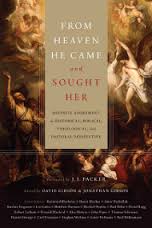
from heavenLast month, Justin Taylor interviewed a number of the contributors to the new book, From Heaven He Came and Sought Her: Definite Atonement in Historical, Biblical, Theological, and Pastoral Perspective, edited by David Gibson and Jonathan Gibson. One of the questions concerned how Christ’s priesthood might relate to the extent of the atonement. In the book, Wellum develops this biblical-theological theme to argue that a right understanding of Christ’s priesthood necessitates a definite atonement.

I could not agree more. I spent the last four years talking to him about the matter on a weekly basis. At the same time, I wrote my dissertation arguing the same point. In my estimation, the “priestly argument” is the missing link in the exegetical case for definite atonement. While many have made biblical cases against the logical step from penal substitution to definite atonement, it is the priestly office that requires both.

To familiarize yourself with the priestly argument, consider Wellum’s brief answer and then keep your eye out for Wellum’s chapter in From Heaven He Came and Sought Her. 

JT: What is the connection between Christ’s priestly ministry and definite atonement?

Stephen Wellum: In Scripture, the relationship between the role of the High Priest and the act of atonement is tight. Under the old covenant, the High Priest serves as the mediator for a particular covenant people. We see this on the Day of Atonement where the High Priest has the incredible privilege of entering into the Holy of Holies, on behalf of the people and as the covenant mediator of Israel. But it is important to note that the Priest’s act of sacrifice and intercession is a definite work.

As our Lord Jesus brings all of this to fulfillment, this same particular work is stressed. Christ is the new covenant head, mediator, and its great High Priest. As the new covenant head, his work is specific and effective for all those in that covenant. However, Scripture also teaches that everyone without exception is not in the new covenant. All people enter this world in Adam and under the dominion of sin, and it is only by Christ’s priestly work and the Spirit’s application, that we are transferred from Adam to Christ. The priestly and covenantal categories of Scripture demand that we view Christ’s work as definite.

I totally agree, and wrote my whole dissertation under Dr Wellum, attempting to tease this out from all of Scripture. Therefore, I find it interesting that to date, I have not found a substantive refutation of the priestly argument. Let me know if you know of any.

For opposing views on From Heaven He Came and Sought Her, see the reviews of Jason Duesing and Robert Yarbrough. Interestingly, in his helpful review, Duesing does not address (read: have space to address) Wellum’s chapter. For those who have read the book, or may read the book, I’d be interested to hear what you think.

Soli Deo Gloria, dss

Remembering November 22, 1963: JFK, C. S. Lewis, and Aldous Huxley

jfk2

Today marks the fiftieth anniversary of John F. Kennedy’s assassination. What many people do not know is that on that fateful day, two other “world leaders” also died—C. S. Lewis (Christian apologist and children’s literary giant) and Aldous Huxley (author of Brave New World and many other works).

In college, I came across these three fact from the book Between Heaven and Hell by Peter Kreeft. In that book, Kreeft imagines a conversation between JFK, Lewis, and Huxley. It is a compelling look into three different worldviews. Honestly, I cannot remember how the book ends—that is who goes to heaven and who doesn’t—according to Kreeft. But sitting fifty years out from these men’s deaths, Andrew Wilson captures the difference in less than 140 characters:

In memorial of November 22, 1963 and the deaths of John F. Kennedy, C. S. Lewis, and Alduous Huxley, here are a number of links furnished by Joe Carter, Albert Mohler, and a few others to help us make sense of these men’s lasting legacies.

Fifty Years After JFK’s Assassination. Albert Mohler reflects on the respective worldviews of Kennedy, Huxley, and Lewis. (The Briefing)

‘Brave New World’ was a Timely Warning. Allan Massie gives a brief accounting of Alduous Huxley, his Brave New World, and how Huxley’s vision is coming to fruition in the twenty-first century. (The Telegraph)

9 Things You Should Know About C.S. Lewis. In short order, Joe Carter gives us a Lewis trivia that range from his writing, to his friends, to his fondness for nicknames.(The Gospel Coalition)

The Tale of C. S. Lewis’ Imaginative Legacy. Dan Dewitt, Dean of Boyce College, explains how the ‘Elvis of evangelicalism,’ C. S. Lewis abandoned (writing) theology in order to capture the hearts and minds of readers with his most effective medium—literary fiction. (Southern Blog)

Finally, for those who want to go deeper, let me encourage you to pick up the illuminating book I mentioned at the beginning: Between Heaven and Hell: A Dialog Somewhere Beyond Death with John F. Kennedy, C. S. Lewis, and Aldous Huxley.

Soli Deo Gloria, dss

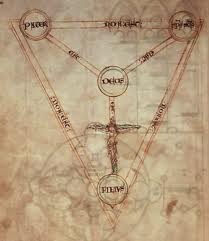
The Doctrine of the Trinity: Three Perichoretic Persons

trinityA few weeks ago I began a three part series on the Trinity. The first post affirmed God’s oneness. The second began to explicate how the one God is three persons. Today, I finish my series by looking at how the one God in three persons lives and moves in the world he created.

In Perfect Motion: How the Father, Son, and Spirit Work in the World

Because God created the world outside himself, creation is not a part of God. Yet, God in his omnipresence is present to bless, or curse, or to sustain his creation. In all places, at all times, and without diffusion of his deity or fluctuation of his power, God is active in the world.

However, as a triune God, each member of the Trinity performs a unique but unified role in creation. Together Father, Son, and Spirit created the universe; they preserve the cosmos; and they effect salvation for all the ones whom the Father gave the Son before the foundation of the world (see John 17). In short, their external activities are as harmonious, congruent, and seamless as their internal essence. Continue reading

The Incarnation: Getting a Handle on Five Heresies

cappadociansYesterday, I gave a short introduction to a number of terms related to the Incarnation of our Lord. Today, I want to offer a short description of five heresies that have infected the church throughout the centuries.

These five heresies are named after four people (Arius, Apollinarius, Nestorius, and Eutychius—can you tell these guys aren’t from Kansas?) and one Greek word (dokein meaning “to seem” and dókēsis meaning “apparition, phantom”). These heresies are related to one another in history, and some of them actually came by means of trying to correct another. What I have spelled out below is but the simplest explanation of each term, with practical application at the end. Continue reading

More Than Baby Talk: A Primer on the Incarnation

gloryPutting our children to bed is always a precious time to read the Bible, sing hymns, and talk about the day. But precious as it is, it is not always simple.

A few days ago, as our five year old was minutes from dream land, he began asking questions about Jesus’ birth. I listened to my wife explain that Jesus had always existed. And I heard him respond, “Yes, but he was also born,” exposing the challenge that if Jesus was born than he must have had a beginning. Right?

Perhaps, we have the making of a little Arian in our home (as in Arius from the fourth century Africa, not the Third Reich in twentieth century), or perhaps he is simply experiencing the challenge that we all face when we begin to press into the incarnation of Jesus Christ. What does it mean that the eternal Son of God who was with God before the beginning of time (John 1:1) took on flesh and became a man in time?

The Incarnation

The subject of the incarnation is puzzling for adults let alone little boys with active imaginations. Continue reading