The Language of Election in the Bible: A Few Word Studies

electionIn today’s sermon on Titus 1:1–4, I considered the question: What is election?

I stated the New Testament teaches that election is individual and unconditional. This, of course, is not an undisputed interpretation, but it is my conviction after wrestling with the doctrine over the last dozen years. In my sermon, I only had time to quote Ephesians 1:4–6 and Romans 9:15–16, 18 as evidence for an individual and unconditional election.

Even as he chose us in him before the foundation of the world, that we should be holy and blameless before him. In love he predestined us for adoption as sons through Jesus Christ, according to the purpose of his will, to the praise of his glorious grace, with which he has blessed us in the Beloved. (Ephesians 1:4–6)

For he says to Moses, “I will have mercy on whom I have mercy, and I will have compassion on whom I have compassion.” So then it depends not on human will or exertion, but on God, who has mercy. . . . So then he has mercy on whomever he wills, and he hardens whomever he wills. (Romans 9:15–16, 18)

However, for those who are interested in considering this subject in greater detail, I have outlined the following word studies. I wrote these a few years ago and edited them this week. For those desirous of seeing what Scripture says about election, predestination, and other related subjects, these documents will introduce and comment upon a number of important texts.

All together the studies comprise over 30 pages. Therefore, to help arrange it, I’ve broken them up into smaller studies. Since I haven’t had time to add the Scripture reference in every case, you should read these word studies and theological reflections with an open Bible. (Because they were written with my congregation in mind they are based on the English Standard Version, not the original languages. Perhaps, at some time in the future, I update the contents with further attention to the Greek and Hebrew).

Word Studies

Theological Reflections

Let me know what you think and what questions remain concerning the doctrine of salvation. I believe iron sharpens iron and that humble, honest discussion about this biblical truth is good and needed in the church.

Soli Deo Gloria, ds


Seeing God’s Holiness in the Pentateuch

mosesOver the summer I took ten weeks to preach on the holiness of God in the Old Testament. Or, that’s what I intended to do.

Somewhere in Numbers, I realized that I needed to limit my Old Testament sojourning to the forty years Yahweh led Israel through the Wilderness. Even then, I didn’t have time to consider all that Numbers says about God’s dealings with Israel.

What I did preach and what I pray our church saw, however, was a God relentless in his pursuit of his holiness. Continue reading

Biblical Theology for the ‘Non-theologian’

bibleWhat is biblical theology?

There are many answers to that question, and just as many approaches to “doing biblical theology.” Recently, friends at the 9Marks e-Journal put out a helpful resource on the subject as it relates to the church: “Biblical Theology: Guardian and Guide for the Church.” And if you keep up on the web, you may come across anything from a blog series on a biblical theology of dessert to a list of resources for understanding the framework of the Bible.

Yet, is there anything out there that simply defines biblical theology for someone whose never heard of it before? What follows is something I wrote up for our church. It expresses my own appreciation for biblical theology and how this discipline can serve non-theologians who may have never heard the term. 

(Disclaimer: “non-theologian” is a misnomer; everyone made in the image of God (that’s everyone) is by nature theological and hence a ‘theologian’ in their own right).

Defining Biblical Theology

Biblical theology can be defined in one of two ways. It can be theology that finds its source in the Bible (as opposed to ‘unbiblical theology’). Or, it can be theology developed over the whole Bible (as opposed to systematic theology, which is organized by topics; or, historical theology, which arises from various people and places in church history).

It is the latter, as a discipline of interpretation, that I want to discuss. Why? Because few things have helped me know or love God more than a clear understanding of a whole-Bible theology, and few things are more important for growing Christians to walk in a manner worthy of the gospel. Continue reading

Why Non-Pastors Should Read the Pastoral Epistles

pastoralsNext week I will begin preaching the book of Titus on Sunday mornings. Although Titus is only three chapters and forty-six verses in length, it contains a great deal of instruction for the church.

Titus is often grouped with two other Pauline epistles—1 Timothy and 2 Timothy. Together these three letters are known as the “Pastoral Epistles.” They are written to two of Paul’s sons in the faith (1 Tim 1:2; 2 Tim 1:2; Titus 1:4), ministers of the gospel sent by Paul to Ephesus and Crete for the purpose of building up those churches. As a matter of fact, Timothy and Titus are not so much pastors themselves but apostolic delegates who are called to confront error (1 Tim 1:3-7), preach sound doctrine (2 Tim 1:13; Titus 2:1, 15), and further the faith of God’s elect (Titus 1:2).

From this little synopsis, one might get the impression that the Pastoral Epistles are strictly for pastors, or at least for those working in the ministry. One might conclude they only have tangential relevance for the stay-at-home mom or the factory worker. However, such a conclusion would be premature, for the Pastoral Epistles have great application for all Christians. What follows are five reasons why every Christian should read them, study them, and apply them. Continue reading

The Ultimate Question: How Do I Know I Will Go to Heaven When I Die?

cemeteryHow do I know I am saved and will go to heaven when I die?

This is the ultimate question, isn’t it?! At least, it is for those who take God’s word about heaven and hell seriously. And it’s weight is even greater for those facing a terminal disease or deploying for military service. But it isn’t just for those who feel threatened by death. Since each of us are ignorant of what tomorrow may hold, the question of our eternal destiny is of ultimate importance.

Fortunately, in his love, God did not leave the pathway to heaven hidden. In John 14:6 Jesus said that he is the Way, the Truth, and the Life, and that all who trust in him will go to the Father in heaven. Writing later in another epistle, John says again that everything comes down to knowing, loving, and trusting Jesus: “Whoever has the Son has life; whoever does not have the son does not have life.” So here is the million-dollar question: What does it mean to have the Son?
Continue reading

Nine Benchmarks for Healthy Intrabiblical Exegesis

bealeOkay, so I admit “intrabiblical exegesis” is a mouthful, but it sums up in two words what any student of the Bible does when he or she tries to understand why Jesus calls himself the Son of Man (e.g., Mark 10:44–45), or what Jude is doing when he says that first century false teachers are walking in the error of Balaam (Jude 11). Intrabiblical exegesis is the process of comparing the Old Testament to the New and seeking to understand how the New Testament writers employed the Old. In short, it is a process of interpretation that engages the whole Bible.

Why Method Matters

Since the Bible was composed over many centuries (about 14 in total), it has many layers of divine revelation. And those layers (read: prophets and apostles) that come later depend upon and recycle (through citation and allusion) antecedent stories, images, turns of phrase, theological ideas, and so on. Therefore, as anyone reading the book of Hebrews knows, it is impossible to understand the New Testament without a general understanding of the Old. And the more you know of the Old Testament, the more you see the way the New Testament writers wrote what they did.

On Monday, I listed five basic principles for discerning types in the Bible. For those just beginning to think about intratextual exegesis, these five “best practices” are a good starting point. But they are only a starting point. So, today I want to go to the other end of the spectrum and consider the very best ways to interpret the New Testament’s uses the Old. And instead of providing my own list, I will cite G. K. Beale who leads the way on helping evangelicals think about these things. Continue reading

How do you recognize a biblical type?  

seekfindIf we agree that typology unites the Bible, identifies who Jesus is, and reveals God’s progressive revelation (which I argued here), then it is vital to know how to recognize a type. Indeed, one of the of the reasons people doubt the validity of a given type (e.g., Joseph as type of Christ, or Noah’s ark as a type of salvation) is that they fear reading too much into the Old Testament. Perhaps, they have seen typology gone wild and have concluded that such interpretations are fanciful and forced. Indeed, while there are many poor examples of misinterpretation, typology remains a vital reality in the Bible. And it behooves us to ask again: “How do you recognize a true biblical type?”

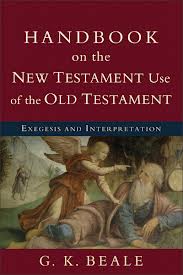
In what follows, I’ve given 5 ways to help you do that. This list isn’t exhaustive and it (over)simplifies some very technical discussions, but for those just beginning to consider or reconsider typology, may it serve as a starting point for recognizing types in Scripture. (For a more comprehensive approach to detecting types, allusions, and patterns in Scripture, see G. K. Beale’s Handbook on the New Testament Use of the Old Testament: Exegesis and Interpretationesp. chapters 3 and 4). Continue reading

Typology: What It Is and Why We Need It


typologyWhat is typology?  

In yesterday’s sermon on Numbers 20, we ran into something known as typology. As it has been variously defined in church history, typology occurs in the Bible when an historical person, event, or institution—in this case a water-giving rock—foreshadows the coming Son of God. As with Exodus 17, this life-giving, water-streaming rock is a type of Christ, at least according to the apostle Paul.

Writing in 1 Corinthians 10, Paul recounts a number of events in Israel’s history (see vv. 1–13), including this rock. He writes, “All were baptized into Moses in the cloud and in the sea, and all ate the same spiritual food, and all drank the same spiritual drink. For they drank from the spiritual Rock that followed them, and the Rock was Christ” (vv. 3–4). In these words, Paul makes the stunning claim that the Rock was to be identified with the Lord, and since Christ is the Lord (cf. 1 Cor 8:6), the Rock is to be identified with Christ.

Two verses later, he adds, “Now these things took place as examples (typoi) for us, that we might not desire evil as they did” (v. 6). Most versions rightly translate typoi as “examples” but you can see from the Greek word that the examples Paul has in mind were types, a word he uses elsewhere to relate Adam and Christ (Rom 5:14), a word Peter uses to speak of Noah’s baptism (1 Pet 3:21), and a word used in Hebrews to relate the tabernacle on earth with the one in heaven (Heb 8:5).

On the basis of passages like these, Christians going back to the early church have rightly seen (and looked for) ‘types’ of Christ in the Old Testament. But at the same time, questions have arisen to ask: What is a type?

That is the question I want to answer today in broad and simple strokes. I recognize that large tomes and complex articles have been written on the subject, but for those just getting acquainted with the idea, I want to introduce typology as simply as I can.

Continue reading

My Twelfth ‘Old Book’

My son, beware of anything beyond these.
Of making many books there is no end,
and much study is a weariness of the flesh.
— Ecclesiastes 12:12 ESV —

On Monday I listed eleven old books that every Christian should read. I asked you what the twelfth book should be. Here are the books suggested.books

  1. The Scandal of the Incarnation selections from Irenaeus’ Against Heresies (Jason Miller)
  2. The Bondage of the Will (John T. Jeffery) 
  3. On the Freedom of a Christian by Martin Luther (Jeffery Hutchison)
  4. Abandonment to Divine Providence by Jean-Pierre de Caussade**
  5. The Mortification of Sin by John Owen (Ben . . . )
  6. The Christian in Complete Armour by William Gurnall (Ben . . . )
  7. The Life and Diary of David Brainerd by Jonathan Edwards (Josh Philpot)
  8. Lives of the Three Mrs. Judsons by Arabella Stuart (Jerod Harper)
  9. Holiness by J. C. Ryle (Cade Campbell)
  10. The Cost of Discipleship by Dietrich Bonhoeffer (Terry Braswell)
  11. In His Steps by Charles Sheldon (Terry Braswell)
  12. The Cross of Christ by John Stott (Tony . . .)

From the responses, it looks like we have our next twelve. I would heartily commend ten of them, with caveats about a few. Continue reading

Twelve ‘Old Books’ Every Christian Should Read

Now there are also many other things that Jesus did.
Were every one of them to be written,
I suppose that the world itself could not contain
the books that would be written.

— John 21:25 —

Growing up my summers were consumed by sports. Until college, the only books I read on my own were biographies of professional athletes. In short, Books had little appeal.

When I became a Christian, however, that changed. Very quickly I discovered that I needed spiritual guidance. What I found was that good books were one of the best ways to grow in grace and knowledge of our Lord Jesus Christ.old

What is a ‘Good Book’?

Yet, I didn’t know what a “good book” was. As a freshman in college, I found myself reading a book by T.D. Jakes who distorts the Trinity and preaches a prosperity gospel. Later I gravitated towards recent releases that mixed biblical truths with the latest psychological fads.

Like so many evangelicals, I missed the classic works of the faith because the Christian bookstores I visited only promoted current authors. Yet, such attention to the new and novel only gives us what C.S. Lewis has called ‘chronological snobbery.’ Simultaneously, it keeps us blind to our contemporary errors and robs us of a rich heritage. Again Lewis corrects us:

It is a good rule, after reading a new book, never to allow yourself another new one till you have read an old one in between. If that is too much for you, you should at least read one old book to every three new ones. . . . We all . . . need the books that will correct the characteristic mistakes of our own period.

With that in mind, I have compiled is a list of twelve “classics” that every Christian should venture to read over the course of their lives. These books come from different eras, and are written in a variety of styles. Some are long, some short, but for any Christian who wants to walk with the cloud of witnesses who have gone before them, these are volumes you should take up and read. Continue reading