 How should I vote for the glory of God?
That is a question that Christ Over All answered in a variety of ways in September of this year. And it serves as the background to this article, where I want to offer a more personal word regarding something that has changed in my own thinking over the last few years, and may help others thinking about their vote this week.
In 2016, when I was still under the sway of Russell Moore, I believed the Leftist media about how bad Donald Trump was, is, and will be. Though he promised to appoint conservative judges, I didn’t believe he had the track record to merit a vote. Likewise, as a 10 year student of Russell Moore at SBTS, and a ERLC research fellow, I largely accepted the line that Donald Trump was immoral, racist, misogynistic, you name it.
Fast forward to 2020, Donald Trump had kept his promise to appoint conservative judges. Economically, until Covid, he had rebuilt the economy with benefits for working class families. And despite his unseemly (and often unwise) use of Twitter, he withstood endless assaults while seeking to put America first. For these reasons, and more, I voted for Donald Trump.
Following the same line of thinking that made Albert Mohler change his mind about Trump, I put my previous Never Trump interests aside, and voted for the business man from New York.
As Mohler framed it in his 2020 article, “In terms of presidential action, Donald Trump has been the most effective and consequential pro-life president of the modern age.” And this was before Roe v Wade was struck down!
Long story short, I shifted from Anti-Trump in 2016 to pro-Trump (with ongoing reservations) in 2020. Though Trump’s character (e.g., his marital record, his vulgar speech, and his Twitter discourse) continued to be a stumbling block, I voted for Trump in 2020 not based on his personal accolades but his political decisions and the promise of policies that would.
In 2024, I would vote for Trump for the same reasons. Yet, in 2024 I would also say that it has become apparent that the character of the man is not everything that it was made out to be by legacy media or evangelical pundits like David French and Russell Moore. And it is this moral dimension of Trump that impels me to write this reflection.
But first a word on voting itself.
What Is a Vote?
To set the context of this argument I need to establish the nature of a vote. On this subject, I have been helped immensely by Trent Hunter in his article, “Make Civics Great Again: A Pastoral Guide to Casting Ballots Wisely.” In that piece, he concludes with three types of voting. As he frames it, there is the
- All-In Vote
- All-Eyes-On-Us Vote
- All-Things Considered Vote
The first type is the kind where the voter identifies with the candidate to such a degree that they are one with him. This might be expressed in wearing MAGA hats and fanboying Trump’s rallies, or it might come with wearing ‘la (yes, Comma-la) tee shirt and fawning over the first woman president. The vote is an extension of the person, and in reverse, the person feels some type of communion with the candidate. As others have termed it, this turns the vote into a sacrament, where any fallibility in the candidate must be overlooked or defended, lest the vote be made for an imperfect person.
In my estimation, this type of voting leads political purists to put Jesus on the ballot or to refuse voting altogether. Clearly, the voter who refuses to cast a vote for Harris or Trump, because both are poor candidates, may honor their conscience. But I would suggest they have too high a view of voting, not just too low a view of the candidates.
The second type is the kind of vote where the voter is not necessarily identifying themselves with the candidate, so much as they are voting for the ways that others will perceive them when they step out of the voting booth. To use Trent’s imagery, this vote is done for the sake of Public Relations, or what I would call a virtue signal vote. And as I reflect on 2016, this is exactly what I was doing.
Due to all the ways Donald Trump was identified (wrongly, I would add!) as a racist 2016, I feared what my black friends would say if I voted for Trump. Sad to say, I voted third party because I didn’t want my vote to be a hindrance to sharing the gospel with POC’s. Indoctrinated by the “White Guilt Gospel” of early CRT proponents, I was more concerned about what people would say, instead of what the vote would do, which leads to a third approach to voting.
The final type of voting is the “principled pragmatic” approach. As Trent frames it, “This view takes a functional view of voting and it sees a vote as a strategic move to advance the greatest good given the circumstances with a special emphasis on the role and goals of government.” After sacramental and virtue signal voting, this third view of voting is a decision about who gets to hold the sword for greatest good (Rom. 13:1–7). In this way of thinking, the vote is less concerned with the candidate or the crowds; it is concerned for the common good of the people. Comparatively, what will be the result of this man’s election?
In short, it is a strategic decision, not a sacramental one. And it is a principled decision, not a man-pleasing one. It is the decision, in my estimation, that is the least emotive and the most dependent on the facts. It requires the most amount of information. And instead of entrusting a vote with the power to save the populous for whom the magistrate will govern—for only Christ can do that—this vote is based upon a simple question: Of the two candidates on the ballot, who will do the most good and the least harm with the sword in their hands?
Better than seeing the vote as a sacrament for a political savior or a signal to some specific group, the vote is best understood in our American, two-party context, as a sword entrusted to one candidate instead of the other.
In 2016, I did not understand that. And today, I suspect many still do not understand what a vote is or how to wield it. Still, that point is necessary to understand what I will say below. For in making a moral argument for Trump, I am not trying to baptize him as a Christian or bring him into church membership. My measurements are moral, but the morality is related to the sphere of political rule under God and not the kingdom and its requisite regeneration. Acknowledging the rudimentary nature of this argument, with limited space and limited knowledge, let me offer one more preliminary remark before articulating seven reasons for handing the sword to Donald Trump and not Kamala Harris.
Seven Reasons to Vote for Donald Trump
In my Sunday Election Sermon, I will address the matter of stewardship and the sin of voting for Kamala Harris and the Democratic ticket. But I will not make the positive case, in a sermon, for Donald Trump. As Andy Naselli framed the matter in his article on voting and the conscience, Christians have three ways to honor God with their vote.
- Vote for a Republican candidate.
- Vote for a third-party candidate. (I personally think this is wasting your vote.)
- Don’t vote. (I personally think this is irresponsible.)
I agree with Andy in saying that these three options are ways that Christians can vote to honor God and not violate their conscience. It is better to vote third party than to sin by voting for Donald Trump, if such a vote violates your conscience. But as I will attempt to argue below, I believe it is better still to acknowledge the demonic evil of the Democratic party, the media’s unending lies about Donald Trump, and the many good and moral reasons for entrusting Donald Trump with the sword for the good of our nation.
At the end, if you are unconvinced by line of argument, we can still be at peace, but for the sake truth, the good of the church, and the condition of this nation for the next generation(s), Christians today have a responsibility to engage politics and to make moral arguments for the greater good. And so, motivated by love of neighbor, it is my aim to remove impediments to voting for Trump and to persuade the persuadable that there are good arguments for Trump. Here are the seven arguments that will be outlined below.
- Christians must do everything they can to thwart the wicked agenda of Kamala Harris and the Democratic Party.
- Countless accusations against Donald Trump have been fabricated or exaggerated.
- Trump’s support for abortion is a moral problem that requires a careful assessment.
- Trump’s election is the best thing for my neighbor.
- Trump is the candidate who is most pro-America.
- Trump’s courage to stand against global threats is a moral strength.
- Trump has the right enemies and continues to expose enemies of the Truth.
(N.B. If you need more than seven reasons, you can also read Wayne Grudem’s longer, more detailed, and more annotated article: 20 Reasons to Vote for Republicans and Especially Donald Trump. )
First, Christians must do everything they can to thwart the wicked agenda of Kamala Harris and the Democratic Party.
As many have observed, Kamala Harris is the most radical presidential candidate in United States history. And she is being put forward by the most radical version of the Democratic Party that has ever existed. With respect to radical ideas and ideologies, David Closson has noted that the Democratic platform “makes a full-throated, comprehensive case for legalizing abortion. It laments the overturning of Roe and expresses outrage that more than twenty states have enacted laws to protect unborn children.” Democrats have made abortion a sacrament, with their crowning achievement being the abortion bus that parked outside DNC.
Additionally, Democrats fully endorse transgenderism, the mutilation of children, the replacement of parents with the state, the ongoing inclusion of men in women’s sports, open borders that permits criminals into the country. Not to mention the lawfare and totalitarian abuses of the voting system, which Robert Gagnon outlines in his most recent Christ Over All article. As Gagnon makes known, the Harris-Walz ticket are not only wicked, but they will usher systemic changes in America, whereby the freedoms of our nation have been totally corrupted and constrained. To borrow Auron MacIntyre’s language, their attempts at democracy will result in tyranny. In short, the Democratic party’s views on life, marriage, sexuality, family is demonic in source and all-encompassing in scope.
For these reasons, we must seek the greater good of opposing this “demonic death cult,” and thus I believe the most effective way to do that is to vote for Trump. In this way, voting for him is a moral good.
Second, countless accusations against Donald Trump has been fabricated or exaggerated.
In 2016 I was convinced that Donald Trump was, among other things, a racist. And why? Mostly because I listened to the legacy media and evangelical leaders who did the same. Disturbingly, the events of Covid revealed that countless media sources could not be trusted, And today, many of the claims made against Trump have been proven to be false, fabricated, or taken out of context. Consider just a few examples: the Russian collusion accusation, the “very fine people on both sides” lie, and the claim that Trump is a racist have all been overturned—with the last argument finding countless counter-testimonies.
Ironically, but not surprisingly, in 2020 many of the reports related to Hunter Biden’s laptop and other incriminating evidence against Joe Biden were swept away. Related to Covid, Mark Zuckerberg has admitted to manipulating search engine results. And when Twitter was not by Elon Musk, the same was true. Elon Musk reported election interference, and only with the advent of X and the prominence of podcast appearances like that of Joe Rogan has Donald Trump received any type of positive media coverage.
In short, anyone who has a strong, negative appraisal of Donald Trump dating back to 2016 should seriously consider revisiting the facts. To name one voting block, black men have been coming to support Donald Trump with increasing numbers. And many have had to admit they they were previously lied to about the sitting president.
Indeed, if our negative views of Trump were based on misleading, magnified, or manipulated searches or new reports—as mine were—then a commitment to truth requires us to revisit who Trump is and isn’t. Certainly, there are negative details to be found in Trump’s past, and the media has circled like buzzards over certain lewd stories. No question, multiple marriages and sexually immoral and vulgar language are readily available for voters to find. Yet, if we are evaluating Trump with equal weights and measures, the same accusations against him come up against other presidents. And we must not make the mistake of letting the Leftist media steer conservative voters by only focusing on Trump’s sins.
Now, some will hear me say this and think I am trying to whitewash Trump’s image. I’m not. What I am arguing for is an appraisal based on facts, not feelings generated by biased media. And this is something is very difficult to find from the legacy media. There are political and financial reasons that the media companies have stood against Trump, and if our views of Trump come from these media companies alone, then it stands to reason that our judgments are based upon skewed information.
Thus, I am arguing that Donald Trump, fallible as he is, is not as bad as he is made out to be. More on that in a minute, after squarely dealing with his worst policies.
Third, Trump’s support for abortion is a moral problem that requires a careful assessment.
If there are negative aspects of Trump’s reputation that are exaggerated or fabricated, there are others that are entirely real. And in this case, I am speaking most clearly about his recent stances on abortion and LGBTQ+ rights. In both instances, the GOP platform and the talking points he’s given related to life and family have been morally unbiblical and politically unhelpful.
By all appearances, he has capitulated to the Left in an attempt to claim votes from the “Center.” Yet, by doing this he has not only ignored evangelicals politically, he has also assumed a position that stands against the core tenet of their voting block—the protection of life and the abolition of abortion. This is a major problem and one that has many withholding their vote.
To speak directly to those who are voting third party or not voting, I would offer a couple thoughts. First, I will not defend Trump’s stance. We must continue to push for the abolition of abortion and to call for a proper (read: biblical) view of life, sex, and marriage. Full stop.
At the same time, we must understand why Trump made this change. As far as I can tell, Trump’s position is on abortion entirely political. He is looking to make a deal to retake the White House. That’s his aim. In 2016 he played his cards to win the evangelicals vote, by offering conservative judges. And he kept his word. Even then, honest voters knew he was less committed to the principles of Scripture, conservatism, or the ethics of abolishing abortion, but God’s providence God raised him to end Roe.
If God can raise up Cyrus to rebuild the Temple, God can raise up Trump to help bring an end to abortion. And that took place. And apparently, he think he’s done enough, and he’s said the issue now resides at the level of the state. That may be his position, but I suspect this is more of a calculated political move, more than a pure commitment to states rights.
If there was more popular appeal for abolition, then it would likely reframe his position. While Christians develop their ethics from Scripture, we must admit that Trump is not making his decision in the same way. Thus, we should not be surprised that Trump makes decisions like a business man, not a ethicist. Accordingly, that may lead individuals to dismiss Trump from receiving their vote. But in my estimation, that misses an important point—on the issue of abortion, Trump is malleable in a way that Kamala Harris is not.
That is to say, the Democrats treat the right to an abortion as a matter of religious devotion. In their platform they can give lip service to religious liberty, but then Kamala will speak candidly about forcing Christians, Catholic hospitals, or whomever to provide abortions even if it violates their conscience. This is fundamentally different than Trump.
With Trump, there is a place to make an argument and to change his mind. This is what happened when conservatives spoke up against his remarks about abortion in Florida, and it proves the point that his views on abortion are not written in stone. Clearly, this is a morally-deficient weakness of his, but it is important to understand what kind of weakness this is. It is worlds apart from the Democrat pursuit of abortion at all costs, and that is something that should not be lost.
Certainly, it must not be lost that Donald Trump and the GOP have moved in the wrong direction with abortion. The same can be said about so-called same sex marriage. Still, his openness to dialogue about the matter is clearly preferable. And when it comes to a binary option, where both parties are now differing shades of pro-abortion, it matters what kind of pro-abortion they are and which party can be more effectively convinced to save life and not to take it. In fact, in a Trump administration there will be pro-life appointees, Christians, and conservatives who will protect life. The same cannot be said with a Democrat administration.
In my estimation, when it comes to abortion, Donald Trump is far more reasonable, if still wrong, than his Democratic opponent(s). Accordingly, when it comes to deciding who gets the sword, I would entrust the presidency to him every time over Kamala. And more, despite all his weaknesses on this issue, I would want to give him the sword so that Kamala cannot receive it.
Fourth, Trump’s election is the best thing for my neighbor.
While the issue of defending life, especially unborn life, is the “one issue” that conservative Christians vote on, there are other aspects to consider. And one that covers a wide area is that of loving our neighbor. Indeed, Jesus said that loving God and loving neighbor were the two greatest commandments and a summation of the law (Mark 12:29–30). Accordingly, one way to consider voting is by asking: How do I best love my neighbor? Or, how will this candidate do the most good and least harm to my neighbor?
By asking this question it moves from the emotive question of “Do I like the candidate?” To “What will be the effect on the people if this man or woman is elected?” And this question leads to two answers. First, we have a track record of what a Trump presidency was like. In four years, Trump governed the nation in a way that supported Americans and made decisions that were best for the country. By contrast, the Biden-Harris administration made decisions related to open borders and illegal immigration that have been fundamentally harmful for our nation and our neighbors.
If we care about the rule of law and a nation whose magistrates protect the people and their interests; if national security is necessary for the security of a people where people can live, move, and assemble for worship; if freedom of speech and freedom of religion are necessary rights to be protected; then it is clear that Trump loves his neighbor more than Harris does. To be sure, this is a comparative argument, but that’s just the point. The election is not based on a endless list of perfect candidates; it is based on two. And only one has demonstrated a real love for the people. For that reason, it both reasonable and loving to vote Trump.
Fifth, Trump is clearly the candidate who is most pro-America.
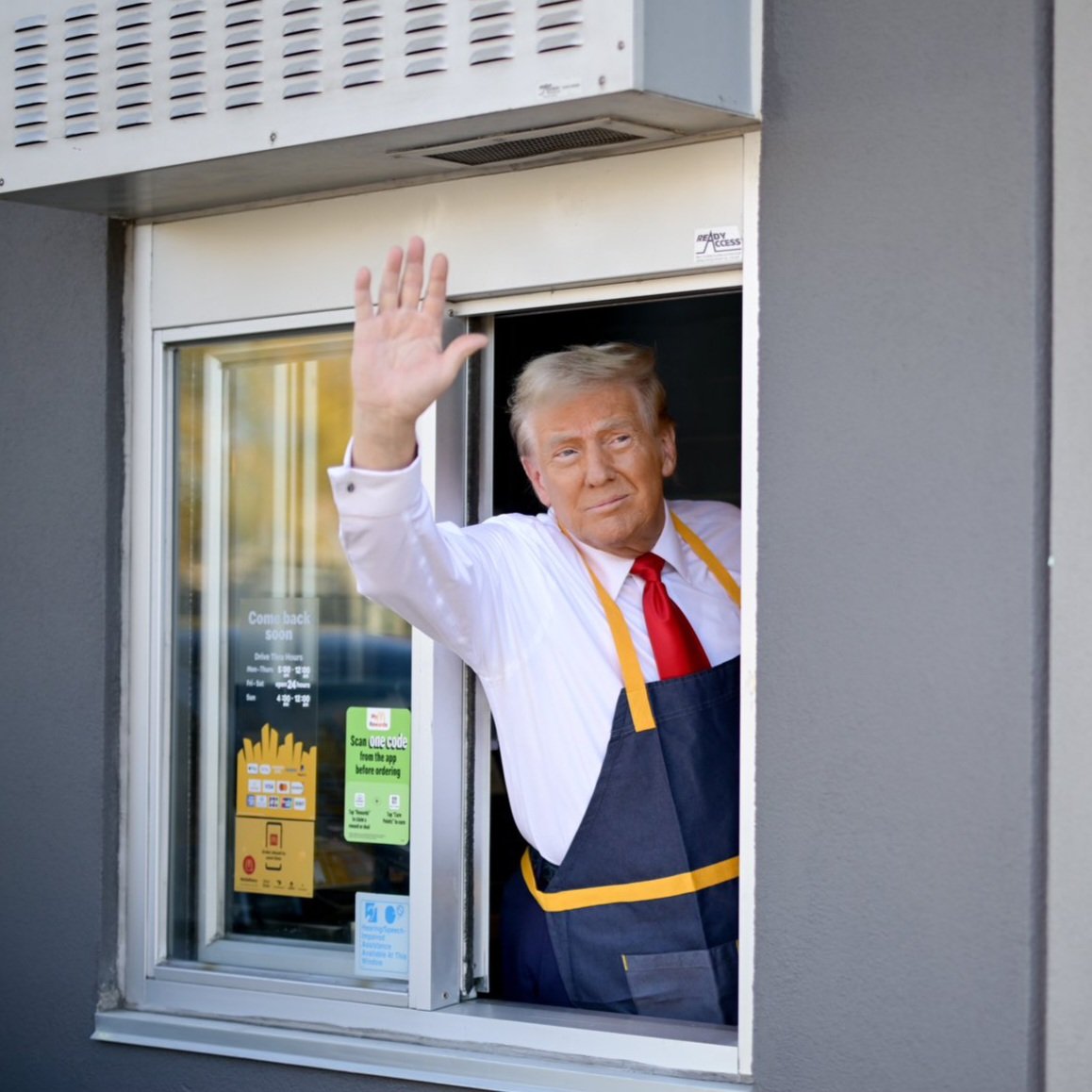
With one term in office, and with countless speeches on record, Trump is a president who is interested in protecting our nation. He is interested in reducing inflation and the cost of living. He is more honest in his speech and wise in his plans. And if it is not apparent in the way that he interacts with people—McDonald’s fries and Trash Trucks included—he actually has a care and concern for the American people.
Indeed, acknowledging all the ways that Trump’s persona may turn some people away, it is clear that he actually knows and loves Americans. Now anyone with globalist instincts may recoil at this, or who think that open borders is the best way to spread the gospel. But the truth is, God set boundaries in place (Acts 17:26), so that the nations could be brought to Christ (Matt. 28:19–20).
In our fallen world, nations exist if and only if they can maintain their borders, and God never told citizens of a country to knowingly destroy themselves by ignoring those borders or flooding he nation with illegal immigrants. Indeed, the effect of such mass immigration is national suicide. Especially, as Democrat policy makers give large sums of tax dollars to illegal immigrants.
While there are complexities to this debate, one thing is certain, high levels of taxation that take money from citizens to give it to non-citizens is both theft and recipe for violence. Yet, only one candidate on the ballot seems to understand that for love America means fighting for America and what it means to be American. Indeed, while the narrative that America is an exceptionally evil country has become popular and made self-immolation possible, the president of the United States should actually love his country. And Trump clearly does, and this is worth acknowledging and commending.
In fact, what proved this point to me most is that Trump has no reason to run for office, except that he actually wants what is best for this country. Indeed, anyone who has open eyes can see that America is not doing well. Clearly, the ultimate source of this degradation is spiritual, but it is also economic, political, and governmental. And in this case, Trump’s love patriotism leads him to want to make this country better again for all legal Americans. The same cannot be said for the Democrats, and many Republicans too. All those who are most interested in the globalist agendas shared by the world’s elites are a threat to America. And for this reason—to withstand the rising tide of globalism—Trump is the right choice.
Sixth, Trump’s courage to stand against global threats is a moral strength.
Closely related to Trump’s stand for America and against the techno-globalist zealots, is the way Trump is willing be hated to make America great again. Whether it is the globalists, the Democrats, the Legacy Media, Hollywood, the DEI Grifters, or Evangelicals for Harris, all of these groups who stand against what is true, good, and beautiful have turned their back and mocked, maligned, and murdered in effigy President Trump. Indeed, until Trump ran for office he was beloved. Just go back and look at his interviews with Oprah, Whoopie Goldberg, etc. His cameo in movies from 1980s and 1990s is too many to count. He was a popular on television, in the news, and everywhere else. And yet, that all changed when he ran for the presidency.
In my estimation, this is one of the most valid reasons to vote for Donald Trump. He has weathered endless criticism and he has not retreated. Yes, he is stubborn to a fault and his self-aggrandizing bravado disqualifies him from being a pastor, but for being a president in an age of cancellation, his ability to stay in the arena and to fight, it is both unique and inspiring. The same cannot be said for so many leaders who whither under criticism.
Even more, when so many leaders live to appease others and avoid conflict, Trump’s ability to stand against the grain, to oppose global leaders, and to take on the media is incredible. In fact, I would even say that since Twitter banned him, Trump’s focus has improved. His ability to stay on message and to have fun doing it, displays a kind of humility—yes, humility—that his otherwise harsh language and tough exterior do not show. And to do all of this in the face of such hatred, including two assassination attempts, reveals that he is head and shoulders above Kamala Harris.
Seventh, Trump has the right enemies and continues to expose enemies of the Truth.
Finally, Trump is not loved by everybody, but if we are deciding on who gets the sword, the qualification is not loveliness, but sturdiness. Who is most reliable to do right with the sword? Will Trump initiates legislation to execute the innocents? Or will he seek to eliminate the freedoms of American citizens? Certainly not! Not in the ways that the Democrats have promised to make Roe the law of the land and are willing to regulate free speech until it is no more.
Indeed, the final reason that Christians have a moral reason to vote for Trump is that he is hated by the same people who hate Christians.
Think about it: All the people who would censor, prosecute, and slander Christians for their commitment to life, liberty, and the pursuit of Christ, these are the same people who hate Trump. Despite all of his shortcomings, the greatest moral argument for Trump is that he has proven his character by who hates him. As Jesus said, the one who is not against us is for us (Mark 9:40). Taking this as general principle: Trump is not against Christians, and he proves that by identifying with people, many of whom are Christians, who are despised by people who are hateful towards Christians.
To be clear, this doesn’t make Trump a Christian or absolve him of his faults, but if you know a man by his enemies, then Trump’s enemies tell us a great deal about him. He is hated by the same people who are adversarial towards Christians. The same cannot be said about Harris, and her willingness to run over the Christian convictions in the name of sexual liberty.
In fact, to take this point one step further, the election of Donald Trump in 2016 revealed more about America, and especially American evangelicals, than I could have imagined. Sadly, some of the most reliable voices in evangelicalism before 2016 were afflicted by Trump Derangement Syndrome and have never recovered. Similarly, countless media accounts and personalities have proven themselves to be absolutely craven liars. Instead of reporting truth, they report whatever the political machine needs them to print. At a national level, the presence of Trump has divulged countless fakes, phonies, and fallacies. And for those who are committed to the truth, this type of unveiling should make you want another Trump presidency.
Yes, Trump’s enemies are a reason to vote for Trump. But the way Trump reveals the enemies of Truth is also a moral reason to vote for him. Few things have revealed the fault lines in evangelical churches like the presence of Donald Trump. And though many would like to see him go away, he was clearly used of God in 2016–2020 to reveal many hearts. And if that is what another four years produces, that might be the kind of purification the church continues to need. Purification and preservation.
For in fact, a Trump presidency will do more than reveal problems, it is our best hope to slow down some of the moral insanity imposed by the Democrats. Truly, the reason why the state is given the sword is because there are evil people and wicked regimes in the world. Yet, as we have seen in recent years, when wicked rulers govern a nation, the people suffer.
Looking at the options in front of us, the choice is clear. A Kamala presidency will speed up the destruction of America, as it will only repeat the last four years. A Trump presidency will look fundamentally different. And though it will not be utopia, it promises to be a slower approach to the cliff, such that before we go over, the Lord might grant reformation and revival, or at least he will better prepare the church for what is coming.
What is Coming?
In truth we don’t know what is coming, and that is part of God’s good plan. We must cling to him no matter what happens this week. Yet, as active citizens in America, we also have a responsibility to be a part of seeking the good and opposing evil. And that means that as we vote, we should do all we can to prayerfully push the needle towards a presidential candidate, and candidates all over the country, who will do the greatest good and the least harm.
And with that in mind, that is why I have articulated these seven reasons for voting for Trump: (1) to oppose the evil of Kamala and the Democrats, (2) to walk in the truth and not according to the lies of the media, (3) to choose a pro-abortion candidate who would listen to reasonable arguments, (4) to seek the good of my neighbor, (5) to love America as my country and the place where my children will inherit, (6) to stand against globalists enemies, and (7) to stand in solidarity with a president who is hated by the same people who hate Christians.
For these reasons and more, I believe that voting for Trump is not simply permissible, I believe under all the circumstance it is the best of all possible options. And for that reason, when Tuesday comes I will have no reservations about voting for Trump and praying that God’s mercy will bring about a presidential administration that promotes peace in our land, so that Christ’s gospel and Christ’s church can continue to flourish. For indeed, how the nation goes has a direct impact on the church and vice versa.
Therefore, as Tuesday comes don’t ignore your stewardship to vote, but vote to the glory of God, as you offer the sword to the magistrate who will best serve your neighbors, your children, your church, and the glory of God!
Soli Deo Gloria, ds
 Via Emmaus
Pingback: What is an Election Sermon? An Example and An Argument | Via Emmaus