 This summer, when the Southern Baptist Convention met in Indianapolis, Daily Wire reporter, Megan Basham, spoke to a packed room of 1000 people. In her speech, which you can now find online, she revealed various ways that pastors, churches, and other ministries have been targeted by well-funded political activists.
More recently, Megan’s book, Shepherds for Sale: How Evangelical Leaders Traded the Truth for a Leftist Agenda, became a New York Times Bestseller, as it uncovers multiple instances of evangelicals compromising their Christian commitment to the truth to have a place at the world’s table.
In eight chapters, she highlights how false teaching has been brought into the church. These issues include making climate change a Christian mission, opening borders to permit illegal immigration, diluting the pro-life movement, hijacking Christian media, employing the church to promote COVID protocols, preaching Critical Race Theory, refusing to call homosexuality a sin, and weaponizing the claims of sexual abuse.
Sadly, these eight subjects are not just matters that we find outside the church. All too often, they have been brought into the church, and they have been brought into the church by otherwise faithful pastors. Megan’s book highlights these compromises, documents their sources, and calls on faithful Christians to stand against these progressive trends.
Not surprisingly, her book has book has received a great deal of pushback. Yet, what is surprising is how evangelical leaders, including popular authors and one former SBC president, instead of admitting errors have doubled-down and repudiated Megan’s claims. It appears repentance is hard to come by these days, even among those who preach the gospel.
For my part, I have appreciated Megan’s book because it resonates with what I have seen up close and personal. I can count close to ten individuals named in this book who I know personally. And her reporting puts one place what I have seen over the last decade—once faithful friends compromising with the world in small or great ways. To give one example, my former Sunday School teacher, the Dean of the Theology School at Southern Seminary, and the man who signed both of my seminary diplomas is now partnering with an organization (Evangelicals for a Diverse Democracy) that is sponsored by an Interfaith organization led by an American Muslim. If that does not evidence Christianity astray, I don’t know what does.
Long story short, the weakness of the church in America today has not happened by accident alone. It is has also been planned by outside agitators who are looking for Christians willing to sell their birthright for a bowl of stew (Gen. 25:29–34). And sadly, many evangelical leaders have done just that. Megan’s book chronicles the last decade to show how this has happened, and Christ Over All recently sat down with her to discuss her book and why it matters for local churches.
I would encourage you to listen to our podcast and then, if time and interest allows, read (or listen) to her book and pray for the church in America. Every month, we gather on the third Wednesday to pray and one of repeated prayers is for revival to come to America. Yet, such revival will not come until repentance is led by church leaders. Judgment, Peter says, begins with the household of God (1 Peter 4:17). And to be sure, the Spirit, in order to build an unshakeable kingdom (Heb. 12:25–29), is shaking the church in America today.
So, let us pray that he grants us grace and pleas for mercy (Zech. 12:10), even as God exposes many faults in his churches. Today, as in every generation, churches need pruning. And so, let us not despise the discipline of the Lord, but let us trust him and see his lovingkindness in it.
False Teachers in Our Day
At the same time, let us also return to the Word of God with fresh conviction.
In Jude, the Lord’s brother seeks to write a letter delighting in our common salvation. Yet, instead, the dire situation of the church requires a different letter. In Jude 3–4 he writes,
Beloved, although I was very eager to write to you about our common salvation, I found it necessary to write appealing to you to contend for the faith that was once for all delivered to the saints. For certain people have crept in unnoticed who long ago were designated for this condemnation, ungodly people, who pervert the grace of our God into sensuality and deny our only Master and Lord, Jesus Christ.
“I found it necessary to write appealing to you to contend for the faith.” Indeed, just as Jesus found it necessary to go to Samaria to find the woman at the well and pronounce salvation to the world (John 4:42), so now Jude finds it necessary to urge his hearers to contend for “the faith that was once and for all delivered to the saints.” And why? Because “certain people have crept in unnoticed.”
Apparently, “shepherds for sale” is not a new issue. Rather, it is the very reason why the Spirit of God inspired Jude. Equally, the Spirit inspired Peter to address the same problem in 2 Peter. And these two books are not alone, Paul tackles false teachers in all three of his Pastoral Epistles, and by my count there are more than 40 places in the New Testament where false teaching and false teachers are addressed. In the days to come, I hope to highlight some of them. For now, however, I want to focus on 2 Peter and Jude.
Introducing 2 Peter and Jude
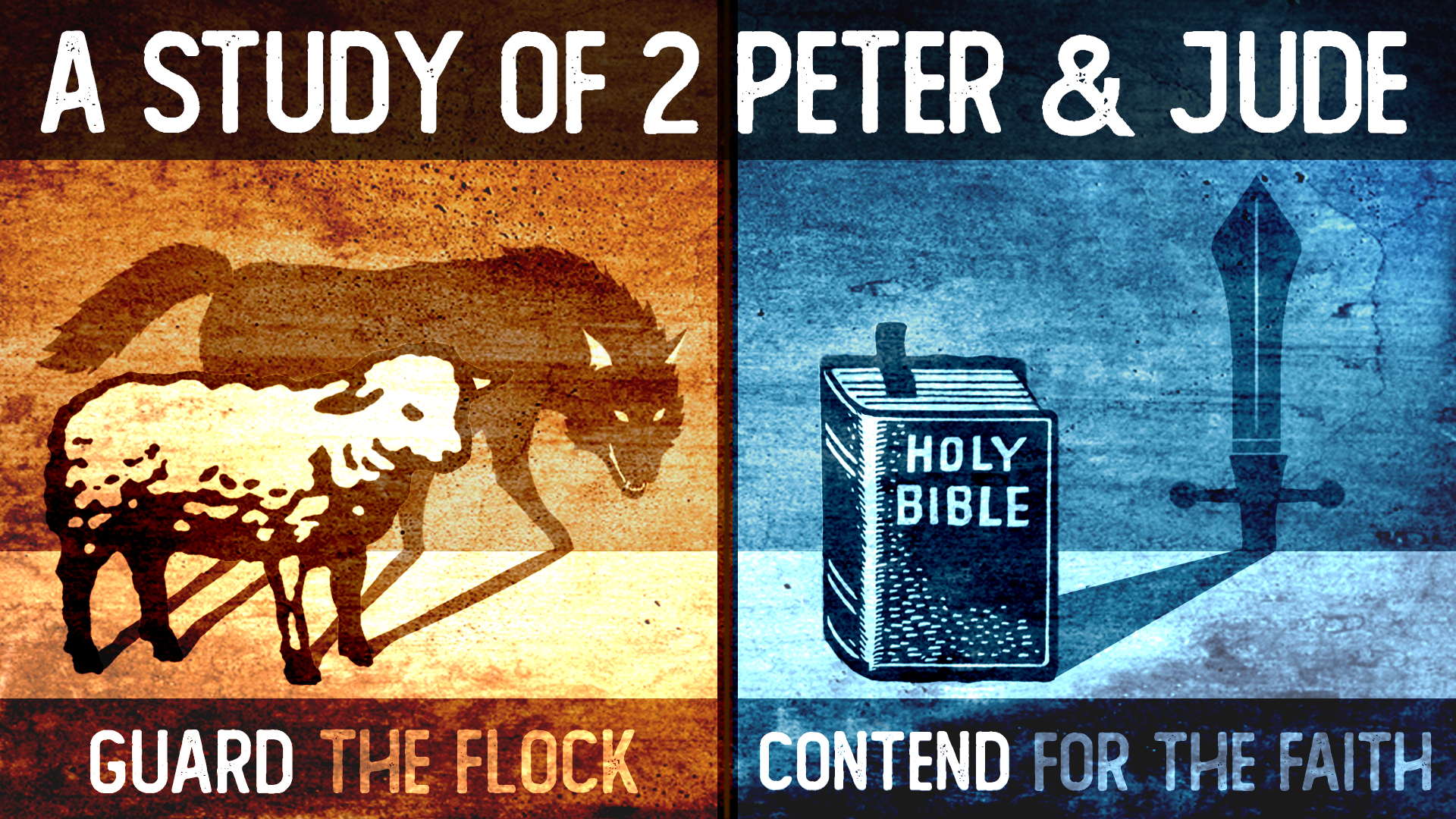
If you read these two books together, there are obvious similarities. Scholars debate whether Jude depended on Peter, Peter on Jude, or whether they both depended on other material (e.g., 1 Enoch). Regardless of the relationship, and whether or not they are tackling the exact same people or false teaching, the response is the same: Guard the flock by contending for the faith. Truly, this is what shepherds do.
Shepherds do not merely feed the flock, comforting the hurting and strengthening the weak. Shepherds must also protect the flock, preaching the true word of God, opposing error, and laboring to cultivate faith, hope, and love. In 2 Peter and Jude, this is what the apostles do. In the former, Peter addresses the problem of false teachers who deny the coming judgment of the Lord, by reminding his audience of God’s judgment in the past. Yet, he does more than pronounce a message of judgment; he also preaches the good news of Jesus Christ, who is Lord and Savior. Thus, he begins with a chapter on cultivating faith that leads to holiness and love. Truly, this is the aim of his letter, but it is occasioned by false teaching and false teachers.
Similarly, Jude’s singular imperative is to keep yourself in the love of God (Jude 21). Yet, he writes this imperative in the face of false teachers who have crept in unnoticed. If you weigh his word count, he spends most of his time pointing out sin and sinners. He is not softly and gently urging the people of God to love Jesus with greater sincerity, though that may have been what he wanted to write (Jude 3). Rather, he is forcefully—can we say violently?—chastising those in his midst who are causing divisions.
Remarkably, the way that Jude is seeking to incite love in his hearers is not by being sweet and sympathetic, as Evangelicals for a Diverse Democracy would have it. He is not urging tolerance or letting sin go unnoticed. Instead, he is pointing at the sins of the “creepers.” He is exposing their errors; he is making a case for the true saints to see their falsehood and to disassociate with them. As a true shepherd, Jude is making distinctions between sheep and wolves wearing sheepskins. And he expects shepherds and sheep to be able to see the differences too.
Second Peter does the same. Stressing the fact that God does judge, Peter preaches a message of salvation from judgment, such his hearers would know the true God and not some false approximation. Peter calls his hearers back to the Word of God (2 Pet. 1:15–21) and he illustrates the sins of false teachers by comparing them to those who were judged in the past (2 Peter 2). As it stands, the best way to see false teachers in the present is by learning from the past. In 2 Peter 2 and Jude 6–19, both apostles illustrate their arguments with multiple examples of God’s judgment. And again—don’t miss this—this is how they intend to guard the flock, contend for the faith, and cultivate love.
Love Remains and Grows by Contending for the Faith
As love is defined today, it is assumed that it should be cultivated by soft hands and soft voices. Hardness, harshness, and hatred are incompatible with love, so it is believed—or to be more honest, so it is felt! Yet, the truth is, any time sin is treated softly, it will not produce soft hearts, only hard. True love will only remain love when it hates evil, opposes wickedness, and stands forcefully against falsehood.
Why have so many churches compromised in recent years?
Because they have bought into a compromised gospel that prioritizes Jesus as gentle and lowly, without other continuing to stress Jesus as holy and almighty. They have centered themselves on the gospel, divorced from the law. They presented God as loving Father (which is true), without also maintaining that God is also a consuming fire (which is also true). As a result, unbalanced presentations of God become unbiblical.
If we are honest, all of us are unbalanced in our vision of God and in our conformity to his Son. Accordingly, some need to grow in gentleness, while others need to grow in boldness. Yet, all of us need to learn how to contend for the faith, so that love may abound. For in truth, love will grow cold unless sin is put to death within our hearts; but love will also grow cold if false teachers are permitted to remain in the church.
As 2 Peter and Jude teach us, one of the greatest ways for love to fade or become corrupted is for division to spring up in the church caused by falsehood. To that end, therefore, we need to study these inspired books, and learn from them how to stand for truth and against error, so that love may remain and abound.
For the rest of the Fall, that is exactly what I will be doing in my preaching. At our church, we will start with Peter’s second epistle and then before and after Advent (Christmas) we will turn to Jude. At a time when the church is compromising, the church needs to be equipped to know how to recognize true and false shepherds.
And so, for the sake of cultivating faith, hope, and love, I will turn to 2 Peter and Jude this Fall. And I expect there may be a few blogposts here that come as a result. As we seek the truth, may our great God teach us to contend for the faith, so that by God’s grace we would learn to keep falsehood out of the church and his unchanging truth in.
Soli Deo Gloria, ds
 Via Emmaus