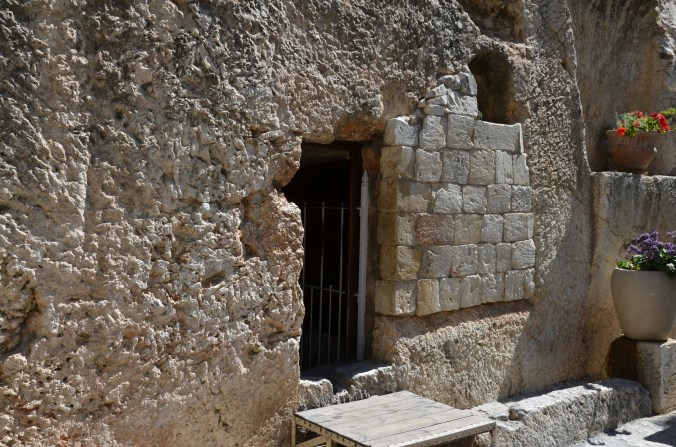
The tombs also were opened. And many bodies of the saints who had fallen asleep were raised,
and coming out of the tombs after his resurrection they went into the holy city and appeared to many.
— Matthew 27:52–53 —
What happened on Holy Saturday, the day situated between Good Friday and Resurrection Sunday? That is a good question that my fellow elder, Jared Bridges, has answered at the Washington Stand. And in his article, he takes a “topside” view—what was happening in Jerusalem on the day between Jesus’s cross and resurrection.
But there is another answer that needs to be considered, an answer that takes us below the surface, if you will. On Holy Saturday, while Jesus’s body rested in the grave, Jesus’s soul pronounced his victory over the spirits in prison (1 Pet. 3:19). That is to say, that when Jesus died, his body and soul were torn asunder, just like the temple veil (see Luke 23:44–46). As his body hung lifeless on the cross, soon to be buried, his soul, like all human souls, departed and went to realm of the dead, the place known as sheol in Hebrew or hades in Greek.
Importantly, sheol (or hades in Greek) is not the same thing as Hell (Gehenna), the place of eternal torment for the damned. Indicating their difference, hades gave up the dead to the lake of fire (i.e., hell) in Revelation 20:14. This means, Jesus did not go to “hell” after he died. But he did go to sheol, the realm of the dead. Often, we miss this fact, and missing what Jesus did in sheol, we miss the impact of Christ’s cross on the cosmos.
The Cross and the Cosmos
That is to say, when Jesus’s soul descended to sheol (the realm of the dead), he went to demonstrate his authority over the spirits held in prison there. That is the point of 1 Peter 3:19. But there is something else. Descending to the dead, he also came to the saints who had gone before him, the one who awaited his coming. Indeed, throughout the Old Testament, men and women of faith died looking for the day when God would bring them from death to life and from sheol to Zion (see Psalm 16). As Hebrews 11:13–16 puts it,
These [men and women of faith] all died in faith, not having received the things promised, but having seen them and greeted them from afar, and having acknowledged that they were strangers and exiles on the earth. 14 For people who speak thus make it clear that they are seeking a homeland. 15 If they had been thinking of that land from which they had gone out, they would have had opportunity to return. 16 But as it is, they desire a better country, that is, a heavenly one. Therefore God is not ashamed to be called their God, for he has prepared for them a city.
Indeed, when saints died in the Old Testament, they did not go to heaven, the place where God dwells. Instead, they went to sheol, a realm of the dead inhabited by the wicked and the righteous alike. In that place, there seems to be a division between those who lay in torment (see Isa. 14:9–11) and those who were in comfort (see Luke 16:22), but nevertheless, the true saints longed to be delivered from sheol and brought to the city of God. Yet, such ascension could not be had without Christ.
That’s where Holy Saturday comes in. When Jesus descended to the grave, he came to proclaim his victory over his enemies and to bring his saints to heaven. As Hebrews 11:39 tells us, the saints of old could not enjoy access to God’s holy hill without Christ and without the new covenant saints who were now joined to Christ too.
Wonderfully, however, in Christ’s death, burial, resurrection, and ascension, the way had been cleared. Jesus would climb the mountain of God to sit in glory. Furthermore, as he ascended to heaven, he would be received by the angels above and joined by the saints who were coming from below. In other words, when Christ descended on Saturday, he went to gather the saints waiting for him. So that on resurrection Sunday, he would bring them into the holy city on the way to Jerusalem above.
In Hebrews 12:22–24, we discover the end of the ascension, namely a festival of glory surrounding the throne of God. Here’s what it looks like.
But you have come to Mount Zion and to the city of the living God, the heavenly Jerusalem, and to innumerable angels in festal gathering, 23 and to the assembly of the firstborn who are enrolled in heaven, and to God, the judge of all, and to the spirits of the righteous made perfect, 24 and to Jesus, the mediator of a new covenant, and to the sprinkled blood that speaks a better word than the blood of Abel.
Marvelously, this passage tells us that we who gather to worship God on earth join the chorus of praise around God’s throne in heaven. But also, this means that the chorus is now filled with the saints made perfect. The idea of perfection is one of resurrection unto glory; those Old Testament believers who dwelt for ages in sheol are not perfected as they have entered the eternal realms of glory. Indeed, this what Christ accomplished when he went to sheol: he brought a train of captives up the mountain of God to join him in worship.
Across the world, this means that those who die in Christ today, do not go to realm of the dead. They go to heaven. Wonderfully, the sting of death for Christians today is not aggravated by the plight of waiting in sheol. Rather, because we live at a time when Christ has ascended, the path of our soul after death is brought immediately into the presence of the Lord. Because Christ is ascended, he can say that absence from the body means presence with the Lord in heaven (2 Cor. 5:8).
But it wasn’t always this way.
The Day Jesus Brought His Saints Out of Sheol
This promise of heaven is the fruit of Christ’s death on the cross, as well as his descent to sheol and his ascent to glory (see Eph. 4:8–11). Accordingly, we should give thanks to God for this cosmic shift that took place on Holy Saturday. Equally, we should consider this glorious translation from sheol to Mount Zion as we read about saints of old walking into the city of Jerusalem on the day of Christ’s resurrection.
As Matthew 27:51–54 record the events surrounding Christ’s death, he discover that tombs were opened, so that saints could walk into the city of Jerusalem.
And behold, the curtain of the temple was torn in two, from top to bottom. And the earth shook, and the rocks were split. 52 The tombs also were opened. And many bodies of the saints who had fallen asleep were raised, 53 and coming out of the tombs after his resurrection they went into the holy city and appeared to many. 54 When the centurion and those who were with him, keeping watch over Jesus, saw the earthquake and what took place, they were filled with awe and said, “Truly this was the Son of God!”
Tomorrow, I will preach about these verses. Today, however, I leave you with the comments of John Calvin who offers a reading that matches what I have assembled above. Namely, that the saints of old were set free from their tombs by way of Christ’s death. But more, it was his descent into the grave that brought these believers from sheol to glory. And in Matthew’s Gospel, this brief mention of resurrected saints walking through Jerusalem appears to confirm the ancient promise that God would bring his saints to glory. And their appearance serves as a confirmation of this truth.
Knowing that, we should not be “weirded out” by dead men walking in Jerusalem. Instead, we should see their resurrection as an effect of Christ’s cross and a sign that God was rearranging the cosmos. No longer would God’s saints dwell at a distance from God in sheol; now in Christ they would ascend the hill of the Lord.
That is what Holy Saturday entails. And we would do well to understand why Christ’s descent to the dead played a critical role in advancing redemptive history and making a pathway for saints to go to heaven. This was true for those in Israel and it is true today. Tomorrow, I will explain more from Matthew 27. Today, I will leave you with Calvin’s commentary on Matthew 27:52.
Soli Deo Gloria, ds
Photo by Jonny Gios on Unsplash
**********
52. And graves were opened.
This was also a striking miracle, by which God declared that his Son entered into the prison of death, not to continue to be shut up there, but to bring out all who were held captive. For at the very time when the despicable weakness of the flesh was beheld in the person of Christ, the magnificent and divine energy of his death penetrated even to hell. This is the reason why, when he was about to be shut up in a sepulchre, other sepulchres were opened by him. Yet it is doubtful if this opening of the graves took place before his resurrection; for, in my opinion, the resurrection of the saints, which is mentioned immediately afterwards, was subsequent to the resurrection of Christ.
There is no probability in the conjecture of some commentators that, after having received life and breath, they remained three days concealed in their graves. I think it more probable that, when Christ died, the graves were immediately opened, and that, when he rose, some of the godly, having received life, went out of their graves, and were seen in the city. For Christ is called the first-born from the dead, (Col. 1:18,) and the first-fruits of those who rise, (1 Cor. 15:20,) because by his death he commenced, and by his resurrection he completed, a new life; not that, when he died, the dead were immediately raised, but because his death was the source and commencement of life.
This reason, therefore, is fully applicable, since the opening of the graves was the presage of a new life, that the fruit or result appeared three days afterwards, because Christ, in rising from the dead, brought others along with him out of their graves as his companions. Now by this sign it was made evident, that he neither died nor rose again in a private capacity, but in order to shed the odour of life on all believers.
But here a question arises. “Why did God determine that only some should arise, since a participation in the resurrection of Christ belongs equally to all believers? I reply: As the time was not fully come when the whole body of the Church should be gathered to its Head, he exhibited in a few persons an instance of the new life which all ought to expect. For we know that Christ was received into heaven on the condition that the life of his members should still be hid, (Col. 3:3,) until it should be manifested by his coming. But in order that the minds of believers might be more quickly raised to hope, it was advantageous that the resurrection, which was to be common to all of them, should be tasted by a few.
Another and more difficult question is, What became of those saints afterwards? For it would appear to be absurd to suppose that, after having been once admitted by Christ to the participation of a new life, they again returned to dust. But as this question cannot be easily or quickly answered, so it is not necessary to give ourselves much uneasiness about a matter which is not necessary to be known. That they continued long to converse with men is not probable; for it was only necessary that they should be seen for a short time, that in them, as in a mirror or resemblance, the power of Christ might plainly appear. As God intended, by their persons, to confirm the hope of the heavenly life among those who were then alive, there would be no absurdity in saying that, after having performed this office, they again rested in their graves. But it is more probable that the life which they received was not afterwards taken from them; for if it had been a mortal life, it would not have been a proof of a perfect resurrection. Now, though the whole world will rise again, and though Christ will raise up the wicked to judgment, as well as believers to salvation, yet as it was especially for the benefit of his Church that he rose again, so it was proper that he should bestow on none but saints the distinguished honour of rising along with him.[1]
[1] John Calvin and William Pringle, Commentary on a Harmony of the Evangelists Matthew, Mark, and Luke, vol. 3 (Bellingham, WA: Logos Bible Software, 2010), 323–326.
 Via Emmaus
Excellent!!