
Apple Park in Cupertino, California
From Brexit to the rise and fall of Donald Trump, we have heard a lot about the dangers of globalism and return of populism. Many charged Trump with a kind of nationalism that led to all kinds of racism, fascism, and other political maladies. But many others, would share a concern for commercial giants like Apple, Amazon, and Alphabet Inc. (that’s Google’s parent company) who are assuming powers that transcend geopolitical nations.
In short, debates range today over what is most dangerous: Is it the tyrannical rise of globalism which calls for diversity, antiracism, and economic justice? Or is the greater concern a view of the world that affirms boundaries, borders, and limited budgets?
Those are big questions which touch on every area inch of public life, but connecting them all is a shared history of how to make sure that the fascism of Nazi Germany and the race-based slavery of America don’t happen again. Indeed, the push towards diversity and the denial of strong authorities is strongly associated with a push against the world events that ran from 1917 to 1945. Throw in the boom of technology and the ideologies of the 1960s (chronicled in Carl Trueman’s The Rise and Triumph of the Modern Self ) and you have a starting place for understanding our age.
The Return of the Strong Gods
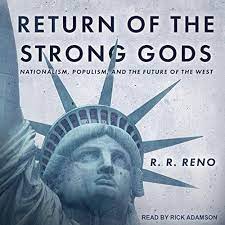 Adding to this understanding in R. R. Reno’s book The Return of the Strong Gods: Nationalism, Populism, and the Future of the West. In this work of history and cultural commentary, Reno begins with the idea of the Open Society put forward by Karl Popper. He argues that Popper, along with many others, pushed hard against the militant authorities of the two world wars and called for a society that had no such “strong gods.” Reno explains how this worked out in the liberal policies of the 1960s and following, and how our world today is suffering under the weight of a world without any strong ideas. In other words, by evacuating strong leaders, strong ideas, strong gods from the world, it created a nice, safe, open space for individuals to express themselves without destroying others.
The only problem, as Reno points out, is how the world hates a vacuum. And when the strong gods, as well as God himself, were evicted from public spaces, new tyrannies arose. These tyrannies include the cult of tolerance, diversity, inclusion, and antiracism. As many have observed, the tolerance police are some of the most intolerant figures going. This was first seen on college campuses, where the liberal elites taught two generations (from 1960s to the present) of students how to seek an open society. But now, the open society is being filled in by a type of fundamentalism which the original advocates of openness were seeking to oppose. Indeed, when God (or gods) is/are removed from culture, the government steps in, and this along with the governing agencies of Big Tech, we are seeing just this.
In Reno’s insightful book, he gives an intellectual history of how we got here and what we can do about it. This book fits with Live Not By Lies (Rod Dreher) and The Rise and Triumph of the Modern Self (Trueman), but with one key difference. It actually ends with a hope-giving conclusion. Like Dreher and Trueman, Reno urges for commitment to family and churches—the mediating institutions which encourage virtue without enforcing it by law—and he suggests that endurance in this pursuit will outlast the lifeless attempts of those trying to fill the void of an open society. He does not deny the tyranny or trouble that will result from globalist leaders who are seeking to enforce their world views, but he does strike a chord of hope that the strength of God will ultimately prevail.
Indeed, if the Lord tarries, this is true. Many are the civilizations that have died and been brought back to life by the truths of the gospel. I say this historically, not because I am a postmillenial, who thinks the gospel will usher in the kingdom. Nevertheless, if the current elites continue to have their way, they will tear down many parts of the globe and many God-given structures (e.g., marriage, family, church, the male-female binary, etc.). If that happens, then the church who holds fast to the truth, may be in a place to speak truth again. Thus, in this time we must continue to conserve and confess that truth, such that in time we might see it rise again. Or who knows, perhaps by speaking the truth of God’s creation and redemption, his salvation and his sovereignty over and for the state, we might even see a revival in our day.
Reno’s book helps us to better see our world and to engage it with truth and grace. Take up and read.
Soli Deo Gloria, ds
For an interview that touches on these matters, but one that really doesn’t get into the heart of the book, see Albert Mohler’s conversation with R. R. Reno: Facing the Intersection of Culture, Politics, and Religion in the Secular Age: A Conversation with R. R. Reno.
 Via Emmaus
“Indeed, when God (or gods) is/are removed from culture, the government steps in, and this along with the governing agencies of Big Tech, we are seeing just this.”
EXACTLY!! I have said the same thing many times over the years. But I would add the role being played by the evangelicals I refer to as the Fellowship of the Pharisees, men and women who have exchanged the gospel for government to gain political power.