
31 So Jesus said to the Jews who had believed him,
“If you abide in my word, you are truly my disciples,
32 and you will know the truth, and the truth will set you free.”
— John 8:31–32 —
I don’t know about you, but when I read lengthy dialogues in Scripture, especially in the Gospels, I find them hard to follow until I have a sense of structure of the argument. In John 8, this has been especially true. After Jesus announces that he is the light of the world (v. 12), his opponents (Pharisees in v. 13 and Jews in vv. 22, 31, 48, 52, 57) object, question, and reject his statements. Yet, this massive disputation is a jumble of back and forth, until you begin to see the order of the court.
As many commentators have observed, John’s Gospel has many elements of a trial in it. And if the whole book is a court case written to show that Jesus is the Son of God (John 20:31), it should not surprise us to find witnesses, evidence, and other elements of a law court. Indeed, that is how I take John 8:12–59, and in the outline included here, I offer a court case in two parallel parts.
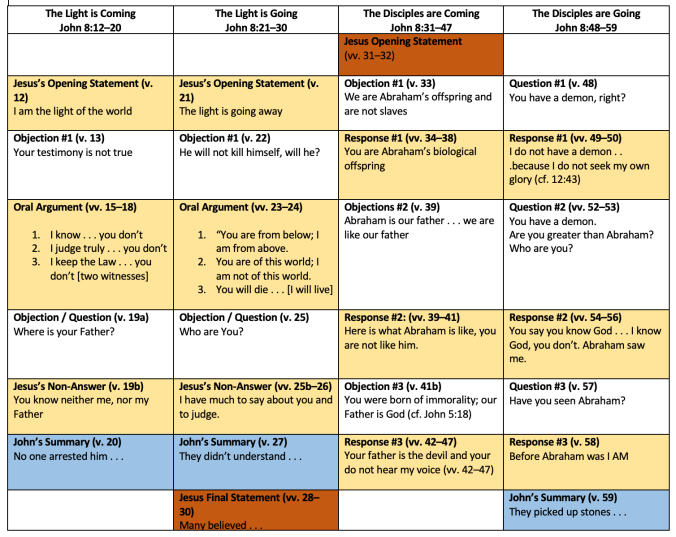
From this outline, let’s consider a couple things.
The Legal Brief in John 8
First, there is, in John 8:12–30, two arguments that run in parallel. This parallel is found in the order of the speech and the shape of the argumentation. Compare verses 12–19 and 20–27. In these two sections, we find Jesus making an opening statement in each. Remarkably these statements should be read together, and give us a sense of what the first trial is addressing. In verse 12, Jesus announces that he is the light coming into the world, and in verse 20 he says that he (the Light of the World) will be departing. Commiserate with so much in John, this trial is about Jesus and the light he brings.
Importantly, Jesus’s statement are met with hostile unbelief, expressed in two objections—one long, one short. This is how the trial proceeds until, in verses 28–30, Jesus points to his coming cross, when he will be lifted up. As verse 30 indicates, many believed in him, even though moments earlier (v. 27), they didn’t understand. So clearly, this faith lacks understanding, which Jesus will proceed to show as false.
Stopping here in the middle of the chapter, notice how this response of faith is the turning point of the chapter. Quite possibly, the faith of his hearers is based upon the hope that Jesus “lifting up” would be an exaltation to glory, which they might enjoy too. What Jesus has in mind with respect to his lifting up, however, is his coming crucifixion. But these disciples do not understand that (v. 27), they simply believe in Jesus for other purposes. This is a warning to us today and to any who believe in Jesus for their own reasons, not his.
In the context of John, we will see that the people of Israel were seekers of glory, and it seems Jesus’s words of lifting up could have invited such a misplaced faith. Accordingly, this is where the next section begins, as it moves to reveal the darkness of Jesus questioners. Like before, the second section has another mirrored debate, a legal dispute in two parts.
Verses 31–32 begins with another opening statement, but this time Jesus’s statement covers the two parts of the trial. As to the content of his statement, Jesus tells his would-be followers how they prove themselves them true. If they remain in his word, they will have life eternal, but if they refuse him and his words, they are false, darkened, and spiritually dead. Tragically, this is what the chapter proves.
Let’s following the argument in order. First, in vv. 31–47, the Jews ask three questions, to which Jesus responds three times. And in that legal debate, Jesus splits the difference between biological seeds of Abraham (which these Jews are) from spiritual heirs of Abraham (which these Jews are not). The result of this distinction is Jesus’s famous and forceful declaration that these “believers” are actually children of the devil. “You are of your father the devil, and your will is to do your father’s desires” (v. 44a).
Next, these devilish sons of Abraham accuse Jesus of demonic activity and Samaritan origins (v. 48), even as they reject his self-identification with Abraham. Again, this legal debate turns on three questions, followed by three responses from Jesus. Ironically, once identified with the devil, these interlocuters do the work of the accuser, questioning Jesus, his identity, and his eternity (i.e., his ancient knowledge of Abraham). But in context, all they do by questioning Jesus is to show their own spiritual ignorance and lifeless religion.
Consequently, when they pick up stones to throw at Jesus, a symbol that the trial has moved from deliberation to execution, John reveals that these accusers of Jesus are the ones who stand condemned by God. They do not know God and this is evident in the fact that they cannot recognize God’s Son. Accordingly, the chapter closes not with a guilty verdict for Jesus, but a guilty verdict for his legal opponents.
All in all, John uses a tight literary structure to lead the reader to see what he is doing. And more, he reveals who Jesus is by contrasting him with those who accuse him. Jesus is the light of the world who will be extinguished on the cross, so that in the light of his resurrection, all who truly believe in him will be saved. Yet, such faith does not come from the selfish will of men who want to glorify themselves by Jesus. Saving faith comes to those who are truly heirs of Abraham, sheep who hear Jesus voice, and children born of God.
John 8 and the Crack in the Cosmos
The division between biological seeds and spiritual heirs is a division, a crack in the cosmos, that ranges across the whole of humanity. And in John, this spiritual division between two kinds of people is seen by paying attention to the trial. In questioning and condemning Jesus, the Jewish leaders show themselves to be men of darkness. By contrast, those who abide in the words of Christ will walk in the light, as he is in the light, because God gives light to those who are children of light.
Again, this spiritual division is what we face in every conflict—whether familial, ecclesial, societal, legal, or political. As Jesus teaches, there are two kinds of people in the world. And as John 8, the sides are determined by God and detected by how one responds to the Son. Ultimately, John 8 reveals much about who Jesus is, but it also reveals much about who we are.
With that realization in mind, let us seek God’s mercy and pray for his light to lead us to Christ. Jesus is the light of the world, and if you rejoice in his light, he will reveal to you his truth, and his truth alone will set you free. Just as he says in John 8:31–32.
Soli Deo Gloria, ds
Photo by Jonathan Petersson on Pexels.com
 [Photo Credit:

 Via Emmaus