Opening Our Eyes to Obergefell and Its Effects: A Pastoral, Cultural, and Legal Round-Up

SCOTUSOn June 26, 2015, in a 5–4 decision, the Supreme Court of the United States (SCOTUS) ruled that same-sex marriage was legal in all 50 states. In the hours that have passed, Christians have been praying and wondering aloud what comes next and how we should respond. To aid our collective understanding of the Supreme Court’s decision, I’ve listed dozens of resources under the following headings:


  • The Decision: What Did the Court Decide?
  • On the Pastoral Front: What do we say to our church?
  • On the Cultural Front: What do we say to our neighbor?
  • On the Legal Front: What about religious liberty?

I am so thankful for the men and women who have been reporting and commenting on these issues. May their wise words aid you—as they have me—to think and pray and act with grace and courage for truth in these days. Still before reading any of these posts, let me encourage you to watch this two minute exhortation from Russell Moore, president of the ERLC.

Continue reading

Eleven Questions to Facilitate Hospitality Evangelism

foodIn our post-Christian age, evangelistic Christians (a redundant statement, if ever there was one) must learn to love their neighbors through means of proactive hospitality. A few years ago I wrote about the subject of evangelism and hospitality (here and here). Today, let me list 11 questions that might help facilitate conversation that goes beyond the weather and sports. Moving from the generic to the more evangelistic, these personal questions may help us to engage others with meaningful questions that move towards the most important subjects of life. Continue reading

Confronting the Ingrown Church

pewsShortly after I stepped down as pastor this year, I came across an illuminating and deeply convicting book by C. John (“Jack”) Miller that addressed so many of the issues in my church—and in so many churches like ours.

The book is entitled Outgrowing the Ingrown Churchand though it is a little dated (1986), it gets at the heart of the problem that many American churches are facing—an unhealthy self-centeredness that undermines the missionary impulse of Christ’s church. While the whole book is worth reading, the opening section (“Where Missionary Life Begins”) was most helpful for me. In those two chapters, Miller outlines the deadly symptoms of the ingrown church. The rest of the book aims at remedying that introversion through means of fresh faith, radical repentance, and active, prayerful, outward ministry.

Let me lay out some of the symptoms of the ingrown church. If they look similar to what you’ve experienced in your church, pick up this little book and begin to work through it with the leaders in your church. Continue reading

Take Up and Pray: Learning to Pray the Scriptures from Donald Whitney

prayDonald Whitney has just released a new book on prayer, Praying the BibleLike his earlier books spurring Christians towards love and good deeds (especially Spiritual Disciplines for the Christian Life), this little volume is sure to encourage believers and provide a pathway to greater, more fervent, more consistent prayer.

As I read the book at the end of last week’s prayer meeting at the SBC, I walked away with fresh encouragement to take up the Scriptures and pray. I am sure any believer will experience the same thing if they pick up this little book (89 pp.). To encourage you to pick up this book, let me give you a sense of Whitney’s argument coupled with his ‘tweetable’ prose. Continue reading

The Trinity and Salvation: The Spirit as the Source for and Reward of Faith (Galatians 3:1–7)

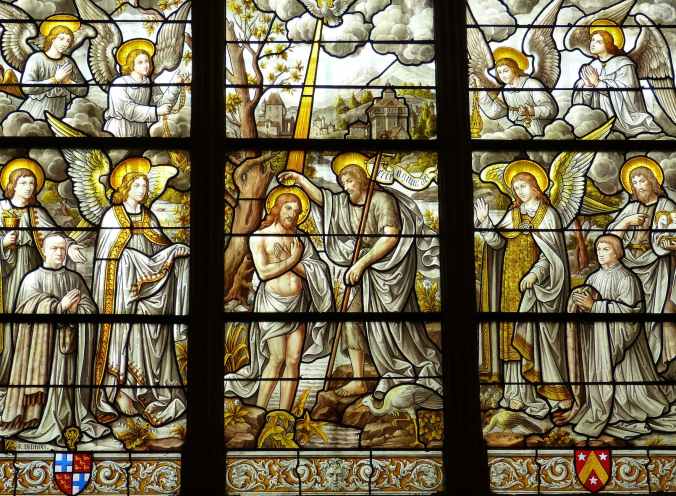
angelic architecture art baptism

O foolish Galatians! Who has bewitched you? It was before your eyes that Jesus Christ was publicly portrayed as crucified. 2 Let me ask you only this: Did you receive the Spirit by works of the law or by hearing with faith? 3 Are you so foolish? Having begun by the Spirit, are you now being perfected by the flesh? 4 Did you suffer so many things in vain—if indeed it was in vain? 5 Does he who supplies the Spirit to you and works miracles among you do so by works of the law, or by hearing with faith—6 just as Abraham “believed God, and it was counted to him as righteousness”? (Galatians 3:1–7)

In keeping with his whole letter, Paul boldly rebukes the churches of Galatia for their turn from the true gospel (see 1:6–9). In this section, he recalls their reception of the Holy Spirit and how God’s Spirit came to them—by works of the flesh or by hearing with faith? The answer is plain in the text: the Galatians received the word with faith.

Theologically, this passage has much to say about the order and operations of the Holy Spirit, and I’d like to make a couple observations that will help us to see how the Spirit’s indwelling is different from his work of regeneration. Continue reading

Believing and Belonging: Which is the Source for True Fellowship?

fellowsThe next time you read through the books of Acts, underline every time you find the word “believe.” At the same time, circle every time you find a mention of the Scriptures, the word, or preaching. What you will soon discover is how radically committed the New Testament church was to proclaiming the Word of God and calling for belief in the gospel of Jesus Christ.

Everywhere the apostles went they proclaimed the Word. Empowered by the Spirit, they were called to be witnesses (Acts 1:8). Indeed, filled with the Spirit they fulfilled their calling of proclaiming the Word (Acts 4:31). As a result, in just a few short decades churches were planted all over the Mediterranean. And within three centuries, the early church would become the dominant world religion. Continue reading

The Doctrine of Creation: A Necessary Part of Our Worship and Evangelism

auroraCould it be that Christ-centered Christians can all too easily forget that the God of the cross is also the God of creation?

Not long ago I was visiting with some church leaders and the topic of transgender persons came up. While a number of good strategies were mentioned about sharing the gospel with them (and all people who sinfully rejected God’s moral norms for their sex lives) there were questions about what is wrong with a man desiring to be a woman, or the reverse. “Which verse does a transgender person violate?” was the question.

The short answer (and this again goes for all persons) is “all of them.” In Adam, all of us are guilty before our maker (Rom 5:12, 18–19). By nature, we are inveterate rebels. We don’t need a verse addressing our specific manifestation of sin, although there are plenty. The whole Bible speaks to the sinful condition of mankind—transgender persons included. Just read Romans 1:18–32 or Albert Mohler’s insightful “Biblical Theology and the Sexuality Crisis.” Sexual morality is far more than keeping all the laws.

But specific answers aside, I think there is a larger need in evangelical churches—namely, the remembrance that we do not worship God as Redeemer only, but also as Creator. In fact, in biblical revelation he is first Creator first, then Redeemer. And even in redemption, the goal is new creation—personal (2 Cor 5:17) and cosmic (Matt 19:28; Revelation 21–22).

In sharing the gospel, we must not forget that sin is not just law-breaking; it is anything that opposes or deviates from God’s created design. But we will only remember this doctrine of creation, if we give ourselves to worship God as Creator.

And for that reason, I offer give you six ways God’s creation should move you to worship and evangelize. Continue reading

Reading the Bible Better: How Out-of-Order Chronology Serves Biblical Theology

bibleWhat do you do when you come to a passage of Scripture that is out of sequence? Like in the case of Genesis 10, which speaks of various tongues (v. 5) before God confused human language in Genesis 11?

Do you challenge the authority and intent of the author, presuming that there is some kind of error?Do you simply ignore it, pretending that the problem is not that large?  Or do you stop and assess what the author is doing? How you proceed in those cases will, in large part, determine (over the course of time) how well you read the Bible.

Biblical Authors Write Selectively . . . Which Includes Order and Arrangement

When an inspired author of Scripture records a collection of events he naturally delimits his account with some measure of selectivity. In conveying his inspired message, he is not just rehashing history.  He is exercising his office as prophetic messenger.  This kind of intention is confessed in places like Luke 1:1–4 and John 20:30–31, but it is also seen in the warp and woof of the biblical text itself. Continue reading

Typological Pairs: From Suffering to Glory

david solomonConcerning this salvation, the prophets who prophesied about the grace that was to be yours searched and inquired carefully, inquiring what person or time the Spirit of Christ in them was indicating when he predicted the sufferings of Christ and the subsequent glories. It was revealed to them that they were serving not themselves but you, in the things that have now been announced to you through those who preached the good news to you by the Holy Spirit sent from heaven, things into which angels long to look.
— 1 Peter 1:10–12 —

What does it mean that the Spirit of Christ foretold of the Messiah’s suffering and glory?

Surely, there were many ways, as Hebrews 1:1 indicates. Nationally, the people of Israel regularly experienced enemy oppression (after they sinned) followed by powerful deliverance that set God’s elect over his enemies. Individually, Joseph, Job, David, and Daniel all experienced humbling affliction before being exalted. Textually, there are some individual passages displaying a suffering-to-glory theme—e.g., Isaiah 53 speaks of the Servant’s humiliating death (vv. 1–9) only to close the chapter by announcing his glorious reward for his vicarious suffering (vv. 10–12). Or see the pattern in the Psalms; both the whole Psalter and some individual Psalms (see especially Psalm 22) reflect this pattern.

It seems that everywhere you look in the Old Testament you find (1) God’s people suffering, followed by (2) cries for mercy. In response, (3) God hears their prayers, and (4) responds with saving compassion in the form of a deliverer—a Moses, a Samson, or a David. The result is that (5) the people are saved and the mediator is exalted.

In the light of the New Testament, these incidents are illuminating shadows of Jesus Christ himself. In fact, in the words of Peter, it’s not too much to say that the Spirit of Christ is a cruciform spirit, who leads his people (under the Old Covenant and the New) through valleys of death to bring them into places of honor and service. This is the Christian way—to be brought low unto death, so that God can raise us up to life (see 2 Cor 1:8–9).

That being said, I am persuaded that there is another way in which suffering-unto-glory might be seen in the Old Testament. Instead of containing the pattern to the nation, individuals, or texts, there are some pairs of people who display the pattern. That is, repeatedly throughout the Old Testament, there are individuals related by kinship or ministerial calling whose composite lives function to display the pattern observed in 1 Peter 1. In other words, the Spirit of Christ was directing their lives such that the first person foreshadowed the sufferings of Christ and the second person reflected his subsequent glories.

Admittedly, I haven’t seen this proposal written down anywhere. So, I’d love your thoughts. Does it work? I think there is merit in the proposal and am writing it out (in part) to explore the idea. (That’s what blogs are for, right?) I think, in the end, such pairs may help reflect the binary nature of Christ’s ministry–first in weakness and humiliation, then in power and glory. Or at least, that’s what I will try to show below. Let me know what you think. Continue reading

God’s Marketing Strategy: Christ-Like Churches

marketingFor a whole year [Paul and Barnabas] met with the church and taught a great many people.
And in Antioch the disciples were first called Christians
— 
Acts 11:26 —

Marketing is a big business. From 2000–2006, Coca-Cola spent 15.5 billion dollars to advertise their products to the global market.[1] In 2009, Apple Computers spent half a billion dollars on their advertising, which is a third of what Microsoft paid out in 2009 (1.4 Billion).[2] These leading companies invest incredible capital into these self-promotion schemes for the purpose of cashing in on the customers they solicit.

Genuine Converts are God’s Marketing Strategy

But what about the church? Will advertising help achieve Great Commission success? What is God’s marketing strategy? Surely as the Lord of all creation (Ps 24:1), he has ample resources to fund such a project; as Maker of the Milky Way, he has the creative intuition to impress audiences. Yet, Jesus’ ministry is not marked by such promotion. In the Gospels and Acts, we find something more personal, if not even more hidden. Continue reading