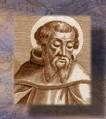
 [This post is the fourth in a series on the biblical theology of Irenaeus of Lyons found in Against Heresies].
Working against an atomistic reading of Scripture, Irenaeus appeals to the variegated testimony of the Old Testament that finds unity in Christ (cf. Eph. 1:10).[8] Drawing on these OT witnesses, Irenaeus vindicates the virgin conception of Jesus in a variety of ways. He points to Isaiah for giving the church a “sign” of its coming Lord,[9] Daniel for “foreseeing [Jesus] advent” in the stone cut without hands,[10] Moses for “giving a type” when he “cast his rod upon the earth, in order that it, by becoming flesh, might expose and swallow up all the opposition of the Egyptians,”[11] and Jeremiah for explaining in history how the Messiah could not be the biological son of Joseph, because Jesus earthly father was, in fact, the descendent of the disinherited Jechoniah.[12] In this logical exposition of the Old Testament text, Irenaeus calls attention to divinely-ordained symbolism, predictive prophecy, typology, and historical deduction based on the revealed will of God. In all of these modes of interpretation, Irenaeus presupposes the Old Testament as a divinely-intended foreshadow of things to come.
Naturally this leads to a very strong sense of recapitulation in his biblical theology. His typology commonly posits Jesus as the divine antitype who recapitulates OT people, events, and institutions. Quoting from Romans 5, Irenaeus comments, “[just as] Adam had his substance from untilled and as yet virgin soil…so did He who is the Word, recapitulating Adam in Himself, rightly receive a birth…from Mary, who was as yet a virgin.”[13] Likewise, Irenaeus sees Jesus blood as recapitulating the “innocent” blood of Abel shed at the hands of his brother Cain,[14] and Jesus entire lifework “sum[s] up all things, both waging war against our enemy, and crushing him who had at the beginning led us away captives in Adam.”[15] Summarizing the kind of revelation found in the OT, he writes:
For the prophets prefigured in themselves all these things, because of their love to God, and on account of His word. For since they themselves were members of Christ, each one of them in his place as a member did, in accordance with this, set forth the prophecy [assigned him]; all of them, although many, prefiguring only one, and proclaiming the things which pertain to one.[16]
In a litany of OT citations, Irenaeus quotes nine OT authors,[17] grouping these oracles according to four intertextual themes—the glories of the Messiah, His sufferings, His resurrection, and the establishment of a new covenant (cf. Luke 24:26, 46-47). In arranging these predictive prophecies in this way, Irenaeus shows a tremendous grasp of the Hebrew Scriptures, but more than that he expounds a Christ-centered, Gospel-contoured (life, death, resurrection), textually-derived biblical theology. Graeme Goldsworthy summarizes Irenaenus’ interpretation:
In the early church we see attempts to understand the essential unity of the Bible from the epicentre of the person and work of Jesus Christ. These early Christological interpretations of the Old Testament were driven partly by the apologetic needs to counter Judaism…[and in the case of Irenaeus], to oppose Gnosticism by showing the unity of the Testaments.[18]
Irenaeus’ hermeneutic unashamedly unites all things in Jesus Christ. For him, “the Old Testament and the New Testament represented a unity. The prophets were fulfilled in Christ. The apostles, meaning the entire New Testament (the apostolic preaching), in turn preached the same God the Father, the Son, and the Holy Spirit and the same economy of salvation.”[19] Over against the Gnostics whose selective Bible reading led them to posit a false God and a damning form of religion, Irenaeus’ biblical theology led him to see in every person, event, and institution a divinely intended type or shadow of Jesus Christ.[20]
Irenaeus understood typology to be a primary means by which YHWH instructed the people of Israel (OT) and the church (NT). Quoting 1 Corinthians 10:11, he comments, “For by means of types they learned to fear God, and to continue to devoted to His service.”[21] Speaking of the saints in the Old Testament, he argues that all that they received in the law—circumcision and the Sabbath,[22] covenantal stipulations,[23] and the sacrificial system[24]—were given to represent later and greater Spiritual realities. He writes:
Moreover, [God] instructed the people…by repeated appeals to persevere and serve God, calling them to the things of primary importance by means of those which were secondary; that is, to thing that are real, by means of those that are typical [typological]; and by things temporal, to eternal; and by the carnal to the spiritual; and by the earthly to the heavenly; as was also said to Moses, “Thou shalt make all things after the pattern of those things which thou sawest in the mount.”[25]
[1] Deuteronomy 6:4; Mark 12:29-30; Hebrews 13:8; James 1:17.
[2] David Dockery, Biblical Interpretation Then and Now, 59.
[3]Michael Haykin, Defence of the Truth, 37.
[4] See Irenaeus vehement accusation against Marcion in Irenaeus Adversus haereses 1.27.4.
[5] Michael Haykin, Defence of the Truth, 37.
[6] See Irenaeus prolix argument for the unified message of he Bible in Adversus haereses 4.5-15.
[7] Irenaenus Adversus haereses 4.11.4.
[8] Irenaeus Adversus haereses 4.33.10.
[11] This type Moses explains was a part of “the pre-arranged plan of God; that the Egyptians themselves might testify that it is the finger of God which works salvation for the people, and not the son of Joseph [in the flesh]. For if He were the son of Joseph, how could he be greater than Solomon…Jonah…or David” (Irenaeus Adversus haereses 3.21.8).
[12] Irenaeus intratextual argument posits that while Joseph was cut off from the Davidic covenant because of his patriarchal lineage and connection with the accursed Jeconiah (Jer. 22:24-25, 28; 36:30-31), Jesus is not disqualified because he is not his biological heir. He was virgin born. In the flesh, he was the son of Mary, who did not descend from Jechoniah (cf. Matt. 1:1-17, the genealogy of Joseph; Luke 3:23-38, the genealogy of Mary). This intratextual argument exemplifies Irenaeus’s commitment to the biblical text (Irenaeus Adversus haereses 3.21.9).
[13] Irenaeus Adversus haereses 3.21.10.
[14] Ibid., 5.14.1.
[15] Irenaeus’ recapitulation, though primarily accomplished by Jesus Christ, does extend to other aspects of redemptive history (Irenaeus Adversus haereses 5.21.1). In Irenaeus Adversus haereses 5.19.1, he compares Eve to Mary, and asserts how the latter obediently reenacts—he does not use “recapitulate”— the life of the first woman, whose “virginal disobedience” led to death, but now “has been balanced by virginal obedience.”
[17] The full list includes Amos, Daniel, David, Ezekiel, Habakkuk, Isaiah, Jeremiah, Joel, and Zechariah; and includes some of the prominent typological and prophetic passages associated with these inspired writers (Irenaeus Adversus haereses 3.23.9-15).
[18] Graeme Goldsworthy, Gospel-Centered Hermeneutics: Foundations and Principles for Evangelical Biblical Interpretation (Downers Grove, IL: IVP Academic, 2007), 236.
[19] David Dockery, Biblical Interpretation Then and Now, 69.
[20] In his exhaustive work on the word typos in the New Testament, Richard Davidson says of the early church fathers, “Throughout the patristic literature the Scriptural ‘types’ are generally understood to consist of divinely-designed prefigurations of Christ or of the realities of the Gospel brought about by Christ” in Typology in Scripture: A study of hermeneutical TYPOS structures (Berrien Springs, MI: Andrews University Press, 1981), 19.
[21] Irenaeus Adversus haereses 3.14.2.
[22] Ibid., 3.16.1-2. Concerning circumcision and the Sabbath, Irenaeus posits, “These things, then, were given for a sign; but the signs were not unsymbolical, that is, neither unmeaning nor to no purpose, inasmuch as they were given by a wise Artist; but the circumcision after the flesh typified that after the Spirit” (Irenaeus Adversus haereses 3:16.1).
[23] Ibid., 3.16.3-5. Speaking of the instructive and eschatological nature of the Law, Irenaeus writes, “These things [i.e. the Law], therefore, which were given for bondage, and for a sign to them, He cancelled by the new covenant” (Irenaeus Adversus haereses 3.16.2).
[24] Ibid., 3.17-18.
[25] Ibid., 3.14. 2.
 Via Emmaus
Pingback: Irenaeus’ Typology: History and Textual Warrant [5] « Via Emmaus