Intimate Allies (pt. 1): Marriage Means War

Why does the bridegroom stand on the right side of the bride? 

The legend goes:

Long ago, the right arm was considered the sword arm of most fighting men. If a man had to protect his bride, he would hold her with his left hand, and fight off attackers with his right arm.  The reason that men may have had to fight off others was because quite often women were kidnapped. Family members naturally wanted to rescue the stolen brides. Sometimes even during the wedding ceremony, the grooms had to fight off other men who were desirous of their brides, along with the bride’s family members. So having his right arm free was an important strategy.  This tradition is followed today by when facing the officiant, having the bride stand to the left, and the groom stand to the right.  (HT: Wikianswer).

This kind of readiness to defend makes sense in a time and place when marriages were threatened by violent thieves.  But what about today?  In light of the Scriptures, it still makes sense.  Such a posture illustrates the twin realities of love and war, and whether or not we consider marriage to be a violent affair, spiritually speaking, it is.  Marriage is warfare!

In their book, Intimate Allies: Rediscovering God’s Design for Marriage and Becoming Soul Mates for Life, Dan Allender and Tremper Longman make this very important connection.  Love is war!  And for Christian marriages to be strong they must participate in cosmic conflict against the enemies that seek to destroy their marriage.  Concerning marriage and warfare, they write:

The language of a battle may disturb many readers, but life is a war.  And marriage, at times, requires war if the battle of life is to be fought well.  But are our spouses non-combatants, people disengaged from the real battles of our life?  Or worse, are our spouses enemies whom we fight daily?

God’s intention is for our spouses to be our allies–intimate friends, lovers, warriors in the spiritual war against the forces of the evil one.  We are to draw strength, nourishment, and courage to fight well from that one person who most deeply supports and joins us in the war–our soulmate for life.  Husbands and wives are intimate allies (Intimate Allies, xvi).

Clearly strong marriages are not engaged in internecine conflicts, but they are drawing battle lines and contending with external threats.  From the foundation of the world, Satan has been seeking to kill, steal, and destroy (cf. Gen. 3; John 10:10).  He is the accuser, the robber, the murderer, and the home-wrecker.  He loves to pervert and destroy all things that God has created good, and he takes specific aim at marriage, sexuality, and the familial relations of the nuclear family.  One aspect of redemptive history is to re-establish the home.  This is evident in Paul’s letter to the Ephesians, where the fruit of the Spirit-filled life results a properly functioning marriage, where husbands lovingly lead their wives and wives respectfully submit to their husbands (Eph. 5:22-33).  In a return to the properly alligned marriage in the Garden, it seems evident from God’s Word that Spirit-led marriages are in cosmic conflict with the spirit of this age.  Allender and Longman elucidate this point:

What is the basis of the war between the sexes?  It is ultimately, of course, the war between God and his adversary, Satan.  We ought never to be naive.  The deepest struggles of life will occur in the most primary relationship affected by the Fall: marriage.  No one on earth will have more potential to do harm or to do good than your spouse.  Consequently, no relationship will be imbued with more desire and danger than your marriage.  No wonder most couples soon settle down into a distant, parallel existence in which the pain and the joy are kept at a minimum (287).

Sadly, their point is too often the case.  Couples, young and old, settle into patterns of coexistence rather than mutual edification.  Instead of conforming themselves into God’s intimate ideal for marriage, couples accept the luke-warm tensions of marriage, and make it up as they go.  In so doing, they ignore the marriage-transforming power of the gospel, and allow Satan to strip away the joys of marriage.  Yet, it does not have to be that way.  Allender and Longman contend that married is an environment for sanctification, spiritual growth, and gospel-empowered grace.  The battle that closes in on the home provides incentive and opportunity for the God’s power to be made manifest within the marriage, so that the flaming arrows of the enemy become refining fires that illumine and eradicate sin as Christ’s atoning work is applied to each act of sin.  They continue with optimism:

Our marriages are the ground for change.  It is the place where exposure of our need for the gospel is most profound; therefore, it is the relationship where depravity is best exposed and where our dignity is best lived out.  Marriage is the battleground of sin and the place where the Cross is revealed as the only hope for life and joy.  In the midst of the Curse, God promises that redemption will come as the seed of the woman crushes the head of the serpent.  [Therefore], the curse is a friend that drives us to the hope of redemption.  Marriage is the sweet wine and rich meat that heralds the final day and the wedding feast of the Lamb (288).

The first marriage was ruined by the slithering voice of the serpent, yet it was restored by the promise found within the curse: “the seed of the woman will crush the head of the seed of the serpent.”  Adam believed the promise and named his wife Eve, the mother of all living, and thus marital hope was restored, if only partially.  The same kind of redemptive hope is available for every marriage today, and in even greater ways since we know the rest of the story.  Sin still tears at marriage, but through the gospel of Jesus Christ, as depicted in marriage itself (Eph. 5:32), we know that the power of God can restore and reinforce every marriage under threat from sin and Satanic attack.  “Where sin has increased, grace has increased all the more” (Romans 5:21); and “the Son of God appeared to destroy the works of the devil” (1 John 3:8).  Consequently, the attacks of the enemy can in turn become the God’s means for mutual sanctification, as husband and wife humbly cry out to Jesus to come and work wonders in their marriage. 

This is not a civilian’s work (cf. 2 Tim. 2:4).  Picking up the sword of the Spirit, which is the word of God, and believing the promises of God takes courage and tenacity.  Putting to death the deeds of the flesh by the power of the Spirit is an act of war against the one to whom we were once held captive.  It is war, and it is the kind of war that is fueled by love (for God and for our spouse).  Perhaps it is counter-intuitive, but it is absolutely essential that every strong Christian marriage must employ a constant patrol on enemy activity encroaching against their marriage.  Every husband must stand guard, ready to go to war to protect their marriage by destroying every argument and [knocking down] every lofty opinion rasied agsint the knowledge of Christ; just as, every wife must combat Satan through prayers intercession for her home and for her husband.  Marriage is war!

Married people confront life as a battle.  As intimate allies, they push back the chaos.  With the power of God, marriage is an awesome calling and at times a delightful prelude of heaven.  But no matter what joy of what sense of meaning is found in marriage, it is always involved in a war.  At times marriage itself is part of the war… A successful marriage is one in which two broken and forgiving people stay committed to one another in a sacrificial relationship in the face of life’s chaos.  We are intimate allies in the war.  We rejoice together in our victories and cry together as we ecnounter setbacks.  But even in the setbacks, we can have joy because we know that the final victory is ours.  We look forward to the ultimate Wedding, which our own weddings only faintly reflect (346-47).

The pervading thesis of Intimate Allies is that marriage means war.  Once we realize this truth, it will re-adjust how we think of our own marital commitments.  It will re-allign the patterns of our daily interaction.  Our marriages require the daily posture of a pugilist–always ready to embrace our spouse with grace and forgiveness so that the devil does not get a foothold (Eph. 4:26-27).  Simultaneously, we are ever-ready to fight all those who would rend asunder what God has joined together.   Intimate Allies alerts us to the biblical reality of spiritual warfare attacking our marriages, and it implores us to put on our armor because the devil is coming to kill, steal, and destroy.

May the Lord grant us courage to fight sin, Satan, and the spirits of this age that would love to undo our marriages. 

Sola Deo Gloria, dss

Christ-centered, Old Testament Resources

This week Drs. Duane Garrett, Peter Gentry, and James Hamilton discussed the relationship of the Old Testament to the New Testament and the interpretation of Jesus Christ in the Old Testament.  The lively conversation was well-attended on the campus of Southern Seminary and the discussion raised a number of nuanced issues concerning sensius plenior, typology, allegory, interpretive methods, the duplication of apostolic hermeneutics, and the extent to which the Old Testament author’s knew they were writing of Jesus Christ.  In short, they covered a range of key interpretives features of biblical theology.  You can listen to the whole discussion here, while Jim Hamilton makes some follow up comments with pertinent link in his post: How much Christ in the Old Testament

Here are some other resources that may prove helpful in reading the Bible and seeing Christ and the gospel in the Old Testament.

First, James Grant highlights two helpful resources on the the Old Testament concerning its canonicity and its Narrative Structure.  You can find both of these on his blog, In Light of the Gospel: The first reference is to Richard Gaffins’ “Reading the Bible as Canon”.  The other is a link is John Woodhouse on the OT Narrative.

Second, a newer series of books offers to help biblical theologians and pastors see the gospel in the OT.  The Gospel According to the Old Testament Series looks like an incredible series of reflections that highlights, as the title says, the gospel in the Old Testament.  These books are not commentaries, though.  Instead, it seems that they take aim at OT characters.  Some of the books in the series focus on David, Ruth, Elijah & Elisha, Jonah, and others.  Some of the authors are Biblical Theology heavy hitters: Tremper Longman, Iain Duguid, Raymond Dillard, and David Jackson, to name a few. (HT: Chad Knudson)

Hope you find these prophetable!

Sola Deo Gloria, dss

Hapax Legomena? Six Resources to Help Read Biblical Literature Better

This weekend, September 26-28, Bethlehem Baptist Church will be hosting Desiring God’s National Conference for Pastors.  This years plenary sessions will discuss “The Power of Words and the Wonder of God.”  This is a grand subject and one that I look forward to considering more as the MP3’s become available.  Why?  Because the Words of God are the Words of Life, and while they are sufficient for life and godliness (2 Peter 1:3-4) and clear to the Spiritual man (1 Cor. 2:14-16; cf.  Deut. 29:29), they are not equally accessible.  In other words, reading the Bible requires a renewing of the mind (Rom. 12:1-2), able teachers (Eph. 4:11), and Spirit-empowered study (2 Tim. 2:7).  Just ask Peter about the difficulty of Paul’s writing (2 Peter 3:16).

The words of the Bible are not the only difficulty however in ascertaining a proper reading of Scripture.  Language employed to discuss the Bible can also be difficult.  When was the last time you were reading or listening to something about the Bible and got tripped up by unfamiliar langage–things like hypostatic union, pericope, or hapax legomena.  A dictionary sidebar or a parenthetical explanation might be helpful.  Biblical scholars and students of the Scripture have adopted a bevy of words, phrases, and descriptions to synthesize larger concepts and ideas.  Stepping into this river midstream can seem intimidating to the novice interpreter or the young Christian.  Hopefully what follows may help.

Spurred by Chad Knudson’s ‘Biblical Theological Glossary’, I have linked a number of cites that may be of assistance in reading the Bible better by having handy resources to give simple definitions of key terms and concepts in biblical theology, systematic theology, historical christology, archaeology, etc.  I hope these resources are helpful.  If you know of others, let me know and I will update the list.

Theological Word of the Day : A daily blog that provides helpful words, terms, and ideas in theology.  You can sign up to receive RSS feeds, or you can go to their website and browse previous terms.  Consider it a theological dictionary.com.

The Road to Emmaus Glossary: A short list of biblical-theological definitions for those beginning to study the Scripture’s diachronically.

Baker’s Evangelical Dictionary of Biblical Theology: This book is a helpful resource for biblical theology, and the whole of its contents can be found online.

Biblical Archaeology Glossary: Lots of terms about the history and exploration of biblical archaeology.

Biblical Studies Glossary: Contains many definitions and descriptions of terms and words associated with biblical interpretation, theology, and Church history.

Christological Dictionary: A helpful list of historical events, people, and discussions that helped formulate the Christology of the church leading up to Chalcedon.  (See also the Chart for Christological Heresies)

Sola Deo Gloria, dss

The Goal of Marriage is the Kingdom of God

THE PURSUIT OF PLEASURE IN THE PLEASURE OF ANOTHER


Here is a point to ponder.

Darby Livingston, pastor of Come As You Are Fellowship in Union City, OH, comments on 1 Corinthians 7:29, in his book The Pursuit of Pleasure in the Pleasure of Another: A Christian Hedonist Guide to a Happy Marriage (if you are not familiar with the term Christian Hedonism, coined by John Piper, see Pastor John’s explanation here).  Pastor Livingston writes:


“From now on, let those who have wives live as though they had none”  (1 Cor. 7:29)  What does that mean?  Are we supposed to leave our spouses?  NO! [Capital letters mine]… We’re just supposed to be gospel-centered whether single or married.  The gospel isn’t to be used to build better marriages, though sermons and books abound on that topic.  Just the opposite is true.  Marriage is to be used to expand the Kingdom of God through the gospel.  In saying that men with wives should live as though they had none, Paul is saying that the gospel has invaded this evil world and has flipped past priorities on their heads.  Our priority before believing the gospel may have been to build a comfortable little life with our spouse and pray we live long enough to enjoy the fruit of our labor [Ecclesiastes 9:9 does say as much].  Our priority since believing the gospel must be to use every temporal blessing, including marriage, as the means of advancing God’s Kingdom on earth (Darby Livingston, The Pursuit of Pleasure in the Pursuit of Another [USA: Xulon Press, 2007], 124).

In John Piper-esque fashion, Pastor Livingston challenges comfortable Christian marriages, to count the cost, pick up the cross, and carry the gospel.  This is not optional, this is essential.  Overstating his case, Livingston says that “the gospel isn’t to be used to build better marriages.”  Clearly this is not true in and of itself.  The gospel of Jesus Christ does build better marriages.  However, in context his point is dead on!  Good marriages are not the final goal.  The gospel is!  And marriages are to orient themselves around this reality.  As Jesus says with similar hyperbole, “If anyone comes to me and does not hate his own father and mother and wife and children and brothers and sisters, yes, and even his own life, he cannot be my disciple” (Luke 14:26).  In stating his case this way, Pastor Livingston is simply paraphrasing the words of our Lord, and challenging Christian couples to live lives of discipleship.  

Though, I have only read a few chapters of Livingston’s book, I commend it to you as a book that will help you see the glory of God in your marriage and to live radically for the kingdom of God.  If you are a Christian Hedonist, this book is for you; if you are not yet a Christian Hedonist, I would encourage you all the more to check it out.

Sola Deo Gloria, dss

God and Money

In his Sermon on the Mount, Jesus says this about God and money:

No one can serve two masters, for either he will hate the one and love the other, or he will be devoted to the one and despise the other.  You cannot serve God and money.  Therefore I tell you, do not be anxious about your life, what you will eat or what you will drink, nor about you body what you will put on.  Is not life more than food, and the body more than clothing?  … But seek first the Kingdom of God and his righteousness, and all these things will be added to you (Matthew 6:24-25, 33).

Addressing the subject of God and money in his blog today, Southern Seminary President, Dr. Albert Mohler reflects on “A Christian View of the Economic Crisis” .  His sweeping conversation about economic theory, materialism, and the Kingdom of Christ is a helpful reminder in a time of economic unrest that the God who clothes the field and feeds the sparrow will take care of his children.  I encourage you to read Dr. Mohler’s article for insight and to contemplate the field and watch the sparrow to remember the provision of our Lord.

Sola Deo Gloria, dss

Will Revelation 11:18 be Green?

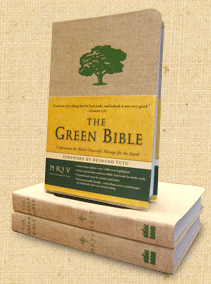
On October 7, Harper-Collins will release the newest “designer” Bible.  Written on recycled paper, using soy ink, and focusing on the eco-friendly aspects of the God’s Word, the Green Bible will draw attention to more than 1000 verses of Scripture that speak about the earth.  Drawing visual attention to these divine statements regarding creation, they will color these verses in a verdant green.  Like the traditional, red-letter Bible, this book will make its environmental mark by “going green.”  Concerning the project, Time Magazine reports:


Green runs through the Bible like a vine. There are the Garden and Noah’s olive branch. The oaks under which Abraham met with angels. The “tree standing by the waterside” in Psalms. And there is Jesus, the self-proclaimed “true vine,” who describes the Kingdom of Heaven as a mustard seed that grows into a tree “where birds can nest.” He dies on a cross of wood, and when he rises Mary Magdalene mistakes him for a gardener.

I would agree, sort of.  From Genesis to Revelation, the Scriptures are very creation-conscious, but always for a larger purpose.  God created the earth for humanity; God sustains and prospers the earth for his image bearers; and one day God will one day regenerate the cosmos so that Jesus Christ and his disciples will superintend that New Earth (cf. 1 Cor. 15:24-28; 2 Tim. 2:11-13). 

Trent Hunter, a good friend and the one who clued me in to the Green Bible’s release, makes several cogent points in his blog on the Green Bible.  He remarks:

Jesus did not enter the earth for the earth. Neither does he redeem humans for the sake of the earth. God’s creative and redemptive purposes are about God’s glory in the praise he receives from those who uniquely bear his image.

I agree.  The pinnacle of creation is the Image Dei, that is humanity, you and me.  However, I would add that while God did not redeem humans for the earth in an ultimate sense.  In another sense, he did.  Jesus died on the cross so that redeemed humanity would again reign over his creation with Him (cf. Revelation 2:28-29).  Thus God is greatly concerned about the earth and its restoration, but his aim in recovering the planet is for His Son and the humanity that his son saved for destruction.  Likewise, God’s wrath is poured out on those who destroy the earth.  This isolated point might be cheered by those who campaign “Reduce! Reuse! Recycle!”  But in truth, it may be those who are most outspoken about the earth that are in fact destroying it by their idolatrous hatred towards its Creator and Restorer.  Consider Revelation 11:15-18:

Then the seventh angel blew his trumpet, and there were loud voices in heaven, saying,
“The kingdom of the world has become the kingdom of our Lord and of his Christ, and he shall reign forever and ever.”
And the twenty-four elders who sit on their thrones before God fell on their faces and worshiped God, saying:

“We give thanks to you, Lord God Almighty, who is and who was,
for you have taken your great power and begun to reign.
The nations raged, but your wrath came,
and the time for the dead to be judged,
and for rewarding your servants, the prophets and saints,
and those who fear your name, both small and great,
and for destroying the destroyers of the earth
(Revelation 11:15-18)

In all this green-talk, I wonder what color Revelation 11:18 will be in the new Green Bible?

In John’s apocalyptic vision, the beloved disciple records the words of the saints who hear the announcement of the kingdom come!  They give praise to the Lord almighty, the one who created all things (see Revelation 4:11), and they exalt him for taking his place as the king of the world he created and established.  They praise because the terror of this age, namely the raging of nations, has come to an end, and they sing for joy because God has come to reward his faithful remnant.  And then they announce these prophetic and perhaps ironic words, “destroying the destroyers of the earth.”  In context, the passage reads: “We give thanks to you, Lord God Almighty, who is and who was…for destroying the destroyers of the earth.”  In other words, with the coming of the kingdom (Rev. 11:15), the time has come for the creator of the earth to judge the earth (Rev. 11:17-18), and this judgment is not upon the flora and the fauna.  It is on the quick and the dead! 

Clearly in this passage, the Green Bible would have linguistic reasons to mark the text green: Those who destroy the earth shall be destroyed!  Don’t miss that, Al Gore may say!  However, the question becomes: Who destroys the earth?  Is it those who litter?  Those who refuse to recycle?  Those corporate industries who emit toxins and dump chemicals into EPA-protected wetlands?  Or is it something else?  The Scripture does not blush.  The destroyers of the earth are those who rage against God (cf. Psalm 2).  The reason that the earth is groaning is not because of carbon dioxide, but because of the curse (cf. Gen. 3:14-19).  The curse that has been declared upon you and me, because of our creation-destroying  sin.  Romans 8 tells the story,

For the creation waits with eager longing for the revealing of the sons of God.  For the creation was subjected to futility, not willingly, but because of him who subjected it, in hope that the creation itself will be set free from its bondage to corruption and obtain the freedom of the glory of the children of God.  For we know that the whole creation has been groaning together in the pains of childbirth until now. And not only the creation, but we ourselves, who have the firstfruits of the Spirit, groan inwardly as we wait eagerly for adoption as sons, the redemption of our bodies.

From the beginning, the earth has been subjected to futility because of Adam’s sin and ours (cf.  Rom. 5:12ff).  And as the rest of Scripture indicates, the only atonement for sin is the life, death, and resurrection of Jesus Christ.  Consewquently, the earth will groan until all sin is dealt with and the sons of God are revealed.  Therefore, the environment will not be restored by legislative efforts to reduce the burning of fossil fuels; the earth will not be saved by green-thumbed gardeners, and it will not be saved by a Green Bible.  It will only be saved by the one man who can re-create and resurrect. 

The testimony of Scripture is clear, we are all destroyers of the earth, and we all deserve to be cast into the burning lake of fire (Rev. 20:14), but the good news is that God sent his son to redeem humanity and the earth.  Again, not through environmental policies, but through his son Jesus Christ–the vine, the gardener, and the second Adam–can humanity and all creation have new life (cf. Col. 1:20).  He alone is the hope of all creation. 

So, what about the Green Bible?  I hope that the Green Bible does well in its sales!  I hope that lovers of God’s creation will pour over the Scriptures that speak of creation and the only One who can bring about the new creation.  I pray that as they read the green and the black ink that they will see that the regeneration of the earth comes not by human effort and green verses, but by one man, Jesus Christ, who alone as the True Vine can save us from our earth-corroding sin.  He alones saves.  He alone restores.  This requires more than just green ink though, it requires red blood.  As Hebrews 9:22 says, “without the shedding of blood, their is no remission of sin,” and as Revelation 11:18 makes clear, without red blood there is no green earth!

May we who enjoy God’s creation and His redemption, praise him for saving the earth by saving a people who are saved by his death, burial, and resurrection.  May those who read the Green Bible come to know the resurrecting power of Jesus Christ purchased with Red Blood.

Sola Deo Gloria, dss

(For further reflection check out: Trent Hunter’s Blog “A Scripture for the Prius Age”, Robbie Sagers and Dr. Russell Moore message Environmental Protection and Animal Stewardship, taught at Ninth & O Baptist Church last year, and John Piper’s sermon on the subject, “God’s Pleasure in Creation.”)

Zondervan Quiz, Three Views Book, and Other Resources on OT/NT Hermeneutics

This Fall Zondervan is set to publish another book in its Counterpoints series.  The book, Three Views on the New Testament Use of the Old Testament, is a survey of differing ways evangelical Christians read the Scriptures.  Darrell Bock of Dallas Theological Seminary, Peter Enns formerly of Westminster Seminary, and Walter Kaiser formerly of TEDS and Gordon-Conwell are its three contributors. 

In preparation for this release, Zondervan’s Koinonia blog has set up a seven question quiz that can help you determine what position best describes your biblical-theological hermeneutic.  It will peg you as either a Fuller Meaning, Single Goal View (Enns), Single Meaning, Unified Referents View (Kaiser), or a Single Meaning, Multiple Contexts and Referents View (Bock).  According to my responses, I am the last–which means, that in reading the OT/NT, I consider the authorial intent of the Old Testament writers to have historical and literary significance for them and their audience in their varied Ancient Near Eastern settings.  At the same time, inspired by the Spirit, I believe that they were aware that what they wrote was eschatologically pointing forward to Jesus Christ.  In other words, they wrote better than they knew.  Peter says as much in 1 Peter 1:10-12 when he writes, “Concerning this salvation, the prophets who prophesied about the grace that was to be yours searched and inquired carefully, inquiring what person or time the Spirit of Christ in them was indicating when he predicted the sufferings of Christ and the subsequent glories. It was revealed to them that they were serving not themselves but you, in the things that have now been announced to you through those who preached the good news to you by the Holy Spirit sent from heaven, things into which angels long to look.”   Likewise, this seems to be the way that Jesus reads the OT, identifying himself by means of these OT writers who pointed forward to him (cf. John 5:39; Luke 24:27, 44).  Moreover, Paul and Jude employ this same hermeneutic when they read Christ into the OT (respectively, 1 Cor. 10:4; Jude 6).

All that to say, if these things interest you as they do me, and they should–putting the Bible together OT and NT is one of the most vital ways we can understand the God who has revealed himself and offered us salvation in his Son–then be sure to check out this multi-sided book.  In the meantime, you can also take the quiz here.

Other helpful resources on the subject include: G.K. Beale and D.A. Carson’s Commentary on the New Testament Use of the Old Testament; G.K. Beale’s The Right Doctrine from the Wrong Text? ; Graeme Goldsworthy’s Gospel-Centered Hermeneutics.

I look forward to reading the arguments in the upcoming Zondervan book, but i am still more excited to simply read my Bible and see Jesus in the Law, the Prophets, and the Writings. 

Sola Deo Gloria, dss

The Story of Marriage

Christopher Ash, in Married for God, writes:

The Bible tells many stories of human marriage, both good and bad, from Adam and Eve through Abraham and Sarah, David and Bathsheba, and countless others. All of them, one way of another, are stories of dysfunctional people in spoiled relationships.

But above these stories the Bible tells a bigger story, the story of a marriage which includes within itself the whole history and future of the human race. It is the story of God the Lover, the Bridegroom, the Husband, and his people his people Beloved, his Bride, and in the end his Wife. It is the story that John the Baptist had in mind when he spoke of Jesus as the ‘Bridegroom; (John 3:25-30), and the story that Jesus himself accepted when he spoke of himself as the ‘Bridegroom’ (e.g. Matthew 9:14-15). It is the story of Paul referred to when he spoke of the church in Corinth as being ‘engaged’ to Jesus Christ like a pure virgin (2 Corinthians 11:2) (Christopher Ash, Married for God, 166).

Supplying his line of thought with more biblical content, the biblical story of marriage is a story that begins with the first union in the Garden of Eden and climaxes with the marriage supper of the Lamb in the Book of Revelation. It is a story of love created, love lost, love promised, love received, and love consummated. It is a story that sounds too good to be true, and yet it is a story more true than any storybook love affair in novels or the news.  It is a story that centers around the king and his bride (cf. Psalm 45). It is a story of a lover and his beloved (i.e. Song of Songs). Tragically, it is also a story of wife who becomes a harlot and prostitutes herself to the nations (cf. Ezekiel 16 and Hosea). Yet, the love of the husband will not be overcome.  The rest of the story concludes with the husband’s redeeming, willing, and cleansing sacrifice restoring his bride to new life (cf. Eph. 5:22-33). Consequently, it is in the end a story of forgiveness, of a husband who searched the marketplace to find his estranged wife, who paid the highest price for her return, and who lovingly and mercifully restored her beauty and radiance to the kind never before seen in a bride. And it is the story of a wedding day that never ends for those who participate in the wedding of the Lamb (Rev. 19:6-10).

And it can be your story if you will turn to the pages of Scripture, read, and believe.  Christopher Ash continues:

It is the story that John speaks of in the visionary imagery of Revelation 19 and 21. The metaphors are mixed and the language is vivid and suggestive; we cannot read it literally and it would not be possible to make a film of this imagery. At the climax of human history John hears the announcement made, “The marriage of the Lamb has come, and his Bride has made herself ready” (Revelation 19:7). The Lamb, the Lord Jesus Christ himself, is to be married at last. His Bride is his people, every believer of all time, corporately to be joined to him forever in union of unmixed delight and intimacy. This is a time of joy and amazement” (166-67).

This is the story of marriage in the Bible. From the beginning, God’s aim with marriage was the final marriage–Christ and the church.  In the garden, the first marriage was for the purpose of the last, and every engagement, wedding, and marriage that has followed has been an eschatological image designed to reflect the final marriage. As a result, our marriages do not stand in the way to that final marriage, they are instead an invitation to come, taste, and see the goodness of the God’s marriage to humanity in the Christ-church mystery (Eph. 5:31).  This marriage is now offered to each husband, wife, or single who will respond to Jesus’ invitation to know him and love him and dwell with him forevermore.  In this way, all of our love stories–past, present, and future–fit into the grand narrative of the Creator of Marriage and the Redeemer of humanity.

As we abide in and enjoy our marriages, may we lift our eyes to a greater union, and with anticipation and hope look forward to our forthcoming union with our loving savior.  Until that day…

Sola Deo Gloria, dss

Fatherhood and the Field Essay

September 11, 2008 020

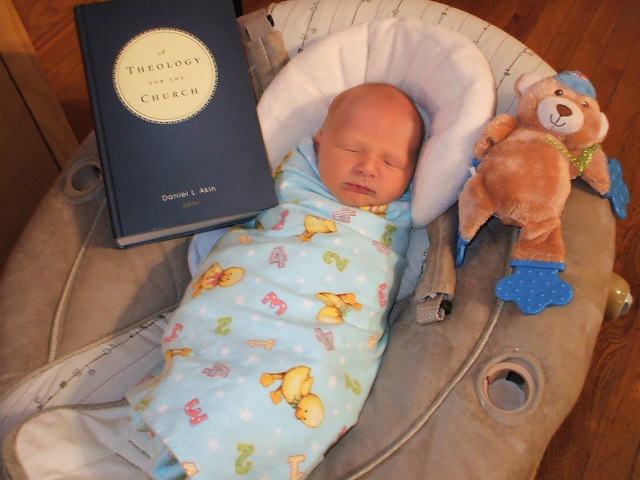
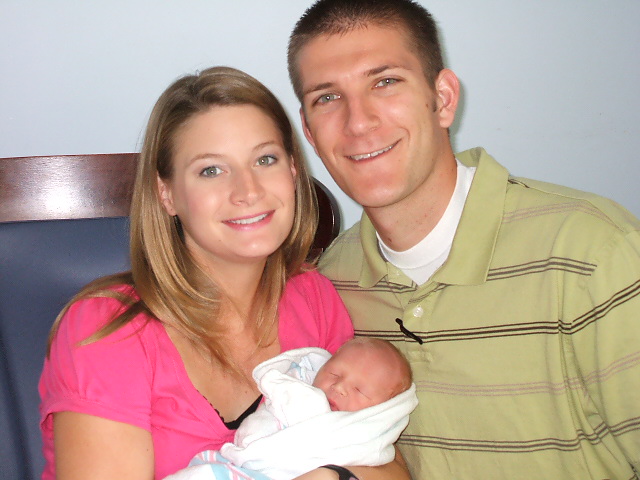
Tomorrow, I settle in for three hours of essay writing and an intensive interview as a part of the PhD application for Systematic Theology at SBTS.  Preparation for the essay(s) and interview have included reading much theology, outlining major doctrines, and rehearsing biblical, historical, and systematic arguments for each.  But unexpectedly (sort of), they have also included the earlier-than-expected arrival of our first son. 

For the last few days, theological preparation has been done while holding Titus, attending to his hiccups, and protecting his face from his flailing hands.  In other words, the studying has been intermittent and often interrupted.  But that is not a complaint.  More important than the non-stop cranium stuffing with facts about Moltmann, Bultmann, postmillenialism, and predestination, God has given me a far greater theology lesson in being a dad.

Consider, the amazing gift to fathers and sons, that they might enjoy a status original to the Trinity itself.  From all of eternity, God the Father has known and loved His Begotten Son (1 John 4:8,16; John 3:16); and God the Son, being equal to the Father, has gladly submitted himself to the hierarchical headship of the Father.  Truly, the mysteries of the Trinity are plenty, but familial relations in this life help pave the way to better appreciating the Godhead.

Likewise, in the history of redemption, God has made himself a father to Israel (Ex. 4:21; Deut. 32:9) and now to those who have trusted in Christ (Matt. 6:9; John 1:12; 1 John 3:1-3).  In other words, God is a Father, and he loves his children.  He does good for them.  He provides (Luke 12); disciplines (Heb. 12:5-11), and shapes his children into offspring who bear a striking resemblance (i.e. Christ-like conformity, cf. Rom. 8-29).  In this way, God is the first and the best daddy (Rom. 8:16ff). 

So more important this week than memorizing all the verses that will help me do well on this entrance exam–though that is important–being a dad is a far greater lesson in theological truth.  Not to say that I have mastered this theological subject, I am only beginning, but in the lifelong pursuit of godly character, this paternal training is an invaluable part–theologically and otherwise.

Reflecting on these two things–fatherhood and the impending field essay–I confess optimistic excitement about the prospect of a doctoral studies, but truth be told, I am all the more excited about being a dad.  Why?  Surely because of the implicit delights of fatherhood, but also because of theological purposes of fatherhood.  As the Spirit instructs in Titus 2:1-10, it is in God-ordained relationships (like fathers and sons) that God provides the greatest lessons in gospel theology.  He conforms us into his image as biblical truth is lived and practiced.  No matter how much theology we know, it is theology enacted in day-to-day relationships that matters most.  As Paul says, “Knowledge puffs up, but love builds up” (1 Cor. 8:1).  This does not put parenting at odds with a PhD (or any kind of rigorous work done for the Lord, cf. Col. 3:23), rather they complement one another.  And they should, for the Father who sent his Son to be mankind’s savior, is also the sovereign Lord who formed Titus in the womb of Wendy, and now gives me the sober joy of caring for his young life.  What could be better?  Truly this is a glorious theology–life lived in light of the Father, Son, and Holy Spirit.

May we who are a part of God’s household of faith, find delight in the relationships God has given us, and may we see the His glory all the more clearly as we live and move and have our being in familial relations.

Sola Deo Gloria, dss

The Schrock’s: A Pledge and A Prayer

Under the Lordship of Christ, a family of God living for the Kingdom: savoring the Scriptures; walking in the Spirit; speaking the truth in love; proclaiming the gospel to the nations.

It is a whole new day in the life of the Schrock household.  With the addition of Titus, priorities change, schedules change; jobs change; logistics change, sleep patterns change.  There is much change.  But one thing remains the same–living by faith in the gospel of Jesus Christ, praying and working for the glory of His name to be exalted in all aspects of our lives–in our home, in our church, across the street, and around the globe. 

One of the most exciting prospects of parenting is introducing our son to Jesus and the Bible’s message of salvation.  At the same time, this privilege is accompanied by monumental challenges.  Besides the day to day challenge of living out a model of Christian character (cf. 1 Cor. 11:1); the tireless work of teaching, explaining, and speaking the things of God (cf Deut 6), the societal dangers and systematic evils that threaten the shalom of family life;  there is the reality that Satan would love to kill, steal, and destroy this home–like all homes.  Left to ourselves, we cannot stand under the outward attacks and inner decay–in fact no one can (cf. John 15:5). 

Yet, we aspire to contend against these cosmic forces.  Why?  So that we can come up short, failing ourselves, damaging our son, disappointing our God? No, instead we trust in a greater reality, a better hope, and surer promise; we trust in the power of the Gospel of Jesus Christ.  With zero confidence in ourselves, we embark with confidence in Him who saved us, who called us to the task of parenting, and who calls us to train our child to fear the LORD.  We entrust ourselves to Jesus, who gave us his Spirit to enable us to do things that we on our own could never do.  With that rock solid foundation, we boldly approach the task of parenting with hope in one unwavering thing– the grace of God in the person and work of Jesus.  Without this we have no hope for survival or success.  This is the gospel we believe.  

The gospel alone can cover our mistakes–and there will be many; it alone can atone for our sins–which lie underneath every ‘mistake’; it alone can equip us with love, forgiveness, wisdom, and patience to disciple Titus; and it alone can comfort our souls when our plans have been rerouted by the roadblocks of this world and the sovereign wisdom of our God.  So, with unchanging commitment to the gospel and trust in its singular message of good news, we embark on this adventure of parenting. 

Despite the uncertainty of our days ahead in this age, I offer this humble pledge and desperate prayer, that the family unit that God has established in our home will shine for the glory of Christ.  To that aim we work and we pray, and we ask that Under the Lordship of Christ, we as a family of God would live for the Kingdom by savoring the Scriptures; walking in the Spirit; speaking the truth in love; and going to the nations.

May our home like your home; and your home like our home, bow the knee to the one who sanctioned all families (Eph. 3:14), who is able to do abudantly more than we ask or imagine (Eph. 3:20), and pray for the gospel to pervade every aspect of our family life.

With a sober pledge and a hopeful prayer, we ask that God would get the glory in our home.

Dave, on behalf of the Schrock’s