Via Emmaus on the Road: John 8

Further Resources

John 8 (ESV)

[The earliest manuscripts do not include 7:53–8:11.]

The Woman Caught in Adultery

[[They went each to his own house,but Jesus went to the Mount of Olives. Early in the morning he came again to the temple. All the people came to him, and he sat down and taught them. The scribes and the Pharisees brought a woman who had been caught in adultery, and placing her in the midst they said to him, “Teacher, this woman has been caught in the act of adultery. Now in the Law, Moses commanded us to stone such women. So what do you say?” This they said to test him, that they might have some charge to bring against him. Jesus bent down and wrote with his finger on the ground. And as they continued to ask him, he stood up and said to them, “Let him who is without sin among you be the first to throw a stone at her.” And once more he bent down and wrote on the ground. But when they heard it, they went away one by one, beginning with the older ones, and Jesus was left alone with the woman standing before him. 10 Jesus stood up and said to her, “Woman, where are they? Has no one condemned you?” 11 She said, “No one, Lord.” And Jesus said, “Neither do I condemn you; go, and from now on sin no more.” ]]

I Am the Light of the World

12 Again Jesus spoke to them, saying, “I am the light of the world. Whoever follows me will not walk in darkness, but will have the light of life.” 13 So the Pharisees said to him, “You are bearing witness about yourself; your testimony is not true.” 14 Jesus answered, “Even if I do bear witness about myself, my testimony is true, for I know where I came from and where I am going, but you do not know where I come from or where I am going. 15 You judge according to the flesh; I judge no one. 16 Yet even if I do judge, my judgment is true, for it is not I alone who judge, but I and the Father who sent me. 17 In your Law it is written that the testimony of two people is true. 18 I am the one who bears witness about myself, and the Father who sent me bears witness about me.” 19 They said to him therefore, “Where is your Father?” Jesus answered, “You know neither me nor my Father. If you knew me, you would know my Father also.” 20 These words he spoke in the treasury, as he taught in the temple; but no one arrested him, because his hour had not yet come.

21 So he said to them again, “I am going away, and you will seek me, and you will die in your sin. Where I am going, you cannot come.” 22 So the Jews said, “Will he kill himself, since he says, ‘Where I am going, you cannot come’?” 23 He said to them, “You are from below; I am from above. You are of this world; I am not of this world. 24 I told you that you would die in your sins, for unless you believe that I am he you will die in your sins.” 25 So they said to him, “Who are you?” Jesus said to them, “Just what I have been telling you from the beginning. 26 I have much to say about you and much to judge, but he who sent me is true, and I declare to the world what I have heard from him.” 27 They did not understand that he had been speaking to them about the Father. 28 So Jesus said to them, “When you have lifted up the Son of Man, then you will know that I am he, and that I do nothing on my own authority, but speak just as the Father taught me. 29 And he who sent me is with me. He has not left me alone, for I always do the things that are pleasing to him.” 30 As he was saying these things, many believed in him.

The Truth Will Set You Free

31 So Jesus said to the Jews who had believed him, “If you abide in my word, you are truly my disciples, 32 and you will know the truth, and the truth will set you free.” 33 They answered him, “We are offspring of Abraham and have never been enslaved to anyone. How is it that you say, ‘You will become free’?”

34 Jesus answered them, “Truly, truly, I say to you, everyone who practices sin is a slave to sin. 35 The slave does not remain in the house forever; the son remains forever. 36 So if the Son sets you free, you will be free indeed. 37 I know that you are offspring of Abraham; yet you seek to kill me because my word finds no place in you. 38 I speak of what I have seen with my Father, and you do what you have heard from your father.”

You Are of Your Father the Devil

39 They answered him, “Abraham is our father.” Jesus said to them, “If you were Abraham’s children, you would be doing the works Abraham did, 40 but now you seek to kill me, a man who has told you the truth that I heard from God. This is not what Abraham did. 41 You are doing the works your father did.” They said to him, “We were not born of sexual immorality. We have one Father—even God.” 42 Jesus said to them, “If God were your Father, you would love me, for I came from God and I am here. I came not of my own accord, but he sent me. 43 Why do you not understand what I say? It is because you cannot bear to hear my word. 44 You are of your father the devil, and your will is to do your father’s desires. He was a murderer from the beginning, and does not stand in the truth, because there is no truth in him. When he lies, he speaks out of his own character, for he is a liar and the father of lies. 45 But because I tell the truth, you do not believe me. 46 Which one of you convicts me of sin? If I tell the truth, why do you not believe me? 47 Whoever is of God hears the words of God. The reason why you do not hear them is that you are not of God.”

Before Abraham Was, I Am

48 The Jews answered him, “Are we not right in saying that you are a Samaritan and have a demon?” 49 Jesus answered, “I do not have a demon, but I honor my Father, and you dishonor me. 50 Yet I do not seek my own glory; there is One who seeks it, and he is the judge. 51 Truly, truly, I say to you, if anyone keeps my word, he will never see death.” 52 The Jews said to him, “Now we know that you have a demon! Abraham died, as did the prophets, yet you say, ‘If anyone keeps my word, he will never taste death.’ 53 Are you greater than our father Abraham, who died? And the prophets died! Who do you make yourself out to be?” 54 Jesus answered, “If I glorify myself, my glory is nothing. It is my Father who glorifies me, of whom you say, ‘He is our God.’ 55 But you have not known him. I know him. If I were to say that I do not know him, I would be a liar like you, but I do know him and I keep his word. 56 Your father Abraham rejoiced that he would see my day. He saw it and was glad.” 57 So the Jews said to him, “You are not yet fifty years old, and have you seen Abraham?” 58 Jesus said to them, “Truly, truly, I say to you, before Abraham was, I am.” 59 So they picked up stones to throw at him, but Jesus hid himself and went out of the temple.

Soli Deo Gloria!

Truth on Trial: Seeing Who You Are By Hearing the ‘I AM’ (John 8:48–59)

john03Here is a life principle: Trials tell you who you are.

How many of us have thought we were strong, smart, and self-sufficient, until the trial came. Likewise, how many continue to believe they are calm, cool, and collected, until the trial.

Trials in life can have names like Alice or Anthony, COVID or cancer, divorce or depression. But whatever the trial is, it is the God-given means by which he reveals who we are.

Such trial are all the more more pronounced, if they take off their metaphorical garb and put on the legal robes of a judge. Maybe you have seen some of the fall out since Roe was overturned by the Dobbs decision.

Resident Biden announced by Twitter that abortion needs to be ratified as law. Senator Elizabeth Warren said that we need to crack down on anti-abortion pregnancy centers. And as I was typing this very sentence, an email came in with an update on David Dalaiden and his 9 felony counts that exposed Planned Parenthood for selling the body parts of babies.

Here’s the point: Currently and in the near future, more Christians will face real and legal trials. Just ask Barronelle Stutzman Stutzman and Jack Phillips, two faithful disciples of Christ, whose public faith required legal defense. So too with the Dobbs decision their will come Christians whose faith leads them to various trials and law courts.

So I say again, trials tell you who you are. And lest we think that Christians should avoid courts at all cost, we should get used to the fact, that faithfulness in twenty-first century America will include legal battles. And these battles—for those on the witness stand and those praying and watching and waiting—will reveal the character of all parties in involved. Continue reading

The Crack in the Cosmos: Letting the Light of John 8:12–59 Expose the Divide in Humanity

brown and green grass field during sunset

31 So Jesus said to the Jews who had believed him,
“If you abide in my word, you are truly my disciples,
32 and you will know the truth, and the truth will set you free.”
— John 8:31–32 —

 I don’t know about you, but when I read lengthy dialogues in Scripture, especially in the Gospels, I find them hard to follow until I have a sense of structure of the argument. In John 8, this has been especially true. After Jesus announces that he is the light of the world (v. 12), his opponents (Pharisees in v. 13 and Jews in vv. 22, 31, 48, 52, 57) object, question, and reject his statements. Yet, this massive disputation is a jumble of back and forth, until you begin to see the order of the court.

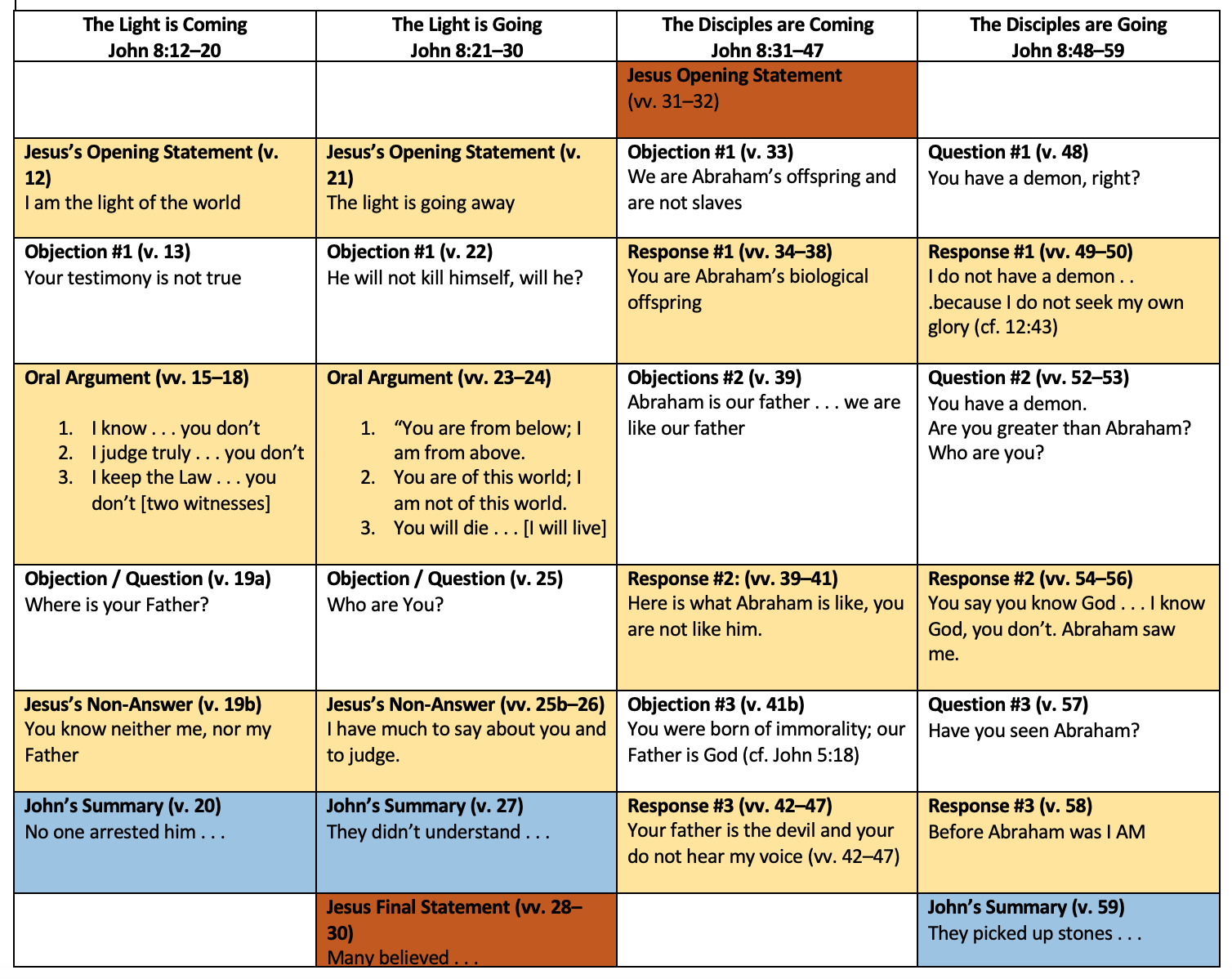
As many commentators have observed, John’s Gospel has many elements of a trial in it. And if the whole book is a court case written to show that Jesus is the Son of God (John 20:31), it should not surprise us to find witnesses, evidence, and other elements of a law court. Indeed, that is how I take John 8:12–59, and in the outline included here, I offer a court case in two parallel parts.

Screen Shot 2022-06-30 at 12.48.41 PM

From this outline, let’s consider a couple things.

The Legal Brief in John 8

First, there is, in John 8:12–30, two arguments that run in parallel. This parallel is found in the order of the speech and the shape of the argumentation. Compare verses 12–19 and 20–27. In these two sections, we find Jesus making an opening statement in each. Remarkably these statements should be read together, and give us a sense of what the first trial is addressing. In verse 12, Jesus announces that he is the light coming into the world, and in verse 20 he says that he (the Light of the World) will be departing. Commiserate with so much in John, this trial is about Jesus and the light he brings.

Importantly, Jesus’s statement are met with hostile unbelief, expressed in two objections—one long, one short. This is how the trial proceeds until, in verses 28–30, Jesus points to his coming cross, when he will be lifted up. As verse 30 indicates, many believed in him, even though moments earlier (v. 27), they didn’t understand. So clearly, this faith lacks understanding, which Jesus will proceed to show as false.

Stopping here in the middle of the chapter, notice how this response of faith is the turning point of the chapter. Quite possibly, the faith of his hearers is based upon the hope that Jesus “lifting up” would be an exaltation to glory, which they might enjoy too. What Jesus has in mind with respect to his lifting up, however, is his coming crucifixion. But these disciples do not understand that (v. 27), they simply believe in Jesus for other purposes. This is a warning to us today and to any who believe in Jesus for their own reasons, not his.

In the context of John, we will see that the people of Israel were seekers of glory, and it seems Jesus’s words of lifting up could have invited such a misplaced faith. Accordingly, this is where the next section begins, as it moves to reveal the darkness of Jesus questioners. Like before, the second section has another mirrored debate, a legal dispute in two parts.

Verses 31–32 begins with another opening statement, but this time Jesus’s statement covers the two parts of the trial. As to the content of his statement, Jesus tells his would-be followers how they prove themselves them true. If they remain in his word, they will have life eternal, but if they refuse him and his words, they are false, darkened, and spiritually dead. Tragically, this is what the chapter proves.

Let’s following the argument in order. First, in vv. 31–47, the Jews ask three questions, to which Jesus responds three times. And in that legal debate, Jesus splits the difference between biological seeds of Abraham (which these Jews are) from spiritual heirs of Abraham (which these Jews are not). The result of this distinction is Jesus’s famous and forceful declaration that these “believers” are actually children of the devil. “You are of your father the devil, and your will is to do your father’s desires” (v. 44a).

Next, these devilish sons of Abraham accuse Jesus of demonic activity and Samaritan origins (v. 48), even as they reject his self-identification with Abraham. Again, this legal debate turns on three questions, followed by three responses from Jesus. Ironically, once identified with the devil, these interlocuters do the work of the accuser, questioning Jesus, his identity, and his eternity (i.e., his ancient knowledge of Abraham). But in context, all they do by questioning Jesus is to show their own spiritual ignorance and lifeless religion.

Consequently, when they pick up stones to throw at Jesus, a symbol that the trial has moved from deliberation to execution, John reveals that these accusers of Jesus are the ones who stand condemned by God. They do not know God and this is evident in the fact that they cannot recognize God’s Son. Accordingly, the chapter closes not with a guilty verdict for Jesus, but a guilty verdict for his legal opponents.

All in all, John uses a tight literary structure to lead the reader to see what he is doing. And more, he reveals who Jesus is by contrasting him with those who accuse him. Jesus is the light of the world who will be extinguished on the cross, so that in the light of his resurrection, all who truly believe in him will be saved. Yet, such faith does not come from the selfish will of men who want to glorify themselves by Jesus. Saving faith comes to those who are truly heirs of Abraham, sheep who hear Jesus voice, and children born of God.

John 8 and the Crack in the Cosmos

The division between biological seeds and spiritual heirs is a division, a crack in the cosmos, that ranges across the whole of humanity. And in John, this spiritual division between two kinds of people is seen by paying attention to the trial. In questioning and condemning Jesus, the Jewish leaders show themselves to be men of darkness. By contrast, those who abide in the words of Christ will walk in the light, as he is in the light, because God gives light to those who are children of light.

Again, this spiritual division is what we face in every conflict—whether familial, ecclesial, societal, legal, or political. As Jesus teaches, there are two kinds of people in the world. And as John 8, the sides are determined by God and detected by how one responds to the Son. Ultimately, John 8 reveals much about who Jesus is, but it also reveals much about who we are.

With that realization in mind, let us seek God’s mercy and pray for his light to lead us to Christ. Jesus is the light of the world, and if you rejoice in his light, he will reveal to you his truth, and his truth alone will set you free. Just as he says in John 8:31–32.

Soli Deo Gloria, ds

Photo by Jonathan Petersson on Pexels.com

On Dobbs and the Growing Rift in America: Why Only a Spiritual Answer Explains the Division 

abortion[Photo Credit: Not The Bee]

June 24 is a date that all Christians should now mark on their calendar.

For nearly half a century, January 22 was the day that remembered the decision to make abortion available throughout America. And since the decision of Roe v. Wade in 1973, January 22 has been a day of prayer, petition, and planning for the end of Roe. And now, that prayer has been answered. Glory be to God!

On Friday, when the Supreme Court decided that Roe was not constitutional, they gave us a new day on the calendar to remember the sanctity of life and to give thanks to God for his mercy. June, a month co-opted for gay pride, has returned the rainbow, if for a moment, to its rightful owner—the God of mercy who does not give us what we deserve (see Genesis 9). More on the rainbow another day.

For now, it is worth remembering how the removal of Roe has been a rallying point for Pro-Life Christians for decades. And now that Roe has been overturned, we should give thanks to God for answering our prayers, and we should honor all those who sacrificed in order to make it happen.

Simultaneously, we should acknowledge the ways that elections have tangible consequences. In the election of Donald Trump, evangelicals supported this polarizing figure not because of his skin color, personal faith, or Twitter personality (definitely not his Twitter), but because of promises like this:

Incredibly, he fulfilled those promises. And Roe is now history.

At the same time, Roe’s end should bring incrementalists and abolitionists closer together, as they work to implement laws which protect life. Abolitionists should give thanks for the work incrementalists have done to end Roe, and incrementalists should take up the challenge set out by abolitionists to legislate equal protection under the law. Far more could be accomplished if these two approaches to abortion would work together.

Still, this post and the sermon that follows are less about abortion qua abortion. Rather, they are a biblical reflection on the spiritual warfare that fuels the battle over abortion. Indeed, as already evidenced by 41 cases of vandalism against pro-life groups, Christians should be ready for the increasing hostility that will come with the Dobbs decision. This is the point I want to make here.

Continue reading